
Sabitlenmiş Tweet
Salik Shah ✨🚀
16.3K posts


Salik Shah ✨🚀
@salik
Actively building @DirghaAI (alpha). An AI computer that runs your business—research, build, ship. Sovereign, agentic. On cloud, on-prem. Ex @MithilaReview 🕊️
India 💌💬 Katılım Mart 2007
1.4K Takip Edilen1.7K Takipçiler
@pmarca The demand will skyrocket. Every profession, every industry. You vibe code, understand the potential, and hire a professional to maintain and take things forward. Security is another big concern, and not many can afford to maintain their own infra either.
English

"Tech job openings rebounded sharply in 2026, challenging popular narrative that AI is wiping out engineering roles...more than 67,000 software eng job openings, highest level in 3 years. Listings have doubled since a trough in mid-2023." businessinsider.com/ai-isnt-killin…
English
@ashpreetbedi Yes, this needed to be said. I am building a CLI for my platform, and to me, it is not different from building a full system.
English

Maybe I'm missing something, but "harness engineering" might be doing more harm than good.
I've read a couple of posts on harness engineering, filesystem memory, subagent architecture. All real, all important. I've learned a lot from them.
But I keep coming back to this: the framing of Agent = Model + Harness undersells the actual engineering involved. And as far as I can tell, none of the major agent products work this way.
Claude, ChatGPT, Devin. These are all systems. They handle authentication, multi-tenancy, deployment, observability, cost controls, state management across sessions and users, RBAC, resource isolation. The "harness" is a subset of the engineering involved in building these products.
A better framing might be Agent = Model + System. This makes sense because you can't serve a raw API call to users. You need the system around it to turn the model into a product. You could argue Agent = Model + Harness + System, and that's fair. But at that point the harness is just a component of the system. Treat it as one.
My concern is that when we center the conversation on harness engineering, we train developers to think about the 30% that touches the model and ignore the 70% that makes the thing actually work in the real world.
When we look at the problem through the lens of the 30%, we end up with things like virtualized file systems which are solving problems that shouldn't exist in the first place.
At best, the harness wraps the model. The system is the product. And there's a reason the consensus is that model progress will eventually swallow the harness. Because the harness is a thin layer. The system is not. The system is the product, and that's what developers should be focusing on.
Another reason to take harness engineering with a grain of salt: it's shaped by coding agents. Coding agents are a very specific form factor which itself is evolving rapidly. Single user. Running in a terminal. Local filesystem. The patterns that emerge from this form factor are useful for this form factor. And I worry that generalizing them to broader agentic systems is damaging to the ecosystem as a whole.
Here's what I mean. And notice a pattern: many of these are solutions to problems that shouldn't exist in the first place if you start with the right system design.
1. Filesystems for memory and storage
Harness engineering recommends patterns like AGENTS.md files for memory. This works when one developer is running one agent on their laptop. It falls apart the moment you need a real product. There's a reason databases exist. Files don't support concurrent access. They don't support querying. They don't support access control. A filesystem as your memory layer is a single-user solution presented as architecture.
And now I'm seeing people build "virtualized file systems" that wrap databases into filesystem-like structures to patch over these limitations. At that point, just expose the database. You get SQL as a first-class interface, proper access control, and durable storage without the abstraction gymnastics. And you know what, LLMs are even better at SQL than they are at cat and bash.
2. No multi-tenancy or RBAC
How do 50 engineers on a team share an agent securely? How do you control which users can trigger which actions? That's multi-tenancy, authorization, and access control. No filesystem pattern solves this. You need real RBAC.
3. No resource isolation
How do you stop one tenant's runaway agent from burning through your entire token budget? That's resource isolation. It lives at the system level. A harness has no concept of it. I hear people recommending sandboxes scoped to individual users and it makes 0 sense to me because your costs will eat you alive.
Btw these problems aren't new. They're the same problems we've been solving in software engineering for decades.
The instinct to create new terminology comes from a good place. "Harness engineering", "Scaffolding”, "Context engineering". People want to name the new discipline. But every time we mint a new term for a subset of systems engineering, I think we make it harder for developers to recognize that the patterns they need already exist and we shouldn't re-invent the wheel.
All problems that harness engineering solves, you can solve with systems engineering. Maybe I'm wrong about this, but I'm just seeing harness engineering create more issues than it solves (virtualized file systems???)
If we want developers to successfully build agentic products, we should encourage them to think in systems. The solutions already exist. We should use them.
Again, maybe I'm missing something. I'll keep an open mind as I learn more. And maybe the answer is simply that harness engineering applies to coding agents and not to broader agentic products, which makes perfect sense.
TLDR: Agent = Model + Harness undersells the real problem. Harness engineering is shaped by coding agents (single user, terminal, local filesystem) and ignores the 70% that makes agents work in production: multi-tenancy, RBAC, approval flows, audit logs, resource isolation, durable storage.
These are systems engineering problems.
English
Spot on. Everyone is burning tokens doing the exact same thing, reinventing SaaS clones with agents.
We desperately need an open-source AI Core Library + standards: plug-and-play modules for all the top apps.
A fictional open-source AI org could drive this, with a “Core Librarian Agent” that continuously maintains, integrates, and upgrades the foundational layer.
This would free compute & tokens for novel tasks, reducing like 90% of duplicate efforts across all platforms.
PS. Today, I finally decided to help Claude out by skipping it for intensive agent tasks. Any chance MiMo could offer an unlimited plan like Fireworks Firepass? How are they able to offer this?
x.com/salik/status/2…
English

Two days ago, Anthropic cut off third-party harnesses from using Claude subscriptions — not surprising. Three days ago, MiMo launched its Token Plan — a design I spent real time on, and what I believe is a serious attempt at getting compute allocation and agent harness development right. Putting these two things together, some thoughts:
1. Claude Code's subscription is a beautifully designed system for balanced compute allocation. My guess — it doesn't make money, possibly bleeds it, unless their API margins are 10-20x, which I doubt. I can't rigorously calculate the losses from third-party harnesses plugging in, but I've looked at OpenClaw's context management up close — it's bad. Within a single user query, it fires off rounds of low-value tool calls as separate API requests, each carrying a long context window (often >100K tokens) — wasteful even with cache hits, and in extreme cases driving up cache miss rates for other queries. The actual request count per query ends up several times higher than Claude Code's own framework. Translated to API pricing, the real cost is probably tens of times the subscription price. That's not a gap — that's a crater.
2. Third-party harnesses like OpenClaw/OpenCode can still call Claude via API — they just can't ride on subscriptions anymore. Short term, these agent users will feel the pain, costs jumping easily tens of times. But that pressure is exactly what pushes these harnesses to improve context management, maximize prompt cache hit rates to reuse processed context, cut wasteful token burn. Pain eventually converts to engineering discipline.
3. I'd urge LLM companies not to blindly race to the bottom on pricing before figuring out how to price a coding plan without hemorrhaging money. Selling tokens dirt cheap while leaving the door wide open to third-party harnesses looks nice to users, but it's a trap — the same trap Anthropic just walked out of. The deeper problem: if users burn their attention on low-quality agent harnesses, highly unstable and slow inference services, and models downgraded to cut costs, only to find they still can't get anything done — that's not a healthy cycle for user experience or retention.
4. On MiMo Token Plan — it supports third-party harnesses, billed by token quota, same logic as Claude's newly launched extra usage packages. Because what we're going for is long-term stable delivery of high-quality models and services — not getting you to impulse-pay and then abandon ship.
The bigger picture: global compute capacity can't keep up with the token demand agents are creating. The real way forward isn't cheaper tokens — it's co-evolution. "More token-efficient agent harnesses" × "more powerful and efficient models." Anthropic's move, whether they intended it or not, is pushing the entire ecosystem — open source and closed source alike — in that direction. That's probably a good thing. The Agent era doesn't belong to whoever burns the most compute. It belongs to whoever uses it wisely.
English
@OpulentByte @FireworksAI_HQ Yeah, asked Claude to confirm it. It was using something else. Skill issue. 😂
English

@salik @FireworksAI_HQ The model id for firepass has /router in it, so it is easy to tell.
English

Qwen 3.6 Plus, Alibaba's latest flagship model, available exclusively through Fireworks!
app.fireworks.ai/models/firewor…
English
phase 0: "buy, don’t build hardware → off-the-shelf arms, mobile bases, sensors. your edge is integration, not reinventing motors."
Mustafa@oprydai
how to approach a robotics startup as a solopreneur don’t try to build a “robot company.” build a narrow system that solves one real problem. what to focus on: • pick a painful niche → warehouses, farms, inspection. repetitive, costly tasks where automation actually pays. • start with software + simulation → validate perception, control, and logic before touching hardware. faster loops, cheaper mistakes. • buy, don’t build hardware → off-the-shelf arms, mobile bases, sensors. your edge is integration, not reinventing motors. • teleop first → humans in the loop. collect data, understand edge cases, then automate gradually. • data pipeline → logging, labeling, replay. robots improve through data, not just code. • service over product → sell outcomes, not machines. “we pick items for you,” not “we sell robots.” • iterate on-site → deploy early, learn from real environments, fix what breaks. constraints: • capital is tight • iteration is slow • hardware will fail so keep the system small, focused, and revenue-driven from day one. as a solo founder, your advantage isn’t scale. it’s speed of learning and tight feedback loops.
English
This is the way.
Pushmeet Kohli@pushmeet
Using AI to solve the Traveling Salesman Problem at warehouse scale. 📦 AlphaEvolve helped FM Logistic improve its routing algorithm by 10.4%, resulting in a reduction of total warehouse travel by over 15,000 km per year. 🚚 A great example of how @GoogleDeepMind and @googlecloud are using AlphaEvolve to help companies become more efficient. Read more at: cloud.google.com/blog/products/…
English


@sriramk One product -- a personal computer. That's it. Everything collapses at the OS layer.
English

How to use Claude with Kimi?
This is the way, anon. 👇

Harveen Singh Chadha@HarveenChadha
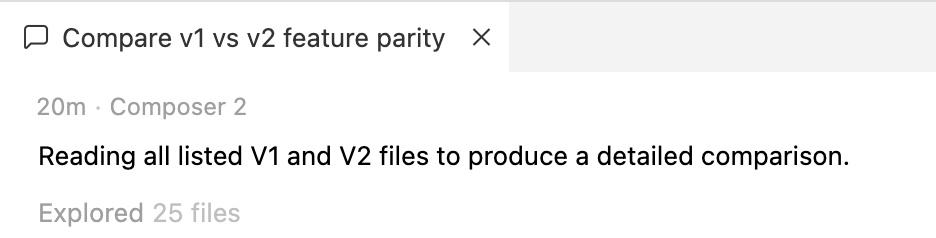
TIL, Cursor uses composer-2-fast for all the auto spawned subagents by default even when you have selected opus-4.6 as the main model if you are on enterprise plan with request based model, you can't change this behaviour you are charged for opus, but opus is just the orchestrator, under the hood all subagents are composer..
English
@HarveenChadha Haha! I just caught Claude using its own model even when I asked it to use Kimi (Composer with RL) today. Cost is definitely an issue, and why use Claude when anything else gets work done.

English

TIL, Cursor uses composer-2-fast for all the auto spawned subagents by default even when you have selected opus-4.6 as the main model
if you are on enterprise plan with request based model, you can't change this behaviour
you are charged for opus, but opus is just the orchestrator, under the hood all subagents are composer..
English
@levelsio This is why sometimes you need outside help for things you are good at but don't want to do it for yourself
English

There has to be some word for this concept
It's why designers from tech who design touchscreens like Jony Ive won't put a touch screen in a car but use real knobs
Or why programmers don't actually like smart homes and smart appliances at all but want things analog
Or why tech people raise their kids without mobile devices
Like knowing things so well from inside of it (tech) that you choose to NOT use it because you know the negatives that come with it in specific contexts
Top Gear@BBC_TopGear
"A large touchscreen doesn't work in a car": Sir Jony Ive on designing the Ferrari Luce's interior ➡️ top-gear.visitlink.me/yTpZer
English
Salik Shah ✨🚀 retweetledi
Silly Business Theory is right: in the future the best work, greatest progress, most valuable innovations won't come from laboring under the false consciousness that work must be hard and serious to produce value. The best work is going to come from people playing and having fun.
47fucb4r8curb4fc8f8r4bfic8r@47fucb4r8c69323
The more I look at this the more impressed I am and the more I realize how grateful we should be to Tao. 1. He acknowledges ignorance: this is something academics almost never do since their cultural capital is tied up in them knowing things. But he can since, well, he's Terence Tao. 2. He is explicitly acknowledging his use of GenAI to fight the stigma of using AI. If the child prodigy turned UCLA prof who studied with Erdos uses AI, it is legitimate technology. (please start using this sentence with AI skeptics btw) 3. He is also showing how AI is best used: as a kind of syntactic tool that finds connections in possibility space and has access to a larger library of information than our brains can. There's more here but the cool internet thing is a list of three. I often lament Tao has too playful of a mode of operating, feeling like he plays with linear algebra when he should be doing foundations of mathematics. But not only does this moment prove my view wrong, it also proves just how much Silly Business Theory #SBT is right: in the future the best work, the greatest progress, and the most valuable innovations won't come from people laboring under the false consciousness of Protestantism and Marxism that asserts work must be hard and serious to produce value. The best work is going to come from people playing and having fun. We're on the cusp of a near utopian explosion in human potential and quality of life. And you're bearish?!?!?!?!??????!?
English
My algorithm keeps surfacing your tweets, and they land. Apologies in advance for being your reply guy, but this one hits close to home.
One push: India doesn't have "a few decades." Crazy times demand crazy deadlines. This has to be a decade, max. Warp speed. War footing.
AI assistant in every student's hand. Labs in every school and factory floor. Talent diaspora pulled back with real equity, real mandate, real ownership. Not just subsidies.
Land, ocean, space, moon, Mars. We mobilize at that scale or we don't mobilize at all.
The AI question you raise at the end is the real wildcard. It may compress decades of capability-building into years. That's the bet worth making.
x.com/Rainmaker1973/…
English

This article on the Indian semiconductor industry misses one specific point. Beyond subsidies, land, water and labor regulations, we need the best of our talent to return to India. We've got so many Indians across the best of the semiconductor companies. Without that talent, nothing else matters. (Sorry, Metallica)
If we can frame a moonshot Public - Private partnership, which can enable good pay (competitive, with perhaps some equity upside), visibility for outlandish projects to take shape, speed of execution, encouragement, policy to have incentives for local fabs, we might, just might have a state of the art fab in a few decades.
Yep, even doing all things right will be barely enough. But like everything else, we should do all the right things and hope to get lucky.
Wonder if AI will change the talent equation though. :)

English
Salik Shah ✨🚀 retweetledi

Most tech companies break out product management and product marketing into two separate roles: Product management defines the product and gets it built. Product marketing wires the messaging- the facts you want to communicate to customers- and gets the product sold. But from my experience that's a grievous mistake. Those are, and should aways be, one job.
There should be no separation between what the product will be and how it will be explained- the story has to be utterly cohesive from the beginning. Your messaging is your product. The story you're telling shapes the thing you're making.
I learned story telling from Steve Jobs. I learned product management from Greg Joswiak. Joz, a fellow Wolverine, Michigander, and overall great person, has been at Apple since he left Ann Arbor in 1986 and has run product marketing for decades. And his superpower- the superpower of every truly great product manager- is empathy. He doesn't just understand the customer. He becomes the customer.
So when Joz stepped into the world with his next-gen iPod to test it out, he fiddled with it like a beginner. He set aside all the tech specs- except one: battery life.
The numbers were empty without customers, the facts meaningless without context.
And, that's why product management has to own the messaging. The spec shows the features, the details of how a product will work, but the messaging predicts people's concerns and finds way to mitigate them.
- #BUILD Chapter 5.5 The Point of PMs
English
Salik Shah ✨🚀 retweetledi

🚨 In 1992, a MIT lecture quietly revealed more about product and sales than most 2-year MBAs ever will.
Most people have never seen it.
It came from Steve Jobs and instead of teaching theory, he broke down how great products actually win.
Watching it today feels unreal.
He explained that people don’t buy products they buy meaning. The best products aren’t just functional, they connect with how people see themselves. That’s why some ideas spread effortlessly while others die, even if they’re technically better.
He also made it clear that marketing isn’t about features. It’s about clarity. If you can’t explain why your product matters in simple terms, it won’t matter at all. Complexity doesn’t impress it confuses.
And his biggest edge? Obsession with experience. Not just what the product does, but how it feels. The small details, the simplicity, the story that’s what separates good from unforgettable.
That’s why this MIT lecture still hits hard.
Because while most people are building products…
Very few understand why people actually buy them.
English
Salik Shah ✨🚀 retweetledi

I think it’s @NaveenGRao who said it before but wouldn’t be surprised if the frontier labs cut their APIs entirely at some point. In a compute constrained world, they’ll always prioritize their own direct products/customers. Makes it scary and unsustainable to only build on top of their APIs!
English