
sards3

1.9K posts

sards3 banner
sards3

sards3

@sards3

Unafraid of taboos.

Katılım Aralık 2010
193 Takip Edilen19 Takipçiler
sards3
sards3@sards3·
@_baklon @timothycbates That would be the general trend, sure. But at the high end, this test will surely overrate someone who spends a lot of time reading poetry vs. someone who spends their time studying theoretical physics or writing cryptography software, for example.
English

0
0
0
17
baculum
baculum@_baklon·
@sards3 @timothycbates The reality is that these people would end up exposed to those words more frequently than less intelligent people, just due to the nature of their intelligence. Reading Wikipedia in spare time for example.
English
1
0
0
13
Timothy Bates
Timothy Bates@timothycbates·
This post is correct and the community notes get the reality back to front. The NART is a good estimate of current IQ in normal people. In people with brain injury or disease, it is a remarkably stable indicator of pre-morbid IQ (what their general ability was prior to the brain insult). It works because words in your vocabulary are also in your lexicon (unless you have surface dyslexia), the "whole word" expert reader component of the dual-route reading system. Vocabulary is the single best indicator of general ability. This is itself is a remarkable fact: High IQ develops an incredibly fine-grained and articulated latent conceptual map of the objects it experiences: Most of those 100,000+ concepts get a unique verbal label so they can be expressed in communication: Vocabulary mirrors our model of the world. The lexical storage system is robust, so a person who can no longer define what a military Colonel is, can still say "kernel" when presented with "COLONEL". It has a good range for its size, because irregular words (e.g., Gauche to use a topical example) can be as rare or common as we wish to design the test to be. So yes: you can literally test someone's IQ in 90 seconds by asking them to pronounce 50 irregular words.
Hitchslap@Hitchslap1

You can literally test someone’s IQ in 90 seconds by asking them to pronounce 50 words. The more they get correct, the higher their IQ.

English
14
7
126
18.9K
jean
jean@TW1NKD3STR0YER·
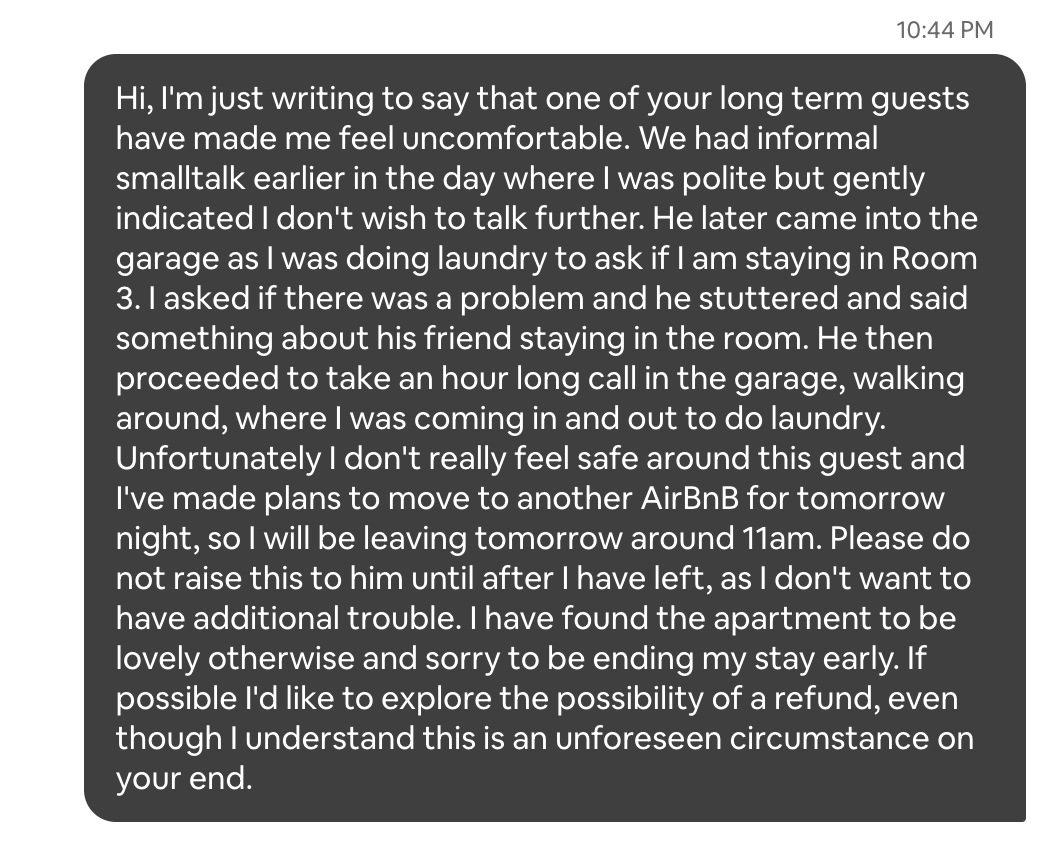
im staying in a shared airbnb and i felt insane sending this message. am i making a big deal out of nothing? Am I insane?
jean tweet media
English
92
10
4.6K
564.2K
sards3
sards3@sards3·
@Hardymatt0 @timothycbates Can you address the conceptual issue that I outlined? And the g-loading is only about 0.8, which is far from perfect.
English
0
0
0
31
Matt Hart
Matt Hart@Hardymatt0·
@sards3 @timothycbates It doesn't matter what your problem is. It's just a fact that these kind of tests are extremely highly g-loaded, and therefore are an accurate measure of g i.e IQ
English
1
0
0
31
sards3
sards3@sards3·
@timothycbates Doesn't the WAIS also have a section that tests obscure vocabulary? And any thoughts on my contention that many smart people do not read poetry or old books and thus will be underrated by such tests? And what bet do you have in mind?
English
0
0
0
115
Timothy Bates
Timothy Bates@timothycbates·
@sards3 Need to define “particularly” and “plenty”. Also stipulate also that “genius” here simply means “140 scorers on the WAIS or other accepted measure” How much do you bet? 💵💴🪎
English
2
0
3
378
JonesyOnTwitr
JonesyOnTwitr@on_jonesy·
@moultano @sards3 seriously, i eat less the older I get, it probably peaked in high school/college. I would eat an entire pizza then, now if I go past 2 slices I feel like shit, lol. Wife and I share 1 main and maybe an appetizer at every restaurant. Just shared an 8 inch sandwich for lunch!
English
1
0
0
57
Ryan Moulton
Ryan Moulton@moultano·
Seeing $28 lunch floating by on the feed made me wonder if I was out of touch, so I checked chipotle around here, not a cheap area. Burritos are still $10.50, and more food than I can eat in one sitting. What are y'all doing?
Ryan Moulton tweet media
English
581
26
2K
883.6K
Tom
Tom@tom_anseo·
@sards3 @moultano Its about 1200 calories, thats almost 2 lunches or 1 huge dinner
English
7
0
34
1.5K
sards3
sards3@sards3·
@xwanyex 91% is an oddly specific number. Does it mean anything?
English
2
0
8
981
sards3
sards3@sards3·
@sgodofsk For most people, eating tasty and varied food is one of life's great pleasures. You seem to lack appreciation for this, which is fine. But to be clear, you are the weird one in this discussion.
English
1
0
1
80
Steven Godofsky
Steven Godofsky@sgodofsk·
The thing is you don't need any of this stuff, like you don't need spices at all. I mean except salt and pepper. Onion and garlic powder if you're fancy. I didn't use anything but those the entire 4 years I was in college. And usually just salt and pepper.
Deva Hazarika@devahaz

Some reasons why cooking is overwhelming for many: -To cook each cuisine requires different base set of spices, staples, etc -Popular recipes often include obscure, expensive ingredients -Purchasing exact item amts often not possible -Utilizing rest of perishable food challenging

English
7
1
58
5.5K
sards3
sards3@sards3·
@Doriteaux @xwanyex If motherhood were so important to women, they would not choose to work in jobs that interfere with motherhood. The free market is working just fine here.
English
0
0
4
97
Doriteaux
Doriteaux@Doriteaux·
@xwanyex Yeah but this is where my latent Dem proclivities rise up like a zombie. Motherhood is important and it’s worth interfering with the “free market” to promote and protect it. Funny enough my “liberal” position here is rooted in conservatism.
English
5
0
38
1.1K
sards3
sards3@sards3·
@thefrog1394 @xwanyex Are you under the impression that if government did not regulate the workplace, employers would eliminate bathroom breaks? That is obviously false.
English
1
0
1
35
I aint got no towtruck dumbass
@xwanyex Same argument could be used to support employers eliminating bathroom and lunch breaks. Those are flaws in human biology after all! Claude Code doesn't take breaks. This is why government exists. To provide guardrails to protect human needs which capitalism is happy to ignore.
English
4
0
5
310
sards3
sards3@sards3·
@SimpinAintEZ95 @xwanyex I have to disagree. The problem with liberal ideas is not the liberty. The problem is the left-authoritarianism.
English
0
0
0
19
Leo
Leo@SimpinAintEZ95·
Liberal ideas sound great in theory, they don't work in practice. If your culture hinges on an idea of "live whatever lifestyle you want, it's all valid" then people choose to live in ways that are counterproductive to the society that everyone wants. Your social framework needs to have standards that sacrifice hedonistic pleasure for long term stability.
English
2
0
2
124
Ben Wronged
Ben Wronged@IBenWronged·
@sards3 @ChristianHeiens @realJeremyCarl I love Dr Paul, but I recognize he would have gotten steamrolled as president. Trump succeeds, whether you like his policies or not, because he does not give a shit about what people think of him. The president needs to be a bully.
English
1
0
0
5
Christian Heiens 🏛
Christian Heiens 🏛@ChristianHeiens·
A lot of people are asking why the "Libertarian moment" failed to materialize. Here are my thoughts, as a former Libertarian myself. About ten years ago, there was an expectation, certainly within libertarian circles but across the Right at large, that the future of "Conservatism" in the US would be Libertarianism. There was this belief that the GOP would become a vehicle for libertarian philosophy and that the Right as a whole would be moving in a far more libertarian direction. The Tea Party movement, Ron Paul's presidential bids, the prospect of a future Rand Paul bid, and old Reagan quotes about how the essence of conservatism is libertarianism were all in vogue if you were involved in any sort of Right-wing politics in America. There really was this feeling that the old Reaganite fusion was exhausted and the Iraq era had discredited Neoconservatism. Meanwhile, the 2008 crash, coupled with the managerialism of the Obama presidency, had radicalized a bunch of young men into rejecting what they saw as the establishment narratives of both parties. For a 20-something-year-old guy, being able to proudly say that he hated both Bush and Obama felt incredibly liberating. Ron Paul's two presidential runs, and the prospect of a third and potentially more successful one from Rand, promised to herald in a new era for American politics. Libertarianism also seemed like a great diffuser of the insidious social Progressivism that was beginning to creep into all mainstream institutions. The Great Awokening was just in its beginning stages, and at the time there seemed to be absolutely no response to the Progressive agitprop that was gaining traction on the Left. We understood that these "social movements" were all pulling in the same direction, but no one had any idea how to address them because they were about as intense as they were insane. Libertarianism seemed to offer a great response. Do nothing. I'm serious. There was this expectation that we could completely sidestep the Great Awokening and nip the entire thing in its bud by adopting a "You do you" approach. By pretending like social or cultural issues didn't matter, or in some cases, that Progressives were actually in the right on them, Libertarianism offered an avenue for the Right to seemingly take off the table an entire revolutionary movement that we all thought was driving young millennials (who were still in their teens and early 20s) into identifying as Democrats or Socialists or even Communists. "I don't care about the culture war. I want gay married couples to be able to adopt and protect their marijuana operation that's going on in the basement of their private property with AR-15s, and I want to abolish the income taxes they make on it, too." But when this tactic was put into practice, it never seemed to work. I remember in my old libertarian days over a decade ago, having conversations with Leftists my age in high school and college, and it was always disappointing. It's like I kept trying to win them over and explain I was on their side and that they just needed to understand that wealth redistribution and socialism were bad policies, but that we were both "social liberals" who wanted the same thing. I just wanted them to be rich on top of it all. And for some reason, it just never worked. At the time, I didn't understand why. But I do now. Libertarianism offered the possibility of escaping politics itself while still being political. You could tell someone that you didn't care about their lifestyle, worldview, theology, or culture, and still plausibly make the case for why they should vote for you and implement your policies, because your policies were all about transcending conflict rather than confronting it. Libertarianism offered the illusion of a sophisticated ideology for adults who had outgrown the tribal passions of the past. But that's exactly why it failed. It was always operating like a parasite on an older order that it didn't create and couldn't defend, but few of us could see it at the time because of the nature of the world around us. But that world, like the Bushite one before it, died. Mass migration and open borders actually changed the visual landscape of America in a way that was far more abrupt than the gradual changes of decades earlier. The Great Awokening, which Libertarianism offered to neutralize with its "live and let live" attitude, ended up devouring everything around it until people could no longer ignore it. The economic situation, which Libertarianism had such elegant solutions for as the centerpiece of its entire worldview, actually ended up being far more complex than the activists ever expected. America's massive twin fiscal and trade deficits, endless QE, zero interest rate environment, and the hollowing out of the Rust Belt all coincided with the rise of managerial credentialism, the professional laptop class, and the adoption of Progressivism as the civic religion of every institution and profession that seemed to be benefiting from these very policies. "Social Justice Warrior" and "Rich Liberal" became synonymous with all the institutions that had betrayed America. This created a rebellion, as Libertarians expected, but the moment Trump arrived, he revealed that the overwhelming majority of those rebels were not interested in smaller government in the abstract. They were looking for a government that would fight for them. They had felt betrayed, humiliated, forgotten, and denigrated. They believed, correctly, that they were losing their country. They had a deep resentment of our oikophobic ruling class and their wacky social views that seemed to always pop up whenever core elements of their way of life were about to be torn away from them. And once those things came to the surface, the "Libertarian moment" was essentially dead because it had no satisfying answer to the actual question being asked, which wasn't "how to balance the budget?" or "what procedural railguards can we set up to protect Americans from warrantless wiretapping?" It was “Who rules, in whose interest, and can we do anything to stop our dispossession at the hands of people who openly hate us?” The Libertarian moment failed because it had no answer to this question, which has essentially been the foundation of all of American politics since Obama's second term. It's a political ideology that wants to escape politics itself, and the moment politics became more than just a complicated math problem and instead was about which vision of civilization would prevail, the entire premise disintegrated.
English
276
514
3.5K
119.6K
sards3
sards3@sards3·
@ailtonfilho @cremieuxrecueil Gambling is not a scam. If you had said we should ban scams, I would agree with you. But what does that have to do with gambling?
English
1
0
0
59
tets
tets@ailtonfilho·
@sards3 @cremieuxrecueil Are you familiar with the concept of a scam targeting people who can't distinguish between the two? Apply this to politics get even better
English
1
0
0
58