Sam Cartmell

21 posts

Sam Cartmell

Sam Cartmell

@scdCartmell

Katılım Ekim 2012
233 Takip Edilen17 Takipçiler
Sam Cartmell
Sam Cartmell@scdCartmell·
@radfugee How do you like to report this without that history? Frequently see similar albeit less extreme findings in patients without obvious myelopathy
English
0
0
0
144
Kurt Harris MD 🇺🇦🇮🇱
Undercalling spinal cord abnormalities is a modern day plague Previous radiologist at another institution described this severe cord deformity following discitis as “mild impingement” Patient has had numbness and weakness in both hands for well over a year
Kurt Harris MD 🇺🇦🇮🇱 tweet mediaKurt Harris MD 🇺🇦🇮🇱 tweet mediaKurt Harris MD 🇺🇦🇮🇱 tweet media
English
10
3
55
8.7K
Kurt Harris MD 🇺🇦🇮🇱
Instead of saying “paraclinoid“ for every aneurysm you can see on an MRA/CTA, why not be more precise and give the proper numbered segment usually it’s going to be C6, which is ophthalmic, so why not just say that?
English
3
2
11
2.6K
Francis Deng, MD
Francis Deng, MD@francisdeng·
@radfugee so many more precise descriptors possible - distal cavernous, carotid cave, ophthalmic, superior hypophyseal, dorsal wall, posterior communicating, anterior choroidal
English
2
0
13
1.4K
Sam Cartmell
Sam Cartmell@scdCartmell·
@radfugee how do you like to report these findings instead? not uncommon to have some degree of cord deformity without obvious clinical correlate
English
0
0
0
6
Kurt Harris MD 🇺🇦🇮🇱
For the love of God, please stop saying the phrase “no abnormal spinal cord signal intensity“ when the spinal cord is squashed to the shape of a B2 bomber Lack of abnormal signal is not any kind of reassurance they don’t have myelopathy
English
5
2
11
2.1K
Sam Cartmell
Sam Cartmell@scdCartmell·
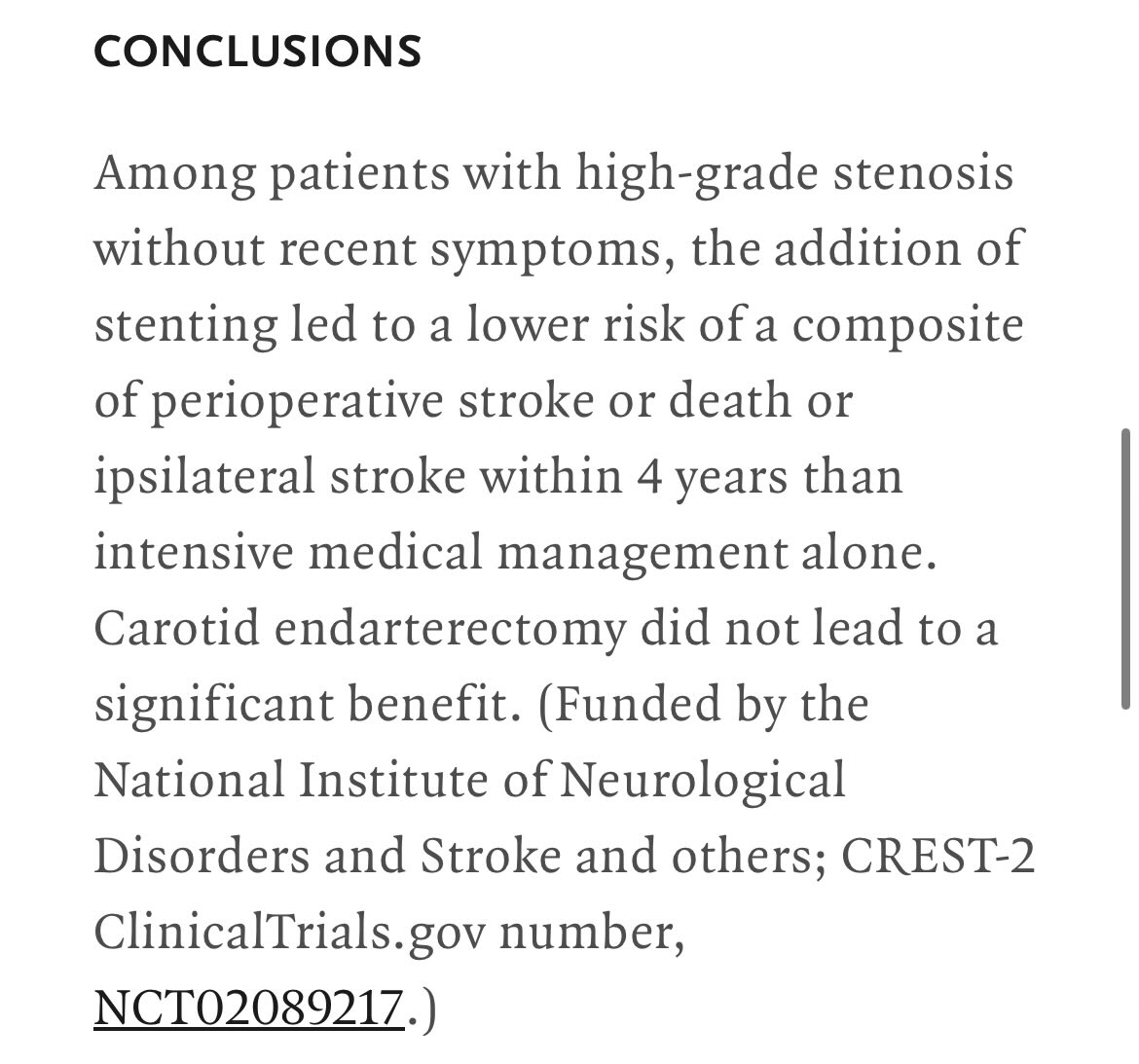
@tylcole Curious for your take Implication seems to be that CAS>CEA but the design doesn't permit this direct comparison and medical cohort in CEA group did worse. Looking at KM curves, seems like strong revasc effect but weaker evidence for diff between CEA and CAS.
English
2
0
0
114
Tyler Cole, MD
Tyler Cole, MD@tylcole·
CREST-2 trial for asymptomatic carotid stenosis released. Carotid stenting outcomes better than endarterectomy.
Tyler Cole, MD tweet media
English
2
0
4
5.6K
Sam Cartmell retweetledi
Andrej Karpathy
Andrej Karpathy@karpathy·
Finally had a chance to listen through this pod with Sutton, which was interesting and amusing. As background, Sutton's "The Bitter Lesson" has become a bit of biblical text in frontier LLM circles. Researchers routinely talk about and ask whether this or that approach or idea is sufficiently "bitter lesson pilled" (meaning arranged so that it benefits from added computation for free) as a proxy for whether it's going to work or worth even pursuing. The underlying assumption being that LLMs are of course highly "bitter lesson pilled" indeed, just look at LLM scaling laws where if you put compute on the x-axis, number go up and to the right. So it's amusing to see that Sutton, the author of the post, is not so sure that LLMs are "bitter lesson pilled" at all. They are trained on giant datasets of fundamentally human data, which is both 1) human generated and 2) finite. What do you do when you run out? How do you prevent a human bias? So there you have it, bitter lesson pilled LLM researchers taken down by the author of the bitter lesson - rough! In some sense, Dwarkesh (who represents the LLM researchers viewpoint in the pod) and Sutton are slightly speaking past each other because Sutton has a very different architecture in mind and LLMs break a lot of its principles. He calls himself a "classicist" and evokes the original concept of Alan Turing of building a "child machine" - a system capable of learning through experience by dynamically interacting with the world. There's no giant pretraining stage of imitating internet webpages. There's also no supervised finetuning, which he points out is absent in the animal kingdom (it's a subtle point but Sutton is right in the strong sense: animals may of course observe demonstrations, but their actions are not directly forced/"teleoperated" by other animals). Another important note he makes is that even if you just treat pretraining as an initialization of a prior before you finetune with reinforcement learning, Sutton sees the approach as tainted with human bias and fundamentally off course, a bit like when AlphaZero (which has never seen human games of Go) beats AlphaGo (which initializes from them). In Sutton's world view, all there is is an interaction with a world via reinforcement learning, where the reward functions are partially environment specific, but also intrinsically motivated, e.g. "fun", "curiosity", and related to the quality of the prediction in your world model. And the agent is always learning at test time by default, it's not trained once and then deployed thereafter. Overall, Sutton is a lot more interested in what we have common with the animal kingdom instead of what differentiates us. "If we understood a squirrel, we'd be almost done". As for my take... First, I should say that I think Sutton was a great guest for the pod and I like that the AI field maintains entropy of thought and that not everyone is exploiting the next local iteration LLMs. AI has gone through too many discrete transitions of the dominant approach to lose that. And I also think that his criticism of LLMs as not bitter lesson pilled is not inadequate. Frontier LLMs are now highly complex artifacts with a lot of humanness involved at all the stages - the foundation (the pretraining data) is all human text, the finetuning data is human and curated, the reinforcement learning environment mixture is tuned by human engineers. We do not in fact have an actual, single, clean, actually bitter lesson pilled, "turn the crank" algorithm that you could unleash upon the world and see it learn automatically from experience alone. Does such an algorithm even exist? Finding it would of course be a huge AI breakthrough. Two "example proofs" are commonly offered to argue that such a thing is possible. The first example is the success of AlphaZero learning to play Go completely from scratch with no human supervision whatsoever. But the game of Go is clearly such a simple, closed, environment that it's difficult to see the analogous formulation in the messiness of reality. I love Go, but algorithmically and categorically, it is essentially a harder version of tic tac toe. The second example is that of animals, like squirrels. And here, personally, I am also quite hesitant whether it's appropriate because animals arise by a very different computational process and via different constraints than what we have practically available to us in the industry. Animal brains are nowhere near the blank slate they appear to be at birth. First, a lot of what is commonly attributed to "learning" is imo a lot more "maturation". And second, even that which clearly is "learning" and not maturation is a lot more "finetuning" on top of something clearly powerful and preexisting. Example. A baby zebra is born and within a few dozen minutes it can run around the savannah and follow its mother. This is a highly complex sensory-motor task and there is no way in my mind that this is achieved from scratch, tabula rasa. The brains of animals and the billions of parameters within have a powerful initialization encoded in the ATCGs of their DNA, trained via the "outer loop" optimization in the course of evolution. If the baby zebra spasmed its muscles around at random as a reinforcement learning policy would have you do at initialization, it wouldn't get very far at all. Similarly, our AIs now also have neural networks with billions of parameters. These parameters need their own rich, high information density supervision signal. We are not going to re-run evolution. But we do have mountains of internet documents. Yes it is basically supervised learning that is ~absent in the animal kingdom. But it is a way to practically gather enough soft constraints over billions of parameters, to try to get to a point where you're not starting from scratch. TLDR: Pretraining is our crappy evolution. It is one candidate solution to the cold start problem, to be followed later by finetuning on tasks that look more correct, e.g. within the reinforcement learning framework, as state of the art frontier LLM labs now do pervasively. I still think it is worth to be inspired by animals. I think there are multiple powerful ideas that LLM agents are algorithmically missing that can still be adapted from animal intelligence. And I still think the bitter lesson is correct, but I see it more as something platonic to pursue, not necessarily to reach, in our real world and practically speaking. And I say both of these with double digit percent uncertainty and cheer the work of those who disagree, especially those a lot more ambitious bitter lesson wise. So that brings us to where we are. Stated plainly, today's frontier LLM research is not about building animals. It is about summoning ghosts. You can think of ghosts as a fundamentally different kind of point in the space of possible intelligences. They are muddled by humanity. Thoroughly engineered by it. They are these imperfect replicas, a kind of statistical distillation of humanity's documents with some sprinkle on top. They are not platonically bitter lesson pilled, but they are perhaps "practically" bitter lesson pilled, at least compared to a lot of what came before. It seems possibly to me that over time, we can further finetune our ghosts more and more in the direction of animals; That it's not so much a fundamental incompatibility but a matter of initialization in the intelligence space. But it's also quite possible that they diverge even further and end up permanently different, un-animal-like, but still incredibly helpful and properly world-altering. It's possible that ghosts:animals :: planes:birds. Anyway, in summary, overall and actionably, I think this pod is solid "real talk" from Sutton to the frontier LLM researchers, who might be gear shifted a little too much in the exploit mode. Probably we are still not sufficiently bitter lesson pilled and there is a very good chance of more powerful ideas and paradigms, other than exhaustive benchbuilding and benchmaxxing. And animals might be a good source of inspiration. Intrinsic motivation, fun, curiosity, empowerment, multi-agent self-play, culture. Use your imagination.
Dwarkesh Patel@dwarkesh_sp

.@RichardSSutton, father of reinforcement learning, doesn’t think LLMs are bitter-lesson-pilled. My steel man of Richard’s position: we need some new architecture to enable continual (on-the-job) learning. And if we have continual learning, we don't need a special training phase - the agent just learns on-the-fly - like all humans, and indeed, like all animals. This new paradigm will render our current approach with LLMs obsolete. I did my best to represent the view that LLMs will function as the foundation on which this experiential learning can happen. Some sparks flew. 0:00:00 – Are LLMs a dead-end? 0:13:51 – Do humans do imitation learning? 0:23:57 – The Era of Experience 0:34:25 – Current architectures generalize poorly out of distribution 0:42:17 – Surprises in the AI field 0:47:28 – Will The Bitter Lesson still apply after AGI? 0:54:35 – Succession to AI

English
414
1.2K
9.5K
2M
medmalreviewer
medmalreviewer@medmalreviewer·
Either a 3-5 minute Youtube video or 2-3 short paragraphs about what you're seeing. Geared toward an audience of physicians from across all specialties. Happy to give you credit or let you remain anonymous, whichever you prefer.
English
1
0
5
2K
medmalreviewer
medmalreviewer@medmalreviewer·
In the next few days I might have a need for a neurorad to look at a CTA head/neck and give a brief tutorial on what they're seeing and what was missed. It's from a med mal case I published a few years ago. Anyone interested?
English
1
0
15
4.6K
Sam Cartmell retweetledi
Derek Thompson
Derek Thompson@DKThomp·
Gutting scientific funding and scaring away talented immigrants while raising the cost of manufacturing stuff in America is, genuinely, like something we’d be forced to do after losing a war to a geopolitical adversary that deviously sought to hamstring US technological power for generation.
English
105
900
4.5K
513.8K
Sam Cartmell
Sam Cartmell@scdCartmell·
@tszzl To what extent do you think it’s latent vs the bias of RLHF (as original post hypothesizes)?
English
0
0
0
23
Sam Cartmell
Sam Cartmell@scdCartmell·
@teachplaygrub Is there a reference that discusses this aspect of the vascular anatomy (and propensity for emboli vs athero) that you’d recommend?
English
0
0
0
433
Lea Alhilali, MD
Lea Alhilali, MD@teachplaygrub·
Talk about shallow minds!   Cortical perforators are important for perfusing the superficial cortex along the surface of the brain    Is your knowledge of superficial perforators only skin deep?   If Instagram has taught us anything, it's that shallow & superficial do matter!   Everyone knows deep perforators, but superficial cortex has perforators too--cortical, subcortical, & medullary twigs to white matter.   Largest are the lateral perforators along the convexity, while deep medial perforators are small   Cortical perforators can be affected by emboli or atherosclerosis: 
Embolism Emboli tend to be large relative to the size of the vessel Tends to affect the lateral perforators Can usually only travel to the 1st or 2nd division which is at the gray-white junction This is why emboli tend to be lobar at the GW junction!   Atherosclerosis Lipohyalinosis and fibrinoid necrosis usually affect very small arterioles This is the medial perforators and small branches of the lateral perforators in the white matter This is why lacunar infarcts tend to be in the basal ganglia & deep lobar white matter!   Now hopefully your knowledge of superficial perforators is anything but superficial!
Lea Alhilali, MD tweet media
English
6
87
424
26.4K
Sam Cartmell
Sam Cartmell@scdCartmell·
@VPrasadMDMPH have you written about the use AI for mammograms? interested in learning more about your position
English
0
0
1
70
Sam Cartmell retweetledi
Stephan J. Guyenet
Stephan J. Guyenet@sguyenet·
Glad this misleading post got a Community Note, although I wish it had happened faster. People with cancer who choose alternative therapies instead of taking their oncologist's advice are 2.5 times as likely to die prematurely. doi.org/10.1093/jnci/d…
Stephan J. Guyenet tweet media
English
11
29
193
12.1K
RJ
RJ@northwoods1980·
Interesting how the positive hit rate of appendicitis on CT has dramatically dropped over the past several years. With the most common diagnosis resulting – constipation. It's also interesting to see the linear correlation with frequency of exams ordered by mid levels working in ED/replacing board certified physicians. Of course must be coincidence. Correlation and not causation. More research needed....🥳
English
20
8
128
27.7K
AJ Kay
AJ Kay@AJKayWriter·
True story: @Grok diagnosed my daughter’s broken wrist last week. One of my daughters was in a bad car accident last weekend. Car is totaled but she walked away. Everyone involved did, thankfully. It was a best case outcome for a serious, multi-vehicle freeway collision. There was no need for emergency transport from the scene but her arm was hurting badly by the time we were able to leave (9pm-ish) so I took her home with the intention of visiting Urgent Care early the next morning. Well, ofc she didn’t sleep and by 6am, I was convinced it was broken. The way she was favoring it and the amount of pain she was in indicated more than soft tissue injury. So we got to Urgent Care and they examined her and took some x-rays. Both the doctor who saw her and the radiologist declared her free of breaks and, after answering some of our questions, sent her home with an ace wrap and ibuprofen. On the way out, I asked them to please print out the X-ray images for us so I could take them to her PCP. I hoped they were right, but wasn’t sold. At home, things were rough. Her hand kept going cold and tingly and she couldn’t move her thumb — and I don’t know how to describe it, but it just didn’t *look* right. She had other aches and pains too — including two bruised ribs and some minor whiplash — but the arm pain just kept breaking through. So, as soon I was able, I opened my laptop and started “doing my own research.” I poured over x-rays of normal wrists and broken wrists and, remembering a post from a few weeks ago by @elonmusk that Grok2 could read medical images, I uploaded the wrist X-ray to Grok and asked if there were any abnormalities. Grok: “There’s a clear fracture line in the distal radius.” 👀 I had actually asked the doctor about the line Grok mentioned and he said it was just her growth plate. So I asked Grok if it was seeing a fracture line or a fused growth plate. Grok: “It’s a fracture line.” 👀 Finally, I asked if this was a subtle fracture or obvious. I really wanted to give the benefit of the doubt to the doctor. Grok: “quite obvious” 👀 Long story short, we went to PCP, got a referral to the ortho, and the next day the wrist specialist took new x-rays (multiple views), examined her, and confirmed Grok’s diagnosis of a distal radial head fracture with dorsal displacement. (And, FTR, I didn’t tell the doctor about my foray into Grok, largely because I didn’t want her to think I was insane. Her diagnosis was completely independent.) They set it and cast it. The ortho said that, due to the displacement, had it gone untreated, she likely would have needed surgery that she can probably avoid now. And it probably would’ve gone untreated — at least for a while. Because the doctor and radiologist said it was fine and I’m just a mom, right? Who the hell am I to question their diagnosis? Now, maybe the doctor and radiologist at Urgent Care were tired and coming off a long night. Maybe they were looking only for an obvious clean break. Or maybe they’re in need of some CME. But *both* of them missed what the ortho and Grok agreed was an “obvious” break. And I do harbor a fair amount of skepticism about LLMs and the limit(s) of their capabilities and potential impact on society— but this was eye-opening for me and I’m very grateful to @grok and @X for getting this one right. 🙏
AJ Kay tweet mediaAJ Kay tweet mediaAJ Kay tweet mediaAJ Kay tweet media
English
970
1.6K
10.9K
14.4M