
Stephan J. Guyenet

19K posts

Stephan J. Guyenet banner
Stephan J. Guyenet

Stephan J. Guyenet

@sguyenet

The neuroscience of eating behavior and obesity. Author of The Hungry Brain. Founder and director of Red Pen Reviews. Neuroscience PhD, University of WA.

Seattle, WA Katılım Nisan 2011
370 Takip Edilen330.6K Takipçiler
Stephan J. Guyenet retweetledi
Alex Leaf
Alex Leaf@Alexleaf·
Excellent review paper by Roy Taylor on his journey to verifying the cause of type 2 diabetes. Aptly titled: "Aetiology of type 2 diabetes: an experimental medicine odyssey" (PMID: 40316731). I wanted to share two quotes from the conclusion, because there still seems to be a tremendous misunderstanding of this disease among both scientific and layperson communities. "The original destination of this experimental medicine odyssey was to identify the cause of type 2 diabetes and now this can simply be stated. If a person develops type 2 diabetes, they have accumulated more fat than can be tolerated by their own genetic constitution." "There is a single environmental, modifiable cause. Type 2 diabetes only develops if an individual has eaten more than they require over a long period. However, there are two important stop–go stages, both determined by the lottery of inheritance. Diabetes appears only when fat can no longer be stored safely under the skin... Even if fat spills over into ectopic sites, diabetes will only occur if there is also genetic susceptibility to fat suppression at the level of the beta cell... Even if full genetic susceptibility is present, the writing is clearly on the wall: no positive energy balance, no diabetes."
English
6
8
69
7.4K
Alex Leaf
Alex Leaf@Alexleaf·
I can't say I've ever encountered someone who conflates elevated LDL with heart disease. Most operate, rightly so, from the standpoint that heart disease is a probabilistic outcome influenced by numerous factors, one of which is circulating LDL / apoB concentrations. This is entirely compatible with Nick's personal experience. Since his anecdote has zero external validity, it can rightly be ignored in favor of population-level data and mechanistic inferences when dealing with literally any person other than Nick himself. Most importantly, is there any health benefit from maintaining higher vs lower levels? What, exactly, is the point of keeping LDL extremely elevated when it probabilistically increases disease risk?
Nick Norwitz MD PhD@nicknorwitz

Concisely put @MikhailaFuller. I agree. We’ve advanced too far for any reasonable mind to equate one lipid biomarker for the presence of disease, i.e. high LDL = atherosclerosis. I’d also suggest people consider this fact: while I’m an N = 1, I did essentially bet on this outcome by virtue of my choices — the stakes were my life. Kinda’ a big bet to just get lucky. So, maybe we’re onto something? P.S. More to the story coming Monday…

English
29
9
114
27.6K
Stephan J. Guyenet
Stephan J. Guyenet@sguyenet·
@CaloDefici Added fats are one of the most effective way to get a caloric surplus in an ad libitum diet
English
1
0
2
33
Calo Defici
Calo Defici@CaloDefici·
@sguyenet Not true. Calorie surplus makes you fat. Not fat consumption.
English
1
0
0
115
Stephan J. Guyenet
Stephan J. Guyenet@sguyenet·
@crumulusXII Not what I'm saying. "Adding concentrated sources of fat to the diet, like oils and butter, tends to make people gain fat"
English
0
0
0
192
Stephan J. Guyenet
Stephan J. Guyenet@sguyenet·
@TheNashvillian I expect people to have enough reading comprehension that when I say "added fat" and "oils and butter", they understand I'm not talking about nuts, meat, eggs, etc.
English
0
0
0
14
The Nashvillian
The Nashvillian@TheNashvillian·
@sguyenet But you included oils. And when you start a conversation by telling people they’re going to get fat by eating fat, they’ll easily see all fat as fungible.
English
1
0
0
34
Stephan J. Guyenet
Stephan J. Guyenet@sguyenet·
@lumiferrous I'm talking about which foods are selected in a free-living diet, which is the most relevant framing for most people. The problem with added fats is that they mostly add to the diet rather than replacing, because they have very low satiety per kcal.
English
1
0
0
29
Lumifer
Lumifer@lumiferrous·
@sguyenet You're now talking about *replacing* some foods with others. There's a lot of variation in there, the averages aren't very useful, and the topic becomes satiety, tastiness, and general preferences.
English
1
0
0
30
The Nashvillian
The Nashvillian@TheNashvillian·
@sguyenet OK, but maybe just a bit oversimplistic? We do need a certain amount of healthy fat that can come in the form of olive, fish, or flax seed oil. Will your message keep people from adding avocado or slivered almonds to their salad? Nutrition education must have nuance.
English
1
0
1
399
Stephan J. Guyenet
Stephan J. Guyenet@sguyenet·
@cadospharma It sounds like your situation is confounded by other dietary changes. Your profile says PE. The easiest way to mess up PE is added fat. I'd love to see scientific evidence for the claim that all else equal, adding fat to a diet causes weight loss 😁
English
1
0
2
171
Protein with PE strategy
Protein with PE strategy@cadospharma·
@sguyenet The view is not unpopular, it is not scientific. The more i eat butter, MCT oil, and meat, the more i loose weight. The stronger i get, so i dont listen to any more epidemiology studies because there are thousands and have different conclusions. epidemiology is not science
English
1
0
0
217
Stephan J. Guyenet
Stephan J. Guyenet@sguyenet·
@DIY_Tardis The difference between those diets is mostly added fat. Oils, butter, cream. It doesn't need to be low-carb to demonstrate the point that added fat increases calorie intake and is fattening.
English
3
0
0
174
Stephan J. Guyenet
Stephan J. Guyenet@sguyenet·
@lumiferrous In a typical ad libitum diet, adding lean protein will typically lower total energy intake, and added fats will typically increase total energy intake more than most other types of food
English
1
0
1
123
Lumifer
Lumifer@lumiferrous·
@sguyenet As stated, the claim is true for any caloric food. *Adding* carbs and proteins is fattening as well.
English
1
0
2
108
Stephan J. Guyenet
Stephan J. Guyenet@sguyenet·
Added fat is fattening. It may not be a popular point of view these days, but it remains true.
English
36
7
123
53.3K
Crémieux
Crémieux@cremieuxrecueil·
It bothers me that everything I've been told about Ancel Keys until I started actually reading his stuff was a slanderous lie Grifters actually lie and say he committed fraud when he was completely fine as a researcher But I thought otherwise because I trusted people not to lie
English
27
7
226
25.2K
Mark Wilson
Mark Wilson@ketosprinter·
@sguyenet @cremieuxrecueil So the science is settled then? Heard that before somewhere, haven't we? Conclusions driven by money, fame and pharma have established the status quo.
English
1
0
2
40
Stephan J. Guyenet
Stephan J. Guyenet@sguyenet·
@maxkshen Biologically, it's in the brain, but much of the experience of it is felt in the body. There's no incompatibility there.
English
1
0
2
542
Max Shen
Max Shen@maxkshen·
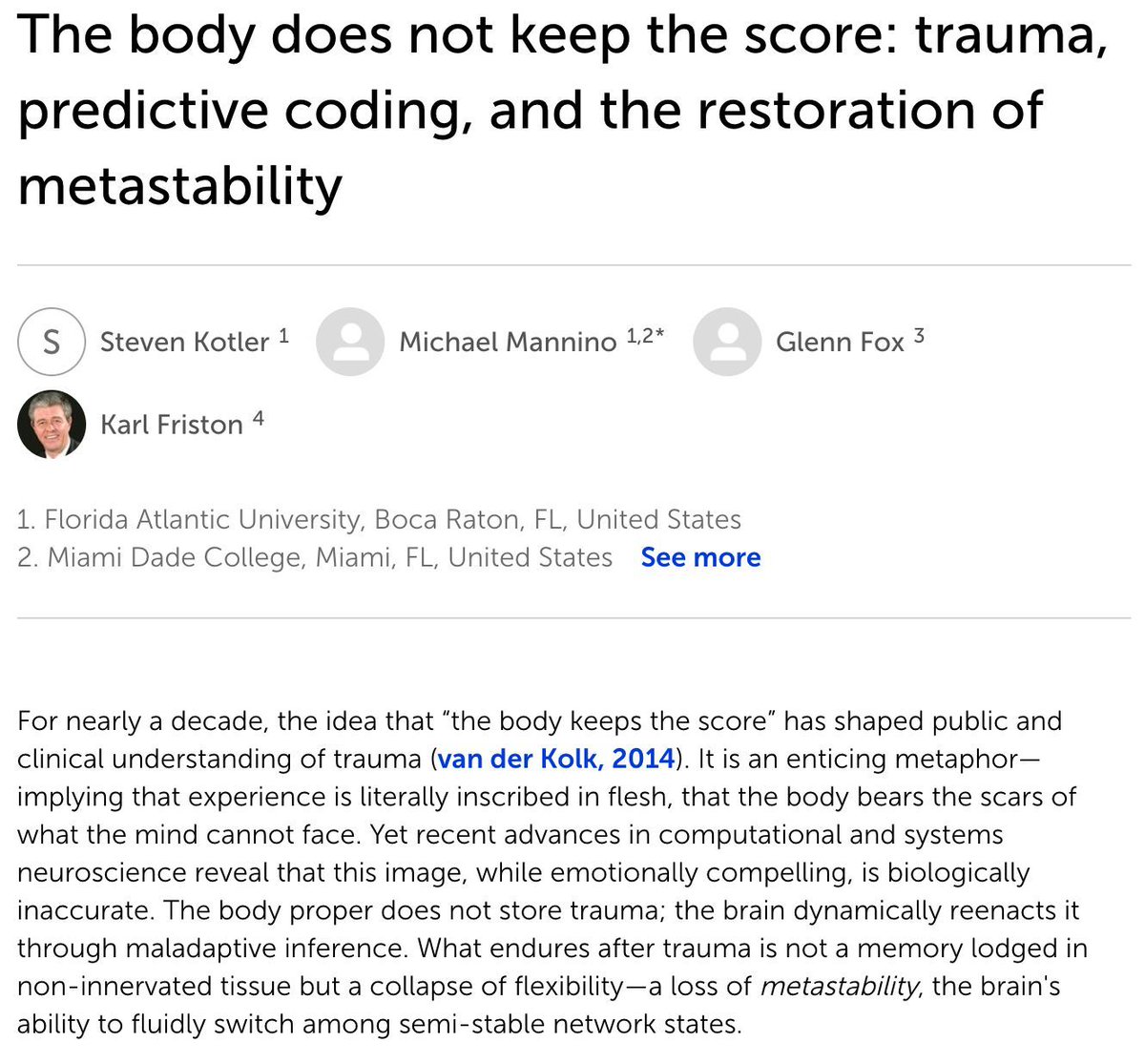
"The body does not keep the score" — new opinion piece by Kotler, Mannino, Fox, and Friston the title is inflammatory and in my view misleading. the basic claim is ‘trauma is more like a trapped prior than an inscription”. trauma is an maladaptive lack of responsivity, not like a bullet wound or physical injury but there are two parts to the debate here: Anti-inscription - their main argument: we should not think about trauma as something that is stored and accumulated (they are basically pushing back against the ‘storehouse model’ of trauma). Brain-only - trauma is in the brain, not the body They smuggle in ‘Brain-only’ when really they are arguing about ‘Anti-inscription. But we can look at these in turn. I think anti-inscription is basically right. van der Kolk’s The Body Keeps the Score is vague on what constitutes trauma. “the score” he refers to is about debt, like an accounting debt, but he also uses metaphors like ‘watchtower’ and ‘smoke detector’ throughout the book — though the end message is that you need to get into the body to resolve the stored trauma. Kotler et al. say that this is wrong. you shouldn’t see the body as ‘storing’ trauma. most people don’t get PTSD from war, death of a spouse, etc (though very many do) — which would not happen if it were permanently inscribed in the body. (note: i doubt anyone (incl van der Kolk) believes that trauma is permanently inscribed in the body; ‘watchtower’ and smoke alarm are pretty compatible with the trapped prior view of trauma) instead, kotler etc say that trauma is about a stuck prediction. “loss of metastability — the brain’s ability to fluidly switch among semi-stable network states”. They try to relate everything to free energy minimization — a move that I’ll just note confuses more than clarifies things for me. This is basically compelling, and I do think ‘trapped prior’ is far better than ‘storehouse’ for how to think about trauma. Then they basically try to explain that because trauma is about predictions, it must be about the brain (which they use interchangeably with the central nervous system). my basic objection to this is that it is experientially obvious that memories in general (not just trauma) involve parts of the body outside the central nervous system. very obviously, the enteric nervous system and cardiac neurons encode memory that can be linked with trauma. more speculatively, i think something like @johnsonmxe idea of smooth muscle acting as a form of ‘prior’ is quite plausible. annoyingly, this whole piece feels like an old rehash of the perennial mind-body debate, where the predictive processing people are insisting ‘trauma is in malformed prediction (mind)’ and the somatic people insist ‘trauma is in the viscera (body)’ the way forward is what the somatic scientists like Thomas Hanna and Feldenkrais gestured at, which I think in principle the PP people should be on board with, but probably in part because there isn’t yet a mature science of somatic memory tend to default to reducing everything to the brain.
Max Shen tweet media
English
10
4
95
5.5K
JT | Jerry Teixeira
JT | Jerry Teixeira@jerryteixeira·
@MattBMartin To be fair, according to CDC, smoking rates in the US have fallen approx 73–74% (from 37.4% in 1970 to 9.9% in 2024) (This isn’t an anti statin take, by the way)
English
3
1
17
1.5K