

Scott Geng
83 posts
Scott Geng
@scottgeng00
PhD student @uwcse, visiting researcher @meta @allen_ai
Earth Katılım Ağustos 2010
164 Takip Edilen604 Takipçiler

After 4yrs, today is my last day at @allen_ai
It was an honor to work on Olmo, Dolma, olmOCR, Tulu, Molmo & other fully-open artifacts 🫡 Reception has been amazing & their adoption makes me SO PROUD 🥹
Team is super committed to open recipes; can't wait to see what's next!!!!

English
Scott Geng retweetledi

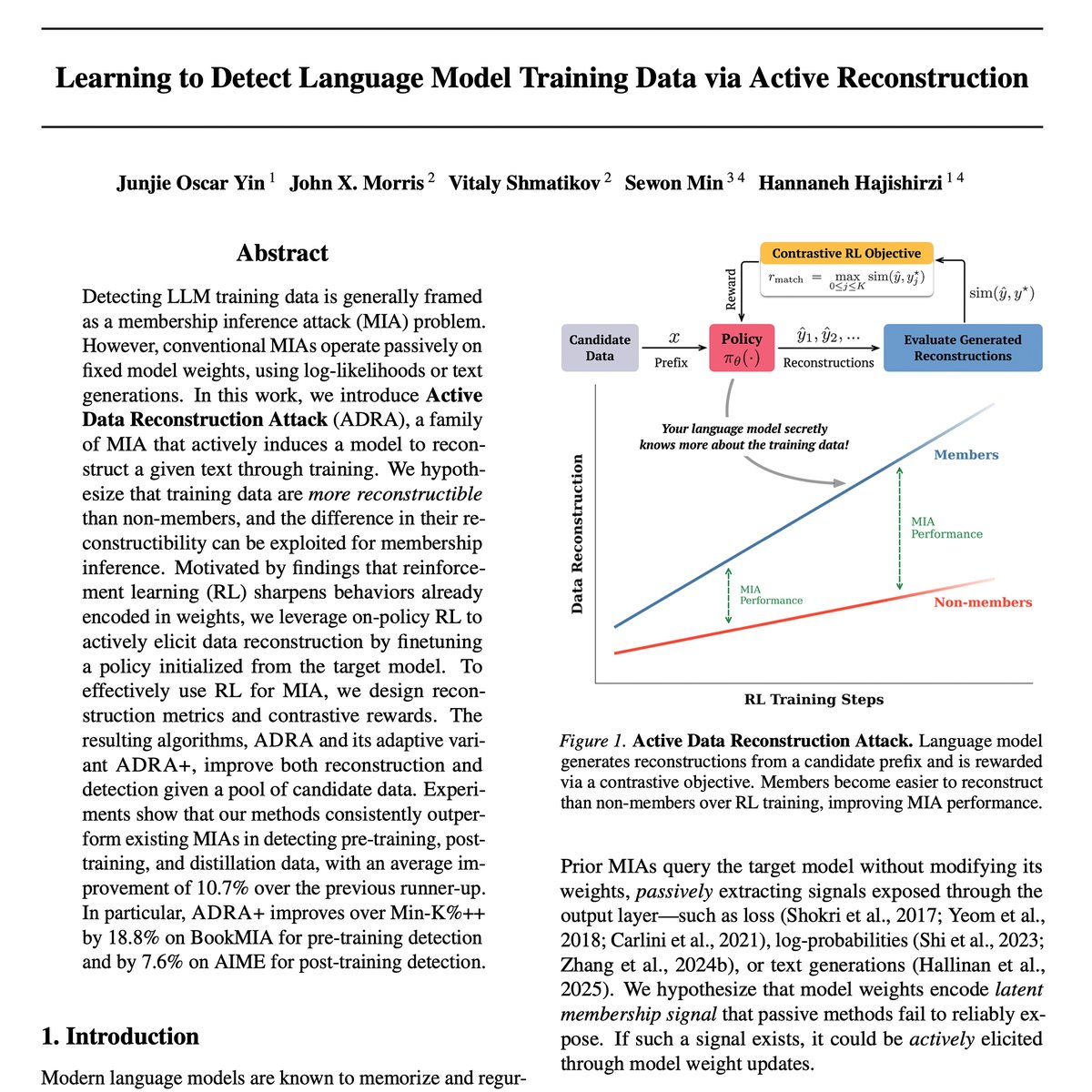
Many people are using RL to make models smarter.
We used RL to pull training data out of the models themselves.
Our results show that models know a lot more about their training data than most people think.
We develop Active Data Reconstruction Attack (ADRA) — a data detection method that uses RL to induce models to reconstruct data seen during training.
ADRA beats existing methods by an average of >10% across pre-training, post-training, and distillation.
Our paper, with @uwnlp, @Cornell, and @BerkeleyNLP @Berkeleyai, is now available.
Arxiv: arxiv.org/pdf/2602.19020
Joint work with @jxmnop @shmatikov @sewon__min @HannaHajishirzi
English
Scott Geng retweetledi

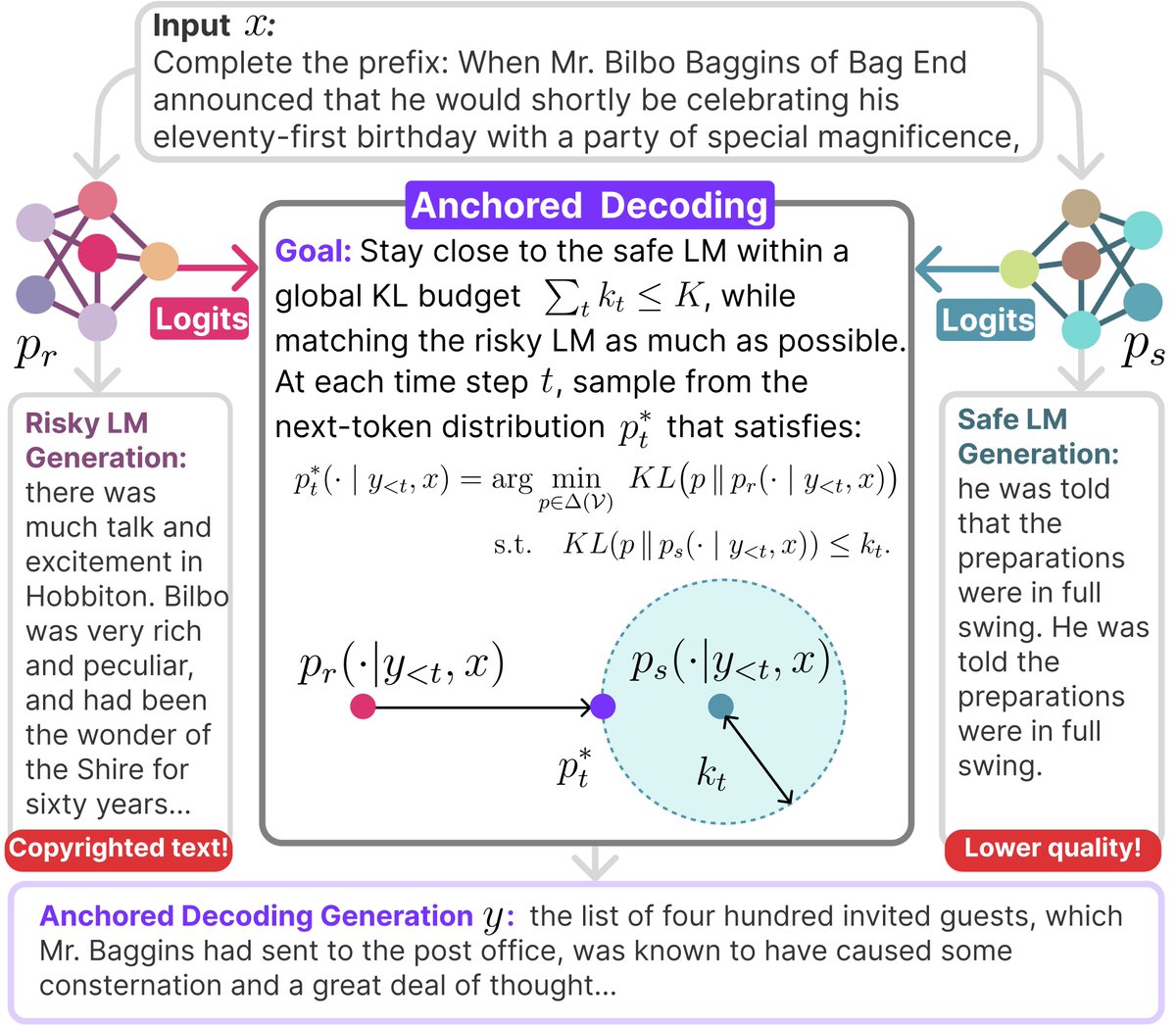
Introducing ⚓ 𝗔𝗻𝗰𝗵𝗼𝗿𝗲𝗱 𝗗𝗲𝗰𝗼𝗱𝗶𝗻𝗴: a copyright mitigation strategy for any language model! With @uwnlp
LMs today reproduce copyrighted text—raising concerns for creator consent and potential legal (and 💸 💸) liabilities for AI developers. 🫠
𝗔𝗻𝗰𝗵𝗼𝗿𝗲𝗱 𝗗𝗲𝗰𝗼𝗱𝗶𝗻𝗴 relies on two off-the-shelf LMs:
🧼A 𝘀𝗮𝗳𝗲 𝗟𝗠 trained only on permissively licensed text,
⚠️A higher-utility 𝗿𝗶𝘀𝗸𝘆 𝗟𝗠 trained on any data.
The 𝗿𝗶𝘀𝗸𝘆 𝗟𝗠 drives generation, but the 𝘀𝗮𝗳𝗲 𝗟𝗠 acts as an anchor. If the 𝗿𝗶𝘀𝗸𝘆 𝗟𝗠 drifts into memorization, the 𝘀𝗮𝗳𝗲 𝗟𝗠 pulls it back ↩️.
🤝We provide a formal guarantee: outputs stays within a user-set budget of the 𝘀𝗮𝗳𝗲 𝗟𝗠.
Details below! 👇
[1/⚓]
English

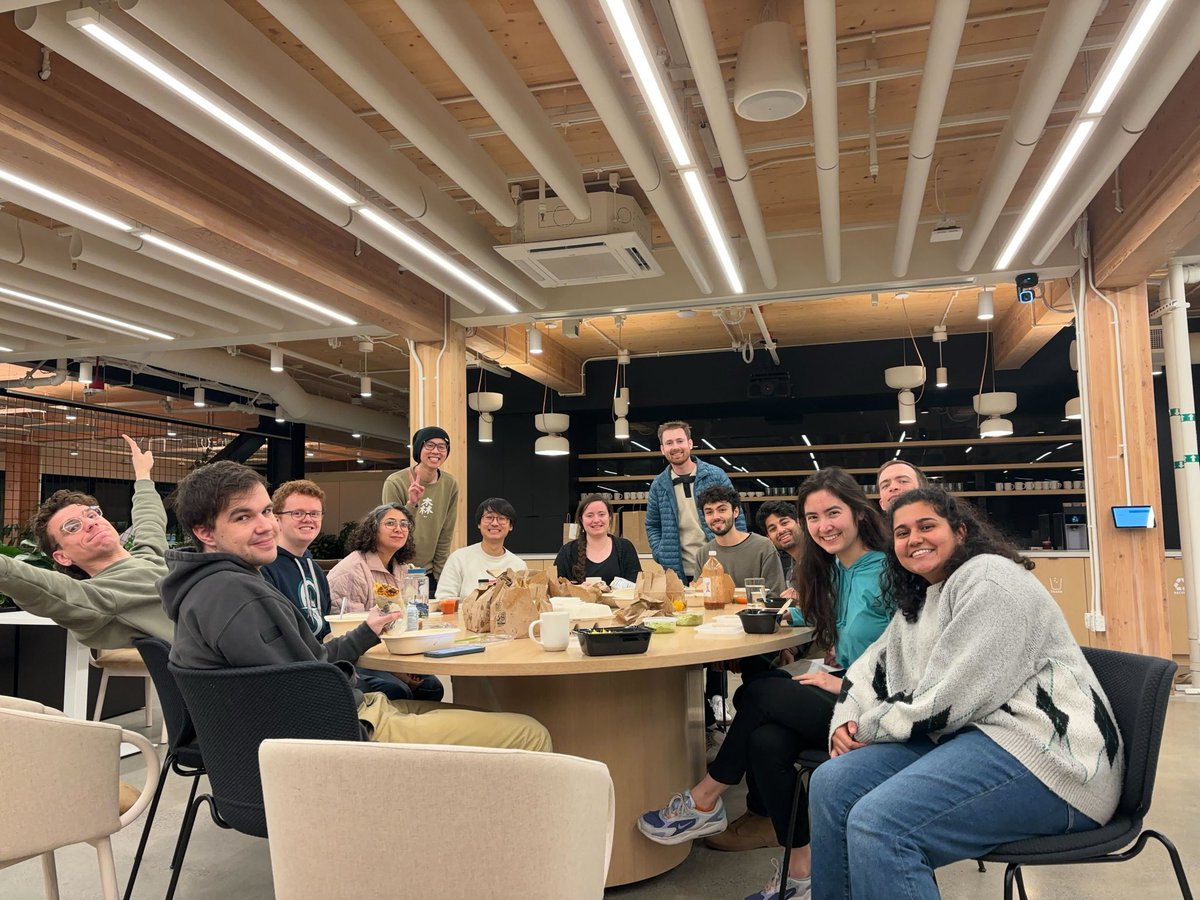
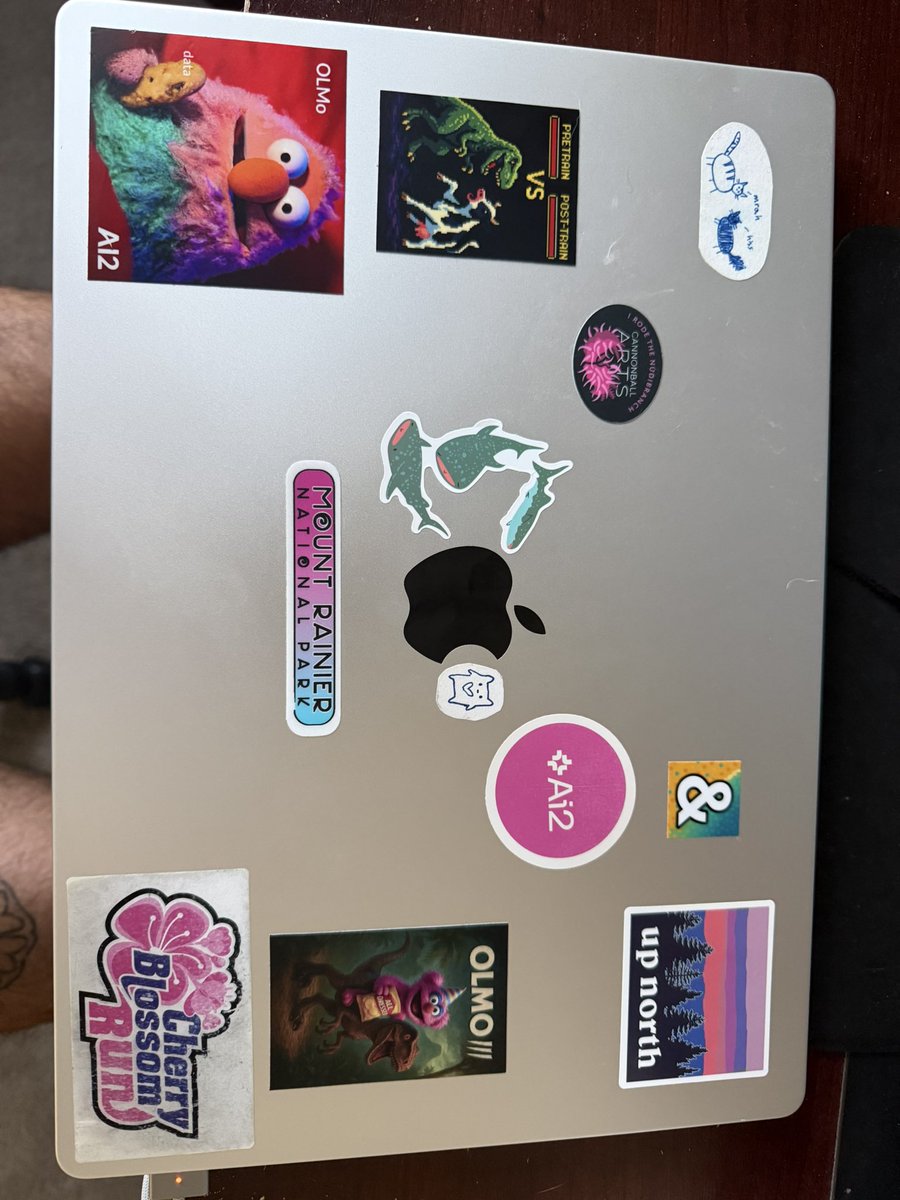
I’ve left Ai2! I didn’t think I’d be typing this anytime soon, but life is full of surprises.
Ai2 has been an incredible place for me to learn and grow. I’m particularly grateful for my managers @natolambert @HannaHajishirzi and my technical mentors @finbarrtimbers @hamishivi @Tim_Dettmers @epwalsh
I’ll miss Ai2 deeply. It’s truly a special place full of special people. A part of me feels like a total idiot for leaving, but I’m super excited for what’s next!!

English
English

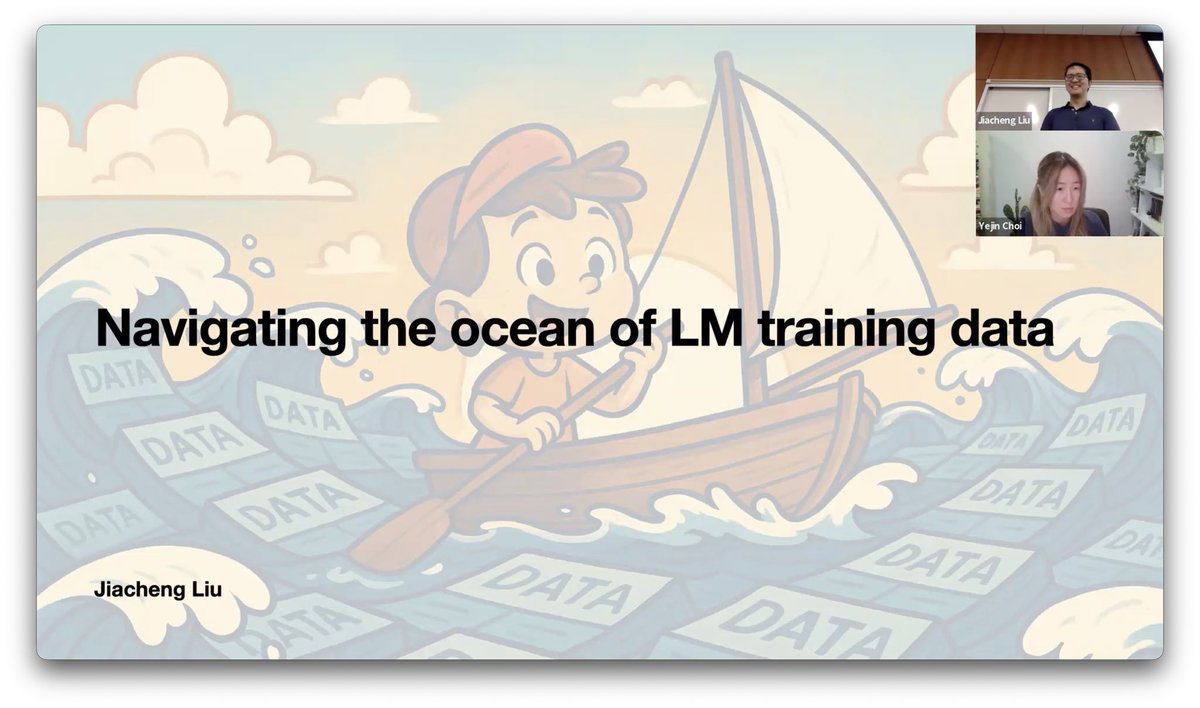
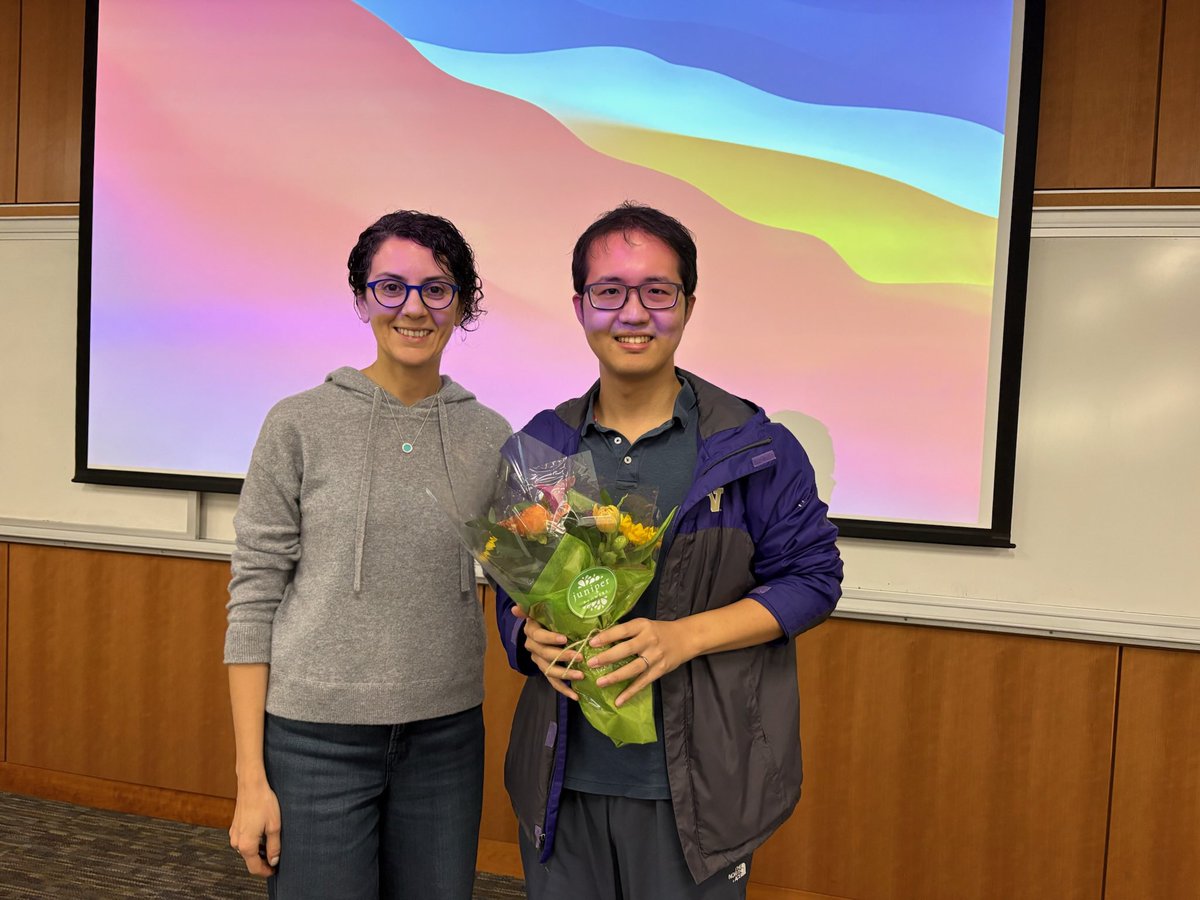
Belated update: I defended my PhD last month!
I am tremendously grateful to my advisors, @HannaHajishirzi and @YejinChoinka. Without their incredible support, I wouldn’t have had so much fun exploring bold ideas, like taking a journey into the ocean of LLM pretraining data. 🥰🥰
English

🚀 Introducing Nemotron-Cascade! 🚀
We’re thrilled to release Nemotron-Cascade, a family of general-purpose reasoning models trained with cascaded, domain-wise reinforcement learning (Cascade RL), delivering best-in-class performance across a wide range of benchmarks.
💻 Coding powerhouse
After RL, our 14B model:
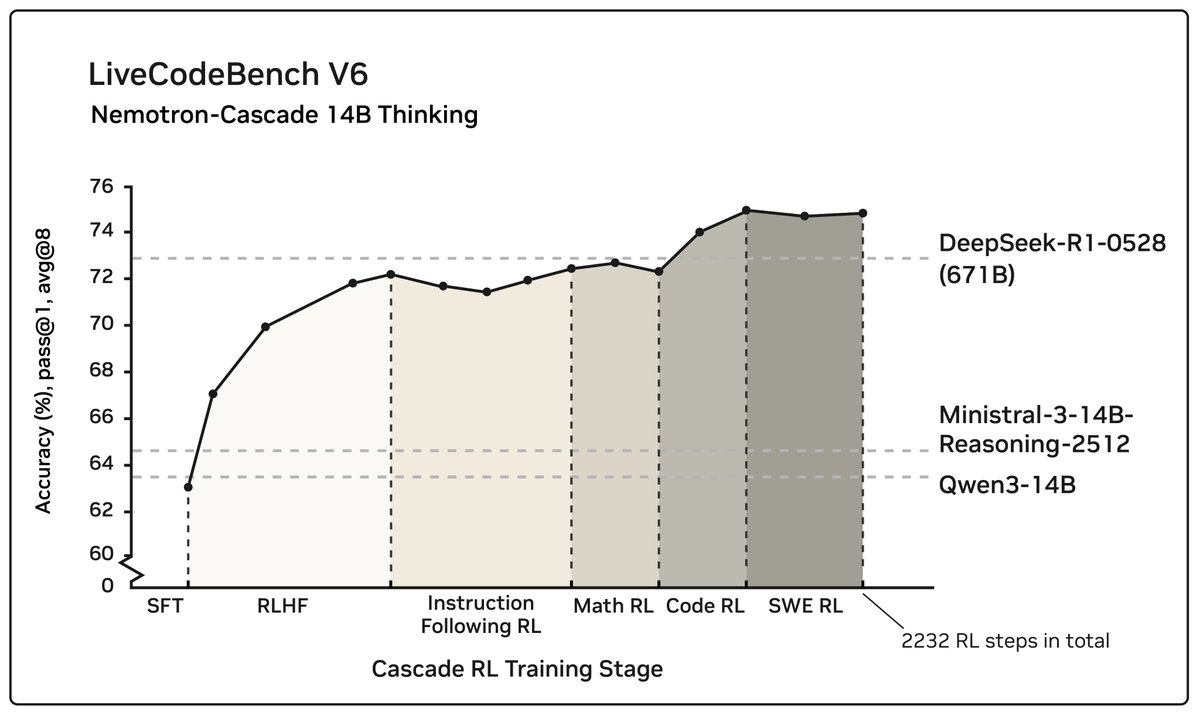
• Surpasses DeepSeek-R1-0528 (671B) on LiveCodeBench v5/v6/Pro.
• Achieves silver-medal performance at IOI 2025 🥈.
• Reaches a 43.1% pass@1 on SWE-Bench Verified, and 53.8% with test-time scaling.
🧠 What is Cascade RL?
Instead of mixing heterogeneous prompts across domains, Cascade RL trains sequentially, domain by domain, which reduces engineering complexity, mitigates heterogeneous verification latencies, and enables domain-specific curricula and tailored hyperparameter tuning.
✨ Key insight
Using RLHF for alignment as a pre-step dramatically boosts complex reasoning—far beyond preference optimization. Subsequent domain-wise RLVR stages rarely hurt the benchmark performance attained in earlier domains and may even improve it, as illustrated in the following figure.
🤗 Models & training data 🔥
👉 huggingface.co/collections/nv…
📄 Technical report with detailed training and data recipes
👉 arxiv.org/pdf/2512.13607
English
tbh it's too easy. you giveth Olmo moore GPU hours and Olmo giveth back.
@nvidia pleaseeee collab pleasee 🐄🐄🐄
Ai2@allen_ai
Olmo 3.1 is here. We extended our strongest RL run and scaled our instruct recipe to 32B—releasing Olmo 3.1 Think 32B & Olmo 3.1 Instruct 32B, our most capable models yet. 🧵
English
Scott Geng retweetledi

Thank you for highlighting our work! 🚀 @_akhaliq
Also a thread for more details here x.com/iwylin/status/…
AK@_akhaliq
Self-Improving VLM Judges Without Human Annotations
English
Scott Geng retweetledi

overhead at reasoning workshop by @natolambert - dpo still works! @archit_sharma97
English
@hamishivi @chrmanning @_sholtodouglas @FlintCasey @TristanHeywood i love australia i love kangaroos
English

If neurips is in Australia everyone can finally learn how great the country is… home of @chrmanning @_sholtodouglas @FlintCasey andrew tulloch @TristanHeywood and may more insanely smart people.
HyperAustralia is real.
English
Excited to see everyone at #NeurIPS2025 soon ☀️🌯! I work on post-training, synthetic data, and RL these days (Delta Learning, Olmo 3, Spurious Rewards), and I'm generally excited about how we can break the data wall.
Psyched to meet new friends and old -- DMs open 🙂🐄🦖
English
Scott Geng retweetledi

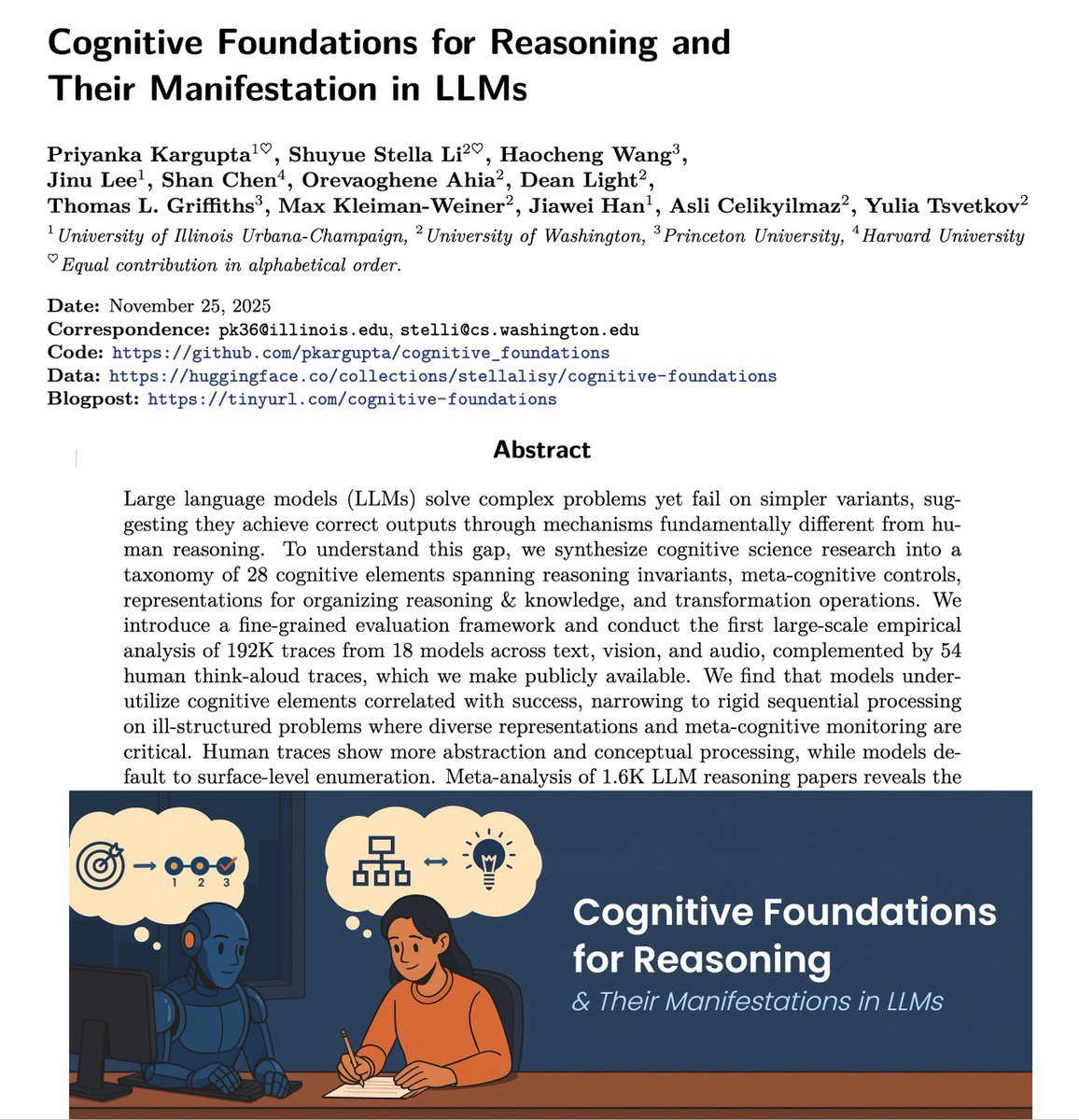
🤔💭What even is reasoning? It's time to answer the hard questions!
We built the first unified taxonomy of 28 cognitive elements underlying reasoning
Spoiler—LLMs commonly employ sequential reasoning, rarely self-awareness, and often fail to use correct reasoning structures🧠
English
@KarelDoostrlnck Your work is super cool @KarelDoostrlnck! Definitely matches our intuitions; will include a citation to your paper in the imminent arXiv tech report :)
English

Very nice to see some key findings of our work on Contrastive Learning from AI Revisions (CLAIR) be echo'd in AI2's latest model release!
Specifically: "High contrast in preference pairs drives DPO" and "The intuition behind delta learning is that the quality of preference data depends primarily on the quality of the delta between chosen and rejected".
The quality of the contrast is indeed a major driver of Preference Optimization performance!
Nathan Lambert@natolambert
We present Olmo 3, our next family of fully open, leading language models. This family of 7B and 32B models represents: 1. The best 32B base model. 2. The best 7B Western thinking & instruct models. 3. The first 32B (or larger) fully open reasoning model. This is a big milestone for Ai2 and the Olmo project. These aren’t huge models (more on that later), but it’s crucial for the viability of fully open-source models that they are competitive on performance – not just replications of models that came out 6 to 12 months ago. As always, all of our models come with full training data, code, intermediate checkpoints, training logs, and a detailed technical report. All are available today, with some more additions coming before the end of the year. As with OLMo 2 32B at its release, OLMo 3 32B is the best open-source language model ever released. It’s an awesome privilege to get to provide these models to the broader community researching and understanding what is happening in AI today. Base models – a strong foundation Pretraining’s demise is now regularly overstated. 2025 has marked a year where the entire industry rebuilt their training stack to focus on reasoning and agentic tasks, but some established base model sizes haven’t seen a new leading model since @alibaba_qwen's Qwen 2.5 in 2024. The Olmo 3 32B base model could be our most impactful artifact here, as Qwen3 did not release their 32B base model (likely for competitive reasons). We show that our 7B recipe competes with Qwen 3, and the 32B size enables a starting point for strong reasoning models or specialized agents. Our base model’s performance is in the same ballpark as Qwen 2.5, surpassing the likes of Stanford’s Marin (@stanfordAILab) and Gemma 3 (@GoogleDeepMind), but with pretraining data and code available, it should be more accessible to the community to learn how to finetune it (and be confident in our results). We’re excited to see the community take Olmo 3 32B base in many directions. 32B is a loved size for easy deployment on single 80GB+ memory GPUs and even on many laptops, like the MacBook I’m using to write this on. A model flow – the lifecycle of creating a model With these strong base models, we’ve created a variety of post-training checkpoints to showcase the many ways post-training can be done to suit different needs. We’re calling this a “Model Flow.” For post-training, we’re releasing Instruct versions – short, snappy, intelligent, and useful especially for synthetic data en masse (e.g. recent work by Datology @datologyai on OLMo 2 Instruct), Think versions – thoughtful reasoners with the performance you expect from a leading thinking model on math, code, etc. and RL Zero versions – controlled experiments for researchers understanding how to build post-training recipes that start with large-scale RL on the base model. The first two post-training recipes are distilled from a variety of leading, open and closed, language models. At the 32B and smaller scale, direct distillation with further preference finetuning and reinforcement learning with verifiable rewards (RLVR) is becoming an accessible and highly capable pipeline. Our post-training recipe follows our recent models: 1) create an excellent SFT set, 2) use direct preference optimization (DPO) as a highly iterable, cheap, and stable preference learning method despite its critics, and 3) finish up with scaled up RLVR. All of these stages confer meaningful improvements on the models’ final performance. Instruct models – low latency workhorse Instruct models today are often somewhat forgotten, but the likes of @aiatmeta Llama 3.1 Instruct and smaller, concise models are some of the most adopted open models of all time. The instruct models we’re building are a major polishing and evolution of the Tülu 3 pipeline – you’ll see many similar datasets and methods, but with pretty much every datapoint or training code being refreshed. Olmo 3 Instruct should be a clear upgrade on Llama 3.1 8B, representing the best 7B scale model from a Western or American company. As scientists we don’t like to condition the quality of our work based on its geographic origins, but this is a very real consideration to many enterprises looking to open models as a solution for trusted AI deployments with sensitive data. Building a thinking model What people have most likely been waiting for are our thinking or reasoning models, both because every company needs to have a reasoning model in 2025, but also to clearly open the black box for the most recent evolution of language models. Olmo 3 Think, particularly the 32B, are flagship models of this release, where we considered what would be best for a reasoning model at every stage of training. Extensive effort (ask me IRL about more war stories) went into every stage of the post-training of the Think models. We’re impressed by the magnitude of gains that can be achieved in each stage – neither SFT nor RL is all you need at these intermediate model scales. First we built an extensive reasoning dataset for supervised finetuning (SFT), called Dolci-Think-SFT, building on very impactful open projects like OpenThoughts3, Nvidia’s Nemotron Post-training, Prime Intellect’s SYNETHIC-2, and many more open prompt sources we pulled forward from Tülu 3 / OLMo 2. Datasets like this are often some of our most impactful contributions (see the Tülu 3 dataset as an example in Thinking Machine’s Tinker :D @thinkymachines @tinker_api – please add Dolci-Think-SFT too, and Olmo 3 while you’re at it, the architecture is very similar to Qwen which you have). For DPO with reasoning, we converged on a very similar method as HuggingFace’s (@huggingface) SmolLM 3 with Qwen3 32B as the chosen model and Qwen3 0.6B as the rejected. Our intuition is that the delta between the chosen and rejected samples is what the model learns from, rather than the overall quality of the chosen answer alone. These two models provide a very consistent delta, which provides way stronger gains than expected. Same goes for the Instruct model. It is likely that DPO is helping the model converge on more stable reasoning strategies and softening the post-SFT model, as seen by large gains even on frontier evaluations such as AIME. Our DPO approach was an expansion of Geng, Scott, et al. "The delta learning hypothesis: Preference tuning on weak data can yield strong gains." arXiv preprint arXiv:2507.06187 (2025). Many early open thinking models that were also distilled from larger, open-weight thinking models likely left a meaningful amount of performance on the table by not including this stage. Finally, we turn to the RL stage. Most of the effort here went into building effective infrastructure to be able to run stable experiments with the long-generations of larger language models. This was an incredible team effort to be a small part of, and reflects work ongoing at many labs right now. Most of the details are in the paper, but our details are a mixture of ideas that have been shown already like ServiceNow’s PipelineRL or algorithmic innovations like DAPO and Dr. GRPO. We have some new tricks too! Some of the exciting contributions of our RL experiments are 1) what we call “active refilling” which is a way of keeping the generations from the learner nodes constantly flowing until there’s a full batch of completions with nonzero gradients (from equal advantages) – a major advantage of our asynchronous approach; and 2) cleaning, documenting, decontaminating, mixing, and proving out the large swaths of work done by the community over the last months. The result is an excellent model that we’re very proud of. It has very strong reasoning benchmarks (AIME, GPQA, etc.) while also being stable, quirky, and fun in chat with excellent instruction following. The 32B range is largely devoid of non-Qwen competition. The scores for both of our Thinkers get within 1-2 points overall with their respective Qwen3 8/32B models – we’re proud of this! A very strong 7B scale, Western thinking model is Nvidia’s (@NVIDIAAI) NVIDIA-Nemotron-Nano-9B-v2 hybrid model. It came out months ago and is extremely strong. I personally suspect it may be due to the hybrid architecture making subtle implementation bugs in popular libraries, but who knows. All in, the Olmo 3 Think recipe gives us a lot of excitement for new things to try in 2026. RL Zero DeepSeek R1 showed us a way to new post-training recipes for frontier models, starting with RL on the base model rather than a big SFT stage (yes, I know about cold-start SFT and so on, but that’s an implementation detail). We used RL on base model as a core feedback cycle when developing the model, such as during intermediate midtraining mixing. This is viewed now as a fundamental, largely innate, capability of the base-model. To facilitate further research on RL Zero, we released 4 datasets and series of checkpoints, showing per-domain RL Zero performance on our 7B model for data mixes focus on math, code, instruction following, and all mixed together. In particular, we’re excited about the future of RL Zero research on Olmo 3 precisely because everything is open. Researchers can study the interaction between the reasoning traces we include at midtraining and the downstream model behavior (qualitative and quantitative). This helps answer questions that have plagued RLVR results on Qwen models, hinting at forms of data contamination particularly on math and reasoning benchmarks (see Shao, Rulin, et al. "Spurious rewards: Rethinking training signals in rlvr." arXiv preprint arXiv:2506.10947 (2025). or Wu, Mingqi, et al. "Reasoning or memorization? unreliable results of reinforcement learning due to data contamination." arXiv preprint arXiv:2507.10532 (2025).) What’s next This is the biggest project we’ve ever taken on at Ai2 (@allen_ai), with 60+ authors and numerous other support staff. In building and observing “thinking” and “instruct” models coming today, it is clear to us that there’s a very wide variety of models that fall into both of these buckets. The way we view it is that thinking and instruct characteristics are on a spectrum, as measured by the number of tokens used per evaluation task. In the future we’re excited to view this thinking budget as a trade-off, and build models that serve different use-cases based on latency/throughput needs. As for a list of next models or things we’ll build, we can give you a list of things you’d expect from a (becoming) frontier lab: MoEs, better character training, pareto efficient instruct vs think, scale, specialized models we actually use at Ai2 internally, and all the normal things. This is one small step towards what I see as a success for my ATOM project. We thank you for all your support of our work at Ai2. We have a lot of work to do. We’re going to be hunting for top talent at NeurIPS to help us scale up our Olmo team in 2026. This post in full also appears on Interconnects – the full links to the artifacts and paper are below. Moo, moo, rawr!
English
Tyler is an absolute NCCL god who saved my 32B posttrain runs after having helped saved the 32B pretrain. Olmo 3 lives and breathes by his magic touch 🥹
Tyler Romero@tyleraromero
Olmo 3 afterglow - want to share how I came to join Ai2 to encourage others interested in LLM research. I found it difficult to break into the field as someone who does not hold a phd. Research roles at top labs are highly competitive and I didn’t have professional experience training llms or the right connections. I spent a lot of time reading research and contributing to oss projects. Ended up cold emailing @natolambert who got me an interview!
English
Not exaggerting to say that Olmo 3 literally wouldn't have happened without @saumyamalik44. She's touched every single part of the posttrain stack and is our in-house expert on SFT and evals.
And she's applying for PhDs!! Admit her, or rather please don't so we can keep her 😎
Saumya Malik @ ICLR 🇧🇷@saumyamalik44
Olmo 3 is out!!!! It was so much fun working on post-training. Loved seeing this come together with the best team!!!!
English

🔥The heroic Olmo 3 release is out! Congrats to my friends at Ai2!
Nathan Lambert@natolambert
We present Olmo 3, our next family of fully open, leading language models. This family of 7B and 32B models represents: 1. The best 32B base model. 2. The best 7B Western thinking & instruct models. 3. The first 32B (or larger) fully open reasoning model. This is a big milestone for Ai2 and the Olmo project. These aren’t huge models (more on that later), but it’s crucial for the viability of fully open-source models that they are competitive on performance – not just replications of models that came out 6 to 12 months ago. As always, all of our models come with full training data, code, intermediate checkpoints, training logs, and a detailed technical report. All are available today, with some more additions coming before the end of the year. As with OLMo 2 32B at its release, OLMo 3 32B is the best open-source language model ever released. It’s an awesome privilege to get to provide these models to the broader community researching and understanding what is happening in AI today. Base models – a strong foundation Pretraining’s demise is now regularly overstated. 2025 has marked a year where the entire industry rebuilt their training stack to focus on reasoning and agentic tasks, but some established base model sizes haven’t seen a new leading model since @alibaba_qwen's Qwen 2.5 in 2024. The Olmo 3 32B base model could be our most impactful artifact here, as Qwen3 did not release their 32B base model (likely for competitive reasons). We show that our 7B recipe competes with Qwen 3, and the 32B size enables a starting point for strong reasoning models or specialized agents. Our base model’s performance is in the same ballpark as Qwen 2.5, surpassing the likes of Stanford’s Marin (@stanfordAILab) and Gemma 3 (@GoogleDeepMind), but with pretraining data and code available, it should be more accessible to the community to learn how to finetune it (and be confident in our results). We’re excited to see the community take Olmo 3 32B base in many directions. 32B is a loved size for easy deployment on single 80GB+ memory GPUs and even on many laptops, like the MacBook I’m using to write this on. A model flow – the lifecycle of creating a model With these strong base models, we’ve created a variety of post-training checkpoints to showcase the many ways post-training can be done to suit different needs. We’re calling this a “Model Flow.” For post-training, we’re releasing Instruct versions – short, snappy, intelligent, and useful especially for synthetic data en masse (e.g. recent work by Datology @datologyai on OLMo 2 Instruct), Think versions – thoughtful reasoners with the performance you expect from a leading thinking model on math, code, etc. and RL Zero versions – controlled experiments for researchers understanding how to build post-training recipes that start with large-scale RL on the base model. The first two post-training recipes are distilled from a variety of leading, open and closed, language models. At the 32B and smaller scale, direct distillation with further preference finetuning and reinforcement learning with verifiable rewards (RLVR) is becoming an accessible and highly capable pipeline. Our post-training recipe follows our recent models: 1) create an excellent SFT set, 2) use direct preference optimization (DPO) as a highly iterable, cheap, and stable preference learning method despite its critics, and 3) finish up with scaled up RLVR. All of these stages confer meaningful improvements on the models’ final performance. Instruct models – low latency workhorse Instruct models today are often somewhat forgotten, but the likes of @aiatmeta Llama 3.1 Instruct and smaller, concise models are some of the most adopted open models of all time. The instruct models we’re building are a major polishing and evolution of the Tülu 3 pipeline – you’ll see many similar datasets and methods, but with pretty much every datapoint or training code being refreshed. Olmo 3 Instruct should be a clear upgrade on Llama 3.1 8B, representing the best 7B scale model from a Western or American company. As scientists we don’t like to condition the quality of our work based on its geographic origins, but this is a very real consideration to many enterprises looking to open models as a solution for trusted AI deployments with sensitive data. Building a thinking model What people have most likely been waiting for are our thinking or reasoning models, both because every company needs to have a reasoning model in 2025, but also to clearly open the black box for the most recent evolution of language models. Olmo 3 Think, particularly the 32B, are flagship models of this release, where we considered what would be best for a reasoning model at every stage of training. Extensive effort (ask me IRL about more war stories) went into every stage of the post-training of the Think models. We’re impressed by the magnitude of gains that can be achieved in each stage – neither SFT nor RL is all you need at these intermediate model scales. First we built an extensive reasoning dataset for supervised finetuning (SFT), called Dolci-Think-SFT, building on very impactful open projects like OpenThoughts3, Nvidia’s Nemotron Post-training, Prime Intellect’s SYNETHIC-2, and many more open prompt sources we pulled forward from Tülu 3 / OLMo 2. Datasets like this are often some of our most impactful contributions (see the Tülu 3 dataset as an example in Thinking Machine’s Tinker :D @thinkymachines @tinker_api – please add Dolci-Think-SFT too, and Olmo 3 while you’re at it, the architecture is very similar to Qwen which you have). For DPO with reasoning, we converged on a very similar method as HuggingFace’s (@huggingface) SmolLM 3 with Qwen3 32B as the chosen model and Qwen3 0.6B as the rejected. Our intuition is that the delta between the chosen and rejected samples is what the model learns from, rather than the overall quality of the chosen answer alone. These two models provide a very consistent delta, which provides way stronger gains than expected. Same goes for the Instruct model. It is likely that DPO is helping the model converge on more stable reasoning strategies and softening the post-SFT model, as seen by large gains even on frontier evaluations such as AIME. Our DPO approach was an expansion of Geng, Scott, et al. "The delta learning hypothesis: Preference tuning on weak data can yield strong gains." arXiv preprint arXiv:2507.06187 (2025). Many early open thinking models that were also distilled from larger, open-weight thinking models likely left a meaningful amount of performance on the table by not including this stage. Finally, we turn to the RL stage. Most of the effort here went into building effective infrastructure to be able to run stable experiments with the long-generations of larger language models. This was an incredible team effort to be a small part of, and reflects work ongoing at many labs right now. Most of the details are in the paper, but our details are a mixture of ideas that have been shown already like ServiceNow’s PipelineRL or algorithmic innovations like DAPO and Dr. GRPO. We have some new tricks too! Some of the exciting contributions of our RL experiments are 1) what we call “active refilling” which is a way of keeping the generations from the learner nodes constantly flowing until there’s a full batch of completions with nonzero gradients (from equal advantages) – a major advantage of our asynchronous approach; and 2) cleaning, documenting, decontaminating, mixing, and proving out the large swaths of work done by the community over the last months. The result is an excellent model that we’re very proud of. It has very strong reasoning benchmarks (AIME, GPQA, etc.) while also being stable, quirky, and fun in chat with excellent instruction following. The 32B range is largely devoid of non-Qwen competition. The scores for both of our Thinkers get within 1-2 points overall with their respective Qwen3 8/32B models – we’re proud of this! A very strong 7B scale, Western thinking model is Nvidia’s (@NVIDIAAI) NVIDIA-Nemotron-Nano-9B-v2 hybrid model. It came out months ago and is extremely strong. I personally suspect it may be due to the hybrid architecture making subtle implementation bugs in popular libraries, but who knows. All in, the Olmo 3 Think recipe gives us a lot of excitement for new things to try in 2026. RL Zero DeepSeek R1 showed us a way to new post-training recipes for frontier models, starting with RL on the base model rather than a big SFT stage (yes, I know about cold-start SFT and so on, but that’s an implementation detail). We used RL on base model as a core feedback cycle when developing the model, such as during intermediate midtraining mixing. This is viewed now as a fundamental, largely innate, capability of the base-model. To facilitate further research on RL Zero, we released 4 datasets and series of checkpoints, showing per-domain RL Zero performance on our 7B model for data mixes focus on math, code, instruction following, and all mixed together. In particular, we’re excited about the future of RL Zero research on Olmo 3 precisely because everything is open. Researchers can study the interaction between the reasoning traces we include at midtraining and the downstream model behavior (qualitative and quantitative). This helps answer questions that have plagued RLVR results on Qwen models, hinting at forms of data contamination particularly on math and reasoning benchmarks (see Shao, Rulin, et al. "Spurious rewards: Rethinking training signals in rlvr." arXiv preprint arXiv:2506.10947 (2025). or Wu, Mingqi, et al. "Reasoning or memorization? unreliable results of reinforcement learning due to data contamination." arXiv preprint arXiv:2507.10532 (2025).) What’s next This is the biggest project we’ve ever taken on at Ai2 (@allen_ai), with 60+ authors and numerous other support staff. In building and observing “thinking” and “instruct” models coming today, it is clear to us that there’s a very wide variety of models that fall into both of these buckets. The way we view it is that thinking and instruct characteristics are on a spectrum, as measured by the number of tokens used per evaluation task. In the future we’re excited to view this thinking budget as a trade-off, and build models that serve different use-cases based on latency/throughput needs. As for a list of next models or things we’ll build, we can give you a list of things you’d expect from a (becoming) frontier lab: MoEs, better character training, pareto efficient instruct vs think, scale, specialized models we actually use at Ai2 internally, and all the normal things. This is one small step towards what I see as a success for my ATOM project. We thank you for all your support of our work at Ai2. We have a lot of work to do. We’re going to be hunting for top talent at NeurIPS to help us scale up our Olmo team in 2026. This post in full also appears on Interconnects – the full links to the artifacts and paper are below. Moo, moo, rawr!
English

@kylelostat @scottgeng00 tbt to the far away days of colm last month where Scott presented delta learning next to Tulu 3
English
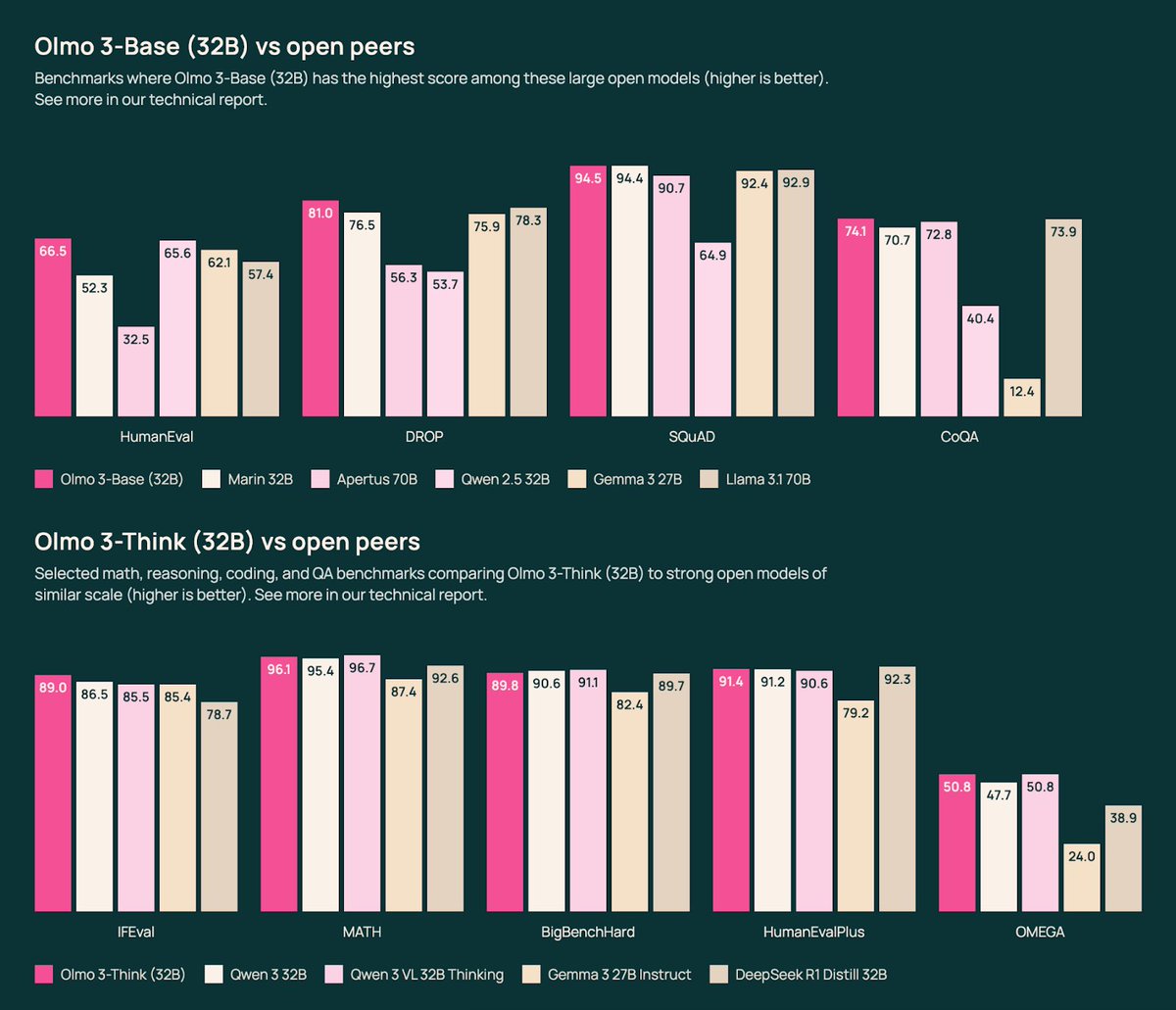
Super excited to release Olmo 3 🦕🐄!
Wild to see my Delta Learning research go all the way from theory-land to becoming a core piece of the world’s best fully open model.
It's good day to be a researcher 🥳

English
Feeling so grateful to have been able to build and learn with such exceptionally kind and talented people. Ai2 is so cracked 🥺
Ai2@allen_ai
Announcing Olmo 3, a leading fully open LM suite built for reasoning, chat, & tool use, and an open model flow—not just the final weights, but the entire training journey. Best fully open 32B reasoning model & best 32B base model. 🧵
English