Simone Arrigoni 🇪🇺🇺🇦

836 posts

Simone Arrigoni 🇪🇺🇺🇦 banner
Simone Arrigoni 🇪🇺🇺🇦

Simone Arrigoni 🇪🇺🇺🇦

@simone_arrigoni

Research Economist at @BanqueDeFrance | PhD @TCDEconomics @IMTCD | Previously @EconomicsUCD @Centralbank_IE @ECB

Paris Katılım Eylül 2019
1.1K Takip Edilen767 Takipçiler
Sabitlenmiş Tweet
Simone Arrigoni 🇪🇺🇺🇦
Simone Arrigoni 🇪🇺🇺🇦@simone_arrigoni·
What an incredible journey the PhD has been! Yesterday I graduated from @TCDDublin and I'm officially Dr. Arrigoni! 🎓☘️ And as this chapter ends, a new one is about to begin. I’m thrilled to share that in September I will be joining the @BanqueDeFrance as a Research Economist!
Simone Arrigoni 🇪🇺🇺🇦 tweet media
English
9
2
88
3.2K
Simone Arrigoni 🇪🇺🇺🇦 retweetledi
Daniele Siena
Daniele Siena@DanieleSiena_·
Stablecoins are macro-relevant and reshape the international monetary system. Our new ECB Working Paper with Massimo Ferrari shows how USD stablecoins create global linkages --changing U.S. monetary policy effectiveness and exposure to foreign shocks. => tinyurl.com/dzva5pxd
English
2
3
13
376
Simone Arrigoni 🇪🇺🇺🇦 retweetledi
Jesús Fernández-Villaverde
Jesús Fernández-Villaverde@JesusFerna7026·
Let me explain why I believe modern economics is such a powerful tool for understanding the world. I’ll do this by discussing a great paper by Simone Cerreia-Vioglio, @UncertainLars, Fabio Maccheroni, and Massimo Marinacci, “Making Decisions Under Model Misspecification,” published in the Review of Economic Studies a few months ago. Imagine I want to drive from UC San Diego to UCLA, but I’ve never driven that route before. I need to build a “model of the world” to guide me, which we usually call a map. Maps are simplified representations of reality. They can’t include every detail if they’re to be useful. Borges, in his short story On Exactitude in Science, makes this point beautifully. (In practice, I don’t draw the map myself—I use an app—but someone still had to make it.) Because maps simplify, I can’t fully rely on them. Maybe last night’s storm knocked down a tree and closed a street, or there’s construction and the ramp off the highway in LA is shut down. This uncertainty matters. Suppose I’m driving to UCLA for an important talk at 11 a.m. If the ramp is closed, I might need 15 extra minutes. When should I set my alarm to arrive on time, while still getting enough sleep to give a good talk? The problem is that I can’t assign precise probabilities to all these contingencies. How likely is the fallen tree? Or new roadwork? Even the best traffic apps can’t capture every disruption, and some might happen after I’ve already left. In economic terms, my “model of the world” (the map) is misspecified—and no matter how hard I try, I can’t fully fix that. But sitting down and crying about misspecification doesn’t answer my basic question: when do I set the alarm? Too early, and I’m exhausted. Too late, and I’m late. Simone and his co-authors offer a way to think about this. They start from the idea that we often hold several structured models of an economic phenomenon, grounded in theory. For example, a central bank might use a standard New Keynesian model and a search-and-matching model of money. Yet, aware that each model is misspecified by design, the bank adds a protective belt of unstructured models—statistical constructs that help it gauge the consequences of misspecification. The beauty of the paper is that it provides an axiomatic foundation for this protective belt (and even generalizes it to include a Bayesian approach). It shows that if a decision-maker’s preferences meet certain conditions —reflecting both rational and behavioral features— then those preferences can be represented by an augmented utility function that formally accounts for misspecification. Crucially, we don’t assume that augmented utility function; we derive it. We start with general, plausible properties of preferences and prove that they imply such a representation. That’s real progress. Instead of writing endless critiques of expected utility or rational expectations (as many have done for decades, with little to show), we now have a formal way to reason about misspecification—precise definitions, clear boundaries of validity, and awareness of what we still don’t know. Take, for instance, a brilliant Penn graduate student on the market, Alfonso Maselli economics.sas.upenn.edu/people/alfonso… His job-market paper pushes this frontier further. He studies cases where a decision-maker not only faces model misspecification but is also unsure which model best fits the data and can’t assign probabilities to them—what we call model ambiguity. In my example, the central bank is unsure whether the New Keynesian or the search-and-matching model fits better, and it worries that both might be incorrect. If you read Simone et al. or Alfonso’s paper, you’ll see how misguided—and, frankly, cartoonish—many of the recent criticisms of economics on X have been. First: the idea that economists don’t understand math or have “physics envy.” The math in these papers is subtle and advanced—utterly different from what physicists do (neither better nor worse, just distinct). An engineer transitioning into economics would find these tools unfamiliar. Second: claims of ideological bias are unfounded. I have no idea about the political views of the authors, and I’d be surprised if anyone could infer them from the analysis—beyond vague guesses about typical academics. Third: This has almost nothing to do with what one learns as an undergraduate, or even in first-year graduate school. If your knowledge of economics stops at an intro textbook, it’s best not to pontificate on the field’s frontiers. Fourth: Is this science? Debating that word’s boundaries is pointless; every definition of “science” breaks down somewhere. The Germans solved this long ago with the idea of Wissenschaft—the systematic pursuit of knowledge, whether of nature, society, or the humanities. By that measure, modern mainstream economics is clearly a Wissenschaft: a disciplined, cumulative, and highly useful effort to understand how the world works. Simone and his co-authors have demonstrated that beyond any reasonable doubt.
Jesús Fernández-Villaverde tweet media
English
43
473
1.8K
344.5K
Simone Arrigoni 🇪🇺🇺🇦
Simone Arrigoni 🇪🇺🇺🇦@simone_arrigoni·
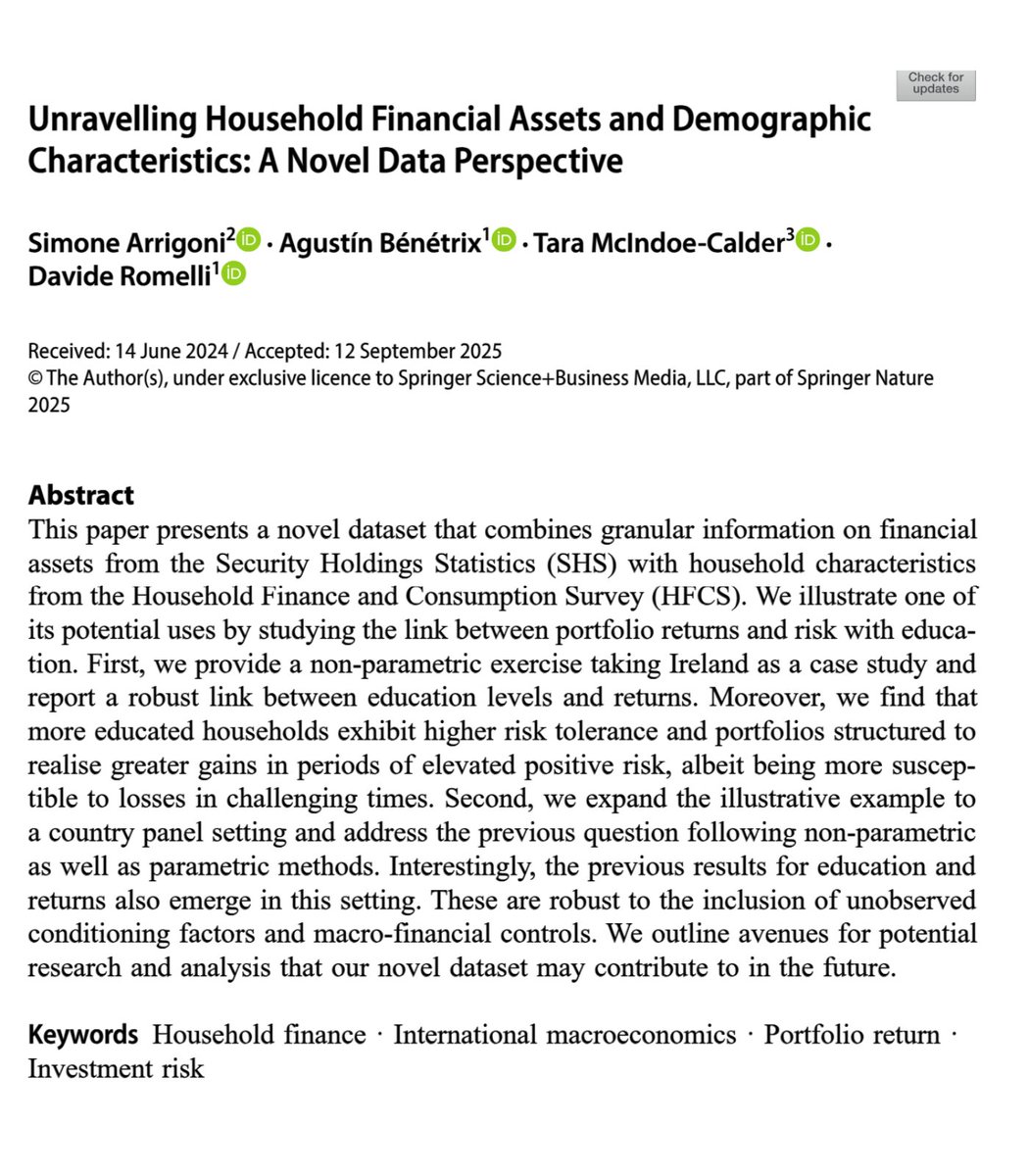
✒️ This dataset and framework enable researchers and policymakers to assess how demographic factors shape household financial decisions, providing insights to promote financial stability and responsible behavior. 5/5
English
0
0
0
32
Simone Arrigoni 🇪🇺🇺🇦
Simone Arrigoni 🇪🇺🇺🇦@simone_arrigoni·
📥 As an illustration of its potential, we use the augmented dataset to examine how education relates to portfolio returns and risk, between and within countries. 4/5
English
1
0
0
35
Simone Arrigoni 🇪🇺🇺🇦 retweetledi
Francesco Barilari
Francesco Barilari@Fra_Barilari·
📢New Publication Alert🚨 Our paper with @d_zambiasi, “Political Rhetoric and Racial Discrimination in Arrests for Drugs”, is now out in the @EJ_RES! We show how presidential rhetoric shaped racial disparities in drug-related arrests in the 1980s–90s. 🧵 A short thread 👇1/6
Francesco Barilari tweet media
English
3
17
67
5.4K
Simone Arrigoni 🇪🇺🇺🇦 retweetledi
Young Irish Economists Seminar Series (YIESS)
It's that time of the year ☘️ Our new Call for Speakers is out! 🚨 If you are a young researcher in Economics and Social Sciences and you would like to present your work to other young researchers based in Ireland, please fill out the form here below! 👇 docs.google.com/forms/d/e/1FAI…
English
0
7
9
857
Simone Arrigoni 🇪🇺🇺🇦 retweetledi
Bruno Pellegrino
Bruno Pellegrino@BPellegrino_CBS·
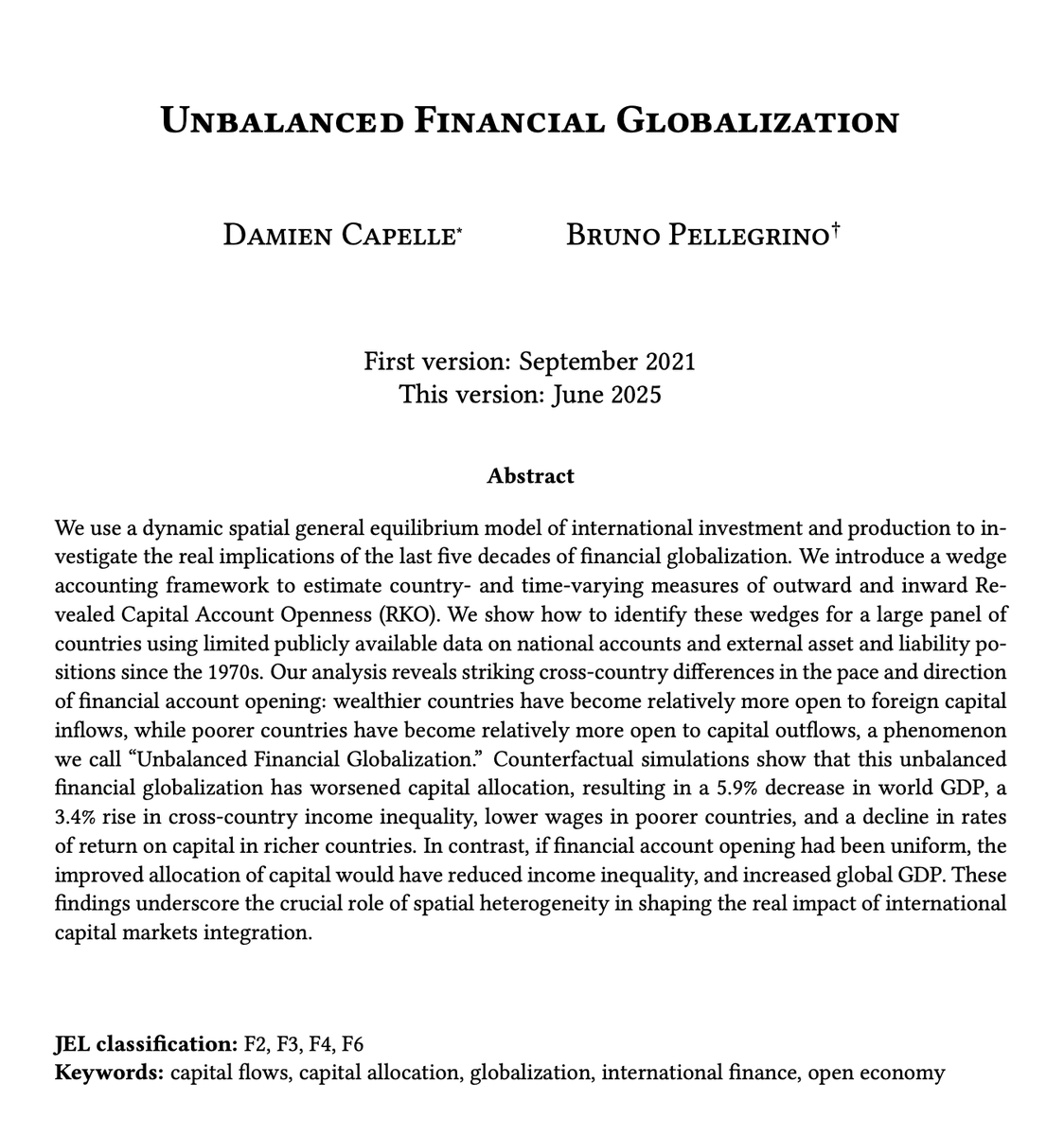
1)📢 Excited to share a new paper with the awesome @DamienCapelle "Unbalanced Financial Globalization" (available on my website - link in bio) We explore how uneven capital account opening since the 1970s reshaped global capital allocation, GDP, and inequality. Thread 👇 #EconTwitter #GlobalFinance
Bruno Pellegrino tweet media
English
1
31
107
13.4K
Simone Arrigoni 🇪🇺🇺🇦 retweetledi
Stefan Schubert
Stefan Schubert@StefanFSchubert·
The fall and rise of inheritance flows
Stefan Schubert tweet media
English
24
104
453
408.3K
Simone Arrigoni 🇪🇺🇺🇦 retweetledi
Young Irish Economists Seminar Series (YIESS)
Another year comes to an end, and so does the 3rd season of YIESS. Join us for the final round! ☘️ Agathe Simon (@ESRIDublin) will present her work on the effects of individualised taxation in Ireland. 📆 June 5th 🕛 6-7 pm 🏦 @TRiSSTCD Seminar Room, Arts Building, 6th floor
Young Irish Economists Seminar Series (YIESS) tweet media
Palermo, Sicily 🇮🇹 English
1
2
7
479
Simone Arrigoni 🇪🇺🇺🇦 retweetledi
Marco Foster
Marco Foster@MarcoFoster_·
If you have never seen this 2013 speech from President Obama on immigration, it’s worth a watch: “A lot of folks forget that most of us used to be them. It’s really important for us to remember our history. Unless you’re one of the first Americans, a Native American, you came from some place else. Somebody brought you”
English
119
2.4K
8.8K
291.9K
Simone Arrigoni 🇪🇺🇺🇦
Simone Arrigoni 🇪🇺🇺🇦@simone_arrigoni·
What an incredible journey the PhD has been! Yesterday I graduated from @TCDDublin and I'm officially Dr. Arrigoni! 🎓☘️ And as this chapter ends, a new one is about to begin. I’m thrilled to share that in September I will be joining the @BanqueDeFrance as a Research Economist!
Simone Arrigoni 🇪🇺🇺🇦 tweet media
English
9
2
88
3.2K
Simone Arrigoni 🇪🇺🇺🇦 retweetledi
Ludwig Straub
Ludwig Straub@ludwigstraub·
New paper on recent US tariffs with Matt Rognlie and @a_auclert Our focus: effects of temporary increases in tariffs (“tariff shocks") Three Qs: 1 Will tariffs lead to a recession? 2 Will they reduce the trade deficit? 3 Why are they not appreciating USD? (as in std theory) 🧵
Ludwig Straub tweet media
English
5
175
614
108.1K