slim jim simons
157 posts

slim jim simons
@slimjimsimons
hyperfixations include the markets and meats.
equinix ny4 Katılım Şubat 2025
42 Takip Edilen106 Takipçiler

@Vedankt @AgustinLebron3 hrt makes more than xtx with neural at this point and it's not close
English

@AgustinLebron3 XTX is the one I always think about with this, I know they r very deep learning heavy and have so many fucking gpus
English


@BeatzXBT - stop trading on a literal potato and buy moar RAM
- stop thinking as % returns and think in dollar pnls (% returns only matter if capacity is >1B)
- use claude code to bear skill issues
good start and good luck!
English

why is everyone saying OpenClaw was a $1B exit?
Jetski Grizzly@Jetskigrizzly
1 man. 84 days. $1B exit. Didn’t even miss a gym day. The future is here
English

@Zerochurn @based16z The moment your IRR beats Founders Fund or Iconiq or Lightspeed, we can talk.
English

You can run an algo on CME commodity futures with 350us tick to trade on a shoestring budget.
1/ +50 us to get the data, with a direct 10G link. $3k/month
2/ +80 us for the feed handler and orderbook feature generation (your code)
3/ +100 us for the decision logic (your code)
4/ +120 us for the pre-trade controls and order routing. $2k/month
This is not particularly competitive, but just flagging that low-ish latency is now feasible at a much lower price point.
English

Theres so much edge in PnL strategy for discretionary traders and I never hear anyone talk about.
- knowing when to stop for the day
- knowing when to press
- understanding what PnL is possible for the current environment
- Knowing when to expand targets and go for the home run
- Size up or down when you are reading the market well
- Sizing down when you are struggling
- understanding how large winning days can affect you psychologically
- the stress of losing days vs the stress of big winning days
Figuring this out was the most difficult part of the journey for me.
English

How do MMs evolve into alpha-driven behemoths? It's fairly natural:
>C tier: market making without an alpha signal
How can I avoid getting picked off? Find alpha, make a model!
>B tier: market making, avoiding bad trades based on an alpha signal.
What if my alpha signal gets so good that I just want to position myself based on it?
>A tier: trading on an alpha signal. Some of these trades might be liquidity-adding, but this isn't the main intention any more.
>S tier: my alpha signal is too good. I have to avoid monetizing it too fast and leaking my intentions into the market before I can size up too much
(Citadel is here).
English

@systematicls > Kaggle GMs. Physics PhD dropouts. Ex-poker pros.
all of these resumes would get an interview lolz
English

ADVERSE SELECTION IN SMALL TRADING FIRMS
Most small trading firms fail to scale because they can't solve a simple economics problem: If [BIG PODSHOP] offers $40mn + $5bn book for top talent, and you offer $1mn + $100mn book, you're priced out of the best traders. So who CAN you hire?
1. People who underpriced themselves -> they leave once they wise up
2. People who aren't worth your bid -> you get adversely selected
The information asymmetry is brutal. Experienced hires always know more about their true probability of success than you do.
This makes hiring experienced talent -EV for small firms. Big shops expand by hiring experienced talent to enter new markets because they can afford the ACTUAL best. You can't. The "best" you can afford is often no better than a fresh trader, sometimes worse because they're stuck in old patterns.
So you pay a premium for "experience" with zero discovery advantage over a grad. This is why most small firms get trapped in their origin market and never achieve escape velocity.
BUT, some firms are solving this brilliantly. Eqvilent is fishing from the Kaggle grandmaster pool for fresh trading talent.
Think about the elegance:
1. Kaggle GMs have PROVEN ability to extract signal from noise
2. They've demonstrated creativity under constraints
3. They're unpriced
4. They have zero bad habits from legacy systems
5. Most importantly, they're SELECTED on the exact skill that matters
They're not hiring "experienced traders" who may have gotten lucky. They're hiring people who've publicly demonstrated they can find alpha in datasets, repeatedly.
This bypasses the adverse selection problem entirely.
Instead of competing with [BIG PODSHOP] for proven PMs/traders, you're building a filtering mechanism that identifies raw talent BEFORE the market prices it correctly.
The smartest small firms aren't trying to outbid the big shops. They're finding orthogonal talent pools where they have an information advantage. Kaggle GMs. Physics PhD dropouts. Ex-poker pros.
People who've demonstrated the cognitive toolkit but haven't been absorbed by the pod economy yet.
The lesson: You can't win by playing the same game as [BIG PODSHOP]. You win by finding talent pools they're not looking at and building the infrastructure to convert raw ability into edge.
English

@0xalpo your example is easily generalizable to "US interest rate in X days", which is most definitely something MMs already have models for (see option markets)
English

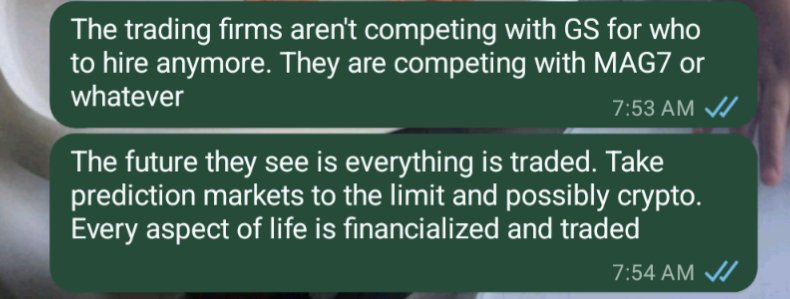
@KrisAbdelmessih @jasoncbuck not mag7, they're competing with openai, anthropic, and deepmind for the brightest quants.
quite hard to do when the frontier labs are paying similar while also selling the vision of solving intelligence once and for all.
English

In response to this mornings letter @jasoncbuck texted me for my take on why prop firms are departing from historical anonymity and posting videos/content
My guess on a long enough timeline is the TAM is huge and they need to keep attracting lots of talent

English

@evanjconrad "growing faster than cursor" is only impressive if your scale is comparable, which it is not
English

What SF Compute does.
When you finance a GPU cluster, you need to get an "offtake" agreement. Basically, someone has to agree to rent the cluster from you, typically for a 3+ year period. If that agreement falls through (the person fails to pay), then the person who owns the cluster gets wiped out, and their lender ends up with a bunch of GPUs, rather than say, money.
It really looks like the world is deploying more capital into the AI build out than any infrastructure project in the history of the world. You remember when people said there was going to be a Manhattan project for AI? The current build out is the size of 20 Manhattan projects. We’re so far past the Manhattan project it’s not even funny. This is the cost of a war.
It would be really bad if that scale of capital was secured against offtake agreements (long term contracts) with application layer companies who turn around and sell to their customers on a month to month basis. If the AI SaaS has a bad few months, can the AI SaaS continue to front their compute bill?
They could in CPUs, because in SaaS you might have a company with $20m in the bank, and has a $1m/year "CPU" bill. But in GPUs, you have a startup that raised $20m, but a $20m+/year compute bill. So a small shift in demand means lights out for your business, because the products are so levered. That works as long as you can plug the gaps with venture capital & high margins. But across the board, AI applications are lower margin than their SaaS counterparts, giving them less buffer to save them in a bad month. And even in a hot market, venture capital won't necessarily save you if you're running unprofitably with a massive liability.
That’s the problem we solve. We let people buy long term contracts they can “exit”, by selling back. That lets them get liquidity in the most critical moments, ensuring they turn a profit rather than a loss on tight margins. In other words, we prevent a bubble.
When we do that, it opens up blocks of compute for smaller use cases too, like academics or startups. When we started, we were "Junelark", a 2-person audio model company that bought too big of a cluster. We had bought 12 months, but could only afford 1 month. To avoid bankruptcy, we had to sublease the other 11 months by acting as GPU brokers. Our audio model company was forced to pivot or die because we didn't have liquidity.
To make SF Compute, we split the company down the middle. One side of the house makes a billing company, a ledger, an order book, and a compliance program. The other side makes a systems engineering company. To make this work, you need to run the clusters. So we make the low level cloud stack that interacts with BMC (Redfish & IPMI), UFM, built a UEFI app that replicates PXE boot in weird environments, and a virtualization layer kind of like EC2. It’s a massively complex machine filled with nitty gritty challenges.
Today, we’re growing faster than Cursor and we’re scaling to secure the risk of the largest infrastructure build out in the history of the world.
We’re hiring across the board for rust programmers, systems engineers, and GTM, and we’d love for you to join us to prevent an AI bubble.
English

“why did a fat man drop off a bomb at our office?”
Beff (e/acc)@beffjezos
Which startup should get the first thermo prototype device shipment? 👀📦

English

@MovieTimeDev calling it “sentiment arbitrage” is certainly one way to out yourself as a larp
English

When I started my fund in summer 2021, my goal was to establish a strong enough five year record that I could raise institutional money and have a “real fund.” Now that I’m four years into the venture, I’ve achieved the track record and lost the desire to raise institutional money.
Has anyone else experienced this? Why do folks even bother seeking institutional money? Is this a shortfall of ambition on my part? Is it a triumph of wisdom over ego? Is it both?
Some reflections:
1) It is a hell of a lot easier to both handle the logistics of a fund and generate outsized returns when you are running a small amount of money (we can debate whether that is under 10mm, under 25mm)
2) It feels really good to run the money “like it is your money” because a major portion of it is actually your money (for me ~25%)
3) It feels amazing to only have a couple of LPs and have them be close friends and allies who signed up wholeheartedly for the above
4) If you compound at 25-50% gross for many years, you end up making so much money on your own LP stake that the fees are really inconsequential by comparison.
What am I giving up?
1) I guess some ego and status stuff?
2) A good year for me is measured in personal rewards in the seven rather than eight figures
3) I don’t get invited to conferences or get good service from providers. I don’t even have a “real” prime broker.
I don’t know. It seems like a decent balance and I love the fact that I don’t have to pretend to be interested in the nonsense that institutional investors and allocators spout. Every time I read posts on here like the original thread from @orrdavid (no personal offense intended) about that game, I just think to myself that I’m glad I don’t have to pretend to take that stuff seriously.
2500cap@2500capital
I agree. I’m confused by these takes. If you are compounding at that type of rate, you end up with more than enough personal wealth almost no matter what you do. Why would anyone who is truly tripling their money every three years be willing to deal with nonsense just to run more money? It seems like a triumph of ego over wisdom.
English

@alyssakrejmas orrrr they are asking these questions to see if y’all have any common ground to riff on
English

@rak_garg if you’re the child of a wealthy new yorker, the hamptons are your very exclusive summer camp. all your childhood homies, frenemies, and crushes are there every summer like clockwork. kinda brilliant.
English

@nic_carter what makes you think capital will be worth anything?
English