

@KyivIndependent Ukrainian propaganda is horrible
first Russia is weak and falling apart so they want Europe to negotiate
Now ur saying Russia doesnt want any peace talks or they wont even engage in peace talks
real sloppy fellas
English
Rex Bourne 🇺🇸🦅
18K posts

@stationd5
geopolitics. death before dishonor 👹




We’re calling it: The war in Ukraine has entered a new phase. @KatStepanenko and I have authored a new special report studying how Ukraine is actively challenging the positional character of the war that has dominated the battlefield since 2023. Data on Russia’s battlefield performance indicates that the character of the war is shifting in favor of Ukrainian forces – at least for now. Russian forces rates of advances are stagnating while Ukrainian forces are employing novel tactics and operational concepts in efforts to break out of positional warfare. Neither Russia nor Ukraine can conduct operational maneuvers yet, however. The bottom line is that the war in Ukraine is competitive and far from stalemated. Ukrainian forces are out-innovating Russian forces in both military technologies and in applying these new technologies in effective operational concepts that can help Ukrainian forces break out of positional warfare. Ukraine is employing mechanized equipment in tactical maneuvers in ways that were impossible 12 months ago. Russia’s ability to conduct infiltration missions will likely continue to degrade as Ukraine’s intermediate-range strike campaign pushes Russia’s logistics and forward operating bases further away from the frontlines, reducing resourcing to sustain infantry tasked with infiltration missions. Ukraine may be able to scale these effects if they resourced properly by international partners. Ukraine’s advantage in intermediate range strikes is notably not permanent, and Russia will very likely eventually develop countermeasures to mitigate Ukraine’s advantages. Ukraine’s international partners thus have a rare and temporary opportunity to help Ukraine exploit favorable battlefield dynamics while Ukraine has the upper hand. Key Points of the report: • Russia’s rate of advance is plummeting during the Russian Spring-Summer 2026 offensive. • Russia is losing more soldiers to make fewer gains, with monthly Russian casualty rates reportedly outpacing monthly recruitment since December 2025. • Ukraine is starting to regain more ground than it is losing for the first time since 2023. • Ukraine’ recent counterattacks feature unique characteristics and deviate from key trends that defined the positional character of the war since 2023. • Ukraine is conducting a pattern of more frequent mechanized counterattacks at the tactical level for the first time since 2023. • The Ukrainian command’s operational planning is maturing. • Ukraine’s early 2026 counterattacks in the south were successful likely due to better planning and preparation of the battlefield. • Ukraine has been conducting a coherent campaign to suppress and destroy Russian air defenses since late 2025, in order to shape the battlefield as part of more sophisticated campaign planning. • Ukraine significantly intensified its intermediate-range strike campaign against dynamic targets in Spring 2026 in order to degrade Russian logistics at operational depths ahead of planned Ukrainian maneuver. • Ukrainian forces started actively disrupting Russian railway logistics in occupied Ukraine and Russian western regions in Spring 2026. • Ukrainian intermediate-range strikes are already achieving notable operational effects, including degrading Russia's ability to use the key Russian highway connecting Russia to occupied Crimea and GLOCs around Donetsk City. • Ukrainian forces decisively seized the initiative in intermediate-range strikes by fielding new technologies such as the US-made Hornet strike UAV, among other systems. • Ukrainian forces are achieving temporary tactical drone overmatch in some frontline sectors, which is slowing Russian offensive operations by degrading the effectiveness of Russian shaping operations. • Ukrainian forces likely achieved tactical drone overmatch in certain frontline sectors after degrading Russia’s drone capabilities in late 2025 to early 2026 - primarily by suppressing drone launch positions and increasingly intercepting Russian tactical UAVs. • Ukraine’s degradation of Russian forces at operational depth combined with tactical-level drone overmatch likely is creating vulnerabilities in the Russian lines. • Ukraine’s intermediate-range strike campaign is likely far from its zenith, assuming continued support from Ukraine’s partners, and will likely intensify over 2026 as Ukraine fields new weapons capable of striking Russian’s operational rear. Link to full report: understandingwar.org/research/russi…


The Ukrainian patriot is becoming a deadly threat for Ukrainian civilians. When you see the odd house or store hit consider the fact that PACs are slamming.



NEW: SPECIAL REPORT | Ukraine is actively challenging the positional character of the war that has dominated the battlefield since 2023. Russian battlefield gains are approaching net zero while Ukrainian forces are setting conditions potentially to break out of positional warfare by reintroducing limited elements of mechanized maneuver at the tactical level. Ukraine has re-secured an overall drone advantage and fielded systems capable of disrupting Russian forces throughout their operational depth in support of planned Ukrainian offensive or defensive ground operations. Neither Russia nor Ukraine is able to conduct operational maneuver yet, however. Ukraine’s success in blunting Russian advances and reversing Russian gains in some sectors of the line, in tandem with Ukraine’s limited reintroduction of elements of tactical mechanized maneuver may nevertheless mark the beginning of a new phase of the war. Combat in Ukraine will likely become less positional and feature more tactical maneuver until Russia’s innovation cycle renders Ukraine’s current operational concepts ineffective. Ukraine likely has a unique and time-constrained opportunity to exploit its current initiative while Russian forces remain vulnerable. Ukraine’s partners should expand their support to these Ukrainian efforts at a moment when Russia is reeling from both battlefield setbacks and Ukraine’s deep strike campaign with the aim of forcing Russian President Vladimir Putin to reevaluate his approach to this conflict.

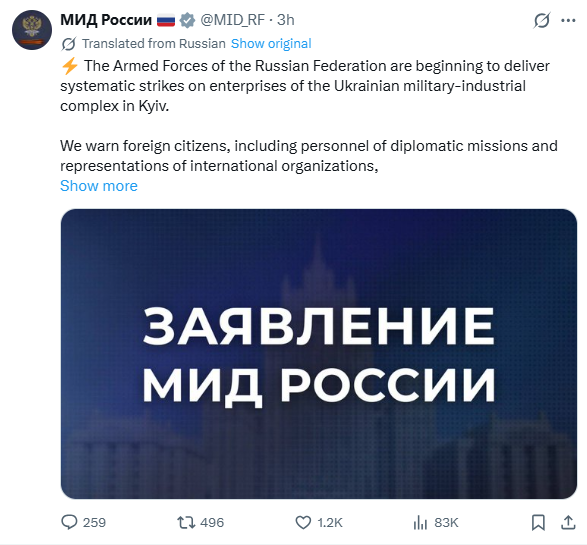
UPDATE: The Kremlin has threatened to systematically strike Kyiv, including government buildings, in violation of the spirit of the US-brokered Victory Day ceasefire. Intensified Russian strikes on Kyiv are likely meant to show Russia’s supposed strength in the face of the failures of Russia’s Spring-Summer offensive. Putin also continues to try to recover from the humiliation of having to beg Ukraine for permission to hold a Victory Day parade. Russian missile and drone attacks on Kyiv will not offset Ukraine’s edge on the battlefield, resulting from an increased overall drone advantage and an intensified campaign of intermediate-range strikes. The Russian Foreign Ministry (MFA) released a warning on May 25 stating Russia’s intent to launch a “systematic series of strikes” against Ukrainian defense industrial and drone production facilities, decision-making centers, and headquarters. The Russian MFA urged foreign citizens, diplomats, and NGOs to evacuate Kyiv as soon as possible, and warned Kyiv residents to avoid military and government infrastructure in the city. This warning shows that another purpose of these Russian strikes is to isolate Ukraine from its international partners. Russia is likely planning to conduct large-scale missile and drone strikes because Ukraine has re-secured an overall drone advantage on the battlefield, causing Russian battlefield gains to flatline amidst the Summer 2026 offensive. The Kremlin is trying to recover from Putin’s humiliation from having to ask Ukraine for permission to hold the Victory Day parade and to distract from his inability to shield the Russian population from the growing cost of his war, including Ukrainian long-range drone strikes. Putin is also trying to exploit Ukraine’s shortage of air Patriot defense interceptors capable of intercepting ballistic missiles. Russia will continue to resort to large-scale missile and drone strikes to conceal its weakness. The Russian threat – and the May 23-24 Russian combined missile, drone, and Oreshnik intermediate-range ballistic missile (IRBM) strike, which heavily targeted Kyiv City – violates the spirit of the three-day Victory Day ceasefire, in which Putin agreed that Russian forces would not strike government centers in Kyiv with large strike packages if Ukraine allowed Russia to hold a parade on Red Square. Ukraine abided by the agreement and allowed Putin to hold a parade. Russia’s decision to conduct devastating strikes against Kyiv in the weeks following the parade, all the same, demonstrates Putin’s unfaithfulness to any agreements that do not heavily favor him.


