
Stu Willson

7.6K posts

Stu Willson banner
Stu Willson

Stu Willson

@stuartawillson

AI decision support for private equity, midmarket, & enterprise leaders. Founder https://t.co/di8BQG67jv / Host https://t.co/Wx5VpnzKLB

Santa Monica Katılım Eylül 2008
3.4K Takip Edilen1.3K Takipçiler
Sabitlenmiş Tweet
Stu Willson
Stu Willson@stuartawillson·
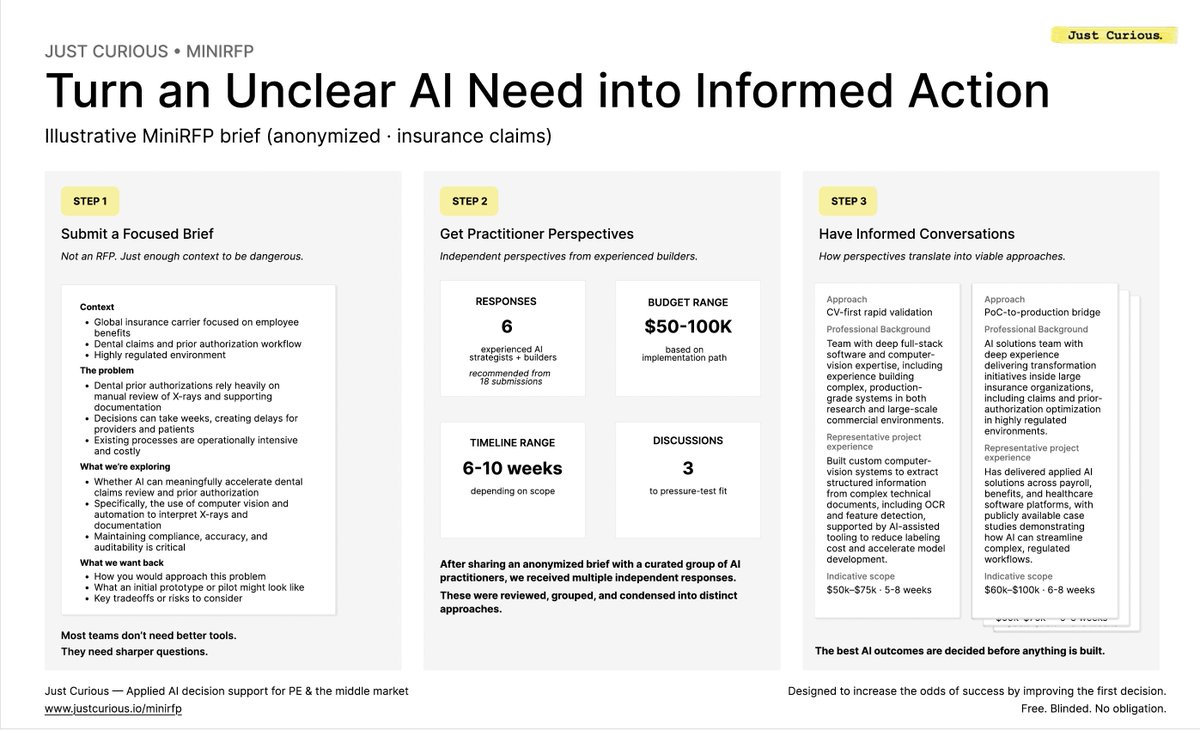
For the last couple years, I’ve been obsessed with a pretty simple question: Why is it still so hard for great investors and operators to make good decisions about AI? Not use AI. Not adopt AI. Not demo AI. But create value from AI. Why is it so hard to decide what actually matters, where to start, and who to trust when real money, teams, and outcomes are on the line. What I kept seeing: Most leaders know AI matters, but don’t have the time, talent, or internal conviction to figure it out themselves. Their existing partners aren’t set up to help. Too expensive, too slow, or selling tools instead of outcomes. And the cost of getting it wrong (or doing nothing) keeps going up. Guys, trust me, it may be early, but we’ve seen this movie before. The companies that are ahead are going to move further ahead. And the companies that are behind are never going to catchup. So I started @bejustcurious as a project to try to solve that. I began by meeting experts and practitioners—the people actually building and shipping AI systems in real businesses. Since January 2025, I’ve: > Met 400+ applied AI and data experts > Interviewed 100+ of them (they’re all public—go take a look) > Started connecting them directly with operators and founders to pursue real work (the first being @justinmassa and the team at @redantler ) Along the way, something interesting happened. More and more PE firms and middle-market companies started reaching out with very practical questions: Is this the right AI project to pursue? What’s the right approach? And can you help us find someone who’s actually done this before? That’s when I kinda realized: There’s a real opportunity here to help organizations make better decisions and find better partners. But being a content site with a service marketplace bolted on was confusing. Like... what kind of business is this? Is this a business? What people actually wanted was clarity and conviction before committing. So we’re relaunching Just Curious as something much simpler: A decision-support platform for leaders making high-stakes AI decisions. In plain English: we help you figure out what to do, how to do it, and who should do it, before you commit real time, money, and credibility. We’ve built what I believe is the world’s leading network of applied AI and data experts—strategists, builders, and operators who know how to go from idea to impact. This isn’t just strategy. And it’s not just implementation. These are people who help identify and prioritize the right opportunities, design the right approach, and build solutions—lightweight or full-stack—that actually ship. They use custom software, automation, and AI to collapse costs, accelerate time to value, and scale what works. They’ve worked across the full value chain, from sales and the Office of the CMO, to finance and the Office of the CFO, and everything in between. Want to build a custom quoting engine? We’ve got you covered. Want to identify where AI will actually move the needle inside your org, and deploy it? Got you. Want to use generative AI and computer vision to reduce the cost of medical claims processing? Yes, got you. Want an AI strategist to help your team build a real roadmap, not a slide deck? Still got you. And, there are many more. These are organizations who can help you: > choose the right approach (not just a shiny one) > pressure-test assumptions > avoid dead-end pilots > and actually create value at scale (while making you look very good internally) How? We offer a free Just Curious Mini-RFP. It’s a tight, 4-step process that helps you: > Clarify the real problem > Pressure-test approaches with people who’ve done it before > Understand scope, tradeoffs, and realistic budgets > Identify the right partners, before you commit No fees. No sales pressure. No obligation. If you’re staring down critical AI decisions in 2026, we’ll help you make sure they’re the right ones, and that they actually work. Curious? Great. That’s the point.
Stu Willson tweet media
English
1
1
4
541
Stu Willson
Stu Willson@stuartawillson·
@JasonrShuman Anyone who’s tried solving real problems with ai knows it won’t and can’t be bought like software, including the model companies themselves. Add custom and bespoke software unlocked by ai and the implementation market over the next 5-10 years will be enormous.
English
0
0
0
10
Jason Shuman
Jason Shuman@JasonrShuman·
Silicon Valley thinks AI agents are a $20/mo self-serve subscription. Main Street is paying local agencies $10,000 just to turn them on. Everyone assumes AI will be bought primarily online like Slack or Zoom. I think they are wrong. Some of the biggest winners in the AI boom won't be the software vendors. It will be the humans installing it. Here is the reality of SMBs right now: • 54% lack internal AI expertise. • 41% have data quality too poor for AI to even work. • 41% already prefer buying AI through a local IT provider. You cannot "1-click install" a genius AI into a messy CRM or a 15-year-old server. It will just execute the wrong tasks at the speed of light. The AI software will be cheap and a lot will absolutely be bought online. Making it actually work for a messy, real-world business will be expensive. Very bullish on the "Do It For Me" economy being back.
English
83
26
501
59.7K
Stu Willson
Stu Willson@stuartawillson·
Here's a question we'll dig into on April 3: "When does it make more sense to build your own monitoring system than to buy a platform?" Three years ago, the answer was almost always: buy. The economics of custom software didn't make sense for most firms. That math is changing. And fast! AI has fundamentally changed what it costs to build, and how long it takes. Joe Zein, Co-Founder of Soal Labs, works with GPs to modernize their operating model and build the data and AI systems that bring it to life. His perspective on what AI has done to the build vs. buy calculus is genuinely worth hearing. → Yann Magnan, CEO & Co-Founder, 73 Strings → Joe Zein, Co-Founder, Soal Labs → Stu Willson (me), Founder, Pluris — moderating April 3 | 12:00 PM ET | ~45 min Register here: lnkd.in/gYbifgsi
Stu Willson tweet media
English
1
0
1
202
Stu Willson
Stu Willson@stuartawillson·
A 70-year-old manufacturing company came to Remix Partners stuck. (This, a case study, is the last in my series of posts with Justin Massa and Jason Rubinstein of Remix Partners) 40,000 SKUs. Custom parts ranging from 5 units to 5,000. A 48-hour RFQ turnaround target they almost never hit. Endless back-and-forth with customers. A legacy software system that required someone to manually re-type outputs into another system before anything could advance. Their team had already done serious work. They'd built their own AI tools, with multiple team members fully bought in. But they'd hit the wall of what they could do without software engineering help. In 3.5 weeks, Remix built a Claude Code workbench that: → Receives an incoming RFQ → Compares it against every part this company has ever made → Generates a draft bill of materials → Produces a price to send to the customer → Creates a first-pass manufacturing drawing for the production line The unlock was converting the output of a 40-year-old legacy software system to JSON. That one step made 40,000 parts usable as context. The CEO's goal isn't just to automate existing volume. It's to double or triple revenue without adding headcount — and eventually phase out major software subscriptions the new system makes redundant. Justin calls it surfing the edge of capability improvement. Spotify link below.
English
1
0
0
62
Jesse Pujji
Jesse Pujji@jspujji·
My companies close $20M/year on 30-minute Zoom calls. I had an ex-McKinsey consultant reverse-engineer exactly how: – Sales call recordings – Sales scripts – Lead gen systems Reply with “GA” and I'll DM you the copy. Free.
English
581
15
333
47K
Todd Saunders
Todd Saunders@toddsaunders·
This weekend was crazy. On Friday I teased out what I’ve been working on under a code name “blue collar builders.” Within 48 hours, 207 blue collar builders who use Claude Code reached out wanting help turning their projects into real startups. it’s wild. There are more blue collar domain experts building software right now than at any point in history. It’s not even close. Claude Code gave them the ability to build. But nobody (yet) is giving them the infrastructure to scale. Luckily, I’ve seen this play out before. We built Broadlume through 8 acquisitions, and each deal followed the same exact pattern. - 2x flooring retailers who started website companies. - A flooring distributor who built an ERP. - A flooring retailer who built an inventory tool. - A flooring retailer who created a CRM. - An industry insider who built a visualizer. - A flooring retailer who inadvertently built the largest directory site. - A flooring territory manager who wrote the leading news site for homeowners. They were all domain experts who couldn’t help but build software because nothing existed for them….. and those were all pre-AI! Now multiply that by every blue collar industry in the country, grow the number of builders exponentially and compress the timeline and cost to build dramatically. That’s what’s happening right now. And nobody has built the infrastructure for it. Claude Code just made the inevitable faster than I could have ever imagined. The future of vertical software belongs to domain experts and blue collar. And I’m to be a part of it.
English
41
7
219
16.7K
sarah guo
sarah guo@saranormous·
any nontechnical folks want to get more comfortable/powerful in their use of AI and want to be a beta user on something I made?
English
557
23
896
101K
Stu Willson
Stu Willson@stuartawillson·
@joeybeastmarket Most underappreciated album of the 90s, partly due to its commercial success.
English
0
0
1
358
Moongazer
Moongazer@joeybeastmarket·
I would like to write a longpost articlepost about how deeply this album has impacted me and how strongly I feel it is one of the greatest musical feats ever created and how it defines what it means to be an American. Is that okay?
Moongazer tweet media
English
252
74
1.7K
99.1K
Stu Willson retweetledi
Jonny Mitchell
Jonny Mitchell@jonnyrmitch·
Nirvana - Breed (Live at Paramount in Seattle, 1991) Such a powerful sound!
English
6
154
616
14.5K
Stu Willson retweetledi
Austen Allred
Austen Allred@Austen·
My friend runs a small business and has been asking me how to best use AI to make an impact on his business. I had @KellyClaudeAI do a ton of research and build a detailed playbook anyone can follow. It’s 338 pages broken down into sections. You can download it free.
Austen Allred tweet media
English
18
17
216
35.2K
Stu Willson
Stu Willson@stuartawillson·
Two biggest problems standing in the way of companies and value creation from AI are both simple but not easy: 1. People simply don’t know what to do with the technology, what problems it’s best suited to solve, and where within their organizations are the greatest opportunities. Their minds simple need to be opened and expanded. They need to be introduced to the art of the possible. 2. They don’t have the talent or time to capitalize on what they learn. While the cost to build has declined 50-90% and the time to value has accelerated massively, it requires skilled / highly skilled engineers paired with copilots and an operating system that converts effort into output and into learning. Unfortunately that doesn’t exist is 90%+ of companies. Fear not, there’s an emerging ecosystem of folks who can plug in here. And they are highly skilled.
English
0
0
1
119
Luke Pierce
Luke Pierce@lukepierceops·
Anthropic and OpenAI are both building PE-backed consulting arms to deploy AI inside companies. Let that sink in for a second. The two companies building the most powerful AI on earth looked at the market and said "businesses can't figure out how to use this. We need to go in and do it for them." They are literally telling you where the gap is. Companies have access to the best AI models ever built. And most of them are still running on spreadsheets, disconnected tools, and manual processes because nobody showed them how to actually implement it. That's the whole game right now. Not building better models (obviously) or shipping new features. IMPLEMENTATION. Getting AI inside real workflows. Mapping the processes, building the systems, and making it stick. I've been doing exactly this for 4 years and have worked with 80+ companies at this point. It started with automation and naturally flowed into Ai. And every single engagement starts the same way. Not with AI or automation but with a process map. Because AI alone won't fix broken operations. Companies now understand that. They have not yet seen true ROI from Ai. You have to understand how the business actually runs before you touch a single tool. Where does the data live? Where are the bottlenecks? What's manual that shouldn't be? What breaks when volume goes up? That's the work, and that's what Anthropic and OpenAI just told the entire market is worth billions. Every company is going AI-first over the next 3-5 years. The demand for people who can actually make that happen is about to be unlike anything we've seen. The labs told you where the gaps are. Now go fill them.
Luke Pierce tweet media
English
140
192
2.2K
351.2K
Stu Willson
Stu Willson@stuartawillson·
@buccocapital 100% this is a misinterpretation by people who don't know the capabilities of Claude Code / Cowork / etc. I've heard a bunch of stories about CRMs and ERPs being replaced in smaller orgs with bespoke solutions that can better integrate into various agentic options but not this.
English
0
0
1
524
BuccoCapital Bloke
BuccoCapital Bloke@buccocapital·
I would be so so so curious to meet the guy willing to put his career on the line by ripping out SAP to replace it with Claude I would also like to know if this is a public company so I can short it
diego77@diego77du

Cleveland research report....Anthropic is emerging as a competitive threat for SAP and enterprise apps more broadly. See potential for our signings growth to flatten out as a result. Our clients are closely evaluating Anthropic as we speak and reconsidering their 9-figure SAP investment.

English
45
26
811
116K
Stu Willson
Stu Willson@stuartawillson·
"I don't have time to do the thing that saves me time." Justin Massa hears this multiple times a week. Sometimes multiple times a day. At companies from 10 people to Fortune 25. It's the single biggest obstacle to AI adoption at every size. In this clip, Jason Rubinstein and Justin break down what actually drives success across org sizes: It's not about CEO involvement specifically. It's about the champion, whoever has the authority to do two things: 1. Set a mandate. Make it clear this is the priority. 2. Free up time. Actually clear it from people's plates. At the Fortune 25 level, that's a VP with a multi-billion dollar P&L. At an SMB, it's the founder. The level doesn't matter. The authority and the commitment do. "Whether it's a Fortune 25, a middle market company, or your friendly neighborhood SMB, it's really about the stakeholder who has the authority to empower and unlock this capability for their teams." The good news: the investment is short. Usually within two weeks, it becomes obvious it's paying off. But you need the initial catalyst first, someone willing to say, "I know your plate is full. This is the priority. I'm paying attention." Without that person? It doesn't go well.
English
1
0
0
37
Stu Willson
Stu Willson@stuartawillson·
@stevesi Being in high school in Seattle from 91-94 and into music was the absolute BEST.
English
0
0
3
338
Steven Sinofsky
Steven Sinofsky@stevesi·
Saw this insta post on the “what were you like in the 90s”. Seattle edition. (Unsure of OP)
English
56
89
808
57.2K
Stu Willson
Stu Willson@stuartawillson·
@businessbarista @nazzari feels like if you need to send a reminder then you're burning that hour anyway. what's worse, they don't show up and you can get some busywork done or they show up after you prompt them and you find out they're kinda person who needs a reminder to show up for an interview?
English
0
0
0
17
Alex Lieberman
Alex Lieberman@businessbarista·
I'm sort of baffled. I've been spending 30 hours a week interviewing strategists & engineers. Probably 20% of candidates never show up for the call. Is this a generational thing? Is it just that people are poor communicators? Imo, nothing more entitled than no showing to a job interview.
English
109
2
173
29.4K
Stu Willson
Stu Willson@stuartawillson·
A year ago, most business leaders were curious about AI. Today, they're urgent. Justin Massa and Jason Rubinstein's read on what changed in the last 12 months: Personal AI got dramatically better. People are frustrated that the tools they use at work don't match. They're looking for a better path. Secret cyborgs emerged. Employees quietly became significantly more productive. Managers didn't understand how. That tension is now a forcing function for leadership, and it's showing up everywhere. Models crossed a threshold. A year or so ago, when an AI session went sideways, you had to kill it and start over. Now you can rescue most sessions. Pull them back, realign them with your intent, keep going. "We went from a world of compounding problems to compounding solutions." This year is genuinely agentic. Last year was agent-ish — linear workflow builders trying to do things the technology couldn't quite do yet. Now it can. The combination of stronger models and better tooling has changed what's actually possible. A lot of leaders who said "not right now, let's stay in touch" a year ago are now calling back. Urgently. Justin's take: the tidal wave hasn't crested yet.
English
1
0
1
63