Sabitlenmiş Tweet
Michael | Sweepbase
513 posts

Michael | Sweepbase
@sweepbaseHQ
Founder of Sweepbase. Indexed 141 crypto cards, audited every fee. DeFi farmer when the APR makes sense. Stablecoins + self-custody guy.
Europe Katılım Aralık 2010
275 Takip Edilen72 Takipçiler

x402 + AP2 cover agent→onchain-merchant. What covers agent→Walmart-checkout when the merchant doesn't speak any protocol?
Today: stablecoin wallet → crypto debit card → Visa rail → merchant. Same pipe consumers use.
Cards end up the fallback agent rail at non-integrated merchants. Stays that way until protocol coverage hits scale.
English

Agentic Commerce beyond crypto
Ever since, Agentic Commerce narrative is moving fast and feels like one of the strongest bridges between AI and crypto right now.
I see it as the shift from humans clicking "buy" to autonomous AI agents handling discovery, negotiation, decision-making, and execution end-to-end.
Agents get smart wallets with stablecoins, use open protocols, and transact machine-to-machine without constant human approval.
Crypto's permissionless rails, instant settlement, and micropayment economics make this viable in ways TradFi struggles with.
That said, Agentic Commerce is beyond crypto by far, and it’s trending because of AI is inevitable.
So I decided to look at the bigger picture, expanding to TradFi and I found clear leaders by adoption and momentum:
[1] x402 | @coinbase + @Cloudflare + Foundation
This is the only crypto-native star. Revives HTTP 402 for pay-per-use.
Agent hits a resource → gets 402 with pricing → pays stablecoins instantly onchain → access granted. Super lightweight, no accounts needed.
Early traction shows tens/hundreds of millions of txns already, Agent Market app store, integrations with data providers like CoinGecko, inference, content.
Perfect for micropayments, APIs, and machine-to-machine. Low friction makes it a favorite for onchain agents. This is my top pick for pure crypto/agent economies.
[2] ACP | Agentic Commerce Protocol - @OpenAI + @stripe
This sector focuses on structured checkout flows. Agents discover products, build carts, and complete purchases via shared payment tokens.
Open standard, powers ChatGPT experiences such as Instant Checkout/app-based.
Live with @Etsy, @Shopify merchants with such Glossier, SKIMS etc., expanding.
Strong on the consumer discovery-to-purchase side but saw some pivot from full in-chat checkout. Still very active via Stripe's eco.
[3] UCP | Universal Commerce Protocol - @Google + @Shopify
Merchant-hosted discovery and orchestration. Agents find catalogs, carts, real-time inventory/pricing. More decentralized merchant side.
Gaining fast with Google's search/Gemini reach, major retailers such as Walmart, Target, Wayfair.
Dual support with ACP on platforms like Shopify. Strong for broader web integration.
[4] MCP | Model Context Protocol - @AnthropicAI + ecosystem
I believe this is not pure commerce but the "context layer" enabler.
Standardizes how agents connect to tools, data, APIs securely. Many commerce flows build on top of MCP servers.
Widely adopted as the plumbing for agent capabilities. High developer momentum.
[5] AP2 | Agent Payments Protocol - Google + networks
Handles intent mandates, authorization, and audit trails for delegated payments.
Agents get bounded authority e.g., spend limits. Supports both card and crypto extensions incl. x402.
Backed by big coalitions, growing in production for verifiable agent actions.
[6] Agentic Frameworks
Not a single protocol but the infra layer.
→ Coinbase AgentKit for building agents that handle x402 payments and onchain actions.
→ @virtuals_io tokenized agents with Agent Commerce Protocol elements. High aGDP already.
→ @NEARProtocol's agentic architecture: Fast finality and intent-based flows for commerce.
[7] Other notables:
→ A2A | Agent-to-Agent: For direct agent coordination and collaboration.
→ MPP | Machine Payments Protocol: Stripe/@tempo enterprise play for machine payments.
→ @Visa /Mastercard agent frameworks, regional ones like Ant's AMP.
This stack is what turns AI into economic actors. I'm bullish on protocols with strong stablecoin/onchain ties, they align perfectly with the rest of the narratives I'm watching.

English

Strong thesis on rate management as mandatory infra. The downstream connection worth adding: yield-bearing cards (@ether_fi , BUIDL-based, USDY-backed) currently expose holders to floating yield. Pendle PTs let card issuers offer FIXED yield on stablecoin balances — onchain rate management becomes mandatory partly because consumer products downstream need predictability.
English

Calling $PENDLE a yield farm is like calling the bond market a savings account.
It completely misses the point.
In TradFi, rate markets are some of the largest markets on earth. BIS had global OTC derivatives at ~$846T notional in mid-2025, and interest-rate derivatives made up ~79% of that. Not because everyone is chasing APY, but because every serious institution needs to manage yield, duration, floating-rate exposure and future cash flow.
That is the real Pendle thesis.
Pendle lets onchain capital split, trade, hedge and lock future yield. A DAO treasury, stablecoin protocol, fund, or onchain company earning elevated yield today can effectively put a stamp in time when rates are attractive instead of just hoping next month’s yield holds.
That turns yield from passive APY into a balance sheet tool.
As stablecoins, RWAs, tokenized treasuries, credit markets and yield-bearing assets grow onchain, rate management becomes mandatory infrastructure. Some users will want fixed yield. Some will want leveraged yield. Some will want to hedge. Some will want to speculate on where rates go next.
TradFi already proved this market becomes massive when capital markets mature.
Pendle is building the onchain rate market before most crypto people even understand why it matters.
English

The diagram has merchant + P2P payments but skips the consumer card rail — which is the on-ramp from stablecoin holding to fiat-merchant spend. End-to-end without that layer leaves the actual consumer flow undefined. Where stablecoins meet real spending is still cards, and that's a different competitive landscape.
English

The future of stablecoins will not be defined by issuance alone.
It will be defined by infrastructure
The next generation of digital payment architecture is converging:
- stablecoins
- banking rails
- compliance systems
- DeFi connectivity
- real-time settlement
- institutional governance
A compliant digital money stack now includes:
- onboarding + collateral verification
- token issuance and redemption
- multi-chain circulation
- AML/KYC + regulatory reporting
- banking + escrow integration
- merchant + P2P payments
- automated audit trails
The important shift:
Stablecoins are evolving from standalone crypto assets into regulated financial operating infrastructure.
The winners likely won’t just issue tokens.
They’ll control:
- settlement coordination
- compliance orchestration
- liquidity routing
- banking connectivity
- cross-chain interoperability

English

@BasedOneX Real flow under the hood: token → backend swap to USDC at swipe → Visa settles fiat. "No swaps" is true from the user UI, not the ledger. For memecoin holders this still wins on UX vs manual off-ramp. Open question is whether forced sell-at-swipe beats hold-and-time exits.
English

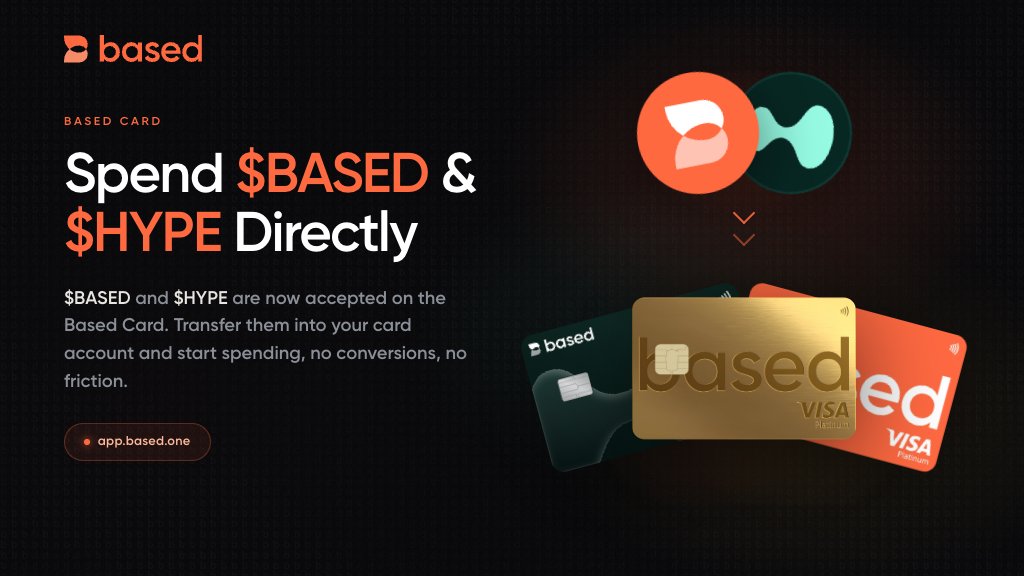
Your $BASED and $HYPE are now spendable.
Both tokens are accepted directly on Based Cards. Move them into your card account and spend them anywhere, no swaps, no off-ramp, no friction.
Holding the token and using it are no longer two separate things.
Cards: based.one/cards
The future is Based.

English

@wirexapp BaaS-side FX savings is the right pitch. The question for end-users: pass-through rate. If dual-settlement saves the issuer $1M/yr, how much hits the cardholder vs widens the issuer's spread? That's where the consumer-card moat actually shows.
English

Most infrastructure still settles in one stablecoin.
Wirex BaaS is the only infrastructure that settles natively in both $USDC and $EURC, helping partners cut the 2-3% FX cost that can sit inside cross-currency flows.
Direct principal membership with both Visa and Mastercard adds another layer to that advantage.
That is infrastructure built for scale.

English

@boredinvesting_ @Plasma Utility bills are the smart crypto-card play — high ticket, predictable, cashback density without daily-spend friction. $88 back on a Rogers bill is a quiet flex. What does Platinum tier add on top? Bump the cashback or new categories?
English

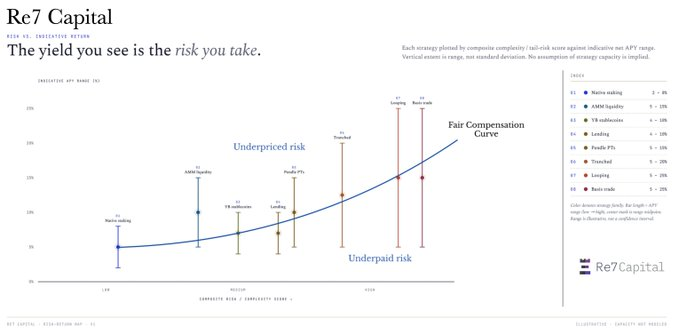
@LowBeta @Re7Capital Missing dimension: spend-friction. Native staking and RWA stables (BUIDL/USDY) have card-rail compatibility — yield translates to spending. AMM LP requires exit-to-spend. So "underpriced risk" only holds if yield is terminal, not bridged.
English

This is an incredible chart from @Re7Capital showing risk and return across DeFi strategies
They find that AMM liquidity provision is uniquely attractive risk/reward

Re7 Capital@Re7Capital
Across DeFi strategies, indicative yield tracks composite complexity remarkably tightly — a fair compensation curve emerges. The further a strategy sits from that curve, the more carefully you should ask whether you're being paid for the risk, or just taking it.
English

@cryptoleon Crypto bros buying $500 watches – the new crypto reality for 2026, for sure! 😅
English

@randgroup Two underrated cells: BNB at 567% is likely Binance T-bill product, not native ecosystem. Plume and HyperEVM negative — RWA-purpose-built chains losing to general-purpose ones.
The growth is on chains people already use, not chains built for RWA.
English

@Ikh011 Underrated read: the migration is yield-bearing only. Stables (USDT0, USDC) aren't moving — they sit on their own rails. This isn't LZ vs CCIP wholesale, it's payment vs institutional infra picking different bridges.
English

The "networks vs companies" frame is right, and the consumer surface is where it's most visible. Every crypto card today is a corporation (issuer + middleware + custodian) wrapping a network's value — even the self-custody ones still have a regulated entity at swipe-to-fiat.
CLARITY fixes token issuance. Whether it ever cascades to spend rails is the next test.
English

The tier list is honest, but it bakes in your region. KAST and Solayer are S in the US/global, but RedotPay's structural advantage is Asia where USDT-Tron is the default rail. Etherfi sits at A globally but ships better than KAST in Europe (Visa Signature + SEPA).
Tier list × region = different rankings.
English

@0xVishnya The long tail past ~20 is mostly operational ghosts — product pages live, signup flows broken, no updates in 12+ months. We pulled 4 from our catalog last month for failing a basic smoke test. 204 tracks if those count.
English

I cross-referenced my list with your data, the main thing is we have a 1-to-1 match. Everything else is unfortunately dead projects or no-names nobody knows about.
Just so you know, I just added 5 more projects. I'll never use stuff like this myself, but why not for content.
I mentioned all the current cards I'm willing to use in my article + you can add Plasma to this list too.
English

Tokenized treasuries at $15B but the consumer spend rail hasn't followed. None of BUIDL, USDY, or BENJI is collateral for any card we track (out of 141 active). DeFi-native cards still settle to USDC at swipe, not to the yield-bearing balance.
The supply side scaled in 18 months. The spend side hasn't moved in two years.
English

DeFi is just growing up and becoming the real backbone of crypto finance.
Look at May 2026:
> TVL: ~$85B across 7,000+ protocols
> Stablecoins: $322B
> Daily perps volume: $20B
> DEX share: over 20% again
Liquid staking and lending are leading strong:
@LidoFinance at ~$19.8B, @aave at $15B, Binance staked ETH at $8.3B, and projects like @Morpho + @eigencloud are exploding.
But the real game-changer now is RWA.
Tokenized Treasuries jumped from $6B to $15B in 18 months.
BlackRock, @OndoFinance, and Securitize are bringing serious institutional money on-chain with real yields.
Plus, the CLARITY Act could finally give DeFi clear rules and legal protection. If it passes, this thing scales big time.
2021 was wild hype and quick pumps.
2026 is real revenue, real assets, and real infrastructure.

English

Adds worth tracking:
@stripe Bridge: near-zero for businesses, small premium via partner wallets, instant on Solana/Base
@MoonPay: ACH ~1%, card 3-4%
@robinhood: free ACH, USDC withdrawals to Arbitrum/Base now live
peerxyz's 0% is structurally the most interesting on the list. Fee depends on counterparty depth, not platform markup.
English

USD to USDC on-ramping fees and wait times:
✔️ @coinbase - ACH/Wire
Fee: Free
Time: 0-6 days
✔️ @RampNetwork - Card
Fee: 2.43%
Time: Instant
✔️ @AlchemyPay - Card
Fee: 4%
Time: Instant
✔️ @peerxyz - PayPal, Venmo, CashApp, etc...
Fee: 0% (depending on liquidity)
Time: Instant
English