Emerson Sprick

1.2K posts

Emerson Sprick banner
Emerson Sprick

Emerson Sprick

@te_sprick

📈 economist at @bpc_bipartisan (but don't hold my tweets against them) 🍸 cocktail enthusiast 🪴 plant dad

Washington, DC Katılım Kasım 2011
289 Takip Edilen315 Takipçiler
Sabitlenmiş Tweet
Emerson Sprick
Emerson Sprick@te_sprick·
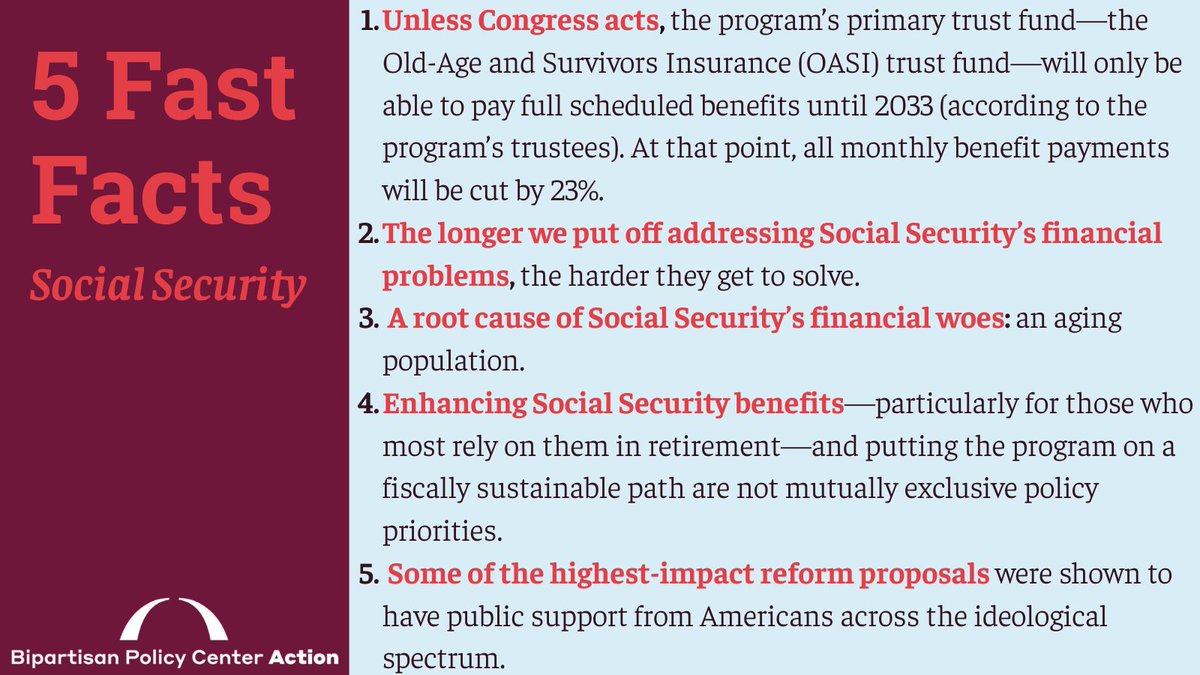
It was great to talk to @ayesharascoe about the state of Social Security’s finances and the steps Congress is going to have to take before the trust fund runs out of money in ~2033. npr.org/2024/05/12/125…
English
0
0
5
412
Emerson Sprick retweetledi
Andrew Lautz
Andrew Lautz@andrew_lautz·
New from @te_sprick and I: There's a large, underdiscussed, and bipartisan trend toward new tax-advantaged savings account proposals underway in Congress. But what would happen if we brought half a dozen new accounts online in short order? We explore: bipartisanpolicy.org/issue-brief/a-…
English
2
4
6
883
Emerson Sprick retweetledi
Bipartisan Policy Center
Bipartisan Policy Center@BPC_Bipartisan·
“Social Security’s fundamental structure is sound. ... What’s needed is the kind of reform Congress undertook regularly throughout the 20th century: straightforward, bipartisan adjustments to ensure Social Security continues as the backbone of retirement security.” In a letter to the editor in this morning’s @washingtonpost, our own @te_sprick, director of retirement and labor policy, underscores why strengthening Social Security requires reform, not reinvention. Pragmatic, bipartisan updates can keep the program sustainable for years.
English
1
1
2
260
Emerson Sprick
Emerson Sprick@te_sprick·
In 2019, ~500 people held $25 million+ in an IRA. 25,000 had at least $5 million. For them, the tax incentive isn't doing anything to help them prepare for retirement—it's just prompting them to shift savings from one type of account to another.
Andrew Lautz@andrew_lautz

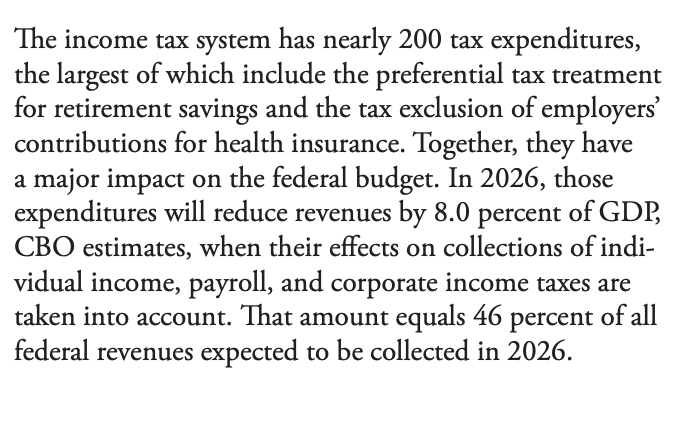
A wild stat from CBO: tax expenditures equal 8% of GDP in 2026 - more than the cost of Social Security, or Medicare, or Medicaid, or the defense budget. We @BPC_Bipartisan summarized the top tax expenditures by budget impact back in 2024: bipartisanpolicy.org/explainer/tax-…

English
1
0
2
63
Emerson Sprick retweetledi
Andrew Lautz
Andrew Lautz@andrew_lautz·
A wild stat from CBO: tax expenditures equal 8% of GDP in 2026 - more than the cost of Social Security, or Medicare, or Medicaid, or the defense budget. We @BPC_Bipartisan summarized the top tax expenditures by budget impact back in 2024: bipartisanpolicy.org/explainer/tax-…
Andrew Lautz tweet media
English
1
4
16
1.7K
Emerson Sprick
Emerson Sprick@te_sprick·
Man, I was not expecting the comments here. I didn't think my mind was irrevocably poisoned by 18 months in a PhD program but apparently it was.
Jesús Fernández-Villaverde@JesusFerna7026

A guide for students of economics: Ten statements that demonstrate that someone does not understand modern economics or what an equilibrium is, and that you can safely ignore everything else they say. 1. “Equilibrium means the economy is stable or at rest.” Many assume that an equilibrium is a peaceful state with no forces at play. Instead, an equilibrium is just an arrangement of actions and expectations over time that are mutually consistent. It can be locally unstable, explosive, or fragile. Nothing in the definition of equilibrium implies stability. 2. “Equilibrium implies optimality or social efficiency.” Equilibrium is often conflated with efficiency, but equilibrium merely reflects decentralized consistency, not welfare maximization. Market power, externalities, incomplete markets, nominal rigidities, and frictions routinely produce inefficient equilibria. I often teach a first-year macro graduate course, and not a single one of the equilibria I define is efficient. 3. “Equilibrium is a unique outcome.” Many often expect models to have one equilibrium. In reality, multiple equilibria arise naturally in dynamic, strategic, and incomplete-market environments. Models of coordination failures, self-fulfilling expectations, bubbles, overlapping generations, and liquidity traps all hinge on the existence of equilibrium multiplicity. 4. “Equilibrium requires perfect foresight or perfect information.” Equilibrium does not assume agents know the future. In fact, equilibria are often stochastic. The definition of equilibrium only requires that beliefs are consistent with the (perceived) stochastic laws of motion implied by the model. Bayesian learning, noisy signals, ambiguity, and subjective uncertainty all fit well within an equilibrium framework, provided beliefs converge to an internally consistent (but possibly incorrect) distribution. Bonus point: equilibria are compatible with agents having diverging beliefs that never converge to a single Dirac distribution. 5. “Real economies are rarely in equilibrium, so the concept is unrealistic.” Equilibrium is not meant to describe the daily state of the world. It is a conceptual device used to understand the outcome of our models under the assumptions we make. Also, see point 1 above. 6. “Equilibrium requires agents to be fully rational in a psychological sense.” Equilibrium only assumes internal consistency: agents optimize given preferences and constraints. It does not assume realism about human cognition. We can and do define equilibria in models with behavioral biases, bounded rationality, inattention, or rule-of-thumb behavior. We only need to ensure that the resulting actions and beliefs are mutually compatible. 7. “Equilibrium eliminates dynamics or learning.” Equilibrium is sometimes misinterpreted as a static state in which nothing evolves. In fact, many equilibria are sequences of probability distributions over states driven by shocks, policy rules, and endogenous responses. Learning dynamics (Bayesian updating, adaptive rules, experience-based expectations) can occur within equilibrium if the evolution of beliefs is self-consistent. 8. “Equilibrium renders expectations unimportant.” A common misconception is that equilibrium mechanically determines outcomes. In reality, expectations are often central: they determine investment, consumption, asset prices, and policy responses. Many equilibria differ only in their expectations. This is why communication, credibility, and forward guidance matter even in fully rational models. 9. “Equilibrium excludes policy intervention.” Some interpret equilibrium as a laissez-faire concept. In fact, equilibrium analysis is the foundation of modern policy evaluation. Fiscal, monetary, and regulatory interventions work through equilibrium responses (prices, wages, interest rates, quantities) and must satisfy equilibrium conditions to be credible. Equilibrium is a tool for policy design, not a barrier to it. 10. “Equilibriums…” Aequilibrium is a Latin neuter noun of the second declension, which forms a nominative plural in “a”. It is composed of aequus (equal; the same root as equality or equity) and libra (balance or scales or the name of several currencies over history). A final thought: “equilibrium” is a term of art. Its meaning in economics differs from its use in the natural sciences or in everyday language. Terms of art are ubiquitous across academic disciplines, and the first act of intellectual diligence when one starts studying a discipline is to learn what they mean.


English
0
0
0
42
Emerson Sprick retweetledi
Jed Kolko
Jed Kolko@JedKolko·
Surprised to see @wsj make this mistake. Changes in native-born employment, labor force, and population levels are artifacts and misleading. By construction, native-born levels adjust to offset changes in foreign-born levels. Link to my explainer in next tweet.
Jed Kolko tweet media
English
4
10
26
4.1K
Emerson Sprick retweetledi
Bipartisan Policy Center
Bipartisan Policy Center@BPC_Bipartisan·
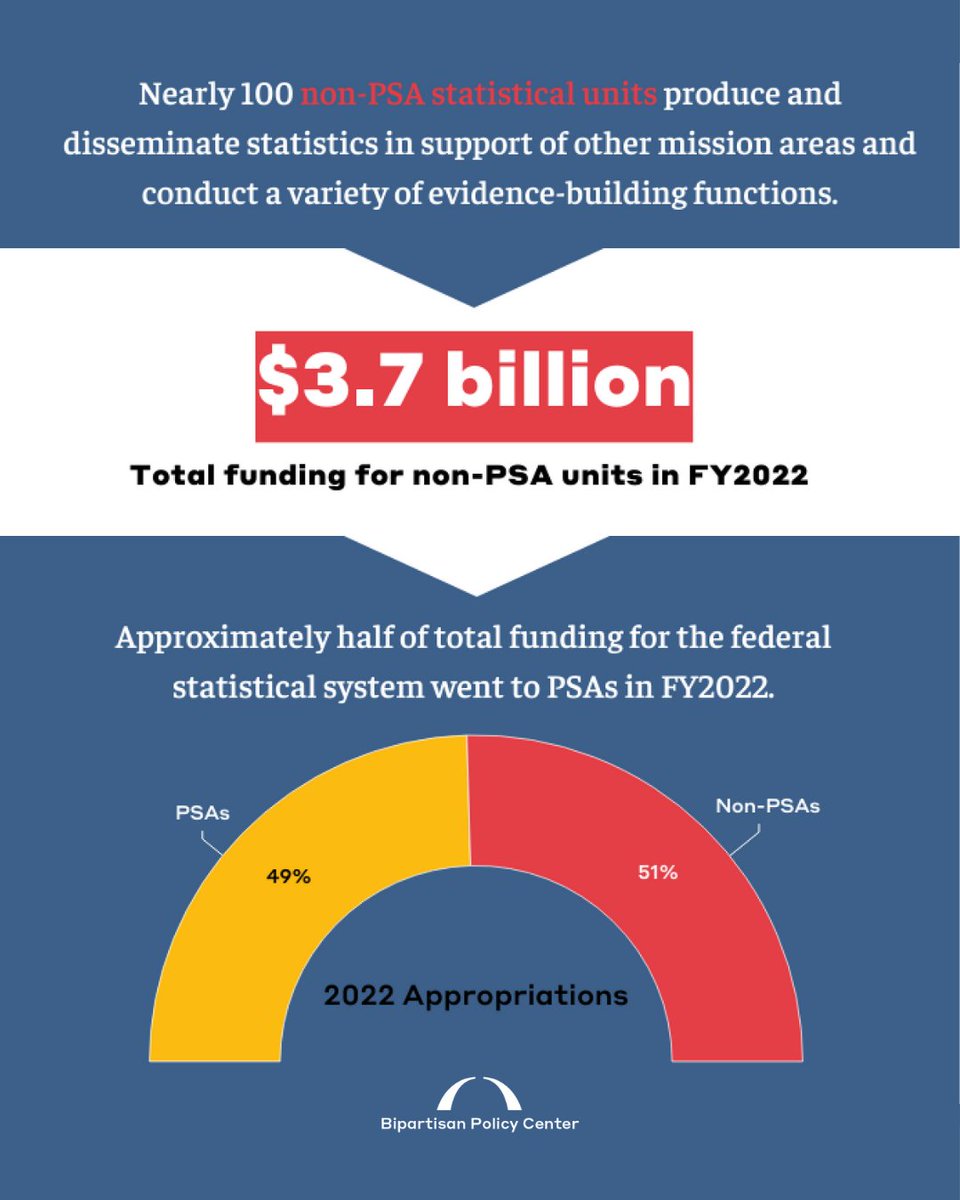
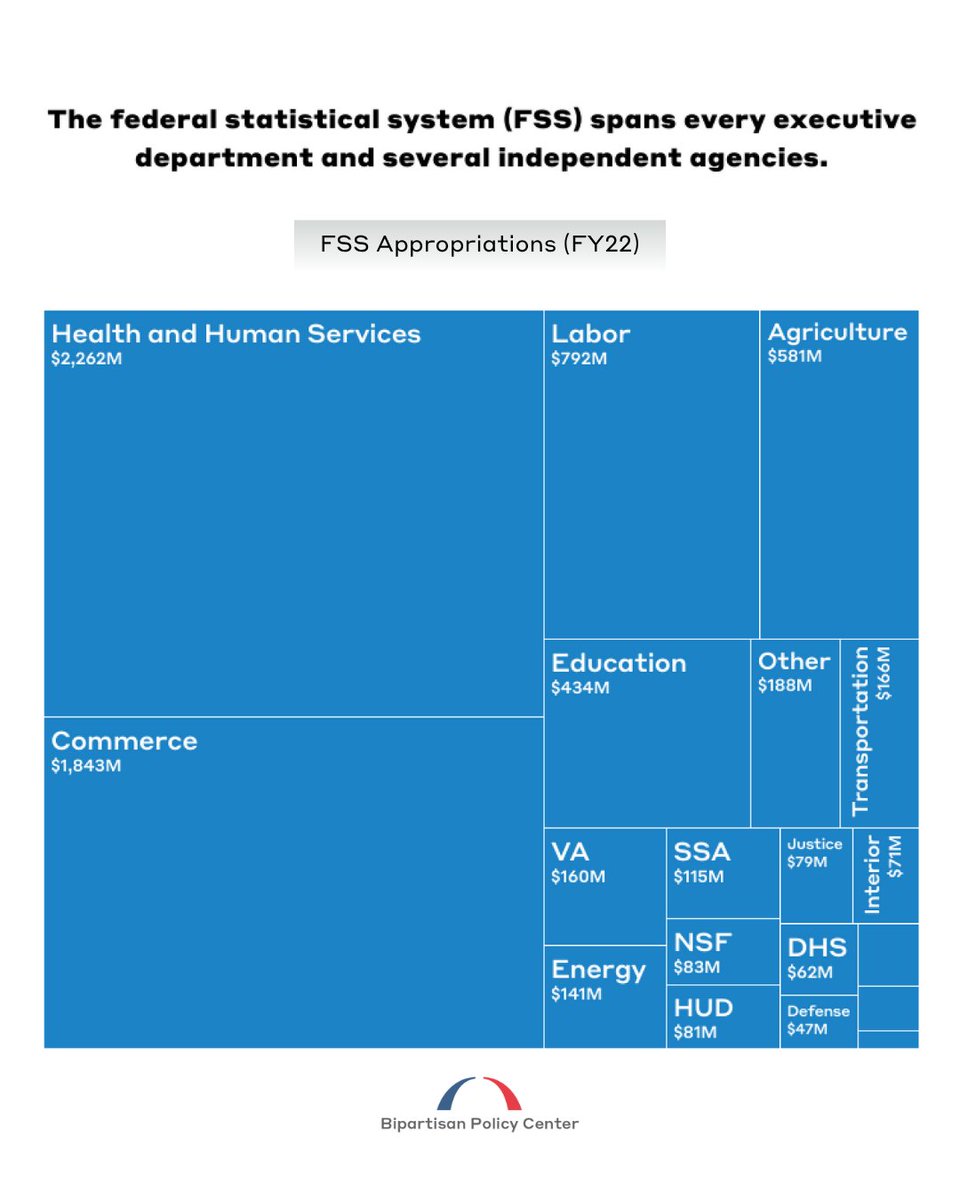
The Federal Statistical System (FSS) quietly powers thousands of decisions in the U.S. every day, from interest rates and federal funding to business planning, public health, and scientific research. But declining survey responses, outdated tools, and shrinking resources are putting this vital system at risk. BPC’s Data for the Future initiative is working to strengthen and modernize the FSS. Learn More ⤵️
Bipartisan Policy Center tweet mediaBipartisan Policy Center tweet mediaBipartisan Policy Center tweet mediaBipartisan Policy Center tweet media
English
1
4
3
471
Emerson Sprick retweetledi
Rep. Lloyd Smucker
Rep. Lloyd Smucker@RepSmucker·
Proud to have my Claiming Age Clarity Act pass through @WaysandMeansGOP committee with strong bipartisan support. This simple, yet powerful bill helps Americans better understand their Social Security retirement benefit options. Thanks for the support @AARP, @AMACforAmerica, @BPC_Bipartisan
English
5
2
13
467
Emerson Sprick retweetledi
Ways and Means Committee
Ways and Means Committee@WaysandMeansGOP·
PASSED: The Ways and Means Committee just passed H.R. 5284, the Claiming Age Clarity Act. Led by @RepSmucker, this bill updates the language the Social Security Administration uses to describe when American workers can claim their retirement benefits, replacing confusing terms with straightforward language so seniors can better understand their options and make the choice that best fits their financial needs.
Ways and Means Committee tweet media
English
0
7
22
4.2K
Emerson Sprick retweetledi
Joey Politano 🏳️‍🌈
Joey Politano 🏳️‍🌈@JosephPolitano·
This chart is actually evidence that revisions are 1) extremely small relative to the 160M workers in the US economy 2) basically random outside a cyclical component 3) not actually increasing over time
Stephen Moore@StephenMoore

The Bureau of Labor Statistics' initial jobs reports are riddled with errors, and the issue is only getting worse.  This chart from Issues and Insights sums it up perfectly. @realEJAntoni is ready to bring the accuracy and honesty America needs in its jobs numbers.

English
12
78
808
32.2K
Emerson Sprick retweetledi
Bipartisan Policy Center
Bipartisan Policy Center@BPC_Bipartisan·
To mark the 90th anniversary of #SocialSecurity, the Bipartisan Policy Center’s @AmSavEdCouncil commissioned a survey of Americans to understand their attitudes toward this essential program. The survey found that:
English
3
4
3
273
Emerson Sprick retweetledi
Kyle Pomerleau
Kyle Pomerleau@kpomerleau·
The standard pitch for a reform that looks something like this is what you lose in progressivity, you more than make up for in increased in economic efficiency. That simply doesn't apply to fiscal package that leans on highly inefficient taxes on imports.
Ricco@riccoja

CBO put out their final distribution analysis of the reconcilation bill yesterday. If you combine those numbers with the most recent @The_Budget_Lab tariff burden estimates, you get a striking result: all income groups but the top decile are made worse off on net.

English
0
4
21
2.6K
Emerson Sprick retweetledi
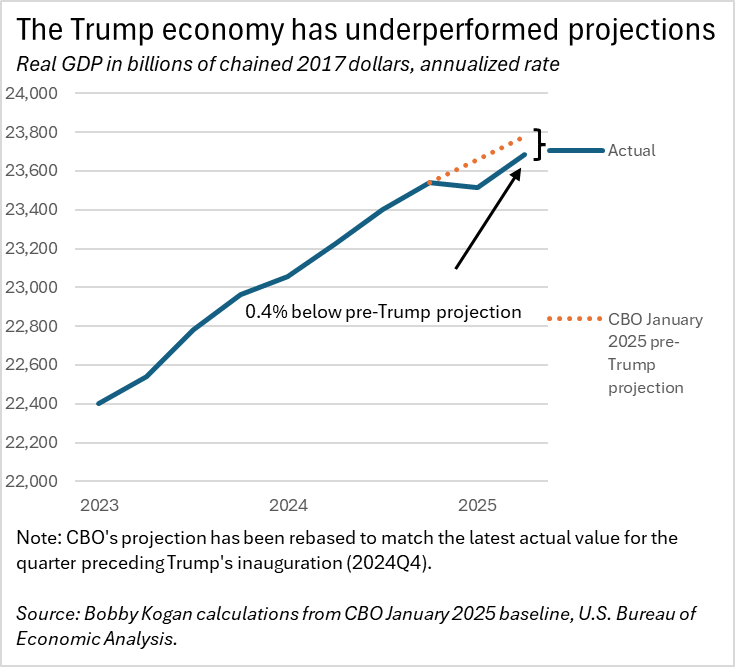
Bobby Kogan
Bobby Kogan@BBKogan·
Real GDP at 3%, weak given last quarter, for an avg of 1.2% over the last two quarters. Real GDP under Trump has underperformed projections made before he took office. Real final sales to private domestic purchasers comes in at just 1.2% after being 1.9% last quarter.
Bobby Kogan tweet media
English
16
94
386
251.1K
Emerson Sprick retweetledi
Heather Long
Heather Long@byHeatherLong·
This is the key chart when anyone talks about Q1 or Q2 2025 GDP. Imports surged in Q1 as companies tried to get stuff into the US ahead of tariffs. Then...imports plunged in Q2 as firms cut back To put it another way: Q2 trade added nearly 5 percentage points to GDP Q2 decline in biz investment subtracted -3.1 percentage points from GDP
Heather Long tweet media
English
21
187
474
65.9K