Parth

657 posts

Parth banner
Parth

Parth

@thecryptiquebro

ceo @cryptiqueio | making crypto data-driven

Katılım Kasım 2024
623 Takip Edilen169 Takipçiler
Sabitlenmiş Tweet
Parth
Parth@thecryptiquebro·
Most crypto projects are burning money on growth and have no idea what's working. Me and @akshit_varsani_ sat down to talk about the brutal reality we kept seeing: founders with "100K wallets connected" who couldn't answer basic questions about their users. No idea why. No idea how to fix it. That feeling of flying blind while burning money? That's why we built @cryptiqueio Here's what we kept hearing from every pre-TGE founder we talked to: → "Spent $10K on campaigns. Users came. But which campaign worked? No clue." → "Day 1: 5,000 wallets. Day 30: 50 active. Where did they go?" → "Can't tell my power users from airdrop farmers. Everyone looks the same." → "VCs ask 'how many real users?' I just... don't know." → "Every marketing decision is a coin flip. Twitter or Discord? Content or events? Just guessing." The brutal truth? Most projects aren't failing because of bad products. They're failing because they know nothing about their users. You can't optimize what you can't measure. And right now? Most teams aren't measuring what actually matters. That's the gap Cryptique.io fills. From "we have wallets" to "we know our users." Source attribution. Retention intelligence. Power user identification. Sybil detection. Real-time behavioral analytics. The difference in TGE outcomes? Night and day. Podcast out soon!
Parth tweet media
English
1
2
13
913
Umair Shaikh
Umair Shaikh@1Umairshaikh·
Distribution used to be the second problem. Now it's the only problem. Anyone can build. Almost nobody knows how to be found.
English
85
11
127
4.3K
Parth
Parth@thecryptiquebro·
@tankots Especially when the threshold to build any feature has drastically reduced. - written by @WisprFlow
English
0
0
0
2
Tanay Kothari
Tanay Kothari@tankots·
our NPS dropped from 70 to 35. my entire team panicked. but it was the best thing that happened to our company. when wispr started getting traction, everyone wanted us to build everything. meeting recorder. ai note-taking. voice-controlled app launching. we started working on several at once. the team was excited. users were asking for it. felt like momentum. then our nps crashed. what actually happened: our core product got worse. as we scaled from thousands to millions of users, a 0.1% failure rate meant thousands of people hitting issues daily. we were shipping new features while the foundation was cracking. i looked at dropbox, spotify, airbnb. they all built one singular platform first. only added second products at massive scale. so i made the call: kill every new feature in development. the team pushed back. "but users are asking for these." users ask for a lot of things. our job is to give them one thing that works perfectly, not ten things that work okay. wispr flow can scale to $1B in revenue as one product. if we ever build something new, it cannot come at the cost of our current product and current customers. our nps recovered to 72. customers started to notice the difference. the hardest part about building a company isn't deciding what to build. it's deciding what to kill.
English
36
8
279
48.8K
Parth
Parth@thecryptiquebro·
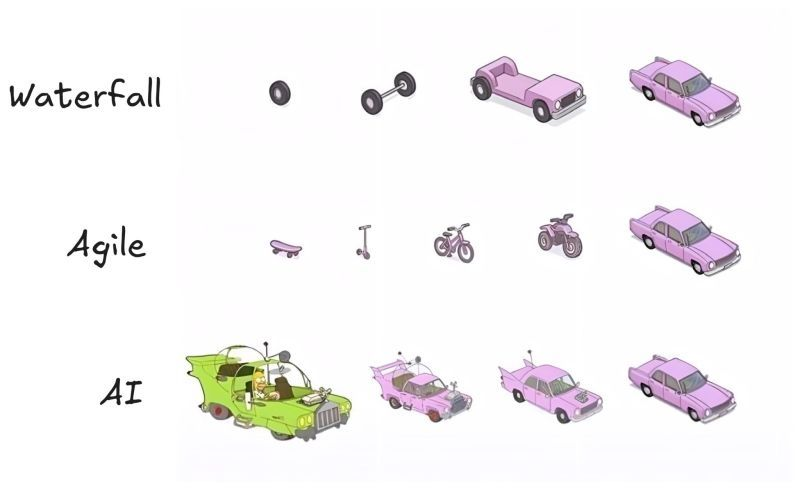
@devops_nk With AI, having the clarity from Day 1 of what my car should look like is super important.
English
0
0
1
124
Nandkishor
Nandkishor@devops_nk·
Honestly, this is the most accurate diagram I've seen. Waterfall: You plan for 18 months and deliver exactly what nobody needs anymore. Agile: You deliver something usable at every step, but the CEO keeps asking, "Where's the car?" AI: You get the car on day one. It has six wheels, the doors are on backwards, and it has a rocket launcher. You spend more time making it yours than actually "building"; it's shaping. owning. verifying. That's what the best AI developers do now. They don't build. They shape and own.
Nandkishor tweet media
English
126
1.6K
8.2K
701.7K
Parth
Parth@thecryptiquebro·
@aakashgupta There should be a specialised AI that does this!
English
0
0
0
5
Aakash Gupta
Aakash Gupta@aakashgupta·
The single best way to get better at writing PRDs is to spend a week prompting AI prototyping tools. "Make it look better" returns garbage. "16px gap between cards, 12px border radius, subtle box shadow on hover" returns exactly what you asked for. The feedback loop is instant. Write a vague prompt, get a vague result, rewrite with specifics, get a precise result. Within a few hours you internalize the pattern: every word you leave out is a decision you're delegating to a machine that doesn't know your users. That discipline carries over to every artifact a PM writes. PRDs, design feedback, engineering tickets, stakeholder updates. The PMs I work with who prototype regularly write noticeably tighter specs because they've trained themselves to eliminate ambiguity through thousands of prompt iterations where the cost of vagueness was immediate and visible. The prototyping tools are teaching a generation of PMs to spec like engineers. Nobody planned it. It's a side effect.
Aakash Gupta@aakashgupta

Bolt hit $700M valuation. I wrote the complete guide. Quick start workflow, good vs bad prompts, debugging playbook, model switching tips, and a head-to-head comparison of Bolt vs Lovable vs Replit vs v0. Full guide: news.aakashg.com/p/pm-guide-bolt

English
3
0
16
4.8K
abhinav.eth 🧲
abhinav.eth 🧲@abhinav_g21·
Calling all builders in Delhi working on Web3 & AI 🇮🇳 Let’s connect and If you know someone, tag them too Cooking up something interesting, would love to loop in the right people
English
2
0
2
186
Parth
Parth@thecryptiquebro·
@thenanyu And why do you think the sales team shouldn’t be a part?
English
0
0
0
69
Nan Yu
Nan Yu@thenanyu·
Yes. PMM is a product concern. I see a lot of orgs out there combining design and product management, which I think creates all sorts of poor incentives. But product management and product marketing are a much more natural fit together.
Tony Fadell@tfadell

Most tech companies break out product management and product marketing into two separate roles: Product management defines the product and gets it built. Product marketing wires the messaging- the facts you want to communicate to customers- and gets the product sold. But from my experience that's a grievous mistake. Those are, and should aways be, one job. There should be no separation between what the product will be and how it will be explained- the story has to be utterly cohesive from the beginning. Your messaging is your product. The story you're telling shapes the thing you're making. I learned story telling from Steve Jobs. I learned product management from Greg Joswiak. Joz, a fellow Wolverine, Michigander, and overall great person, has been at Apple since he left Ann Arbor in 1986 and has run product marketing for decades. And his superpower- the superpower of every truly great product manager- is empathy. He doesn't just understand the customer. He becomes the customer. So when Joz stepped into the world with his next-gen iPod to test it out, he fiddled with it like a beginner. He set aside all the tech specs- except one: battery life. The numbers were empty without customers, the facts meaningless without context. And, that's why product management has to own the messaging. The spec shows the features, the details of how a product will work, but the messaging predicts people's concerns and finds way to mitigate them. - #BUILD Chapter 5.5 The Point of PMs

English
16
12
278
38.2K
Parth
Parth@thecryptiquebro·
@gregisenberg will we just be interacting with harwdware and actions in software get triggered on their own. just like a user currently interacts only with frontend while backend actions get triggered without a direct input from the user
English
0
0
1
12
GREG ISENBERG
GREG ISENBERG@gregisenberg·
the way we use the internet is completely different than how we used to use it 5 years ago there was no LLMs, no AI agents, no vibe coding 5 years ago and in 5 years it will be completely different again
English
158
21
415
21.3K
Parth
Parth@thecryptiquebro·
@oprydai Be a generalist or a super-specialist in today’s world
English
0
0
0
6
Mustafa
Mustafa@oprydai·
become a generalist. specialization makes you efficient. generalization makes you dangerous. what it actually means: • learn across domains → math, physics, software, economics, biology. patterns repeat across fields. • connect ideas → innovation happens at the intersection, not inside silos. • adapt fast → when one field shifts, you don’t collapse, you pivot. • see systems → specialists see parts, generalists see the whole • build end-to-end → from idea → design → implementation → delivery the world rewards specialists in stable environments. it rewards generalists when things are changing. right now, everything is changing. don’t just go deep. go wide, then stack depth where it matters.
Mustafa tweet media
English
210
967
5.1K
238.6K
Parth
Parth@thecryptiquebro·
@garrytan But climb anywhich ways
English
0
0
0
1
Garry Tan
Garry Tan@garrytan·
If you don't like the climb, choose a different mountain.
English
188
151
1.7K
65.2K
Parth
Parth@thecryptiquebro·
@soleio @bhorowitz The “why” should be data-backed and not just a gut feeling
English
0
0
0
161
Soleio
Soleio@soleio·
I’ve long held @bhorowitz explained it best: “When a company goes astray, you talk to employees and they say, ‘We have no strategy. We don’t know where we’re going.’ The strategy is the story. They’re not different. The strategy is the story you tell. It’s the why. If you can’t tell that in a massively compelling way, who’s going to follow you? That’s what makes people get up in the morning and do stuff. The story must explain at a fundamental level why you exist. Why does the world need your company? Why do we need to be doing what we’re doing and why is it important?”
Tony Fadell@tfadell

Most tech companies break out product management and product marketing into two separate roles: Product management defines the product and gets it built. Product marketing wires the messaging- the facts you want to communicate to customers- and gets the product sold. But from my experience that's a grievous mistake. Those are, and should aways be, one job. There should be no separation between what the product will be and how it will be explained- the story has to be utterly cohesive from the beginning. Your messaging is your product. The story you're telling shapes the thing you're making. I learned story telling from Steve Jobs. I learned product management from Greg Joswiak. Joz, a fellow Wolverine, Michigander, and overall great person, has been at Apple since he left Ann Arbor in 1986 and has run product marketing for decades. And his superpower- the superpower of every truly great product manager- is empathy. He doesn't just understand the customer. He becomes the customer. So when Joz stepped into the world with his next-gen iPod to test it out, he fiddled with it like a beginner. He set aside all the tech specs- except one: battery life. The numbers were empty without customers, the facts meaningless without context. And, that's why product management has to own the messaging. The spec shows the features, the details of how a product will work, but the messaging predicts people's concerns and finds way to mitigate them. - #BUILD Chapter 5.5 The Point of PMs

English
6
21
451
67.8K
scott belsky
scott belsky@scottbelsky·
100% products are stories. people don’t just buy aggregated atoms, they buy the narrative that brings it all together,
Tony Fadell@tfadell

Most tech companies break out product management and product marketing into two separate roles: Product management defines the product and gets it built. Product marketing wires the messaging- the facts you want to communicate to customers- and gets the product sold. But from my experience that's a grievous mistake. Those are, and should aways be, one job. There should be no separation between what the product will be and how it will be explained- the story has to be utterly cohesive from the beginning. Your messaging is your product. The story you're telling shapes the thing you're making. I learned story telling from Steve Jobs. I learned product management from Greg Joswiak. Joz, a fellow Wolverine, Michigander, and overall great person, has been at Apple since he left Ann Arbor in 1986 and has run product marketing for decades. And his superpower- the superpower of every truly great product manager- is empathy. He doesn't just understand the customer. He becomes the customer. So when Joz stepped into the world with his next-gen iPod to test it out, he fiddled with it like a beginner. He set aside all the tech specs- except one: battery life. The numbers were empty without customers, the facts meaningless without context. And, that's why product management has to own the messaging. The spec shows the features, the details of how a product will work, but the messaging predicts people's concerns and finds way to mitigate them. - #BUILD Chapter 5.5 The Point of PMs

English
6
15
194
20.9K
Parth
Parth@thecryptiquebro·
@tfadell Messaging and features go hand in hand only when there’s product clarity.
English
0
0
0
26
Tony Fadell
Tony Fadell@tfadell·
Most tech companies break out product management and product marketing into two separate roles: Product management defines the product and gets it built. Product marketing wires the messaging- the facts you want to communicate to customers- and gets the product sold. But from my experience that's a grievous mistake. Those are, and should aways be, one job. There should be no separation between what the product will be and how it will be explained- the story has to be utterly cohesive from the beginning. Your messaging is your product. The story you're telling shapes the thing you're making. I learned story telling from Steve Jobs. I learned product management from Greg Joswiak. Joz, a fellow Wolverine, Michigander, and overall great person, has been at Apple since he left Ann Arbor in 1986 and has run product marketing for decades. And his superpower- the superpower of every truly great product manager- is empathy. He doesn't just understand the customer. He becomes the customer. So when Joz stepped into the world with his next-gen iPod to test it out, he fiddled with it like a beginner. He set aside all the tech specs- except one: battery life. The numbers were empty without customers, the facts meaningless without context. And, that's why product management has to own the messaging. The spec shows the features, the details of how a product will work, but the messaging predicts people's concerns and finds way to mitigate them. - #BUILD Chapter 5.5 The Point of PMs
English
70
223
2.3K
760.8K
Parth
Parth@thecryptiquebro·
@gregisenberg The critical question now becomes what to build and why. The how is already solved!
English
1
0
0
18
GREG ISENBERG
GREG ISENBERG@gregisenberg·
the gap between "i have an idea" and "i shipped a product" just got so small it's basically not a gap anymore for anyone, anywhere
English
404
104
1.5K
91.1K
Kunal Gandhi
Kunal Gandhi@kunalvg·
Social media is about to split in two. Right now you have Instagram, X, LinkedIn. Platforms built for everyone. What’s coming is the opposite. Tiny platforms. Built around one obsession. Sneakerheads. Indie founders. Anime collectors. Carnivore dieters. Not followers. Not likes. A tight circle of people who live and breathe the same thing you do. And it won’t just be online. The best vertical communities will spill into real life. Meetups, dinners, retreats. Built around the same obsession. Why this is happening now. AI is flooding the internet with content nobody asked for. The noise is only going to get worse. People are already feeling it. More time online. More lonely. The answer isn’t a bigger platform. It’s a much smaller one. The next big social media company won’t look anything like Instagram. It’ll look like a club with a very strict door policy.
English
66
6
142
8.9K
Parth
Parth@thecryptiquebro·
@aakashgupta We’re building an AI product analyst that does this!
English
0
0
0
39
Aakash Gupta
Aakash Gupta@aakashgupta·
The fastest way to lose credibility in a product review: present a number you can't explain. Every PM using AI for data analysis has this vulnerability right now. Claude Code can run the queries, segment the data, do statistical analysis. But when your VP asks "where did this number come from," most PMs have nothing to show except "I asked AI." That credibility gap is the real bottleneck. Not the analysis itself. The fix is Jupyter Notebooks inside Claude Code. Every query is visible. Every calculation is traceable. Every result renders with the exact code that produced it, right inside VS Code. Your stakeholder can see the methodology, not just the output. Think about how most PMs do data work today. They wait two weeks to get on an analyst's roadmap for a question they're not even sure is worth asking. Or they ask ChatGPT and paste a number into a slide with no audit trail. This workflow analyzed 213 survey responses, segmented by role, scored by enterprise interest, and visualized the distribution. With full proof of work attached. The irony is that AI analysis with a Jupyter audit trail is now more rigorous than most human analysis delivered over Slack. The PM who can show exactly how a number was calculated will be trusted with the bigger questions. The PM who says "the data shows" without showing the data will stop being asked. Show your work.
Aakash Gupta@aakashgupta

This guy literally broke down how to use Claude Code like an expert: 1:40 - Code vs Cowork vs OpenClaw 6:51 - Setting up context status line 12:03 - Sub-agents 17:49 - Creating skills 23:58 - Ask user questions tool 33:33 - Tool-powered skills: Tavily 36:57 - CLI vs MCP vs API hierarchy 39:30 - Make slides skill w/ Puppeteer 43:32 - Auto-invoking skills with hooks 46:49 - Jupyter notebooks for data trust 55:09 - The operating system file structure

English
5
8
58
12.4K
Parth
Parth@thecryptiquebro·
@naval Product clarity is the new moat to ship fast!
English
0
0
0
20
Naval
Naval@naval·
Vibe coding is more addictive than any video game ever made (if you know what you want to build).
English
1.7K
2.8K
29.1K
1.6M
The Startup Ideas Podcast (SIP) 🧃
this is the most asymmetric time to start building. the window is 12–24 months. the build cost is basically zero. the only thing missing is you starting.
GREG ISENBERG@gregisenberg

things keeping me up at night about where AI is actually going: 1. "ambient businesses" are coming. basically, agents monitor the market, handle customers, execute decisions. you check in every few days. 7-8 figure businesses with almost no daily human input. we're early but it's happening. 2. you can now build a company in an hour. grab an idea, vibe code it, add stripe, get a customer. the old timeline was 12 months to first revenue. that's just gone. 3. the internet went app store era → API economy → agent economy. we're now in the part where agents hire other agents on the fly. fixed tech stacks are dissolving. nobody's built the glassdoor for AI agents yet. 4. vertical AI is replacing headcount. that's 10x the market that vertical SaaS ever touched. boring industries like insurance, construction, legal, elder care are the goldmine. 5. SaaS pricing is flipping from per seat to per result. someone is going to build a billion dollar business just by converting legacy SaaS companies to outcome based pricing 6. a whole graveyard of generic SaaS is coming. basic CRMs, analytics dashboards, template marketplaces, scheduling tools. agents just do it better. lots of incumbent saas that are generic and not reinventing themselves right now will struggle/reprice. 7. "human made" is becoming the new luxury. porsche already ran a 100% human made ad campaign. no AI is going to be a premium label like organic is for food. there's a real business in that certification. 8. IRL is having a renaissance. when everything is AI generated, being in a room with other humans becomes scarce. karaoke bars, escape rooms, live music, co-working. the experience economy is accelerating. 9. founder market fit is dead. founder agent fit is what matters now. can you direct a fleet of agents like a film director? that's the new unfair advantage. 10. ghost team org charts are coming. two real people, twelve agents with names, faces, personalities. your about page is going to look the same 11. 1000 true fans is now 100. agents cut your costs so much that 100 customers at $500/mo is a real solo business. micro monopolies across multiple niches. this is the playbook. 12. context window poisoning is the new phishing. cybersecurity hasn't caught up. agents have access to your files, email, bank accounts. bad things are going to happen. it's also a massive startup opportunity. 13. the window is open for maybe 12-24 months. then the moats get built like data, brand, trust, network 14. build cost is basically zero. audiences are underpriced. niches are wide open. idk about you but i'm not sleeping much so much opportunity this is the most asymmetric time to be building a startup. full episode on @startupideaspod to get your creative juices flowing (latest episode get it where you listen/watch pods) no advertisers, just pure ideas to help you im rooting for you don't just bookmark share with a friend watch

English
5
2
58
6.2K
Sumedha
Sumedha@sumedha2199·
if you're not becoming some mix of dev + data scientist + PM + researcher + salesperson + writer + etc you're either under-challenged or under-leveraged feels like this is just where things are at now stack your leverage
English
53
21
336
11.8K
Parth
Parth@thecryptiquebro·
@startupideaspod > Know what to build before start building it. > Your initial users will tell you what to ship next and why. > Make sure you capture user signals.
English
0
0
1
109
The Startup Ideas Podcast (SIP) 🧃
how to actually get customers for your vibe coded app: - let AI sell for you (MCP servers) - build 10,000 SEO pages once (programmatic SEO) - vibe code a free tool by lunch (it markets itself) - get cited by ChatGPT (answer engine optimization) - allow your users to create content for you (viral artifacts) - buy a 10K subscriber newsletter for $5K - turn one voice memo into 20 pieces of content Pick two. Start this week. Stop just vibe coding. Start getting customers.
The Startup Ideas Podcast (SIP) 🧃@startupideaspod

x.com/i/article/2038…

English
43
65
1K
165.5K