underdav

768 posts

underdav banner
underdav

underdav

@underdav_

hodl #bitcoin

Moon Katılım Şubat 2012
1.5K Takip Edilen75 Takipçiler
underdav retweetledi
Lee Roach
Lee Roach@leevalueroach·
In a hyperinflationary environment, the single most important financial decision you can make, and the one almost nobody who lives through one is psychologically prepared to make, is to maximize fixed-rate, long-duration debt against productive assets, because the entire mechanism of hyperinflation is a wealth transfer from creditors to debtors, and the only question that matters, in the moment it begins, is which side of that transfer you have positioned yourself on. The math is brutal in its simplicity. If you owe a bank $400,000 at a 30-year fixed rate of 6%, and the currency loses 90% of its purchasing power over five years, you are, in real terms, paying back the bank in lottery tickets. The house you bought with that loan retains its real value, because it is a physical asset that the inflation cannot touch. The bank, which lent you future dollars and is now receiving past dollars, takes the loss. You take the gain. The transfer happens silently, invisibly, on the loan amortization schedule, every single month, while the people around you who saved in cash, held bonds, or refused on principle to take on debt watch their lifetime savings evaporate in real time. The Weimar industrialists who emerged from 1923 with their fortunes intact, and in many cases multiplied, were not the ones who hoarded gold or moved their assets to Switzerland. They were the ones who borrowed aggressively, in the local currency, at fixed rates, against factories and farms and apartment buildings, and let the inflation pay off the debt while they collected rents and revenues that repriced upward with the currency. The same pattern played out in Hungary in 1946, in Argentina in the 1980s, in Zimbabwe in 2008, and in every other major inflation event of the modern era. The borrowers won. The savers lost. The people in the middle, who tried to be cautious and hold cash and wait for clarity, were the ones whose lives were quietly destroyed. The reason almost nobody acts on this knowledge in advance is that the human brain treats debt as danger, and treats saving as safety, and these instincts are correct in stable monetary environments and exactly inverted in unstable ones. The middle class, which has been trained for generations to fear debt, is structurally the worst-positioned group when the currency starts to fail. The wealthy, who use leverage as a tool, and who hold the productive assets that the leverage was used to acquire, are structurally the best-positioned. The asymmetry is not an accident. It is the entire mechanism by which monetary debasement transfers wealth from one class to another, every time it has happened, in every country it has happened in, for as long as currencies have existed. You do not need to predict the timing. You need to structure your balance sheet, in the years before the event, in a way that benefits if it arrives. Fixed rate, long duration, productive assets. The trade has worked for 400 years. It will work for the next 400. Almost nobody will run it, because almost nobody is willing to be the person who took on debt while everyone they know was paying theirs down, which is, as it has always been, the entire reason the people who do run it end up owning everything on the other side.
English
154
301
3.6K
310.4K
underdav retweetledi
𝕾𝖎𝖗 𝕮𝖍𝖗𝖎𝖘
pay solid attention; an average millionaire is 40 not 23 an average billionaire is 55 not 35 the average age to buy a house is 35 not 25 most men hit their peak confidence at 32 not in their 20s it takes the average person 66 days to build a habit not 7 the average ceo is 57 not 30 most people meet their life partner after 27 not 18 the average successful business takes 5-7 years not 6 months most people don’t know what they want until they’re 30 not at graduation stop letting social media brainwash you. you are not behind, you’re on your own track. live it ❤️
Hoops@Hoopss

hit me with the harshest reality truth

English
293
8.1K
48.5K
2M
underdav retweetledi
Mads
Mads@europemaxxed·
busy weekend
Mads tweet media
English
142
18.6K
106.1K
2.6M
underdav
underdav@underdav_·
@bvchko @levelsio Can you recommend a legit one, too many variants on Amazon and hard to trust/choose
English
2
0
0
59
BVCHKO
BVCHKO@bvchko·
@levelsio Yeah. 10 years on this - read the research, grabbed a portable CO2 sensor, never went back. Mine alarms at 700, window opens, done. Past 1000 the fog hits exactly like you said. Must-have for any work room.
English
1
0
3
918
@levelsio
@levelsio@levelsio·
CO is not CO2! Very different and unrelated You breathe in fresh air that's 21% oxygen and 0.04% CO2 Then you breathe out 16% oxygen and 5% CO2 So without outside air your room fills up with CO2 just from you breathing You know how when you put your head under the cover you slowly run out of air? That's exactly it! Almost everywhere outside is about 400ppm CO2, which is fresh air, most rooms inside I have encountered are 1000-3000! Very bad Then if you open the window wide within 15min you can get it down to 600ppm CO2 which is good What does CO2 over 1000 get you? Your IQ literally drops, your thinking decreases, you feel kinda drunk, foggy, tired etc. you're literally choking cause there's no fresh air How to fix? Open a window but then the issue with that is that outside is louder than ever. So the real fix is building a system in your house that brings in fresh air from outside (aka HVAC)
@levelsio tweet media
MarcoPolo@Marco777Polo

@scopecr33p @Antmage @TheFizzyMind @levelsio Nice! Do you see if it makes a difference inside the cities or in rural area? Maybe also because Australian cities are so sea-bound with huge &open seas in front of their door. I only found a CO map: I see your stake is too juicy and the wine too sweet.. Meanwhile us others: 😷

English
90
13
500
109.9K
underdav retweetledi
Neil Stone
Neil Stone@DrNeilStone·
I can't figure out if vaccines work or not. Tough one. Need Sherlock Holmes on this one.
Neil Stone tweet media
English
593
4.3K
28.3K
596.4K
underdav retweetledi
Michael J. Miraflor
Michael J. Miraflor@michaelmiraflor·
Getting paid to think is peak everything. If you’re getting paid well to think, don’t take it for granted. That’s 1% of civilization type stuff. Your ancestors are proud and jealous that you’ve gotten this far.
English
111
1.8K
16.6K
364.8K
underdav retweetledi
Ihtesham Ali
Ihtesham Ali@ihtesham2005·
A mathematician who shared an office with Claude Shannon at Bell Labs gave one lecture in 1986 that explains why some people win Nobel Prizes and other equally smart people spend their whole lives doing forgettable work. His name was Richard Hamming. He won the Turing Award. He invented error-correcting codes that made modern computing possible. And he spent 30 years at Bell Labs sitting in a cafeteria at lunch watching which scientists became legendary and which ones faded into nothing. In March 1986, he walked into a Bellcore auditorium in front of 200 researchers and told them exactly what he had seen. Here's the framework that has been quoted by every serious scientist for the last 40 years. His opening line landed like a punch. He said most scientists he worked with at Bell Labs were just as smart as the Nobel Prize winners. Just as hardworking. Just as credentialed. And yet at the end of a 40-year career, one group had changed entire fields and the other group was forgotten by the time they retired. He wanted to know what the difference actually was. And he said it wasn't luck. It wasn't IQ. It was a specific set of habits that almost nobody is willing to follow. The first habit was the one that hurts the most to hear. He said most scientists deliberately avoid the most important problem in their field because the odds of failure are too high. They pick a safe adjacent problem, solve it cleanly, publish it, and move on. And because they never swing at the hard problem, they never hit it. He said if you do not work on an important problem, it is unlikely you will do important work. That is not a motivational line. That is a logical one. The second habit was about doors. Literal doors. He noticed that the scientists at Bell Labs who kept their office doors closed got more done in the short term because they had no interruptions. But the scientists who kept their doors open got more done over a career. The open-door scientists were interrupted constantly. They also absorbed every new idea passing through the hallway. Ten years in, they were working on problems the closed-door scientists did not even know existed. The third habit was inversion. When Bell Labs refused to give him the team of programmers he wanted, Hamming sat with the rejection for weeks. Then he flipped the question. Instead of asking for programmers to write the programs, he asked why machines could not write the programs themselves. That single inversion pushed him into the frontier of computer science. He said the pattern repeats everywhere. What looks like a defect, if you flip it correctly, becomes the exact thing that pushes you ahead of everyone else. The fourth habit was the one that hit me the hardest. He said knowledge and productivity compound like interest. Someone who works 10 percent harder than you does not produce 10 percent more over a career. They produce twice as much. The gap doesn't add. It multiplies. And it compounds silently for years before anyone notices. He finished the lecture with a line I have never been able to shake. He said Pasteur's famous quote is right. Luck favors the prepared mind. But he meant it literally. You don't hope for luck. You engineer the conditions where luck can land on you. Open doors. Important problems. Inverted questions. Compounded hours. Those are not traits. Those are choices you make every single day. The transcript has been sitting on the University of Virginia's computer science website for almost 30 years. The video is free on YouTube. Stripe Press reprinted the full lectures as a book in 2020 and Bret Victor wrote the foreword. Hamming died in 1998. He gave his final lecture a few weeks before. He was 82. The lecture that explains why some careers become legendary and others disappear is still free. Most people who could benefit from it will never open it.
Ihtesham Ali tweet media
English
147
1.9K
8.2K
1.1M
underdav retweetledi
hunter
hunter@3gpmh·
forgive me karl marx for i have bought
English
213
58.4K
312.7K
4M
underdav retweetledi
roon
roon@tszzl·
say it with me now. experts are fake, smart generalists rule the world, everything is designed by people no smarter than you, and courage is in shorter supply than genius
English
118
1.4K
10.2K
0
underdav retweetledi
Aaron
Aaron@aaronp613·
White smoke seen from Apple Park to signify a new CEO
Aaron tweet media
English
1.1K
8.6K
139.4K
5.6M
underdav retweetledi
Benoit Dubosson
Benoit Dubosson@beniduboss·
I am so tired of the “Switzerland is just evil bankers hiding elite money” narrative Banking is only about 5% of Swiss GDP Pharma is bigger, at 5.8%, fyi we account for 10.5% of global pharmaceutical exports Manufacturing is around 24% We also rank #1 in innovation world wide Oh and we also have the only real democracy in the world The issue is that the foreigners view of Switzerland and its economy is plagued by it’s image… No sorry but it isn’t just Zurich and Geneva carrying a country of cows and ski chalets where inhabitants produce chocolate and expensive watches Zurich canton, aka the state of Zurich, produces roughly 18% of Swiss GDP with about 18% of the population Geneva produces about 8% of GDP with only 5.9% of the population The reality is that the country is full of small towns with industrial and service bases that employ people locally and sustain entire regions Take Monthey, where I grew up. It’s a city of around 15,000 people, yet it holds one of the largest contiguous chemical site in Europe: 2,000 people on site daily, with names like Ciba, BASF, Huntsman, Sun Chemical, and Syngenta. For Syngenta, largest crop protection producer in the world, Monthey is a globally important production hub That site is also where the world famous Ferrari red pigment was invented That’s the real Switzerland Small places quietly making world-class things, and the system works: My father grew up on a rural farm, couldn’t get a higher education. To give my family a better life he got a job at Syngenta working night shifts as a factory worker. 20y later he still works there, but now he moved up to a coordinator role in charge of a part of manufacturing where he leads a team of 20. There aren’t many places where you can leave school at 14, spend your whole life as an employee, never invest a cent beyond your retirement savings, and still work your way from the lower class into a very comfortable middle-class life 2 months ago, I took the day off to join my dad as he picked up his Porsche Taycan 4S. Sure, it was secondhand and around 120k off sticker, but for someone who grew up waking up at 4:30 to milk cows before school, then back to work again after class, and never had a vacation until he met my mom in his mid-20s, it’s an extraordinary milestone The state covered my healthcare until I was 20, and it quite literally saved my life, I would not be here otherwise Swiss taxpayers spent roughly CHF 18 million keeping me alive, and a big part of what drives me is the desire to repay that debt by becoming a net positive for my country And yes, of course Switzerland made real moral compromises during WWII, but for the love of god consider the situation it was in Judging those choices without looking at a map is deeply unserious: by 1940 Switzerland was effectively surrounded by Axis-controlled territory, so neutrality was a survival strategy under extreme pressure, not some claim to moral purity lol. So yes, the Swiss National Bank bought gold from Nazi Germany. The real question is not whether compromises happened, but if survival ended and complicity began. It’s very easy to moralize about clean choices once the war is over and someone else had to live through the alternatives… If you are going to criticize Switzerland, do it where criticism is deserved Lastly, before calling Switzerland cowardly for neutrality, remember that Pope Julius II founded the Swiss Guard in 1506 because Swiss mercenaries were the best in the world and had a reputation for loyalty and military effectiveness. Five centuries later we are still protecting the Pope btw Next time instead of taking about our big bad banks, talk about: our factories, our labs, our medicines, our engineering, or the diplomacy, the humanitarian work and so on Oh and look at your own countries actions before having the audacity to criticize others…
Nicola Amadio@nic_amadio

Switzerland: • 16% Debt to GDP ratio • 0.2% inflation As healthy of an economy as it gets. If you had to pick an "issue", it'd be the GDP growth stagnating at ~1%. But even then: hard not to expect CH to come out as a winner of the AI & Robotics race.

English
152
274
2.5K
308.3K
underdav retweetledi
Preston
Preston@metapreston·
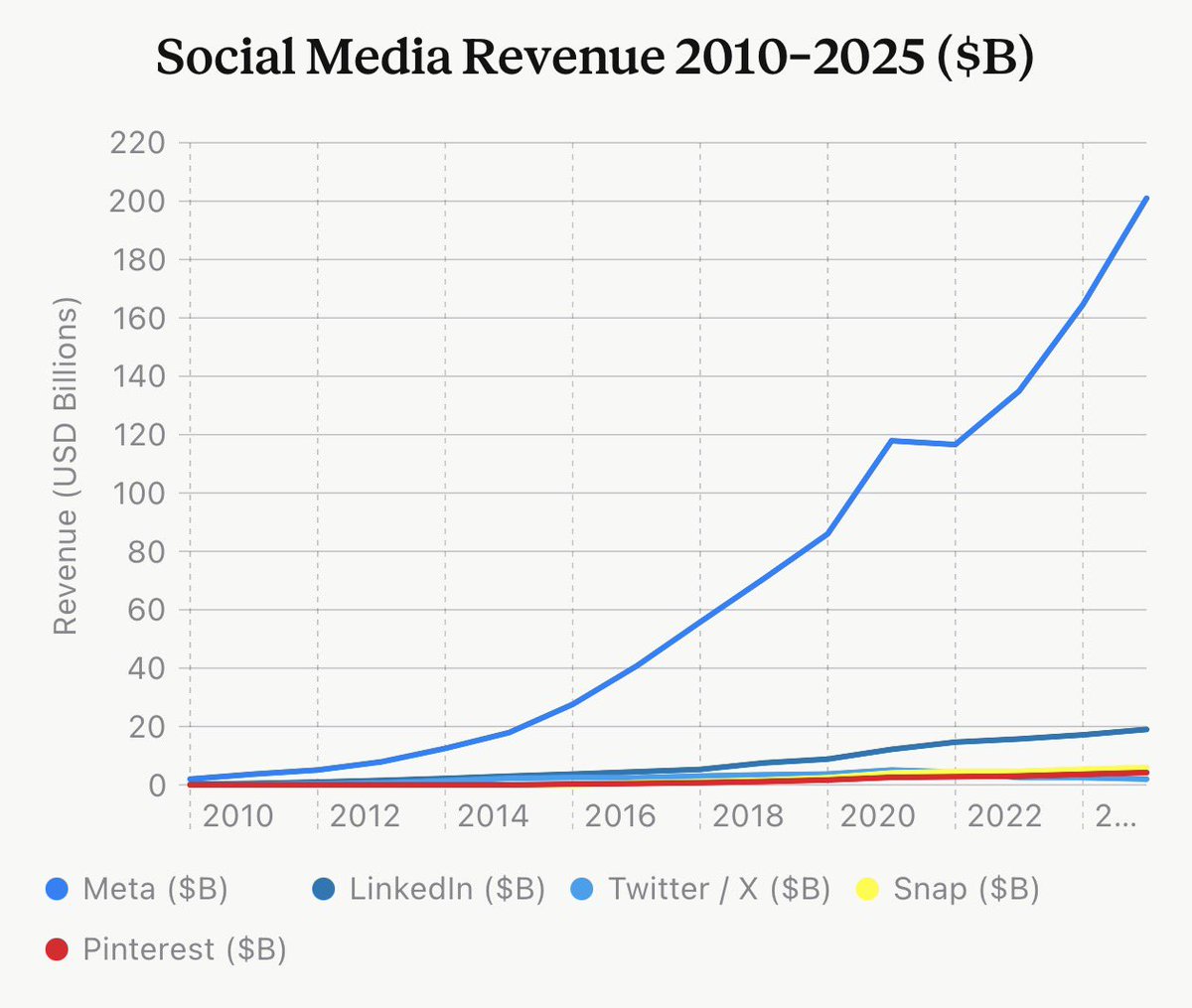
Zuck is a terrible innovator, but he's one of the best hyper-scalers. Bought: - Instagram - Whatsapp Copied: - Snap - TikTok - Twitter Him vs everyone else:
Preston tweet media
English
42
38
727
32.5K
underdav retweetledi
Ulrich
Ulrich@UlrichFm·
Jusqu'à ce jour, les marxistes sont incapables de donner une réponse satisfaisante à ce genre de meme. C'est dire la nullité de leur pensée économique. La valeur n'est pas dans le bien ni dans l'effort fourni pour le produire. Elle est dans l'esprit de celui qui désire ce bien pour résoudre un besoin individuel. La valeur est donc subjective, marginale, contextuelle. Elle n'est pas objective, mesurable, mathématisable. Ainsi s'écrase lamentablement la théorie marxiste de la valeur travail et les théories classiques de la valeur objective. Si ces théories ont réussi à survivre jusqu'à aujourd'hui, c'est uniquement parce qu'elle donne une caution scientifique à l'interventionnisme étatique, rien d'autre.
I,Hypocrite@lporiginalg

Français
1.1K
3.7K
28.2K
32.3M
underdav retweetledi
Joe Nakamoto ⚡️
Joe Nakamoto ⚡️@JoeNakamoto·
a great day to share this graph
Joe Nakamoto ⚡️ tweet media
English
136
2.2K
13.8K
624.8K
underdav retweetledi
Benoit Dubosson
Benoit Dubosson@beniduboss·
The French Elon musk just released a mobile data plan that’s 19.99€ It offers unlimited data in all red countries In Switzerland the cheapest plan by the leading provider for unlimited data and 0 roaming is 69.90 CHF How did Niel pull this off lol I bet I am gonna see Swiss friends with French phone numbers in the coming months lol
Xavier Niel@Xavier75

English
163
150
4.7K
962.1K
underdav retweetledi
John Fadule
John Fadule@fadule_·
Life is amazing: -gyms exist -Christopher Nolan movies exist -hot girls outnumber even moderately put-together dudes 2000 to 1 -you and your wife can get drunk at a dimly-lit steakhouse then go home and watch Titanic and smash all night without a condom -you and your friends can hit the gym then smoke a joint at a Coldplay concert -every food item in the world has been hunted and gathered for you (grocery stores) -you could be working 16 hour days in a coal mine in a third world country -you’re spinning on a sphere in an infinite universe and the fact you’re alive is a 1 in 500 trillion miracle If anyone ever complains in front of you tell them they’re an idiot :)
English
120
447
8.8K
655.3K