@CryptoCoffee369 let it be true.. it's been soo long. h0ly f**k.😍😍😍😍😍😍😍😍😍😍😍😍😍😍😍😍😍😍😍
English
Unprotectedhex
200 posts

@unprotectedhex5
pDAI to $1.00 5555 Hexican $HEX $PLS $PLSX $pDAI



ERC-1967 in plain English (no tech jargon): Imagine #pDAI is like a super-secure digital vault that holds everyone’s money and keeps the coin stable at $1. Normally, once a vault is built and its address is shared with the world, you can never change how it works inside, because changing it would mean building a whole new vault and telling every single user, exchange, and app to move to the new address. That’s messy, risky, and breaks trust. An ERC-1967 proxy is a clever trick that solves this. It’s like having a permanent “front door” (the proxy contract) that never moves. Behind that front door is a separate “control room” (the implementation contract) that actually decides how the vault behaves, how it pegs the price, handles fees, talks to oracles, etc... When the team needs to improve or fix something, they simply swap out the control room for a newer, better one. The front door (and everyone’s money inside it) stays exactly where it is. No one has to update their wallets, no one loses access, and the coin keeps working without interruption. ERC-1967 is just the official, battle-tested rulebook that says exactly where to safely store the note that points to the current control room. It stops accidental mix-ups that could crash the whole system. Why this is a massive win for pDAI and PulseChain: Here’s what it actually means for users and the ecosystem: #pDAI stays “immutable” in the way that matters most. The contract address everyone knows and trusts never changes. It still feels rock-solid and “government-proof” because nobody can force a migration or seize a new contract. Yet the team can quietly upgrade the inner workings whenever needed, for example, to add better stability tools, fix a small bug, or connect new protocols. You get the best of both worlds: looks permanent, but can evolve safely. Stability enforcement without drama. The tweet mentioned “multi-protocol solutions for enforcing stability.” With the proxy live, pDAI can now plug in different mechanisms (oracles, collateral types, or emergency tools) over time without redeploying the entire stablecoin. If one method stops working perfectly, they can upgrade to a better one instantly, keeping the $1 peg rock-solid while the chain grows. No forced migrations for users. Your pDAI in your wallet, in liquidity pools, or in other DeFi apps stays exactly where it is. No “please move to new pDAI v2” headaches. Liquidity never gets split, and trust never gets shaken. Cheaper and safer for a smaller chain like PulseChain PulseChain is fast and low-cost, but it’s still growing. Being able to upgrade without creating new tokens or splitting the community is huge. It prevents the kind of messy forks or liquidity drains that kill smaller chains. Everything stays in one place, making the whole PulseChain ecosystem stronger and more attractive to new users and developers. Future-proofing without losing the original promise pDAI was built to be the stablecoin that governments can’t touch or shut down. The proxy lets it stay true to that vision while still being able to adapt to real-world changes (new regulations, better tech, or market shifts). It’s like having a car that never needs a new VIN plate but can still get engine upgrades at the shop. In short, the “1967 friend” the tweet referred to is this exact upgrade system now being turned on for pDAI. It’s the quiet but powerful move that lets pDAI remain the most trustworthy stablecoin on PulseChain, permanent on the outside, smart and adaptable on the inside. The game really is afoot. #pDAI = $1 is INEVITABLE ❤️💛🧡💚💙🩵💜🩷🤍❤️


Elon responded to @RichardHeartWin tweet.



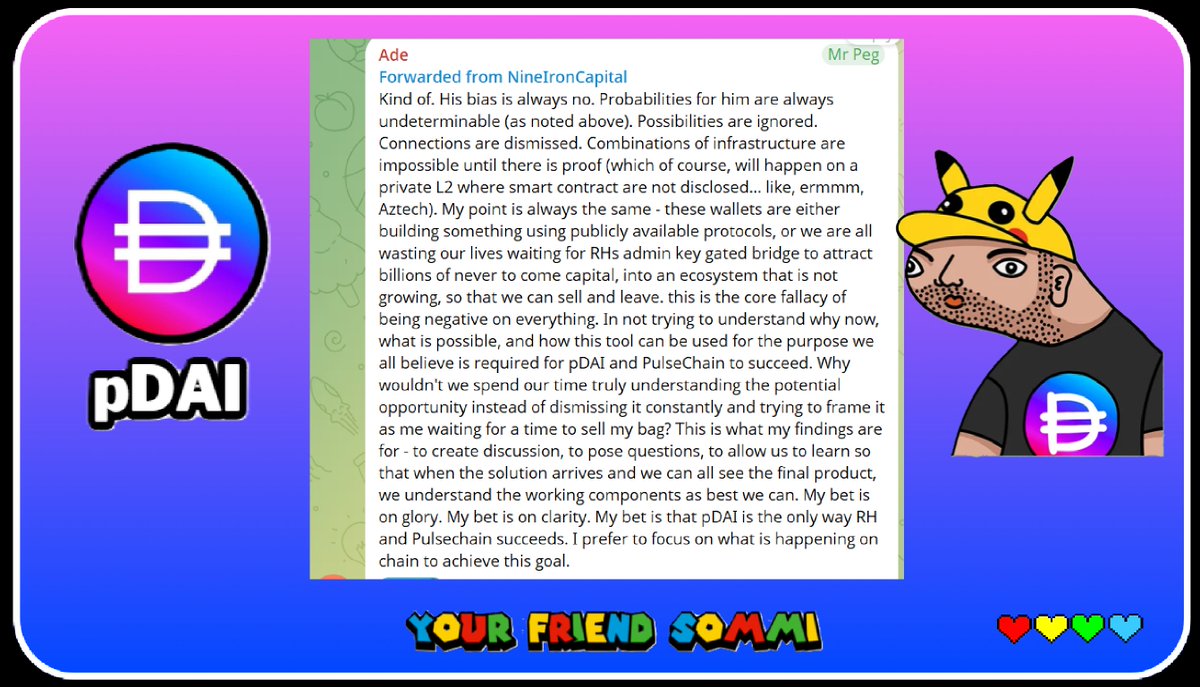



Gearbox liquidations and Aztech RollupProcessor Bridge validation. It feels like things are heating up again. $pDAI to $1.