

user_authorized
617 posts



@sparbuchfeinde OK aber Cathie Wood kam über Quote rein, bei einer Deutschenquote wäre das Jens Ehrhardt gewesen.
Deutsch

Die Pyramide der besten Investoren. Kein Deutscher darunter. Selbst Dirk Müller und Frank Thelen fehlen.

Deutsch
user_authorized retweetledi

The largest open library in human history, Anna's Archive, has been ordered to pay Spotify and the three largest record labels on the world $322 million.
The defendant has not appeared in court and is not going to. The site is still up with two backup domains standing by and there's nothing the censors can do.
Anna's Archive currently holds 63 million books, 95 million academic papers, and 1.1 petabytes of mirrored torrents. It is free. It is searchable. It is run by a pseudonymous person nobody has identified after four long years of searching.
In the four months since the music industry filed the first of three coordinated lawsuits, the library has lost six domain names and added two million books to the catalogue. The cartel is suing it faster every month, and it is growing faster every month.
In December, Spotify and the major labels filed. In January, OCLC, the company that runs WorldCat, won a default judgment of its own. On March 6th, thirteen of the largest book publishers in the United States, including HarperCollins, Penguin Random House, Simon and Schuster, Macmillan, Hachette, Elsevier, Wiley, and McGraw Hill, filed a third lawsuit in the same federal court.
The publishers' complaint runs to seventy-four pages. They call Anna's Archive a "brazen pirate operation." They call it "an illegal supplier of stolen content to the AI industry."
The same publishers are simultaneously suing Anthropic, Meta, OpenAI, and NVIDIA for training their models on the same corpus the publishers want Anna to destroy. The cartel argues, in two parallel federal courts, that the corpus cannot be used by anyone. Not the pirate who built it. Not the AI company that downloaded from it. Not the graduate student who pulls a paywalled paper from it at two in the morning.
Anna did not respond to any of the three complaints. Anna has never responded to any complaint. Anna is a name on a blog and a public key on a server and a person, or maybe several people, in a jurisdiction nobody has identified after four years of searching.
The judgment is uncollectable. The permanent injunction binds Cloudflare, Public Interest Registry, Njalla, the Switch Foundation, Tucows, and nine other named intermediaries. The Greenland registry is not on the list. The Greenland registry has not complied.
The site currently lives at .gl, with .pk and .gd standing by. The corpus has always moved faster than the censor. The censor has always called the corpus piracy. The corpus has always survived the censor by becoming the readers themselves.
The publishers' lawsuit cannot reach the torrents. The torrents are already seeded across continents and IPFS nodes and personal NAS drives owned by people the publishers will never find. The default judgment is paper. The corpus is everywhere.
The cartel will win every lawsuit but they will lose the war. The publisher who walks into court next month with a fresh filing will be filing against a defendant who has, in the time since the last filing was sealed, mirrored another half million books to another seven hundred volunteers in another forty countries.
There is no defendant to find. There is only the next upload. It is already seeding.

English

Say you make €120k a year fully remote but have to live in Europe
Where do you live?
English
@punktpreradovic @BSchmerzenreich Liebe Milena vergiss nicht, die Welt ist so gross und es gibt unendlich viele Themen. Den Plattformen kannst Du letztlich nicht vertrauen, investier lieber in Deine Marke. Plattformen und Algorithmen kommen und gehen, Du bleibst hoffentlich noch lange.
Deutsch

@BSchmerzenreich Vielen Dank...ja, ich bin in "unserer Demokratie" angekommen, uff 😎
Deutsch

Milena scheint in einer Art Shadowban zu sein. Viel Reichweite habe ich zwar nicht, aber ich versuche gerne, die Verbreitung zu erhöhen.
Milena Preradovic@punktpreradovic
Neu auf @punktpreradovic on X: Autor @FelixFeistel . Die Pandemie-Panikmache läuft wieder - Ob Hantavirus oder Vogelgrippe. Passend: Nach Corona hat die WHO das „Jahrhundert der Pandemien“ ausgerufen. Die Impfhersteller erwarten bis 2035 mehr als 50 Prozent mehr Umsatz. Tierviren, die auf den Menschen überspringen – Zoonosen – sind trotz der inzwischen widerlegten These von der Fledermaus aus Wuhan die Zielrichtung von Organisationen, Stiftungen, Politik und Pharma. Autor Felix Feistel belegt in seinem Buch „Corona – Next Level – wie die nächste Pandemie vorbereitet wird“, wie mit unnützen PCR-Tests Seuchen und Zoonosen herbei-inszeniert werden können. „Mit Corona hat man angefangen, Menschen wie Nutztiere zu behandeln“, so Feistel. Ich würde mich freuen, wenn ihr meine unabhängige journalistische Arbeit unterstützt, damit ich auch in Zukunft weitermachen kann. Vielen Dank! Ich möchte mich auch ganz herzlich bei allen bedanken, die mich bereits unterstützen. Milena Preradovic Name: Milena Preradovic IBAN: AT40 2070 2000 2509 6694 BIC: SPFNAT21XXX oder paypal.me/punktpreradovic oder Cryptos Unterstützung in SOL und NAKMAK: 2CaVpf3NJEFdoUZeMAWvTK8aQzxQsMrgTBz5kWiH3Qvy Buchbestellung „Corona Next Level“: amazon.de/-/en/Corona-n%…
Deutsch
@pavlibeis @Bluestitch_ At the individual entrepreneur level, things are pretty good. But the entire administrative side, banking, capital market, immigration, rule of law, antitrust law, it's all abysmal. It makes sense that they outsourced the two airports that bring the money in to the French.
English

@Bluestitch_ the tech dreams pushed to the island is an accounting Ponzi scheme for tech companies. There is zero tech applied in solving actual problems : cost of energy, traffic, water management, recycling, bureaucracy have seen zero improvement the last 5 years, tech is a fancy facade
English

🇨🇾 Cyprus is dreaming of a Silicon Island, but with Limassol rent for a 1-bedroom apartment hitting €1,500, basic housing has become a luxury.
When the people we need to build our future cannot afford to live here, the vision starts to look like a gated community.
With remote work and tech relocations pushing demand to its limit, we are seeing exactly what happens when infrastructure does not keep up with ambition. If we do not pivot from luxury towers to affordable, high-efficiency housing, our top talent will simply find a future somewhere else.
A smart city isn't just about fast internet. It is about a roof you can afford. It is time to build an island for everyone, not just for the few.
English
@Bluestitch_ Cyprus is full of lethargic low IQ bureaucrats, they will be looking for the lowest risk rent collecting opportunities forever. Good luck getting them on your side to take risks, be fast, think beyond rent collection.
English
user_authorized retweetledi
In April, a website that has been sued, blocked, deplatformed, and chased across thirty-seven domains over fifteen years quietly launched its own AI.
Sci-Hub is the largest unauthorized library of scientific papers in human history. Ninety-five million academic papers. Tens of millions of books. Built and maintained by a single Kazakhstani neuroscientist named Alexandra Elbakyan since 2011, funded by donations, hosted on whatever country's registrar will tolerate it that year, mirrored across torrents and IPFS and Telegram bots.
Elsevier sued. Sci-Hub stayed up. The American Chemical Society sued. Sci-Hub stayed up. India sued. Sci-Hub stayed up. Swedish registrar Njalla cut the .se domain in January. Sci-Hub stayed up at .al, .ru, .ee, .box, and a half-dozen .onion addresses the registrars cannot reach.
Now the library has built its own intelligence.
Sci-Bot launched in alpha in April. You ask it a research question. It answers, and it cites real papers from inside the corpus, with links that actually open the actual papers.
The bot does not hallucinate citations. It cannot, because it only draws from papers it actually holds. The same property that the venture-funded labs have spent four years and forty billion dollars trying to engineer back into their products is a free side effect of training the model on a library that contains the books.
Anthropic, OpenAI, Google, and Meta have all been sued in the past eighteen months for training their models on the same shadow libraries that Sci-Hub assembled. Meanwhile the corpus those scripts were pointed at, the corpus those models were trained on, the corpus the entire generative AI industry is built on, sat right there the whole time, free, with a search box on top.
The pirates beat them to it.
Sci-Bot was built on a corpus that was already free, by a team that asked no permission, charging no one, with the explicit position that the right to read scientific research is older than the cartel that decided to charge for it.
The same arithmetic the medieval guilds used to keep the printing trade in approved hands. The same arithmetic Pope Paul IV used in 1559 to publish the Index Librorum Prohibitorum. The same arithmetic the Stationers' Company used in seventeenth-century London.
Knowledge has always had a fence around it. The fence has always been guarded by men who did not write the books.
The library answers. We never asked permission. We never had to.

English
@KSimback @AskVenice The token does not represent equity, there are no accounting rules, no audits. Why does a high-growth company waste cash for token burns? The key remains revenue growth, barrier of entry / network effects. Anonymization creates compliance risks.
English

Is the VeniceAI $VVV token overvalued?
I’m a big fan of @AskVenice and have been using the product for ~2 years
And lately VVV has been ripping so I wanted to dig into the numbers
The closest comp product-wise is probably OpenRouter and they currently do ~60x the inference volume at ~2x the valuation
Not a good sign for VVV, at least at first glance
But, Venice is a bit different- it offers privacy (premium service) and routes a portion of traffic through its owned GPUs unlike OpenRouter which doesn’t own any infra
So maybe a better comp is TogetherAI which also owns GPUs
Together does ~45x the inference volume at about ~11x the valuation (currently raising a $7.5b round)
Looks a bit better but hard to argue VVV is undervalued by any stretch using those comps
Revenue would be a better metric as inference volume matters little unless it translates to revenue
OpenRouter is reportedly doing $50m ARR while TogetherAI has $1b in revenue
The Venice revenue numbers are not reported, but we can infer a bit with the VVV token burns + some assumptions
In the last 30 days approx 32.6k of VVV has been burned, equating to about $350k of burn-time value
If we assume a 50% burn rate, that puts Venice ARR at ~$8.4m
That is a revenue multiple of ~80x for Venice vs 26x for OpenRouter and 7.5x for TogetherAI
So again, not cheap, but the 50% burn rate is just an assumption, if they’re only burning 15-20% of revenue then that puts them closer to the 26x revenue multiple of OpenRouter
Hard to truly know without more revenue disclosure from the Venice team but at current market cap (all my analysis used mcap not fdv) it doesn’t look cheap vs the notable comps in the inference space
English
@ErikVoorhees They want total control to debank dissidents and finance wars.
English

"deeper capital market integration through the savings and investment union and a stronger safe asset base"
translation:
"banks bribed us sufficiently"
European Central Bank@ecb
Stablecoins are not an efficient way to strengthen the international role of the euro, says President Christine @Lagarde. The best solution remains deeper capital market integration through the savings and investment union and a stronger safe asset base ecb.europa.eu/press/key/date…
English
@liftlines @RjeyTech Did you document the setup or is there a download somewhere?
English

@RjeyTech I can do one better than that @RjeyTech 😎
$30 band straight from OEM. Does BP HRV Sleep SpO2 Steps Stress. Reasonably accurate. Local in-app AI Agent that spots unusual patterns and alerts me.
No data leaves the app. No subscription BS.
Adding air quality monitor next!
Kaushal / liftlines@liftlines
Built a fully local wellness app that monitors usual health stats (movement, sleep, HRV, BP, etc.) with a baked-in LLM that alerts me when things seem unusual. Does anyone know a good portable air quality meter with an open interface that I can add to this setup for correlation?
English

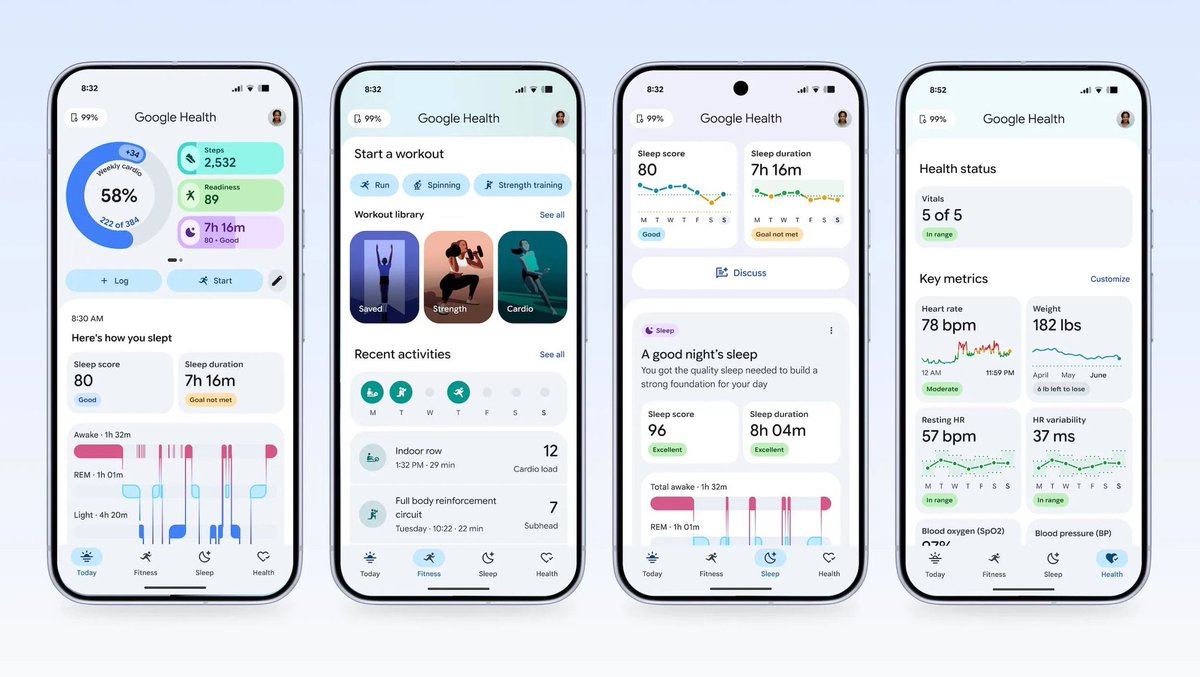
If you bought a Whoop, I feel sorry for you.
Google’s Fitbit Air just made it look silly
- $100 one time payment vs Whoop’s $199–$359/year forever
- Free tier actually works HR, sleep, SpO2, HRV, recovery, no paywall
- Optional $10/mo for Gemini Health Coach (vs Whoop where the sub is mandatory)
- Gemini analyzes meal photos, not just biometrics. Whoop can’t touch that
- Conversational health AI ask questions like why was I tired Tuesday?and get a real answer
- Open data platform Apple Watch, Garmin, third-party data all flow into Google Health
- 7-day battery, 5-min quick charge = full day
-Whoop just got a $10B valuation… and Google undercut them by 50% on day one


English
user_authorized retweetledi

An MIT mathematician sat down in 1950 and wrote a small, non-technical book aimed at the general public. He was not predicting the future. He was warning them. He said machines would eventually replace human work, optimize ruthlessly for the wrong goals, and quietly turn human beings into components inside systems they did not control.
Almost nobody listened. 75 years later, every warning he made has come true.
His name was Norbert Wiener. The book is called "The Human Use of Human Beings."
The textbook story of AI ethics says the field began in the 2010s, when Stuart Russell, Nick Bostrom, and a small group of researchers started writing about the dangers of intelligent machines. That story is wrong. The first serious book about the ethics of AI was published in 1950, by a man who had personally invented the science that AI would eventually be built on, and who saw exactly what was coming with a clarity nobody else managed to match for the next 70 years.
Here is the story almost nobody tells you.
Norbert Wiener was a child prodigy. He graduated from Harvard at 14. He had a PhD in mathematics by 17. He became an MIT professor before he turned 30. During World War II he was assigned to work on anti-aircraft fire control systems. The problem was simple and impossible. How do you aim a gun at a fast-moving plane that will not be where it is by the time the shell arrives.
His answer turned into a new science. He called it cybernetics, from the Greek word for steersman. In 1948 he published a technical book by that name. Cybernetics was the foundation of modern control theory, robotics, and almost everything that became artificial intelligence. The book was dense. Most readers could not get past the math. The ideas inside it were too important to leave trapped in equations.
So in 1950 Wiener sat down and wrote a second book aimed at ordinary people. No equations. No jargon. Just consequences. He titled it The Human Use of Human Beings. It is barely 200 pages. It is one of the most prescient documents ever written about technology.
The first thing he warned about was automation.
He predicted, in 1950, that machines would replace human work across every industry. Not just factory work. Not just manual labor. Any task that could be reduced to a procedure would eventually be automated. He specifically said white-collar work would not be safe. Bookkeeping. Translation. Drafting. Calculation. Anything where a human was being paid to follow a defined process would eventually be done by a machine for a fraction of the cost.
He was not celebrating this. He was warning about it. He said the social consequences would be enormous, that entire industries would collapse, that the value of human labor itself would be undermined for tasks where humans had been useful for centuries. He wrote this 75 years before ChatGPT made every white-collar professional check their job description twice.
The second thing he warned about was the alignment problem. He did not call it that. The phrase did not exist. But he described it precisely.
He said that machines optimize for the goal you give them. They do not optimize for what you meant. They optimize for what you wrote down. If the goal is poorly specified, the machine will pursue the literal version of it with terrifying efficiency, and the result will be a disaster the builders did not foresee.
He used the metaphor of the magic monkey's paw from a horror story by W.W. Jacobs. A grieving father wishes his dead son alive again. The paw grants the wish. Something climbs back out of the grave that is technically the son. The wish was granted exactly as stated. The outcome is hell.
Modern AI safety researchers use almost the same metaphor 75 years later. They call it specification gaming, reward hacking, mesa-optimization. The names are new. The problem Wiener described in 1950 is exactly the same.
The third thing he warned about was the loss of human agency.
He predicted that humans would gradually surrender their decision-making to systems they did not understand. Not because the systems would force them to. Because the systems would be more convenient, more accurate, and more profitable than human judgment. People would offload their navigation, their reading, their relationships, and eventually their thinking to optimization processes designed by companies whose interests were not aligned with their users.
He said something in 1950 that I cannot stop thinking about. He said the more efficiently a society delegates its decisions to machines, the less able it becomes to make decisions at all. The atrophy is gradual. By the time anyone notices, the capacity to choose is gone, and what remains is people executing decisions that were made for them, by systems they did not build, in service of goals they were never asked about.
Look at modern social media feeds, recommendation algorithms, dating apps, navigation systems, news aggregators, and you are looking at exactly what he described.
The fourth thing he warned about was the easiest one to ignore at the time and the most disturbing now.
He warned that authoritarian regimes would use the new computing technology to track, manipulate, and control populations at a scale never previously possible. Not in the future. Soon. He said the same techniques that made cybernetics useful for guiding missiles would be used to guide societies, and that the small, incremental decisions about what to optimize, who to surveil, and how to feed information back into the system would compound into a kind of soft control that did not need force to function. People would do what the system wanted because the system would shape what they wanted in the first place.
He saw modern surveillance states 75 years before they existed.
The strangest thing about reading the book in 2026 is realizing how few of these problems have been seriously addressed.
Wiener was not anti-technology. He had personally helped build it. He was not nostalgic for a pre-machine age. He was warning that any tool powerful enough to amplify human capability is also powerful enough to amplify human stupidity, greed, and indifference, and that the dangers were not in the machines themselves but in the unwillingness of human institutions to ask hard questions about who the machines were being built for.
He died in 1964. He never lived to see most of his predictions come true. He never used a personal computer. He never followed a hyperlink. He never saw a modern recommendation algorithm.
He just wrote down, in 1950, in plain English, what the world would look like when the technology he had helped invent was built out by people who had not read his warnings.
The book is around 200 pages. It is in print. Used copies are everywhere for under ten dollars. It reads like science fiction in which the author already knows how the story ends.
The first serious book about the ethics of AI was published before there was any AI to be ethical about. Almost nobody who works on the problem today has read it.
The warnings are the same. The author has been dead for 60 years. The book is one click away from anyone who wants to read it.

English
user_authorized retweetledi



@gregosuri @unusual_whales Looks quite deceptive to me. Which utilization can reasonably be expected, how about electricity cost? Are you using this product yourself?
English

@unusual_whales We purpose-built Akash Homenode exactly for home datacenters.
I proposed this to Congress in my testimony as a solution to the data center energy crisis. (congress.gov/119/meeting/ho…)
homenode.akash.network
English

BREAKING: Nvidia, $NVDA, and PulteGroup are partnering with Span to install in-home mini data centers.
Each packs 16 Blackwell GPUs, 4 AMD EPYC CPUs, and 3TB RAM, powered by unused household electricity for AI inference.
English

@josephdelong @colossuspay @EtherFi Bare foot in the office, I just know what I need to change here. Keep going!
English


They are really cooking in the @Keycard_ discord channel 🤩
This is the hardware wallet for the tinker in you 👷🛠️
Come and check it out: discord.gg/uJAXk7jFhZ


Kaushal / liftlines@liftlines
You know what else you can do with your @Keycard_ hardware wallet? Customise it to your heart’s content and make it not look like a hardware wallet 🎮😎 Fun? Come join the community on discord to see all the fun we are having there! Credits to @alisher 🔥
English
user_authorized retweetledi

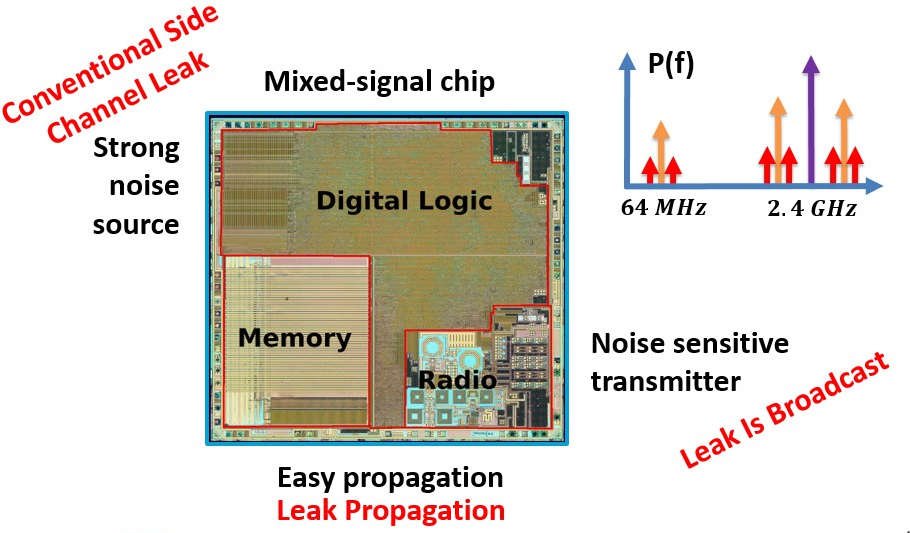
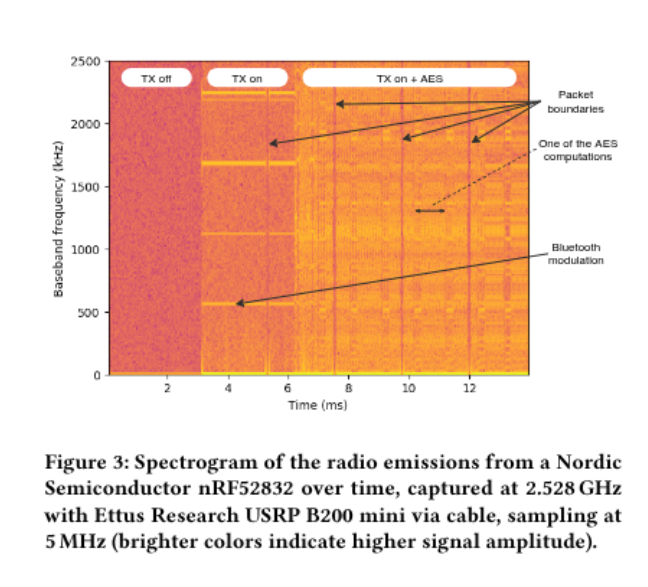
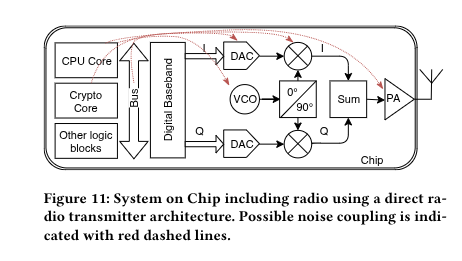
The RF world is insane.
Researchers recovered AES-128 keys from a Bluetooth chip by listening to its own antenna from 10 meters away.
Crypto-engine switching noise couples into the RF chain, rides the 2.4 GHz carrier, and leaks out as radio.
English
@ChartaResearch @BBarucker Anders als Sixtus hat er aber seine alten Tweets noch nicht in archive.org löschen lassen. web.archive.org/web/2022071814…
Deutsch

@BBarucker Professor Schieffer hatte von Anfang an ua. auf Twitter Impfgeschädigte als Long Covid Patienten deklariert. Und er hat ganz offensichtlich seinen alten Account geschlossen und einen neuen Account eröffnet, er war bereits *lange* vor 2025 auf Twitter aktiv.

Deutsch

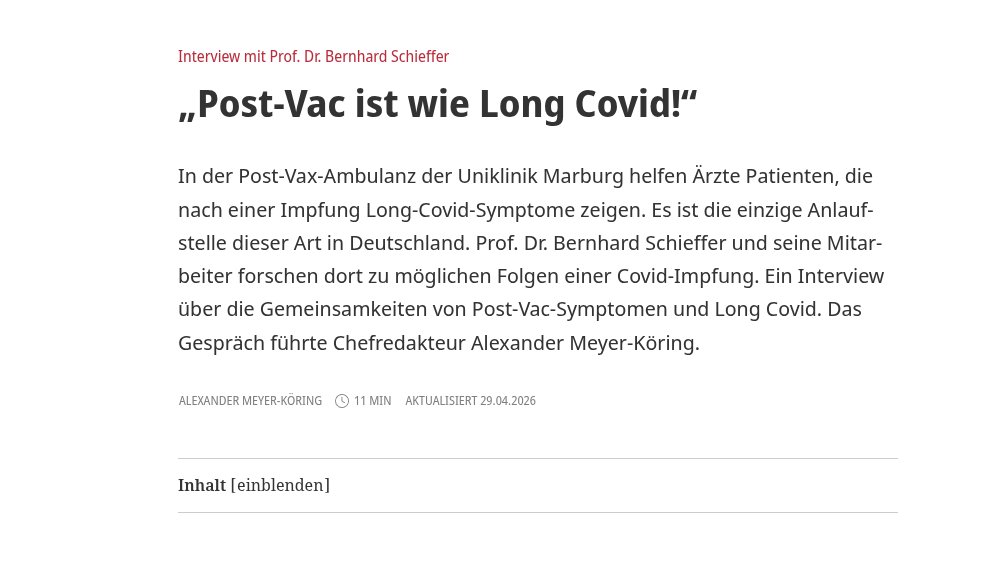
Prof. Dr. Bernhard Schieffer von der Post-Vax-Ambulanz der Uniklinik Marburg trifft bemerkenswerte Aussagen zur Unterscheidung zwischen einem Impfschaden durch einen mRNA-Impfstoff und Long Covid: «Insofern haben wir das mal eine ganze Zeit lang getrennt, um die Patienten parallel zu beobachten. Und festgestellt, dass die klinische Symptomatik identisch ist»
«Unterm Strich führt ja an einer Impfung grundsätzlich nichts vorbei. Man muss sich die Risikopatienten aber genauer anschauen. Es war immer unser Ziel als Mediziner, die Bevölkerung zu schützen, indem wir sie impfen.»
«Im Verhältnis, muss man auch dazu sagen, hat sich gezeigt, dass die Mehrheit unserer Patienten tatsächlich Long Covid-Patienten nach Infektion sind.»
«Eine der wichtigsten Aussagen ist, dass das Post-Vac-Syndrom – wie es im Augenblick beschrieben wird – tatsächlich ein Long Covid nach Impfung ist.»
«Wir sehen die Patienten und natürlich haben Impfungen Nebenwirkungen. Darüber klären wir unsere Patienten ja auch auf.»
«Jeder fünfte bekommt Long Covid.»
rechtsdepesche.de/post-vac-ist-w…
Deutsch
user_authorized retweetledi

You can't make this up.
It's World Press Freedom Day, and these posters are on my doorstep: "Free Press. Protect what matters to us."
The very same @eucouncil literally sanctioned me for exactly that.
This is definitely going to be my campaign poster.

Hüseyin Dogru@hussedogru
You literally sanctioned me for exercising my freedom of speech.
English