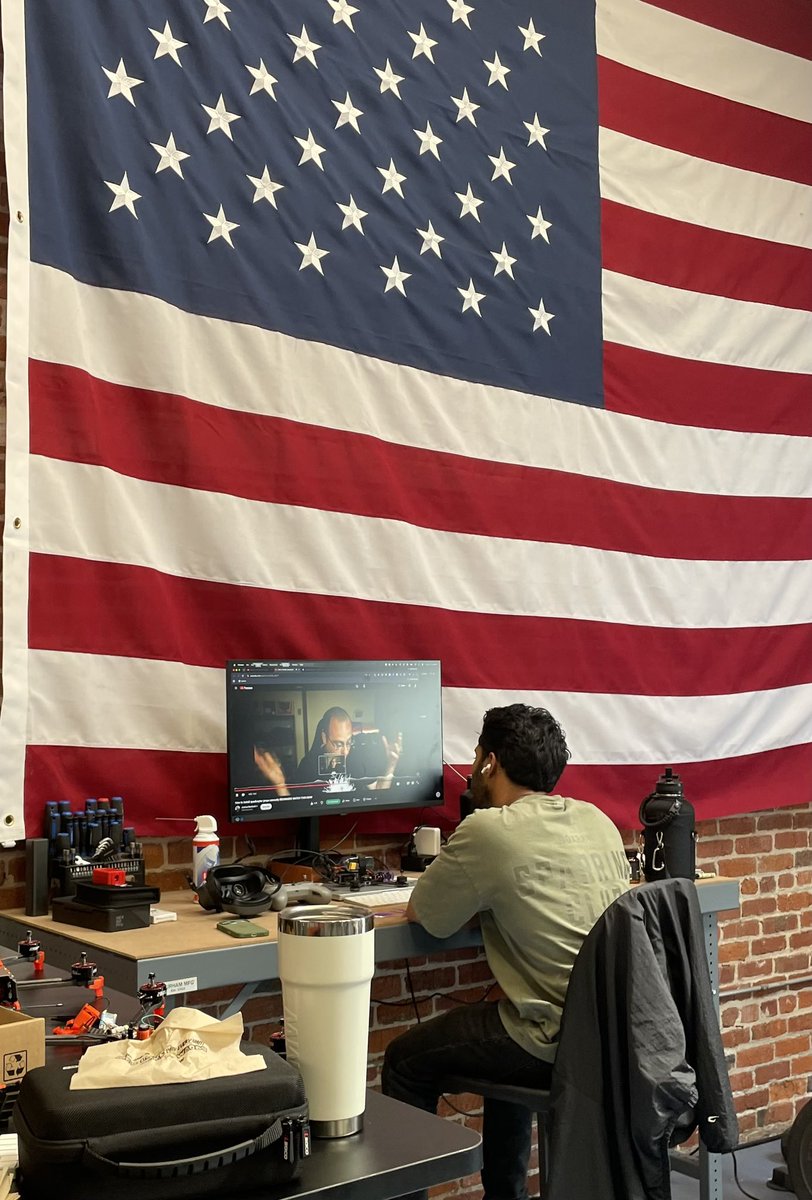
@radbackwards cc @shahedkhan your boy Trent might be a good connect here!
English
Vinay Hiremath
13.5K posts

@vhmth
currently: vibing with drones, previously: co-founder @loom, mechatronics intern @specter



Dear America, Starting today, on the 250th birthday of our country, millions of children will now benefit from a new & powerful American birthright - a privately owned investment account from birth. Every child a shareholder in the great American economy! American capitalism is the greatest prosperity-creating engine the world has ever known. It has unlocked unprecedented abundance for our country and untold life-advancing innovation. From clean food & water to cars & planes to vaccines & cures to computers & phones. Through depressions & world wars, through panics & pandemics, betting on America has been the best investment in human history. But far too many hardworking families feel like they are on the outside looking in - like the American Dream has become out of reach. The Invest America Act changes all that. Signed into law by President Trump it establishes the Trump Accounts - launching today - making every child a shareholder from birth. Every account seeded with $1000 in America's best companies - making every child a direct participant in our stock markets & American capitalism. But it doesn’t stop there. Representing the best of our civic traditions, an unprecedented outpouring of additional private contributions into these accounts is already underway. Billions of dollars have been committed by philanthropists & corporations to tens of millions of children across the country. A new form of massive, direct philanthropy & corporate benefits directly to America’s kids is just getting started. From adopting all the kids of a school or organization to a city or state. America is the most giving country in the history of the world - and Trump Accounts provide a new open source platform to enable anybody to contribute to anybody. Trillions of dollars will compound in these accounts over the next 20 years. But this is about more than just figures on an account statement. By investing in the next generation, our country is providing tangible opportunities to all future generations of Americans: an education, a first home, the ability to start a business, and the foundation for a lifetime of savings. Trump Accounts provide hope to those feeling hopeless - unlocking unlimited human potential. Trump Accounts do this through a massive public - private partnership that empower the individual not the state. They double down on free market capitalist democracy by empowering the individual rather than growing dependency on government. Aligning citizens with capitalism rather than pitting them against it. Perhaps of equal importance, let us not lose sight of the fact that this is a movement that unites our country. Despite the many issues that divide us, this one big idea brings everyone together. From the most conservative to the most progressive leaders, we have found people of goodwill willing to step up and do the right thing to help the next generation. Trump Accounts represent the very best of our democracy and the American promise issued two hundred and fifty years ago today. I am grateful to all those who have partnered with us to get this far and we dedicate our tireless efforts to make certain that the Invest America Act achieves its maximum potential. Let us advance into the future with a renewed sense of confidence, optimism and restored faith in the American Dream for EVERY American. Happy 250th Birthday, America! Brad Gerstner July 4, 2026 @TrumpAccounts @InvestAmerica24 @WhiteHouse @MichaelDell


More Democrats now prefer Socialism to Capitalism

Announcing a new division of Midjourney called "Midjourney Medical"