Kevin Costa

2.7K posts

Kevin Costa banner
Kevin Costa

Kevin Costa

@KevinJDCS

deploying belief capital @beliefholdings

San Francisco, CA Katılım Mayıs 2009
1.7K Takip Edilen977 Takipçiler
Sabitlenmiş Tweet
Kevin Costa
Kevin Costa@KevinJDCS·
excited to share the launch of belief capital and announce the close of our first fund! belief is built to be a concentrated, incentive-aligned partner to founders from day one, because founders don’t get to take a portfolio approach to life. grateful to the early support from LPs and friends -- onwards! sifted.eu/articles/belie…
English

18
7
102
10.2K
Kevin Costa retweetledi
Kevin Gee
Kevin Gee@kevg1412·
New compilation: @peterthiel Gandalf x Girard 500+ pgs on Western Civ, Tech, Politics, Education, Life No matter what you think of him, Peter is undeniably a genius (I don’t use this word lightly) and one of the most important people of this century drive.google.com/file/d/1TeLx_L…
English
5
29
175
0
Christoph Janz 🕊
In the last ca. 2 years we've invested in: - 200-ton autonomous dump trucks for open-pit mines 👋 @b_johannsen - Personalized cancer vaccines (serova.bio) - Autonomous navigation for spacecraft 👋@sumant_neo - Micro-drones that hunt mosquitoes (stealth) - A nitrogen-fixing, protein-rich crop that doesn’t exist in agriculture today (stealth)
English
3
0
21
2.5K
Steve Vassallo
Steve Vassallo@vassallo·
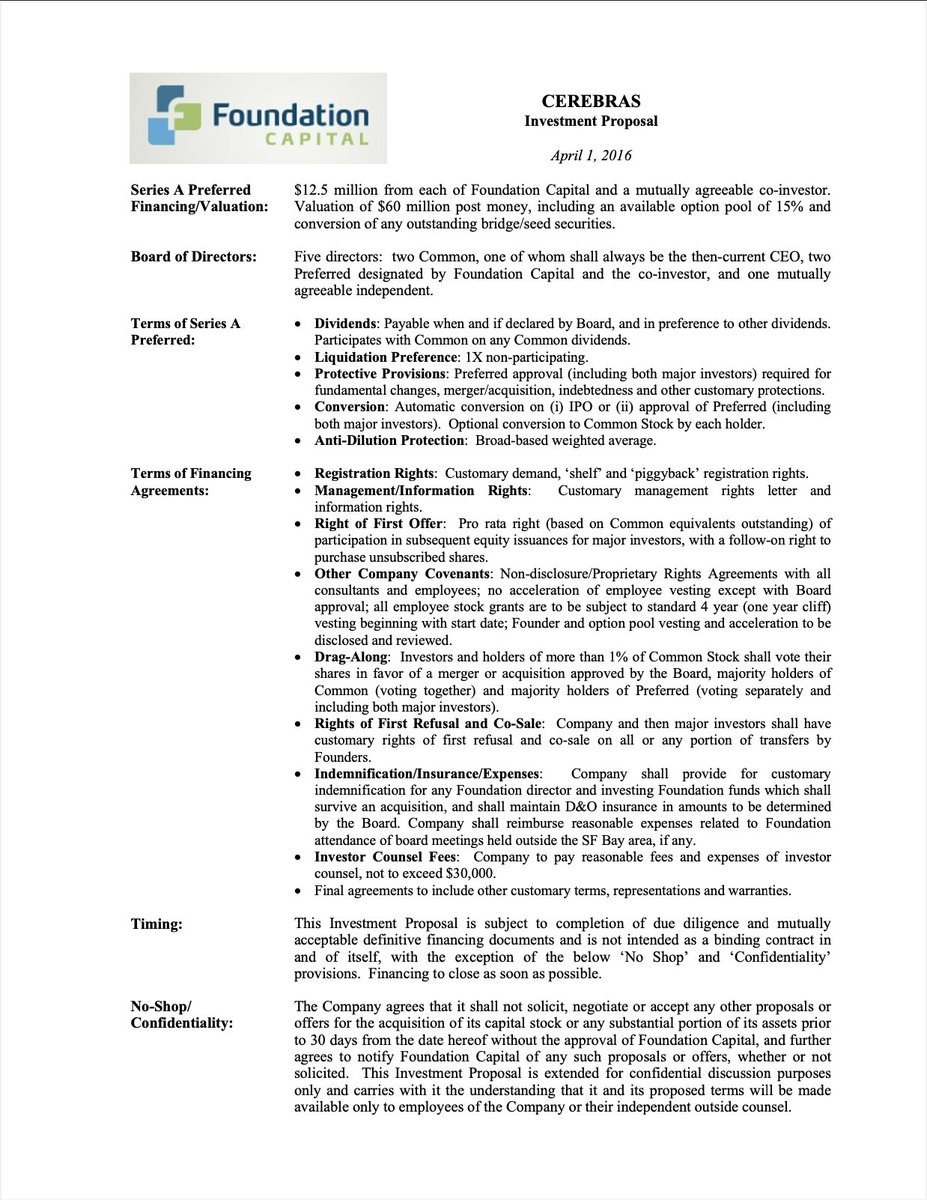
In April 2016, I threatened to climb over @andrewdfeldman's fence to give him his first term sheet for @cerebras. It was April Fool’s day, but I wasn’t fooling around. The story started in October 2007, when Andrew and his co-founder Gary Lauterbach had just started SeaMicro. Even then, Andrew was a force of nature. He was extremely intense and miswired in all the right ways. You could feel the sparks flying off him. We didn't invest in SeaMicro, but we stayed in touch. Andrew and the team built SeaMicro then sold it to AMD in 2012. When AMD acquired SeaMicro, I had a hunch Andrew wouldn't last long inside a big company. He has, as I've said many times, immense ambition and a heart full of disobedience. By early 2014, he was looking for an escape hatch. Over the next year and a half, Andrew and I met 6 or 7 times. Sometimes in our office. Sometimes at a coffee shop in Portola Valley. Sometimes at our local tennis and swim club. We kept coming back to one thing: deep learning workloads were growing exponentially, and traditional compute architectures couldn't keep up. GPUs had become the default for neural network training, mainly because researchers had accidentally discovered they were less terrible than CPUs. Andrew, Gary and Sean saw the GPU for what it was: a battlefield promotion of a chip optimized for graphics. Better than a CPU, but not what anyone would design starting from a blank sheet of paper. Their key insight was that memory bandwidth, not raw compute, was the real constraint on what neural networks could achieve. So Andrew, Sean Lie, Gary Lauterbach, Jean-Philippe Fricker and Michael James set out to do something nobody had pulled off in the 75-year history of semiconductors: Build a wafer-scale chip the size of a dinner plate. In April 2016, I asked Andrew if we could be his first term sheet. @ericvishria at Benchmark and I co-led the round along with Pierre Lamond from Eclipse. Then the hard work began. In the 75-year history of computing, no one had made wafer scale work. Which meant no one had ever had to solve the problems that came from trying. How do you power a chip that large? How do you cool one? How do you maintain electrical continuity across tens of thousands of connection points on a single piece of silicon? To get there, Cerebras had to invent in nearly every modern computing discipline at once: semiconductors, systems, data fabric, software, algorithms. Each was a startup in its own right. Their first wafer self-destructed on initial power-up and Andrew and the team were back in the lab the next morning, identifying what didn’t work and coming up with approaches to solving it. Yesterday, Cerebras went public. 19 years after our first meeting, 10 years after that April Fool's term sheet, they’ve built a generational AI company. From a coffee shop in Portola Valley to ringing the bell at the NASDAQ. What a journey. Proud to have been Andrew's first partner in Cerebras. Even prouder to call him my friend.
Steve Vassallo tweet media
English
40
37
419
90K
Charley Ma
Charley Ma@CharleyMa·
Everyone throws events for founders and investors. We wanted to do something different. Introducing Cliff Club: a community exclusively for early employees at venture-backed companies and we're starting with NYC first! 🧵
English
7
2
59
15.8K
signüll
signüll@signulll·
psa: your “unlimited minutes” cell plan is a lie & is actually capped at 44,640 minutes/month. wake up sheeple.
English
100
192
17.1K
501.9K
Vinay Hiremath
Vinay Hiremath@vhmth·
ripped a big buy of harmonic drive systems inc 🇯🇵
English
3
0
16
1.8K
Niko Bonatsos
Niko Bonatsos@bonatsos·
Never ever forget your first believers. They should always have a special place in your heart.
English
8
6
116
4.1K
Kevin Costa
Kevin Costa@KevinJDCS·
Lower GDP growth = long term tax pressure
English
0
0
2
97
Kevin Hartz
Kevin Hartz@kevinhartz·
Today, we're announcing A* III, a $450 million early-stage fund. We started @A_StarVC with the simple idea to be a founder's first believer. We are generalists by sector, but specialists in the stage and craft of seed investing. We partner with founders before there is consensus, before there is traction, and often before there is even a product. We are not organized around a market thesis. We back exceptional builders and follow them into the most important categories. That matters because seed investing has changed. It is more crowded, more visible, and increasingly transactional. Too often, firms use seed to secure an option and then wait for proof before investing real time and attention. Seed has become a market of access. We believe it should be a market of conviction. We built A* around a different model. We commit early. We show up before external validation, deploying both time and capital from day zero to help founders find their first customer, make an early hire, or work through the decisions that define the company. We are selective at the start and concentrated over time. We partner with a small number of founders and deepen our commitment as their companies take shape. The best outcomes come from knowing where to go deep and having the discipline to do it. This approach has led us to companies like Ramp, Decagon, Whop, Cape, Simile, Paraform, Watney Robotics, and Mercor. We're grateful to the founders who have chosen to build with us and to the limited partners who have backed us. With this fund, A* manages over $1 billion in assets less than five years after launch. Our job remains what it was on day one: back exceptional founders early and be the partner they need when it matters most.
English
109
36
802
80.4K
Bilal Zuberi
Bilal Zuberi@bznotes·
If you are at companies like OpenAI, DeepMind, Palantir, other multi-decacorns…you can also leave now. You will quickly get funded by VCs (I am happy to chat), and you can build a company to maximize value of your own massive equity stake.
Michelle Kim@michelletomkim

@techreview In 2015, Ilya Sutskever left Google to cofound OpenAI. "Google really liked me, and they didn't want me to leave," he says. "They offered me a staggering amount of money"—$6 million a year.

English
7
8
248
61.2K
Isaiah Granet
Isaiah Granet@zaygranet·
@huggingface have an urgent issue with billing fraud / security. Anyone avail to help?
English
4
0
5
1.2K
Kevin Costa
Kevin Costa@KevinJDCS·
what a time to be alive, not enough hours in the day
English
0
0
8
151
Patrick Collison
Patrick Collison@patrickc·
Which are the most common everyday phenomena that we don't properly understand? Off the top of my head: • Lightning (how does it happen?) • Sleep; dreams (why do they exist?) • Glass (thermodynamics of formation) • Turbulence (when does it start?) • Morphogenesis (how does a creature know what should go where?) • Rain (it seems to start faster than models would predict) • Ice (dynamics of slipperiness) • Static electricity (which material will donate electrons?) • General anaesthetic. (And the mechanism of a lot of drugs, e.g. paracetamol.)
Patrick Collison@patrickc

Some progress in lightning: quantamagazine.org/what-causes-li….

English
476
232
3.5K
1.2M
lito
lito@litocoen·
stoked to announce that im joining @ethena to lead a new product which will be revealed publicly soon after my last job, i thought i would take a longer time off but some opportunities don't wait for you there is a very short time window where you need to act or the opportunity may not be there in that form a few months later this was the case here everything i'm passionate about, reunited in one product all the stars aligned for that industry segment to explode over the next few years everything i've done in crypto so far, all the skills i acquired seem like preparation for this next chapter more soon
English
181
23
787
80.6K