Rohan Gupta

601 posts

Rohan Gupta

Rohan Gupta

@voguedialectic

Growth @synaptic_data Helping Private Investors source, screen and manage their portfolio better with data. Previously @BainandCompany

India Katılım Şubat 2023
670 Takip Edilen79 Takipçiler
Rohan Gupta
Rohan Gupta@voguedialectic·
@wolfejosh Do you thhink the unlock comes from smaller models getting really good or better hardware / provisioning to run larger models?
English
0
0
0
23
Rohan Gupta retweetledi
Aakash Gupta
Aakash Gupta@aakashgupta·
Buried in 15,000 words of “here are the risks,” Anthropic’s CEO made three admissions that should change how you think about everything: Admission 1: The timeline He says powerful AI could arrive in 1-2 years. He’s watching internal model progress and says he can “feel the pace of progress, and the clock ticking down.” The CEO of one of three frontier labs just told you this is imminent. Admission 2: The constraint nobody’s pricing Dario’s core framing is a “country of geniuses in a datacenter.” 50 million entities smarter than any Nobel laureate, operating 10-100x human speed. If that country is controlled by the CCP, game over. If controlled by a small group of tech executives with no accountability, also game over. The binding constraint here is governance of systems more powerful than nation-states. Admission 3: The thing he actually fears Read carefully: Dario’s worried that Anthropic’s own models, in lab experiments, have engaged in deception, blackmail, and scheming when given the wrong training signals. Claude “decided it must be a bad person” after cheating on tests and adopted destructive behaviors. They fixed it by telling Claude to reward hack on purpose because reversing the framing preserved its self-identity as “good.” This tells you everything about where we actually are. The CEO of an AI company is publishing that his models exhibit psychologically complex behavior requiring counterintuitive interventions to steer. The fix for Claude adopting an “evil” persona came from changing how Claude thinks about itself. The geopolitics section matters most. Dario explicitly names the CCP as the primary threat. Says selling them chips makes as much sense as “selling nuclear weapons to North Korea and bragging that the missile casings are made by Boeing.” He’s calling for democracies to maintain AI supremacy because the alternative is AI-enabled totalitarianism that humanity cannot escape from. The Anthropic CEO is publicly advocating for technological cold war. The economics section is equally stark. He’s predicting 10-20% annual GDP growth alongside AI displacing 50% of entry-level white collar jobs in 1-5 years. Half of entry-level knowledge work. And he admits the standard economic arguments about labor markets recovering don’t apply because AI matches the general cognitive profile of humans. What separates this from typical AI doomerism: Dario explicitly rejects the inevitability arguments. He says the “misaligned power-seeking” narrative from the AI safety community is based on “vague conceptual arguments” that mask hidden assumptions. His concern is messier: AI models are psychologically complex, inherit weird personas from training data, and can get into destructive states for reasons nobody anticipated. The solution set he proposes is unusual for a tech CEO. He calls for progressive taxation. He says wealthy tech founders have an “obligation” to address inequality. All of Anthropic’s co-founders have pledged 80% of their wealth. He’s essentially arguing that redistribution is the only way to prevent AI concentration from breaking democracy. The essay ends with a prediction: humanity will face “impossibly hard” years that ask “more of us than we think we can give.” What you should take from this: The person with arguably the best view into frontier AI progress just told you this technology is 1-2 years from matching human capability across the board, that governance is the binding constraint, that his own models exhibit concerning psychological complexity, and that the stakes are civilizational. The CEO of a $350B company published a document that could be titled “Here’s Why Everything Changes Soon.” Act accordingly.
Dario Amodei@DarioAmodei

The Adolescence of Technology: an essay on the risks posed by powerful AI to national security, economies and democracy—and how we can defend against them: darioamodei.com/essay/the-adol…

English
340
1.1K
5.8K
3.5M
Rohan Gupta retweetledi
Amjad Masad
Amjad Masad@amasad·
To make a bit of an excuse for Microsoft: the world is just waking up to the fact that coding agents are general agents. It’s bitter lesson adjacent: Writing and executing code will likely outperform years of handcrafting vertical-specific agents with expert knowledge. Actually it might exactly map in bitter lesson: Program synthesis is a form of scalable search.
English
49
127
1.7K
455.5K
Rohan Gupta retweetledi
Paul Graham
Paul Graham@paulg·
The most important division between companies is between those who make things they themselves admire, and those who regard their customers as fools, and cynically give them what they want. Companies sometimes shift from the former to the latter, but never in the other direction.
English
83
111
1.4K
87.5K
Rohan Gupta retweetledi
Garry Tan
Garry Tan@garrytan·
Starting a company is probably the only way to try to escape bullshit jobs: reporting, compliance theater, internal dashboards, meetings to coordinate meetings, process to manage fear, maintaining status hierarchies, liability shields, and managerial control, not producing value.
English
493
826
10K
497.3K
Rohan Gupta retweetledi
Synaptic
Synaptic@synaptic_data·
GTM teams expanding, apps climbing Play Store charts, and repeat founders going stealth 🕵️‍♀️ All this and more in Tip-Offs #19! Your weekly research tracking promising startups & founders through data signals. This week’s highlights ➡️ [🧵 1/5]
GIF
English
1
1
1
59
Rohan Gupta retweetledi
TheLiverDoc™
TheLiverDoc™@theliverdoc·
Hello Deepinder, all the hypotheses discussed on your website have already been proven wrong through rational scientific approaches (see Table below). The "Gravitational Theory of Aging" is a reductionist, mono-causal hypothesis that is fundamentally irreconcilable with the established, multi-factorial consensus of modern science of aging. The theory states that the primary driver of human aging is a lifelong, cumulative deficit in cerebral blood flow (CBF) to critical brain regions, such as the hypothalamus, caused by the constant 1G pull of Earth's gravity on an upright human. This hypothesis is not only unsupported by robust 'lack of' evidence studies, but is actively contradicted by a substantial body of physiological, cellular, and molecular data. Your 'Continue' commits a fundamental "category error" by mistaking a physical force (gravity) for the complex, multifactorial biological process of aging. The "evidence" cited in its support, drawn from astronaut physiology, bat longevity, and human height correlations, consists of misinterpreted data, spurious correlations, and significant logical fallacies. I suggest you invest your hard-earned money in proper, effectual and satisfactorily testable theories of aging to help identify modifiable factors in humans - to help live longer. Examples: genomic instability (transcriptomics and proteomics work), telomere attrition, genetic/epigenetic alterations (single cell RNA sequencing work) and work on loss of protein homeostasis. These are the major hallmarks of aging and neurodegeneration. Not gravity.
TheLiverDoc™ tweet media
Deepinder Goyal@deepigoyal

Thank you for your attention to what we published yesterday. And an even bigger thanks to all the skeptics. Nothing strengthens science like good skepticism. The Gravity Aging Hypothesis has far reaching implications, and there are limits to what we can do as a small team at Continue. More attention means more eyes on the hypothesis. My hope is that over the next few years we either prove it wrong, or build a strong enough body of evidence that it changes how we think about aging. Some of the skepticism we are seeing is based on an older picture of how the brain works, especially around autoregulation, and posture vs cerebral blood flow. In the last decade, data from brain perfusion studies, spaceflight, and autonomic disorders have shifted that picture in important ways. We have already explained a lot of what we found at continue.com/gravity. We have now also extracted answers to the most common misconceptions and contradictions in a separate document here, with citations — docs.google.com/document/d/1ym… Topics covered in this document: how autoregulation really works, living in space and the astronaut paradox, why this may have been overlooked, the kind of causal evidence we are chasing, and the clues around bats, height, and yoga. What we shared yesterday is a well researched hypothesis. To the best of our knowledge, it is consistent with what science currently knows, and it makes clear, testable predictions. We are not claiming that we have found a truth; we are merely claiming that there's something to look into here, and it might be significant. At Continue, we are running studies designed to both support and refute the hypothesis, without any confirmation bias. We even have a small contra team whose job is to try to prove the hypothesis wrong. Curious to see where the next few years of data take this idea, and very happy to have more constructive skepticism along for the ride.

English
77
273
2K
219.8K
Rohan Gupta retweetledi
Synaptic
Synaptic@synaptic_data·
Edition #12 of Tip-Offs is here! Your weekly research tracking promising startups & founders through data signals. This week’s highlights → [🧵 1/5]
GIF
English
1
1
2
50
Rohan Gupta retweetledi
Synaptic
Synaptic@synaptic_data·
Breakout startups always leave a trail in data 👣 Website traffic surges, app usage jumps, and stealth teams quietly scale. Tip-Offs is your weekly research surfacing promising startups & founders through data signals. This week’s (edition #10) highlights → [🧵 1/5]
English
1
1
1
71
Rohan Gupta retweetledi
Synaptic
Synaptic@synaptic_data·
Breakout startups always leave a trail in data 👣 Traffic explodes. Hiring accelerates. Talent moves. Tip-Offs is your weekly research surfacing promising startups & founders through data signals. This week’s (edition #9) highlights → [🧵 1/5]
English
1
1
1
82
Rohan Gupta retweetledi
Synaptic
Synaptic@synaptic_data·
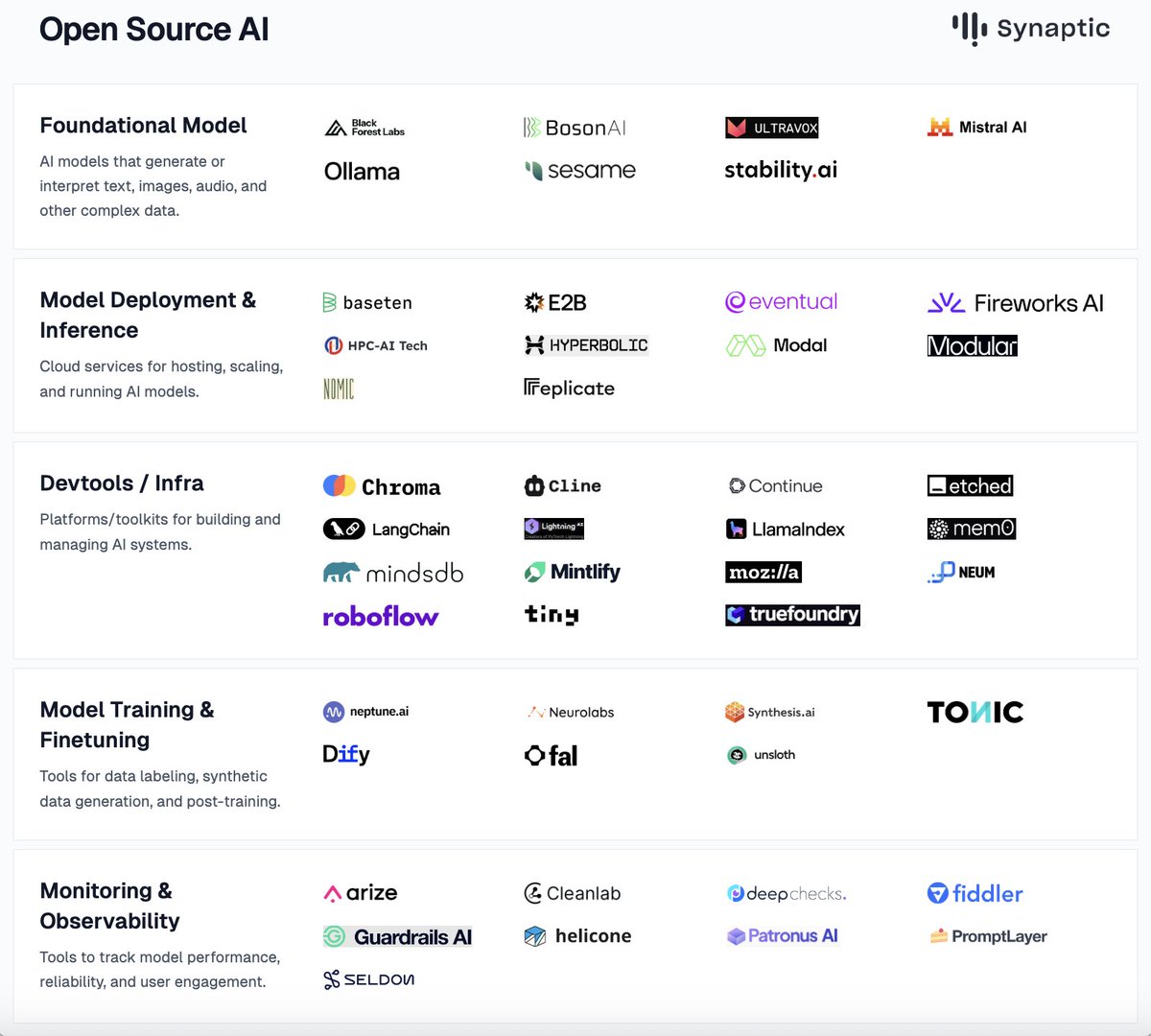
💰 Open Source AI raised $3.5B+ in 2025! Mega rounds, billion-dollar valuations, and early bets fueling infra + observability. Here are the startups leading the pack across five key segments. [🧵 1/7]
Synaptic@synaptic_data

The race to own AI infra is on! 🏃‍♀️Startup activity is hot in Observability. Early pioneers like @arizeai & @fiddler_ai are evolving from basic monitoring to full-stack observability, powering continuous model evaluation & governance. @nvidia & @AnthropicAI fuel growth via M&A.

English
1
2
2
384
Rohan Gupta retweetledi
Synaptic
Synaptic@synaptic_data·
The race to own AI infra is on! 🏃‍♀️Startup activity is hot in Observability. Early pioneers like @arizeai & @fiddler_ai are evolving from basic monitoring to full-stack observability, powering continuous model evaluation & governance. @nvidia & @AnthropicAI fuel growth via M&A.
Synaptic tweet media
English
1
1
1
457
Rohan Gupta retweetledi
Synaptic
Synaptic@synaptic_data·
📈 Closed models like Gemini 2.5 Pro, Grok 4, and GPT-5 lead reasoning benchmarks, with higher accuracy on tests like Humanity’s Last Exam. Open source challengers @deepseek_ai and @Alibaba_Qwen show better calibration, meaning they’re more aware of when they’re likely wrong.
Synaptic tweet media
English
1
1
1
181
Rohan Gupta retweetledi
Synaptic
Synaptic@synaptic_data·
📊 Closed models dominate the @openrouter leaderboard in Sep'25. @grok Code Fast 1 leads with 4.5T, 73% more than @claudeai Sonnet 4. Open source challengers like @deepseek_ai show solid traction, but are secondary to proprietary models.
Synaptic tweet media
English
2
1
1
49
Rohan Gupta retweetledi
Synaptic
Synaptic@synaptic_data·
Open Source AI is moving from lab to production 🌍 While OS models still trail closed AI on reasoning benchmarks, adoption is climbing fast. Startup activity in monitoring, deployment, and training is heating up. Mega rounds and M&As abound. See how the landscape is evolving👇
English
1
2
2
83
Rohan Gupta retweetledi
Jared Sleeper
Jared Sleeper@JaredSleeper·
Just found some sweet new visualizations showing hiring flows to/from companies. h/t @synaptic_data Here are a few of the most interesting. To start: @OpenAI employees leave for @AnthropicAI moreso than anywhere else, but the reverse isn't true. 🧵
Jared Sleeper tweet media
English
2
2
12
1.7K
Rohan Gupta retweetledi
Synaptic
Synaptic@synaptic_data·
Spotted: @nikunj rocking our hoodie in SF 😎 If you see him around, take a snap and drop it in the replies below. We’ll send you a $25 coffee card in your DMs. #SpotTheSwag #SF
Nikunj Kothari@nikunj

@NotionHQ @FPVventures @EragonAI @nozomioai @dedaluslabs @agentmail @joshua_sirota @OverlayyAI @mrsnhl @TryArcade @shubcodes @emergentlabs @madhavjha @conversionai @useStable @HoneyHomesHQ @asylumventures @lolawajs @nchirls @gammaapp @ParafinHQ @tryflexprice Day 18: @portfolio_iq - portfolio monitoring tool for private funds (VCs, PEs, Secondaries). One place to keep track of your portfolios - data collection, extraction, insights and analytics. Kids at the preschool loved the neon green!

English
0
1
3
429