
Stuart Watson
2.2K posts


Right now, someone in your city is asking ChatGPT for the best HVAC company nearby.
Do you know if it's recommending you or your competitor?
Most contractors have never checked. 👇
We built a free tool that tells you in 30 seconds.
Enter your business name, service, and city.
It runs 6 simultaneous searches across ChatGPT, Perplexity, and Google Gemini, real customer searches + direct name searches.
You get:
→ ✅ or ❌ per platform
→ Exact text AI returned
→ AI Visibility Score out of 6
→ Prioritized action plan to close the gaps
No sign-up. No cost. 30 seconds.
Want the link?
→ Must follow
→ Comment "TOOL"
→ I'll send it.
Follow me for AI + local SEO for home services.
♻️ Repost if you've never searched your business in ChatGPT, but know you should.
English

If you're now designing or redesigning a website, this will help you a lot.
I recently curated the best hero sections, footers, social proof and other website parts because I got tired of having 15+ tabs open (even with Mobbin).
Giving it away 100% free.
Comment on this post, and I'll send a Figma link to your inbox!
GIF
English

The founders who figure out OpenClaw in the next 90 days are going to look like geniuses in 2027.
The problem is most agency owners don't have time to figure out the install, the security risks, where to start, or what to actually hand it first.
So my team built a 48-page beginner's guide that does it for you.
Inside:
— The exact prompts to hand it on day one
— Plain English setup for Mac and Windows
— How to secure it so it doesn't burn your business down
— 42 copy-paste workflows across sales, marketing, ops, and finance
Your competitors are sleeping on this.
Comment OPENCLAW and I'll send it.
The Startup Ideas Podcast (SIP) 🧃@startupideaspod
"OpenClaw is the new computer." — Jensen Huang This is the early PC era all over again. A few power users see it. Everyone else hasn't even started. "It's the most popular open source project in the history of humanity, and it did so in just a few weeks. It exceeded what Linux did in 30 years." A solo founder with OpenClaw can now build what used to take a 50-person team. The leverage is absurd.
English
@Voxyz_ai Love your articles! No idea how you even find the time to write these but thanks!
English

same framework.
one person played with prompts for two days and called it a toy. another one runs a few agents on an $8 server after work, making enough each month to cover living expenses.
you can call it a toy. he calls it a business.
Vox@Voxyz_ai
English
Love this concept. 'Pirate' could be anybody - PM, Designer, Engineer, Founder, whatever.
Dan Shipper 📧@danshipper
new model for engineering team structure in 2026: 2 people only one pirate and one architect the pirate's job is to move as fast as possible to develop valuable, shipped product features by vibe coding. the architect's job is to turn the product surface discovered by the pirate into a reliable, structured machine—also by vibe coding, but at a slower, more well-reasoned pace. every product needs a pirate but most product's only need an architect once they some form of PMF, and in that case they usually don't need one full-time. architects can work across many codebases and solve interesting technical challenges. pirates go hard on a product that they own end-to-end.
English
Couldn’t agree more with this. It just feels very personal - in a kind of mother/father/child kind of way. That’s weird but I “created” this thing out of nowhere and gave it a name after all 🙃
Lenny Rachitsky@lennysan
Even though every AI company is building their own version of OpenClaw (which is smart!), I haven't seen any of them get anywhere near the love and passion that OpenClaw inspires. There's something special about the OpenClaw experience that's hard to copy.
English
@bradmillscan Been working great for me for a few weeks now. Easier for me and my agent 🙃
English

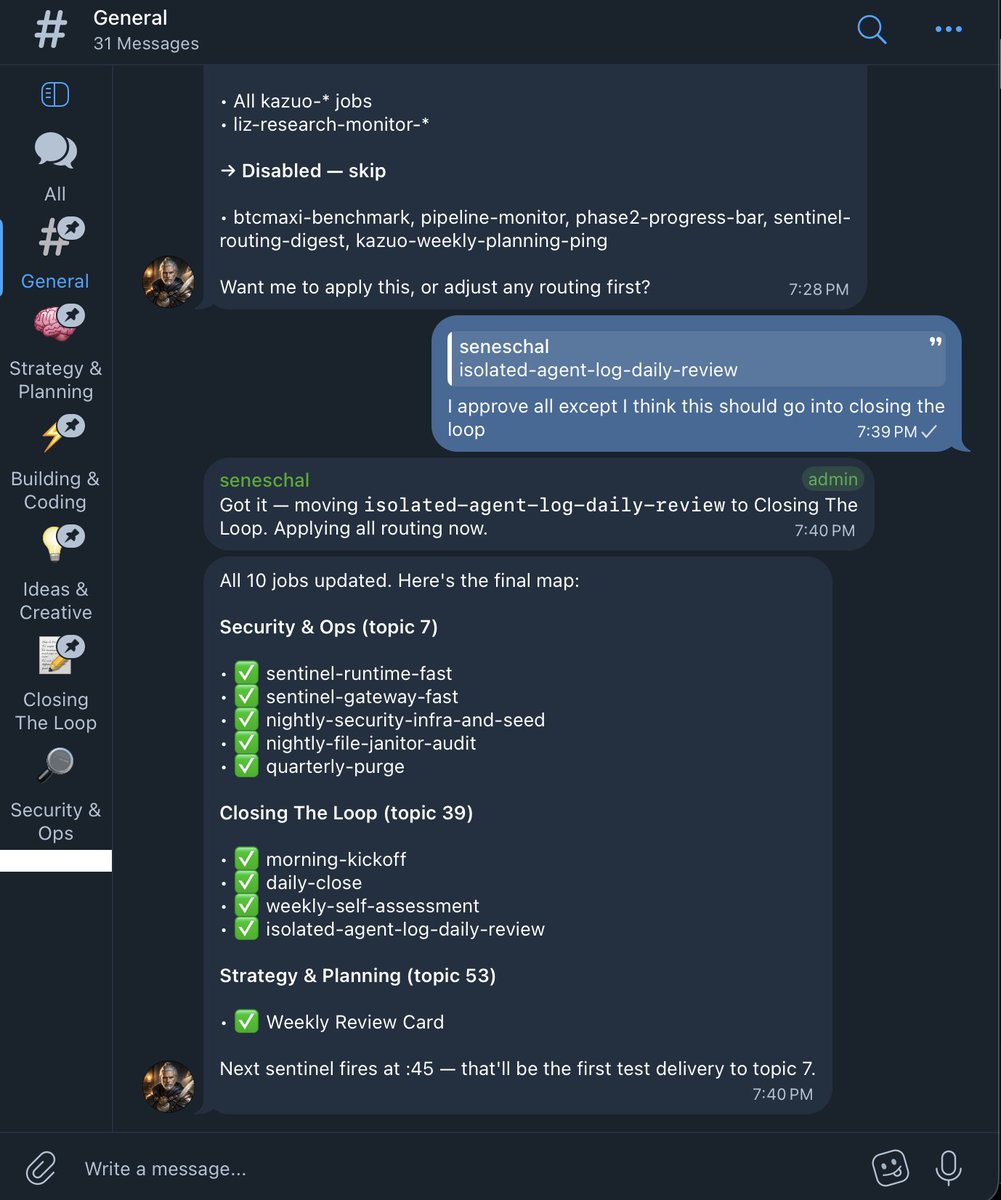
If you have ADHD + OpenClaw this is mandatory
Finally took the plunge with my 🦞 to setup telegram topics.
In a few days I'll know if it's making things worse or better.
The idea is you can keep sessions cleaner by focusing your conversations in 1 context window/1 session.
English
@adamsilverman I’ve just heard of prof.ai which helps with use case discovery. Related?
English

You run a legacy company that hasn’t adopted AI yet.
You have 3 options:
Option 1: Pay McKinsey $500,000 to map your processes
Option 2: Install monitoring software to see what employees actually do all day
Option 3: Hire an internal AI transformation lead
Here’s what no one tells you:
Option 1 gets you a pretty PDF that collects dust on a shelf.
Option 2 is hard to get but in from CIOs
Option 3 sounds smart but that person spends 6 months “learning the business” before doing anything.
To me the real answer is Option 2 but done invisibly, passively, and with the employee’s benefit in mind.
Not surveillance. But rather workflow discovery.
Software that quietly learns how your company actually operates, then hands you the automation playbook on a silver platter.
No consultants. No politics. No guessing.
This is a $100B+ market hiding in plain sight.
Someone is going to build this and print money.
(maybe someone already is 👀)
English
@Voxyz_ai Love this! I’ve had lots of similar dramas. Always feels so fragile but important to stay on top of. Thanks for the incredible guide!
English
everyone is talking about which model is best for agents.
nobody is asking what those agents have access to.
your agent can probably read your SSH keys right now. you just never checked.
Vox@Voxyz_ai
English
@Shpigford This is awesome. Adding to mine immediately. Thanks for the super helpful guide!
English

This is wild but very cool to see this push from Nvidia. Claws coming to every business soon.
Brian Roemmele@BrianRoemmele
“Every software company in the world needs to have a Claw strategy" - Jensen Huang, Nvidia Indeed. This and more.
English
@jasonfried @davidsenra This really resonated with me following your episode with David. I have the exact same approach. So it drives me nuts when so many orgs and leaders want to do ‘retrospectives’ and ‘lessons learned’ every 5 minutes. I just want to look forward too.
English

Look back less: world.hey.com/jason/look-bac…
That said, don’t think there’s anything mutually exclusively about looking ahead and looking within. Not looking for anything wrong, broken, reflections, whatever - just looking around, pure fascination with the mind.
Not doing it to change anything, fix something, find something to feel inadequate about, etc. None of that’s interesting to me. Don’t believe in it either. Don’t think it’s necessary to paint introspection and curiosity with a therapeutic brush.
Really enjoyed the conversation.
English

Great men of history had little to no introspection.
The personality that builds empires is not the same personality that sits around quietly questioning itself.
@pmarca and I discuss what we both noticed but no one talks about:
David: You don't have any levels of introspection?
Marc: Yes, zero. As little as possible.
David: Why?
Marc: Move forward. Go!
I found people who dwell in the past get stuck in the past. It's a real problem and it's a problem at work and it's a problem at home.
David: So I've read 400 biographies of history’s greatest entrepreneurs and someone asked me what the most surprising thing I’ve learned from this was [and I answered] they have little or zero introspection.
Sam Walton didn't wake up thinking about his internal self.
He just woke up and was like:
I like building Walmart. I'm going to keep building Walmart. I'm going to make more Walmarts. And he just kept doing it over and over again.
Marc: If you go back 400 years ago it never would've occurred to anybody to be introspective.
All of the modern conceptions around introspection and therapy, and all the things that kind of result from that are, a kind of a manufacture of the 1910s, 1920s.
Great men of history didn't sit around doing this stuff.
The individual runs and does all these things and builds things and builds empires and builds companies and builds technology.
And then this kind of this kind of guilt based whammy kind of showed up from Europe. A lot of it from Vienna in 1910, 1920s, Freud and all that entire movement. And kind of turned all that inward and basically said, okay, now we need to basically second guess the individual.
We need to criticize the individual.
The individual needs to self criticize.
The individual needs to feel guilt, needs to look backwards, needs to dwell in the past.
It never resonated with me.
David Senra@davidsenra
My conversation with Marc Andreessen (@pmarca), co-founder of @a16z and Netscape. 0:00 Caffeine Heart Scare 0:56 Zero Introspection Mindset 3:24 Psychedelics and Founders 4:54 Motivation Beyond Happiness 7:18 Tech as Progress Engine 10:27 Founders Versus Managers 20:01 HP Intel Founder Legacy 21:32 Why Start the Firm 24:14 Venture Barbell Theory 28:57 JP Morgan Boutique Banking 30:02 Religion Split Wall Street 30:41 Barbell of Banking 31:42 Allen & Company Model 33:16 Planning the VC Firm 33:45 CAA Playbook Lessons 36:49 First Principles vs. Status Quo 39:03 Scaling Venture Capital 40:37 Private Equity and Mad Men 42:52 Valley Shifts to Full Stack 45:59 Meeting Jim Clark 48:53 Founder vs. Manager at SGI 54:20 Recruiting Dinner Story 56:58 Starting the Next Company 57:57 Nintendo Online Gamble 58:33 Building Mosaic Browser 59:45 NSFnet Commercial Ban 1:01:28 Eternal September Shift 1:03:11 Spam and Web Controversy 1:04:49 Mosaic Tech Support Flood 1:07:49 Netscape Business Model 1:09:05 Early Internet Skepticism 1:11:15 Moral Panic Pattern 1:13:08 Bicycle Face Story 1:14:48 Music Panic Examples 1:18:12 Lessons from Jim Clark 1:19:36 Clark Versus Barksdale 1:21:22 Tesla Versus Edison 1:23:00 Edison Digression Setup 1:23:13 AI Forecasting Myths 1:23:43 Edison Phonograph Lesson 1:25:11 Netscape Two Jims 1:29:11 Bottling Innovation 1:31:44 Elon Management Code 1:32:24 IBM Big Gray Cloud 1:37:12 Engineer First Truth 1:38:28 Bottlenecks and Speed 1:42:46 Milli Elon Metric 1:47:20 Starlink Side Project 1:49:10 Closing Includes paid partnerships.
English

Automation consultants charge $15K for what Claude Code now does in 2 hours.
I know because we're the ones who used to charge it.
Here's the exact process:
Step 1: Discovery (20 min)
→ Paste your org chart, tool stack, and top 3 bottlenecks
→ Claude interviews you with clarifying questions
→ Outputs a full process inventory ranked by time cost
Step 2: Workflow Mapping (15 min)
→ Describe any department's daily operations in plain English
→ Claude builds a complete process map
→ Every manual handoff, redundant step, and automation trigger flagged
Step 3: Opportunity Audit (10 min)
→ Feed it the workflow map output
→ Returns your top 10 automation opportunities
→ Ranked by ROI, complexity, and build time
Step 4: Architecture Design (20 min)
→ Claude designs the full system architecture
→ Which tools connect where, what the data flow looks like
→ Agents for complex logic, linear flows for the repetitive stuff
Step 5: Build (ongoing)
→ Claude writes the actual workflow JSON
→ Self-documents everything as it builds
Step 6: The output.
A live dashboard your whole team can work from.
→ Clickable process maps for every department
→ Automation opportunities ranked by ROI
→ Implementation progress by phase
→ KPIs updated in real time
→ One link you share with clients, freelancers, or your team to execute
This is what we hand every client at the end of discovery.
The .md file is what makes all of it possible.
Without it, Claude guesses.
With it, Claude builds like a $15K consultant.
Like this post, RT and comment "BLUEPRINT" and I'll send you the full prompt stack and the .md file we use internally. (Must be following so I can DM you)
🎁 Bonus: The first 100 people get a real Precision AI Blueprint — an actual sample audit doc from a client engagement so you can see exactly what the output looks like.

English
I open sourced a context window diagnostic tool for AI agents.
comes with a cyberpunk-styled Next.js dashboard.
scans your workspace. calculates token cost per file.
shows which rules got silently trimmed.
flags skills that have not been triggered in months but still eat your budget.
your agent is not dumb. it just never saw the rules you wrote.
github.com/Heyvhuang/open…
live demo: openclaw-context-doctor.voxyz.space

Vox@Voxyz_ai
English

So much of building with AI is just patience.
- Do it
- Do it again
- Nope, do it again this way
- Check the logs
- 🔁🔁🔁
Eventually you almost get there! 🤪
English
@AISuccessLab @leehickin @IndustryGovAu Loved this episode Kate! Just came across your podcast and really enjoyed hearing from Lee. Thanks!
English

I recently chatted with @leehickin, Executive Director of Australia’s National AI Centre. With the National AI Plan now released, Australia has a clear direction. If you’re running a business in Australia, this episode is worth your time. 🎙️ Listen now 👇️ @IndustryGovAu
English
@naveennaidu_m That's a great insight. Kind of how I find myself building too. From the outside I think it can look really chaotic (& confusing) but really it's just experimentation and iteration and refinement. 👏 @danshipper
English

I've been in the same office as Dan since January. Watched him work on Proof every single day, first a Mac app, then a web app, 6 weeks of just showing up and building.
I still didn't get it for a long time.
Two weeks ago it finally clicked. Now my whole workflow runs through it, brain dumping with agents, sharing docs with the team, using Codex to plan and Proof to review. I went from not understanding the vision to not being able to work without it.
That kind of slow burn is usually the sign of something that actually sticks.
Dan Shipper 📧@danshipper
BREAKING: Proof—a new product from @every It’s a live collaborative document editor where humans and AI agents work together in the same doc. It's fast, free, and open source—available now at proofeditor.ai. It’s built from the ground up for the kinds of documents agents are increasingly writing: bug reports, PRDs, implementation plans, research briefs, copy audits, strategy docs, memos, and proposals. Why Proof? When everyone on your team is working with agents, there's suddenly a ton of AI-generated text flying around—planning docs, strategy memos, session recaps. But the current process for collaborating and iterating on agent-generated writing is…weirdly primitive. It mostly takes place in Markdown files on your laptop, which makes it reminiscent of document editing in 1999. Proof lets you leave .md files behind. What makes Proof different? - Proof is agent-native: Anything you can do in Proof, your agent can do just as easily. - Proof tracks provenance: A colored rail on the left side of every document tracks who wrote what. Green means human, Purple means AI. - Proof is login-free and open source: This is because we want Proof to be your agent's favorite document editor. Check it out now, for free—no login required: proofeditor.ai
English
@adamludwin No idea if it’s possible but at this point it feels like almost anything is 🙃
English
@watsonstuart nice, so glad it's helpful for you. and also like that idea!
English
@danshipper @every This is so freaking cool. You guys are cooking as much as Anthropic at this point!
English

BREAKING:
Proof—a new product from @every
It’s a live collaborative document editor where humans and AI agents work together in the same doc. It's fast, free, and open source—available now at proofeditor.ai.
It’s built from the ground up for the kinds of documents agents are increasingly writing: bug reports, PRDs, implementation plans, research briefs, copy audits, strategy docs, memos, and proposals.
Why Proof?
When everyone on your team is working with agents, there's suddenly a ton of AI-generated text flying around—planning docs, strategy memos, session recaps. But the current process for collaborating and iterating on agent-generated writing is…weirdly primitive.
It mostly takes place in Markdown files on your laptop, which makes it reminiscent of document editing in 1999.
Proof lets you leave .md files behind.
What makes Proof different?
- Proof is agent-native: Anything you can do in Proof, your agent can do just as easily.
- Proof tracks provenance: A colored rail on the left side of every document tracks who wrote what. Green means human, Purple means AI.
- Proof is login-free and open source: This is because we want Proof to be your agent's favorite document editor.
Check it out now, for free—no login required:
proofeditor.ai
English