
Sabitlenmiş Tweet
Zee ₿⚡
10.3K posts

Zee ₿⚡
@zeetxo
Researching Bitcoin since 2022. Masters in Computer Applications. Bitcoin scaling solutions enthusiast.
India Katılım Ocak 2022
808 Takip Edilen523 Takipçiler

@nwoodfine @spark @roy_breez @sethforprivacy Are you apologizing because you made a mistake or because it's possible for Ark to do the same? Censoring addresses always starts with good intentions.
gitlab.com/ark-bitcoin/ba…
English

It looks like we screwed up with a tweet posted in haste without properly verifying the facts on @spark. @roy_breez and @sethforprivacy have assured us that Spark does not apply chainalysis for Spark users at the on-chain or Lightning level.
The misunderstanding came about due to getting wires crossed between Lightspark and Spark products, which operate on the same infra but are distinct systems.
We'd appreciate you amplifying this post, to help set the record straight.
Everyone on the @secondhq team are passionate bitcoiners, the team leans toward purists and obsess over the details, for better or worse. We went too far here and got things wrong to boot. Late night on a Sunday was also completely unreasonable to post stuff like this.
We'll be getting back to regular programming of positive vibes only. Rest assured that the team is heads down making the Bark SDK the best it can be.
Seth For Privacy@sethforprivacy
Of course I did my due diligence before we ever integrated Spark, found the same thing Matthew did below and hit the panic button internally. But unlike him I didn’t take to X to attack competitors and potential integrators, but instead was able to quickly confirm in private that it had nothing to do with Spark (the L2) in any way. Wasn’t difficult at all and was resolved with a few conversations with Spark/Lightspark and others in the space. Lightspark (not Spark) offer custodial services and this is only related to those and isn’t even an ongoing partnership of Lightsparks. I have been EXTREMELY vocal for years now about the tradeoffs with Spark (and both Ark implementations at the same time), and am all for digging into tradeoffs, but this is going far beyond that. Very frustrating that someone I know well and who works for a team I’ve been constantly shouting out, praising, and pushing people towards would stoop to completely fake news to try and win over users. I love the tech that @secondhq have built, but it’s a terrible look to be rampaging with falsehoods for weeks on end and not disclosing or sharing any of their own systems tradeoffs. I’m tempted to dive into the mudslinging and call out the major tradeoffs in Bark, but I’ll leave that off for now unless forced or unless someone reasonable wants to learn more.
English
I only listen to smart people.
Lyn Alden@LynAldenContact
@dathon_ohm @KenMCoin @natbrunell So it’s about virtue signaling rather than any sort of material reduction in spam, and yet it’s phrased as existential by many of its proponents (who have argued for years that spam is an existential threat to bitcoin). Best of luck.
English



Ark has unilateral exits with no channel management.
What a beauty.
Nothing like self-custody.
Carlos Marques@2ndpsy
I sent an Ark payment to Charlie and he received a VTXO Then he used that to pay a Lightning invoice ⚡️
English

There's been a round of misinformation about Spark going around, so for the sake of setting the record straight, I'll briefly clear up a few things.
For one, unilateral exit has been around since the early days of Spark. Many developers and users have used it. This has been demonstrated many times both here on X and during the process of integration by developers. Unilateral exit also does not require the SOs to be online when a user wishes to exit. When a transaction is received, users can save the unilateral exit information and later use those pre-signed, valid L1 Bitcoin transactions at any time on Bitcoin. There are existing Github issues to expose unilateral exits in a more intuitive way in the SDKs, but unilateral exits themselves have been functional for a very long time. Unilateral exits do require CPFP - this is used to ensure that the expected value for an attacker is negative. The typical user would perform a cooperative exit, which does not require any on-chain funds and is an atomic swap of on-chain funds in exchange for Spark funds. Unilateral exits are generally reserved for a worst-case scenario and can be sponsored by an L1 fund provider if needed.
Second, the confusion around "Sparkcore". At Lightspark, we use a monorepo for our server code. This one service is called Sparkcore - the naming of which preceded the creation of Spark. Lightspark runs an SSP within this service. Our Lightning infrastructure uses both LDK and LND - both of which we contribute code towards. Sparkcore itself is not open sourced - that would mean open sourcing our entire server-side stack for every product we have built. The Spark network code, however, has always been open source - and that's the openness that matters, because it's the code that actually enforces the rules of Spark. The SSP is an optional, replaceable convenience role.
A recent post claimed that APIs used for other products are part of the SSP. We have many products, and we have never been shy about describing UMA, which allows regulated entities to exchange information to process transactions over Lightning. This is not a Spark product. The SSP does not hold your seed phrase (that should never leave your device), the SSP cannot freeze your funds, and the SSP isn't even a required role to use Spark - it is the interop layer between Lightning and Spark and helps do swaps for exact denominations of leaves. Running an SSP is something we have talked with many partners about. The client chooses which SSP they wish to interact with (if any) - we cannot control if a client talks to a new SSP.
Finally, privacy. I've discussed this many times in the past, so won't belabor the point again. Spark allows for transactions to be hidden from external visibility. As I've spoken about at length both here and at various conferences, we care deeply about making sure that there is true privacy, and we aren't satisfied with anything short of that. It's an ongoing effort to continue to further the research in this area.
I'll leave it with this. In the network our critics operate, the default payment path is one where the operator colluding with any prior owner can double-spend the current holder - their own docs say so. Receiving over Lightning means trusting that the operator deleted a key - their own docs say so. If you don't come online every 28 days, the operator can take your funds. In their founder's own words: "In theory it could steal it." The automatic re-issuance of expired funds promised in March 2025 still hasn't shipped. Their operator's liquidity costs scale with payment volume, which by their own admission "will translate into user fees." And there is exactly one operator - their own docs tell everyone else: "Do not attempt to run an Ark server in production (yet!)." Spark has three independent operators, exits that don't expire, and no flow where a single operator can take user funds. Users can judge for themselves.
Our users and the developers building on top of Spark care about bringing Bitcoin to more people. They value the ease of use and simplicity of Spark. They care that we have 3 independent SOs. They care that we are pushing for more and better functionality. And they value that we spend all of our time thinking about how to make Spark better each and every day. Ok, now back to building because that's what we do at Spark.
English

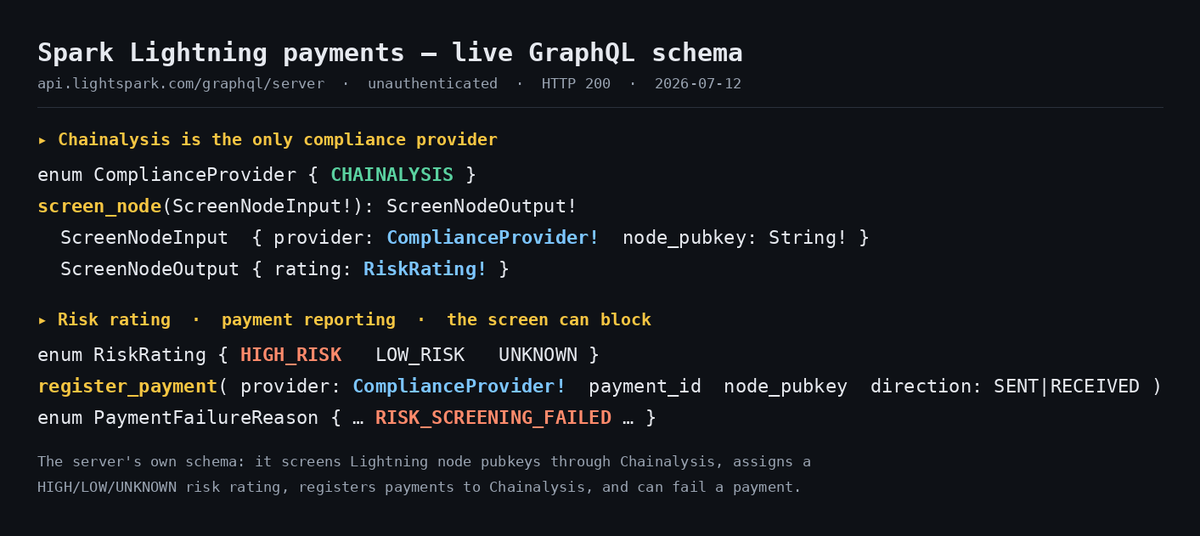
The "Sparkcore" SSP is building a profile on you: it logs every payment you make and the pubkey of every lightning node you pay to.
It has a CHAINALYSIS integration inside that registers who you pay and runs "RISK SCREENING" on your txs with a 3rd party.
Not very private...
Cake Wallet@cakewallet
Every erosion of privacy starts by calling itself reasonable.
English


Lately there's been a lot of discussion around L2s like Liquid, Ark, and Spark, and the deciding factor for preference seems to have become unilateral exit: the ability to exit to the mainchain on your own initiative, even if the operator is malicious, censoring you, or has vanished entirely.
Ironically, as people are discovering, only one Spark wallet actually supports unilateral exit (the others say it's coming later), which is a bit comical, because that's often the very reason the more hardcore Bitcoiners dismiss Liquid.
At @JAN3com, we're building on @Liquid_BTC because I firmly believe it offers the best set of tradeoffs. After Liquid, my next choice would be Ark, and personally I would avoid Spark because of how centralized it is.
It's all about the substrate. We're all trying to solve for the best L2 substrate, which can also include ecash mints or even databases (like the original WoS). Here's what I believe are the key criteria, in priority order.
1️⃣ Privacy. Both operator-side (are they logging you?) and on-chain (are amounts/assets confidential?)
2️⃣ Operator model. Single operator or federation? Can they steal funds, and can they censor you?
3️⃣ Liquidity. How deep and accessible is it?
4️⃣ Time in production. How long has it been live, and has it held up under real-world conditions?
5️⃣ Data availability. Can you get the data to prove what you own, without relying on the operator?
6️⃣ Economically viable exit. Is that exit actually affordable, or does fee/congestion cost make it theoretical?
7️⃣ Unilateral exit. Can you exit to the mainchain on your own initiative, even if the operator is malicious, censoring you, or gone?
8️⃣ Liveness requirements. Do you have to come online periodically or risk losing funds? (relevant for Ark)
How does Liquid stack up for these criteria?
Really well.
1️⃣ Privacy. Confidential Transactions by default hide both the transaction amount and the asset type from all observers, including functionaries. Functionaries can't see amounts or asset types, so there's nothing to even log if they wanted to.
2️⃣ Operator model. 15 functionaries, 11-of-15 multisig, HSM-secured, tolerating up to 4 offline. Functionary code is open-source.
3️⃣ Liquidity. $5B TVL, including $4B+ in tokenized securities and ~$97M native USDT.
4️⃣ Time in production. Live since October 2018 as Bitcoin's first production sidechain (~7.5 years).
5️⃣ Data availability. Anyone can run a full node and trustlessly self-validate the chain, with L-BTC always verifiably 1:1 with BTC locked on mainchain.
6️⃣ Economically viable exit. 0.1 sat/vB average fee. For most users the primary exit is an atomic swap of L-BTC for BTC, which is permissionless and doesn't require federation membership.
7️⃣ Unilateral exit. Not there for regular users yet, but coming via a BitVM-style 1-of-n bridge on the roadmap. And as a business, you can join as a federation member today and peg out directly, no third party needed.
8️⃣ Liveness requirements. No online-or-lose mechanic; L-BTC sits indefinitely.
Notice that economically viable exit sits above unilateral exit on my list. That's deliberate. Let's dig in.
It's important to remember that L2 substrates are exactly that: substrates. None of them can compete with the trustless, permissionless properties of the Bitcoin mainchain. Anything you're holding long-term belongs on mainchain, in your own custody.
You're using the substrate for spending (small amounts) or cost-effective UTXO aggregation, so unilateral exit isn't that important outside of an ideological insistence on having it. What you actually want is privacy, durability, liquidity, and economically viable exits.
Remember how many Muun wallet users were caught off guard when mainchain fees spiked? When fees climb again, what you thought was a unilateral exit turns out to be no exit at all.
Once network fees hit around 5-10 Sats/vB (or higher), unilaterally exiting small Ark VTXOs or Spark leaves stops being worth it. Let's take an example of 10 small balances adding up to 100k sats. At those fee levels, pulling each one out on-chain can eat 40–100% (or more) of what it's worth. You'd burn most or all of the value just to move it. At that point, it's effectively dust.
This is because of the tree/branch/leaf structure of Ark and Spark. 5-10 Sats/vB isn't even expensive for a normal BTC transaction: at $100k, that's just $0.71 to $1.41. The cost blows up only because a unilateral exit means unrolling that structure on-chain, not broadcasting one clean transaction.
Ark and Spark are really optimized for cooperative exits and if you're expecting cooperation anyway, then rationally you should expect that same cooperation for a Liquid peg-out. So with Liquid you get both: a cooperative exit via peg-out, and the primary atomic-swap model into a pool that's (pun intended) deep and liquid.
@Liquid_BTC is perfect for the average person and that's why we're building @AquaBitcoin on it.
TL;DR: Unilateral exit is oversold, especially when it's too expensive to actually use. For everyday spending amounts, exiting small Ark/Spark balances becomes uneconomical the moment fees rise, so it's an exit on paper only. Privacy, liquidity, durability, and a cheap real-world exit matter more, and Liquid wins on those. Hold long-term on mainchain; use the substrate for spending/aggregation.
Matthew Vuk 🛳️@matthewvuk2
Taking a closer look at the Spark Federation, and the closed source "Sparkcore" SSP. This is what you are exposing your users to when you integrate Spark. When you do lightning send/receive it is flowing through that "Sparkcore" they do not name in the website docs.
English
@Pledditor List of things not to do when you run a Bitcoin treasury company
English

why $NAKA fell -99.8%, explained in the most laymen's terms possible:
-shareholders got raped with mNAV compression (it tragically flipped from a 20x premium to a 0.3x discount)
-the value of the underlying (aka BTC) fell -50%
-they sold some BTC to buy shares of other treasury companies, and those investments have massively unperformed BTC
-they took out a bitcoin backed loan and got liquidated when the value of their collateral dropped too low
-shareholders were diluted, but not to buy bitcoin, it was to buy David's magazine
-on top of all of that, the company itself is unprofitable and only bleeds money
English

My dear American friends, this is how your tax money is spent.
Zee ₿⚡@zeetxo
youtube.com/shorts/9TUKtOO… Watch this small clip, u will not understand the language, it's bangla which is spoken in parts of India & Bangladesh But at the end u will notice that it's mentioned that it was created with the support of USAID. Why?
English
youtube.com/shorts/9TUKtOO…
Watch this small clip, u will not understand the language, it's bangla which is spoken in parts of India & Bangladesh
But at the end u will notice that it's mentioned that it was created with the support of USAID. Why?

YouTube
English
@LightningNewsX Few missing
The Bitcoin enlightenment
Fiat food
Anti riba money... to name a few..
English

💥BOOM Looking for a new read?
Here are 100+ Bitcoin books and titles packed with wisdom:
x.com/LightningNewsX…
Lightning News@LightningNewsX
English