Dead Heroes Don't Save
14.6K posts

Dead Heroes Don't Save
@_DHDS
if I claim to be a wise man, it surely means that I don't know. This is a former elder & seminarian's place to discuss theology & share posts from the blog
The Silent Planet Entrou em Ekim 2022
541 Seguindo382 Seguidores
Tweet fixado

Though we debate aspects of being in Christ, think we can all agree:
if anyone is in Christ, he is a new creature
[having been]
created in Christ Jesus to do good works
[which we do with]
our liberty which we have in Christ
[so we]
do not turn [our] freedom into an opportunity for the flesh, but through love serve one another
English


@ReformedCaio Is he defining "modern" Arminianism or are you?
English

@_DHDS Take it up with Oslon, he is making the distinction. And I agree. I've read Arminius. A lot of what I see in modern discussions from Arminians are extremely far removed from the classical/historic form that Olson/Wesley promoted.
English

Classic/Historic Arminian, Roger Olson, rightly understood that many forms of modern Arminianism fall into Pelagian and semi-Pelagian categories, and these are seen as heretical views.
"Synergism is any theological belief in free human participation in salvation. Its heretical forms in Christian theology are Pelagian and semi-Pelagianism. The former denies original sin and elevates natural and moral human ability to live spiritually fulfilled lives. The latter embraces a modified version of original sin but believes that humans have the ability, even in their natural fallen state, to imitate salvation by exercising a good will toward God. When conservative theologians declare that synergism is a heresy, they are usually referring to these two Pelagian forms of synergism. Classical Arminians agree... Contrary to confused critics, classical Arminianism is neither Pelagian nor semi-Pelagian! But it is synergistic. Arminianism is evangelical synergism as opposed to the heretical, humanistic synergism... I am referring to evangelical synergism, which affirms the provenience of grace to every human exercise of good will toward God, including simply nonresistance to the saving work of Christ."
- Olson, Arminian Theology, Introduction
English

Prevenient grace reveals and enables
Faith is trusting what was revealed
What more could have been done than I have done?
- Isaiah 5:4
Is the answer nothing since I've provided everything necessary or there is more to be done such as providing irresistible, efficacious grace and saving faith that can't be refused?
English

@_DHDS @just_keep_read Yes, the ability to see Jesus as the Christ, the Lamb of God is indeed a gift all Christians should be thankful for!
Matt. 16:15-17
English

@ReformedCaio Why would you label Pelagianism or Semi-Pelagianism as modern Arminianism...
Getting this right doesn't even require distinctions 🤣
English

Exactly as Olson does in the quote.
"Its heretical forms in Christian theology are Pelagian and semi-Pelagianism. The former denies original sin and elevates natural and moral human ability to live spiritually fulfilled lives. The latter embraces a modified version of original sin but believes that humans have the ability, even in their natural fallen state, to imitate salvation by exercising a good will toward God."
English

@BaptistBavinck @just_keep_read Yay! A box of faith, trust and conviction
I guess I'm elect after all 🤣
GIF
English

@just_keep_read Faith can be both the condition required and gift provided.
English

@autocorrect2_0 After inviting the rage of PETA, the hero goes all John Wick on those responsible for killing his wife
English

Mark was likely first and used by Matthew and Luke
It is hard to imagine Mark intentionally ending at 16:8 and the LE seems even less likely to be original
My own favorite speculative theory is that some form of the original ending of Mark was used by Matthew in chapter 28 where Jesus and the disciples meet in Galilee
English

@_DHDS It was necessary.
Luke and Matthew had been circulating for years, then, with an extended ending. He knew, and had nothing extra to add. This explains its abruptive short end
English
Dead Heroes Don't Save retweetou

There is a passage in 1 Corinthians 15 that puzzles many readers. Paul writes that Christ “was raised on the third day in accordance with the Scriptures” (1 Cor. 15:4).
But which Scriptures did Paul have in mind? If you search the Old Testament, you will not find a single prophecy that explicitly says the Messiah would rise on the third day.
So what does Paul mean?
One helpful way to understand Paul’s words is to look for a pattern in the Old Testament. Again and again, God does something decisive on the third day or after three days. These moments often involve life, deliverance, restoration, or divine revelation.
Consider these examples:
1. Creation: On the third day, life springs forth from the earth in the form of plants and trees (Gen. 1:11–13).
2. Abraham and Isaac: On the third day, Abraham arrives at the mountain where Isaac is spared, and Hebrews later says that Abraham received him back “figuratively” from the dead (Gen. 22:4; Heb. 11:19).
3. Mount Sinai: God descends upon Mount Sinai on the third day to reveal himself to Israel (Exod. 19:11, 16).
4. Jonah: Jonah spends three days and three nights in the belly of the fish before being delivered (Jonah 1:17).
5. Hosea’s prophecy: The prophet says, “After two days he will revive us; on the third day he will raise us up” (Hos. 6:2).
When we look at these passages together, a pattern begins to emerge. The third day becomes the day when God brings life from the ground, life out of death, rescue out of danger, and hope out of despair.
This is likely what Paul has in mind in 1 Corinthians 15:4. He is not pointing to a single proof-text prediction but to this repeated scriptural pattern or typology.
The resurrection of Jesus on the third day is the climactic fulfillment of that pattern. What God had been foreshadowing throughout the Scriptures reaches its fullest expression when Christ rises from the dead.
______
We read 1 Corinthians 15 today in Bible in One Year. To join us, visit 1517.org/oneyear

English

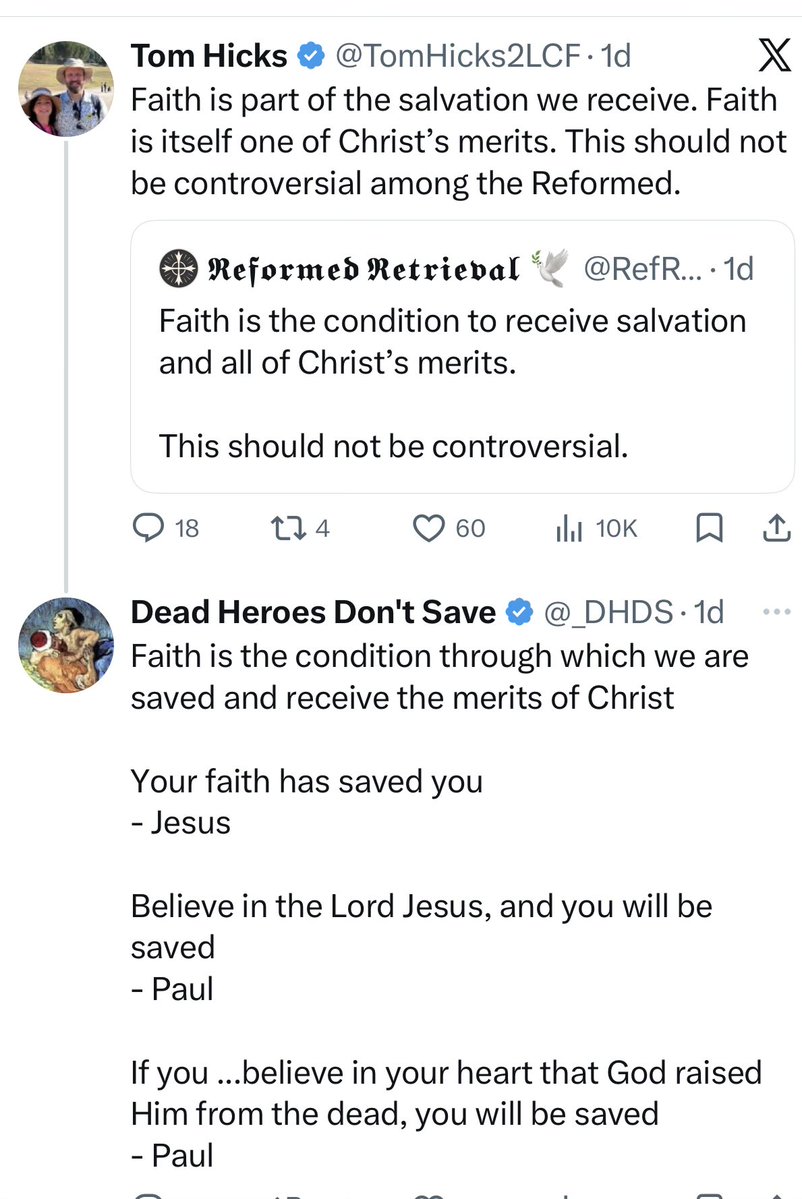
@TomHicks2LCF Faith is the condition through which we are saved and receive the merits of Christ
Your faith has saved you
- Jesus
Believe in the Lord Jesus, and you will be saved
- Paul
If you ...believe in your heart that God raised Him from the dead, you will be saved
- Paul
English

Faith is part of the salvation we receive. Faith is itself one of Christ’s merits. This should not be controversial among the Reformed.
𝕽𝖊𝖋𝖔𝖗𝖒𝖊𝖉 𝕽𝖊𝖙𝖗𝖎𝖊𝖛𝖆𝖑 🕊️@RefRetrieval
Faith is the condition to receive salvation and all of Christ’s merits. This should not be controversial.
English

Universalism has always impressed me as the triumph of hope over exegesis, the pressing of theological conclusions from lovely presuppositions (most of which, to be sure, any Christian should hold) to conclusions that simply cannot stand in the light of Scripture’s frequent and stark opposition.
- John Stackhouse Jr
English

@rootcausesleuth @RefRetrieval I am understanding them as "every spiritual blessing"
English
Dead Heroes Don't Save retweetou

Starting in 5:1 we read "having been justified by faith ... through Jesus"
And in v9 we read "having been justified by His blood"
So when we get to the middle of the chapter and read "through one act of righteousness here resulted justification of life to all men"
We should remember that His blood makes it possible to justify all men but faith is still required. Both are clearly stated in this chapter
And of course the main point in Romans 4 was that Abraham and all of us are justified by faith
English

@1984_nate When the text says “all are justified.” It just assumes all have because of the act of the one
English

Where does Romans 5 make it clear that all receive the act of Christ?
It doesn't.
Jon Bowlin@_jonbowlin
@SwordMasterPub @1984_nate Except Romans 5 says that by the act of one, all are justified. Justification happens when one receives and it makes it clear all are justified
English

@OJarod3315 @Curi_Christian 🤔God would be free to intervene as He wills and in particular would certainly act to insure His promises were fulfilled, as in your example, regarding Israel
English

@Curi_Christian @_DHDS Thats an interesting spin on the idea, that God gave us a role and expects us to fulfill it
My only pushback from there would be it seems God does at times intervene to stop or limit evil and “takes” our role, Genesis 20:6 for example
English

But I would probably reword my note above re: Isaiah 5 to be clearer
--
In Isaiah 5 God clearly says “What more could I do” in such a way where His infinite wisdom and power and loving kindness are not damaged because everything necessary to get the people to follow Him and produce fruit was provided. But in the text it's clear they could have both willed to and chosen to follow Him, having all the necessary abilities and necessary divine enabling, but were unwilling
English

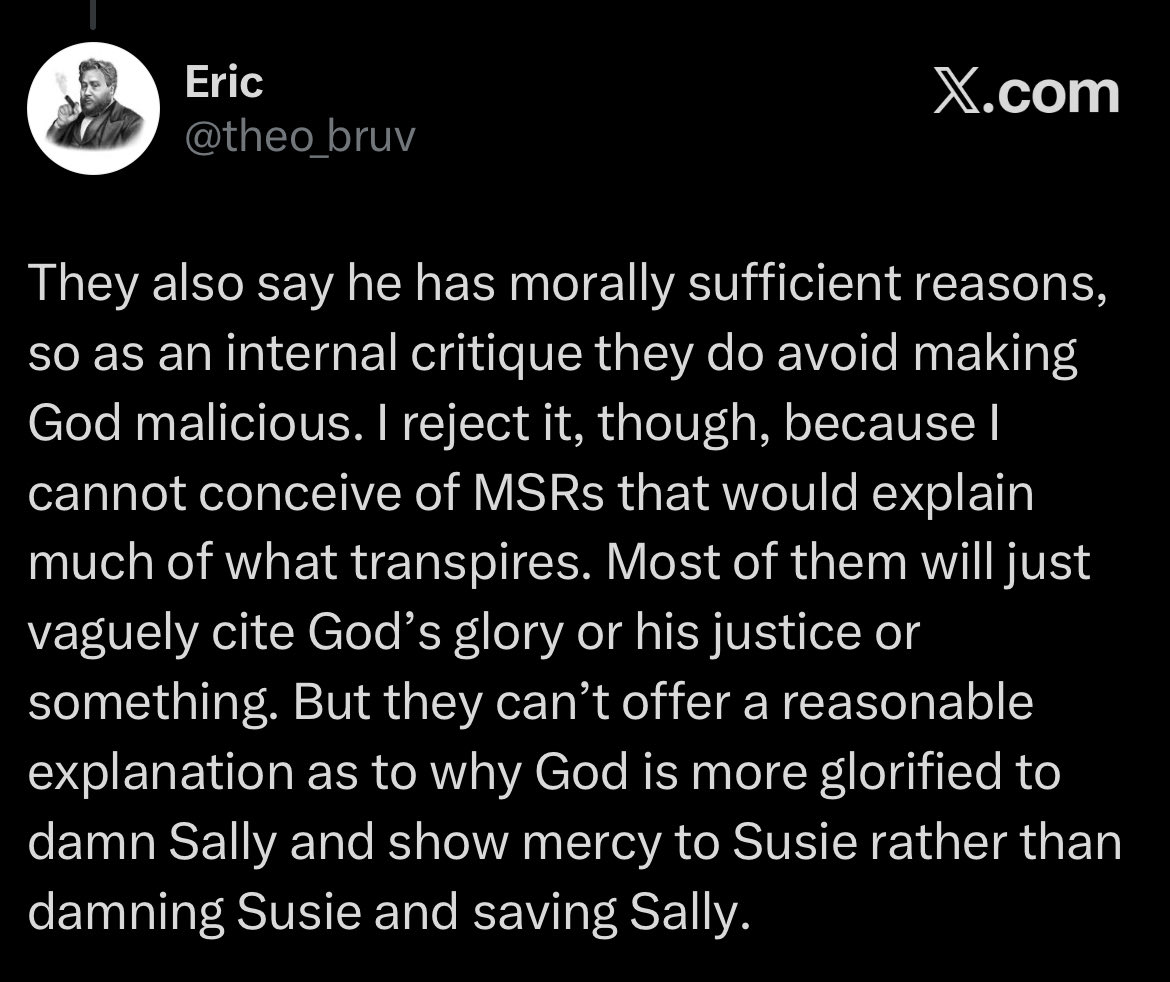
A note on (3) and why I find Calvinism’s soteriology highly implausible

Eric@theo_bruv
Calvinism posits that: (1) God truly desires all freely repent & believe so as to be saved; (2) God could bring about free R&B for all; (3) God chooses not to do so for morally sufficient reasons. Highly implausible as it is. No need to misrepresent.
English