

Neil Johnson
562 posts

@sayerjigmi I was a huge fan of ground flaxseed for years, and am fully aware of all these benefits. But I dumped it when I discovered that flaxseed oil and flaxseed meal KILL YOUR TESTOSTERONE LEVELS.
English

1/We live in a medical culture that offers statins to 40 million Americans and calls it prevention.
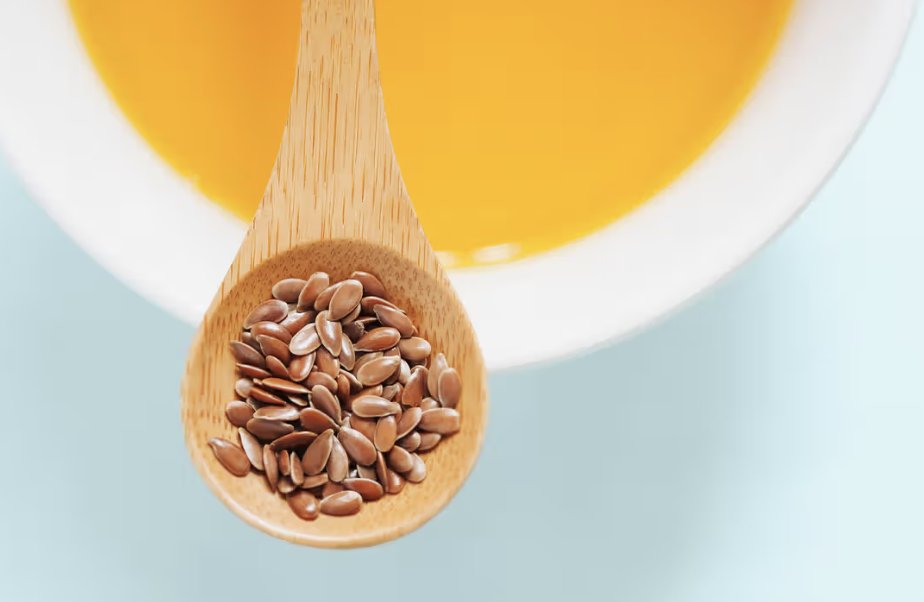
Meanwhile, a seed cultivated for 10,000 years — with hundreds of peer-reviewed studies behind it — sits in the bulk section of your grocery store for $2/lb.
Its name means "most useful." The ancients weren't wrong. 🧵👇
English
@elonmusk When will we see electric buses in the city? NYC is full of dirty noisy diesel buses.
English

Tesla Semi is so clean, cool & fun!
Tesla Semi@tesla_semi
Cities will be much quieter & cleaner with Tesla Semi
English
@MichaelMindrum "It seems UPF’s are here to stay." I imagine a post-scarcity future where all food is prepared fresh.
I've doubled down on fresh home milled grains. Tempered (germinated), high extraction (protein + vitamins), white pastry & bread flour.
English

It seems UPF’s are here to stay. I think we should be able to create palatable, satiating, and healthy ultra-processed foods. The question is how to get there and that is something NOVA can’t answer.
You know there was a scientist that was well positioned at NIH and was directly studying how UPFs led to overconsumption via metabolic and neurobiological pathways that Dr Ludwig is inquiring about?
Sadly those in HHS did not want any scientific findings to be shared that went against their bias and attempted to restrict @KevinH_PhD from communicating them! So being a person of integrity, he left.
Instead they will rehash the past wrongs. They will resort to vibes, capitalize on the current fad of demonizing seed oils for political points, celebrate lard and “natural” cane sugar, take a dye out of fruit loops to call it a day.
And the diet camps can now keep circling around with theories of why UPFs are bad or good which can survive unmodified as they are no longer being subjected to rigorous study and scientific scrutiny.
Dr. David Ludwig@davidludwigmd
Do highly tasty (“hyper-palatable”) foods make us overeat? Must food manufacturers market bland products to protect the public from obesity? My thoughts in a Perspective in PLoS Medicine. 👉Open access at this link: journals.plos.org/plosmedicine/a…
English
@BrownJem @JulianMellentin @jksequoia Followed @jksequoia . Traditional food has been nothing short of miraculous. We've doubled down on the desserts too, eggs, cream, milk, fresh home milled (white) pastry & bread, flour, fruit, + chocolate. Fresh grains --> high extraction white flour --> nirvana.
English


Ancel Keys and heart attacks - let me quote from @EvidenceOpen "The Mediterranean diet significantly reduces the risk of heart attacks, with evidence from both randomized controlled trials and observational studies demonstrating a 27-35% reduction in myocardial infarction risk." For those interested here is the paper --PMID: 30676058
Dr. Ammous@AmmousMD
How many heart attacks has Ancel Keys been responsible for?
English
@SamaHoole Lines up with my experience so far at year four. I'm off all meds. Doctor approved.
English

The carnivore patient's doctor timeline:
Month 1: "This is dangerous. I have to advise against it."
Month 3: "Your results are... unusual."
Month 6: "Everything is improving. But the LDL is up."
Month 12: "Triglycerides optimal, HDL excellent, inflammation gone, blood pressure normal. The LDL is still elevated though."
Year 2: "You've come off your diabetes medication, lost four stone, and your CRP is undetectable. The LDL concerns me."
Year 3: "I don't fully understand what's happening here but your markers are better than most patients half your age."
Year 5: "Everything is exceptional. I'd still like to discuss the LDL."
Translation: Your body is functioning at a level the guidelines did not predict and we would all feel more comfortable if you could return to the foods that were making you unwell, because at least then the numbers would make sense.
English
@AmmousMD I don't sunburn anymore. This past weekend I skied both days in full sun. Not the slightest bit of discomfort or warmth on my face in the evening. The sunspots and age spots are disappearing from my face too. 66yo, off all meds Dr. approved.
English

The propaganda is so strong that telling people to eat meat and get out in the sun is considered misinformation.
🥩 ☀️
English
@ApoDudz I'm looking forward to June 2026, topline results expected from the Phase 3 Lp(a) HORIZON CVOT of pelacarsen (ASO lowering Lp(a) ~80%). Will targeted reduction cut MACE in high- Lp(a) ASCVD patients? Curious for your take,
@MichaelMindrum
English

“This study demonstrates that OxPL/apoB levels predict 10-year CVD event rates independently of…
👉🏻traditional risk factors,
👉🏻hsCRP, and
👉🏻FRS [Framingham Risk Score]...”

English
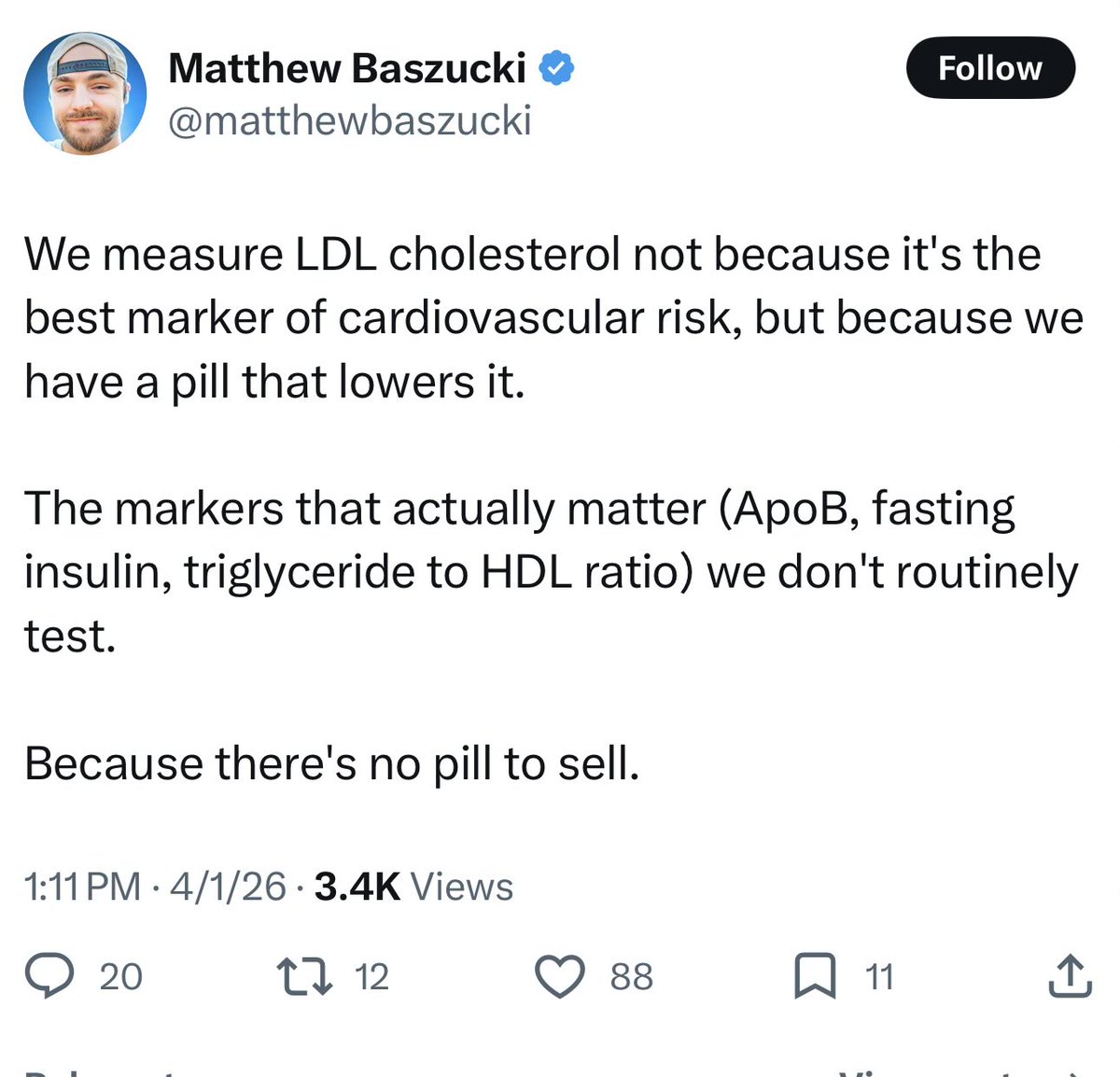
@MichaelMindrum @realDaveFeldman is uploading an interview with Matthew Baszucki tomorrow. Me, I'm dealing with secondary prevention. It would be helpful if you too could share your knowledge on Dave's podcast. x.com/i/status/20394… @matthewbaszucki @ApoDudz
Dave Feldman@realDaveFeldman
Tomorrow I'll be dropping one of the most powerful #FeldmanProtocol episodes we've recorded. @matthewbaszucki shares a story of severe bipolar disorder, psychosis, hospitalizations, and what it was like to fight his way back. It’s raw, intense, and ultimately – inspiring.
English
Ben Bikman and company are an inspiration to all these rising 💫 influencers. With just a bit more time this kid is going to absorb all the lingo and knock it out of the park.
English
@trikomes Me too, off all meds doctor approved. It was simple as eliminating seed oil and industrial processed grains.
English

It's becoming more common for people to assume I'm "on something" or ask, "do you take anything?"
Usually means testosterone, peptides, or GLP-1 drug.
They just assume I must be. Some of them appear to not believe being in good shape is possible in middle-age without "help."
English
@TuckerGoodrich Much higher rates for revascularization for primary prevention.
English

Question: are there any confounders for this? Like, um smoking? 🙄
Charlie Smirkley@charliesmirkley
Solved is a fake standard. Does LDL reduction cause reduced events? See chart below. LDL fell 12%. Heart attack deaths fell 51%, controlling for age. And only 8% of adults aged 40–55 are on a statin. The 40–64 bracket: 17–20%. Adults 65+: 58%. Treatment is concentrated in the oldest cohort, people who have accumulated three or four decades of atherogenic exposure. The area under the LDL-time curve matters. The Mendelian randomization shows genetic LDL elevation maps dose-for-dose onto MACE risk across hundreds of thousands of people in independent datasets.
English
@bschermd Butter is cardiovascular protective. I'm dealing with secondary prevention. It was pure hell with yearly revascularizations. After switching to butter, AS-CVD symptoms are in remission. My views are consistent with the evidence. jacc.org/doi/10.1016/j.…
English

There's a lot to unpack here, but I'm super curious what everyone thinks about the full fat dairy section. They basically admit the science doesn't support avoiding full fat dairy, yet they go ahead and recommend it anyway. Anybody else perplexed by that?
The Wall Street Journal@WSJ
New nutrition guidance from the American Heart Association advises getting protein from plants rather than meat and choosing low-fat or fat-free dairy. The recommendations clash with recommendations from RFK Jr.’s Health department. 🔗 on.wsj.com/4bSiJaF
English
@modo1979 @yoyonofukuoka Most perfect English from Taiwan and Japan
English

@yoyonofukuoka 台湾からも一言。自動翻訳が完璧になったら、僕の『怪しい日本語』も一瞬でバレちゃいますね(笑)。でも、国を越えて『話が通じる相手』と『話が全く通じない非常識』がはっきり分かれる世界、最高にワクワクします!🚀 翻訳機の向こう側で待ってます!🥰
日本語

@SeedOilDsrspctr I avoid all refined oil. Grains are tempered ( germinated) and fresh home milled. I make high extraction pastry flour + super fine bread flour. We eat lots of beef, butter, cookies, bread, veggies, cinnamon rolls, home made gram crackers,+ home made bone broth. OCD omnivore.
English

I’m at the point where I don’t believe any of these studies where people “didn’t eat seed oils”.
So, they went to zero restaurants? Ate basically no food from packages? Never had salad dressing or used sauces?
The only people NOT eating seed oils are those who are VERY specifically altering their lives in drastic ways, and people with crippling OCD and they only eat boiled cabbage or something. (Rare)
English
@SamaHoole @JIX5A It's best to avoid refined bleached deodorized oils including avocado oil. They're often contaminated as a result of low quality inputs + processing steps required for clean up.
Legit unrefined avocado oil is usually rancid. --According to UC Davis
English
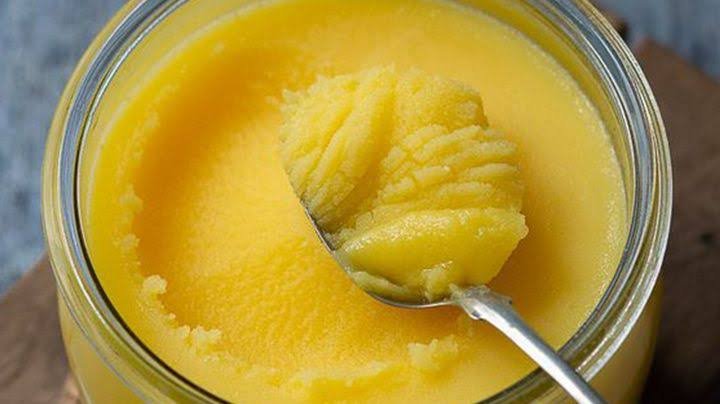
India used to cook in ghee. Clarified butter, rendered slowly, shelf-stable, rich in fat-soluble vitamins and butyrate, with a smoke point suitable for the high-heat cooking that Indian cuisine requires.
Ghee was Ayurvedic medicine. Ghee was considered sacred. Ghee was the cooking fat of a civilisation.
Then, in the latter half of the 20th century, two things happened simultaneously: the global campaign against saturated fat reached India, and the seed oil industry, particularly soybean and sunflower oil, scaled aggressively into the Indian market.
Ghee was repositioned as unhealthy, old-fashioned, and associated with a rural past the modernising middle class was moving away from. Seed oil was modern. Scientific. Heart-healthy. The cardiologists said so.
India is now the world's largest consumer of seed oils. Ghee consumption has fallen dramatically across large portions of the population, particularly in urban and middle-class households.
The cardiovascular disease rates have risen in lockstep with the oil transition.
The ghee is still being blamed.
The sunflower oil is still being recommended.
In India.
In 2026.
Sama Hoole@SamaHoole
India is frequently presented as evidence that vegetarianism works. A country of 1.4 billion people, with a large vegetarian population, a tradition of plant-based eating stretching back millennia, and, the implication runs, a health profile to match. Let's look at the health profile. India has the highest number of diabetics of any country on Earth: approximately 100 million diagnosed, with estimates suggesting a further 130 million in the pre-diabetic range. This is a population where type 2 diabetes is not a disease of the old or the obese in the Western sense: it strikes Indians at lower BMIs, at younger ages, and with more aggressive metabolic consequences than in comparable Western populations. India has among the highest rates of cardiovascular disease in the world, again emerging at younger ages and lower body weights than typically seen elsewhere. India has significant rates of micronutrient deficiency: B12, iron, zinc, vitamin D, the precise nutrients found most abundantly in animal foods. India also has the highest consumption of seed oils per capita of any major nation. It is the world's largest consumer of refined vegetable oils, predominantly soybean and sunflower. The vegetarian diet is the mascot. The seed oil is doing the damage. Nobody is talking about the seed oil.
English
@ApoDudz I was hospitalized with hyponatremia. I give a lot of credit to Dr. James's for my path back to wellness. As stated before, I'm off all meds primary care Doctor approved. Doc. still can't figure out how I got my TRIG=51 eating butter beef & grains. (No seed oil). @drjamesdinic
English
Truthfully, it was more of a joke than anything, particularly given I’m a pharmacist (we call ourselves doctors 🤣 as do dentists and some other HCP, but I think it just serves to confuse 😝) but JD is PharmD, not PhD afaik.
But to answer your question, I have not…not bc I don’t want to…but I have limited bandwidth - I hope you enjoyed your dinner!
English
He’s not a doctor!
He’s a pharmacist! 🤣
GIF
L. Amber O'Hearn@KetoCarnivore
This guy has a PhD. "I can add whatever [poor quality] evidence I want when the human studies also support my argument." "It adds to the converging lines..."
English
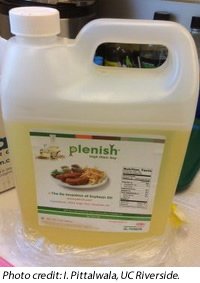
@robertlufkinmd The seed oil industry takes the blame (obesity and fatty liver), no worries, new GMO soy oil is less obesogenic. isaaa.org/kc/cropbiotech… @exfatloss
English

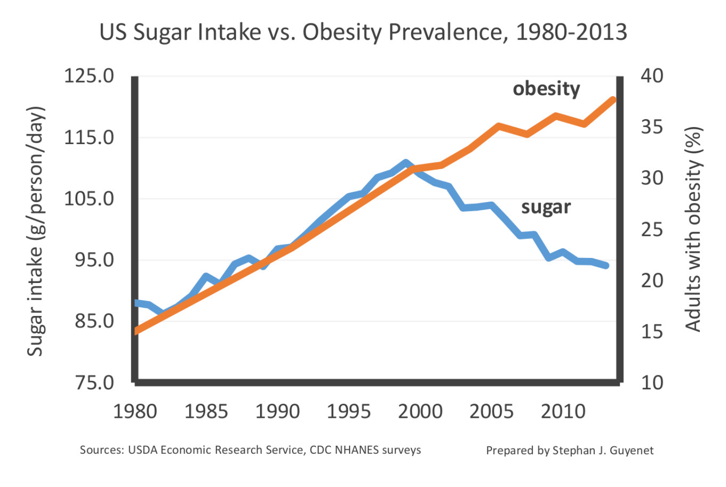
@TuckerGoodrich Specific research paper referenced above.
nature.com/articles/s4159…
@ApoDudz "GM Soybean Oil Causes Less Obesity and Insulin Resistance" --Plenish® (the GM low-linoleic-acid soybean oil from DuPont) isaaa.org/kc/cropbiotech…
English
"They found that olive oil produced identical effects as Plenish® - more obesity than coconut oil, although less than conventional soybean oil - and very fatty livers, which was surprising as olive oil is typically considered to be the healthiest of all the vegetable oils. "Plenish®, which has a fatty acid composition similar to olive oil, induced hepatomegaly, or enlarged livers, and liver dysfunction, just like olive oil," said Poonamjot Deol, co-first author of the research paper."
English
The most boring explanation is obviously wrong.
We've known how to use seed oils to induce obesity since 1949, and physicians have been using them to cause weight gain since 1956.
Dupont recently developed a GMO soybean oil that was lauded in the industry press as being less obesogenic (causing obesity) than standard soybean oil.
This isn't hard, it's basic science, and the fact that seed oils cause obesity is the key fact of the industry that researches obesity.
Zero HP Lovecraft@0x49fa98
seed oils are not what made this woman fat. eating too much food and never exercising are what made her fat. The most boring explanation for the obesity epidemic is the likely correct one: people have grown more sedentary and they eat more snacks
English