
Закреплённый твит
cryptking
3.4K posts

cryptking
@crypttrade8
Long time trader and investor since 2006. Not here for follows or fame. Love art, travel, and life. New to x.
Присоединился Mayıs 2025
67 Подписки228 Подписчики

If you understand this reference, you are one of us.

English
cryptking ретвитнул

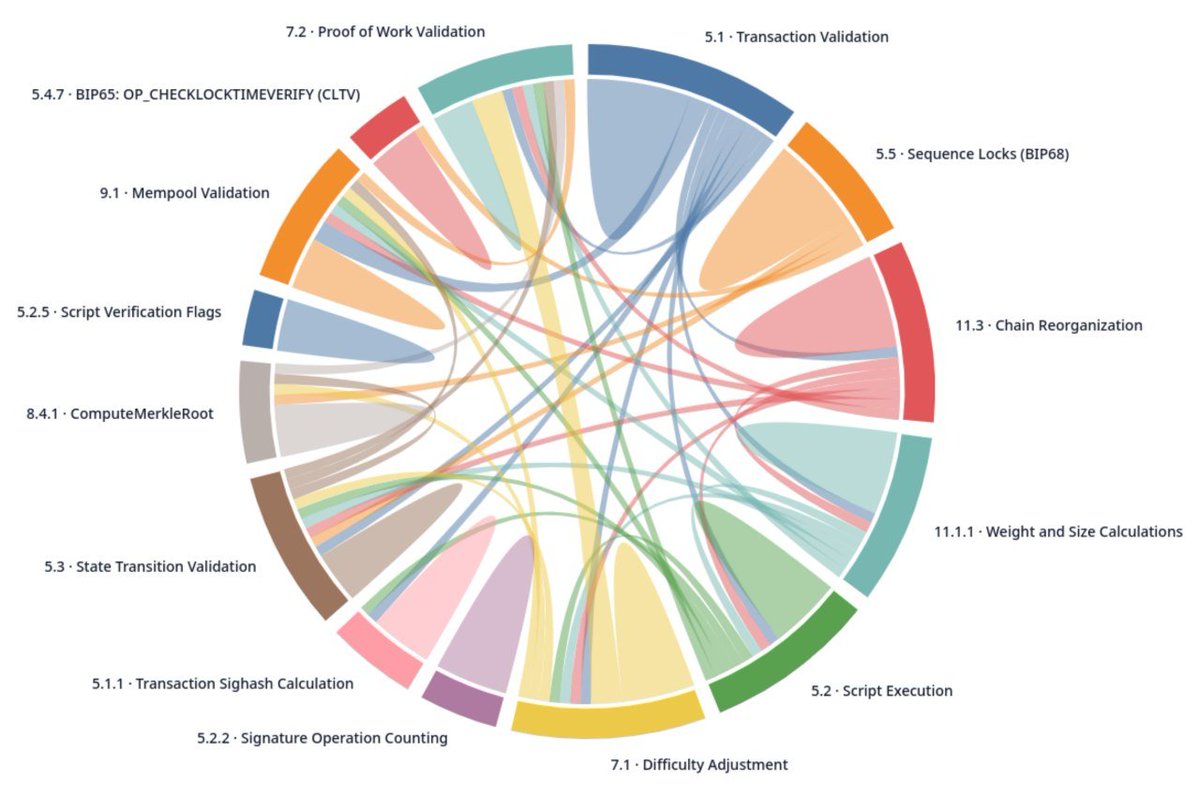
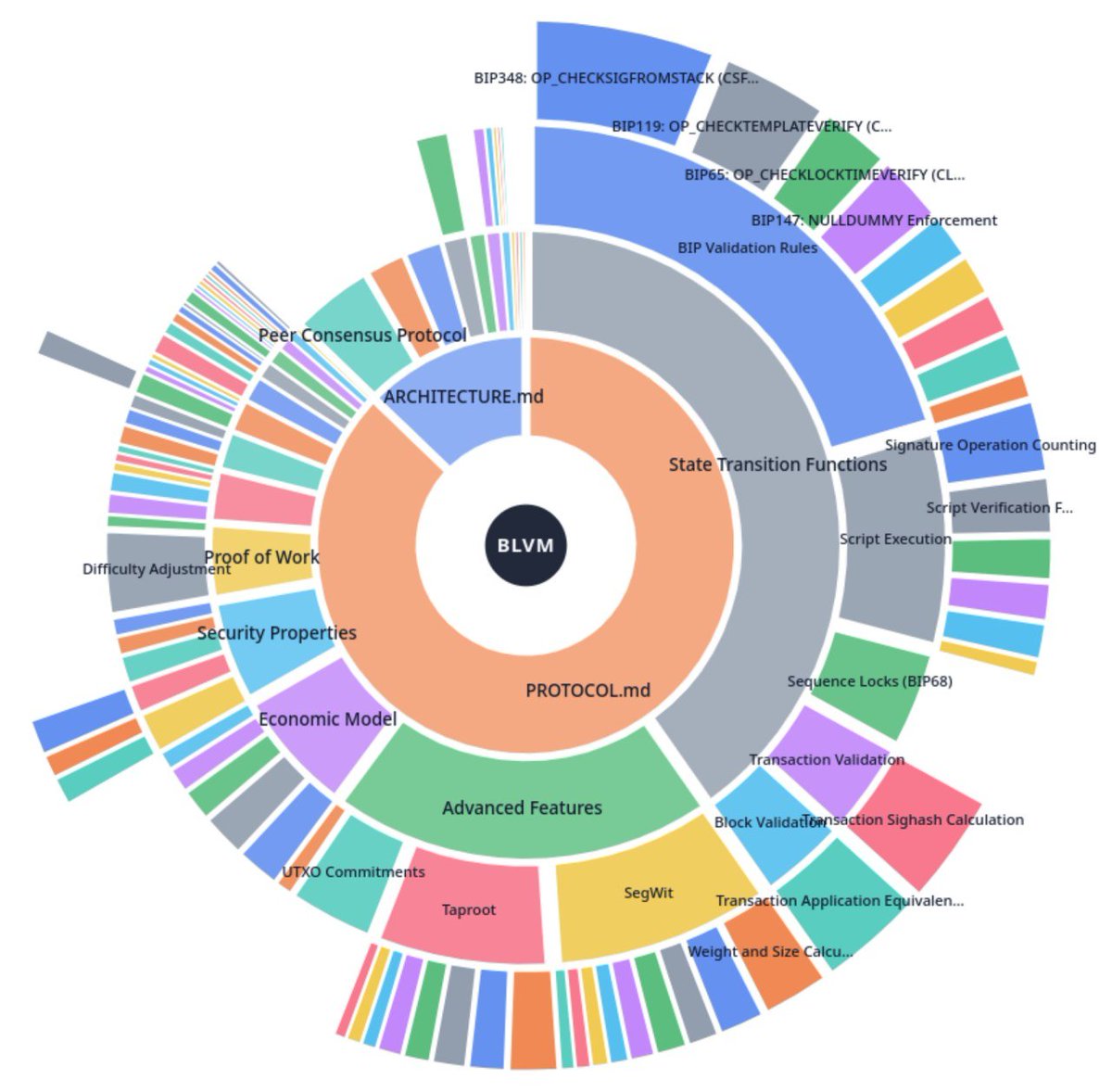
Bitcoin has had forks. It has not had alternative implementations. Not real ones. And forks don't solve the problem.
A Core fork is not an alternative implementation. It inherits everything. The technical debt, the undocumented behavior, the monolithic architecture. Change the team, keep the structure, and the structure wins. That's not an exit from the problem. That's the same castle with a different flag.
Node diversity matters. But nodes don't mine blocks. Without a value proposition for miners, implementation diversity remains a preference signal rather than a security guarantee. No Core fork has given miners a reason to switch.
The hardening problem is real, but the solution isn't forking Core. It's building from an independent mathematical specification and proving consensus validity through fuzzing and differential testing across the full chain history. That's verifiable safety. Everything else is institutional trust with better branding.
That's why we're building. @BtcCommons
English

Lots of news we'll be shared here! Please tune in!
QRL: The Quantum Resistant Ledger@QRLedger
Join us tomorrow for the next Official QRL Show Live with special guest Hunter Beast. Hunter (@cryptoquick) is a leading Rust/Bitcoin developer and the author of BIP360- Pay to Quantum-Resistant Hash (P2QRH). As quantum risk continues to progress, there's a lot for us to cover at the intersection of Bitcoin and post-quantum security 🔐 🗓️ When: Wednesday- April 15th ⏰ Time: 11 AM ET (15:00 UTC) Here's the link below to bookmark. See you there 👇 youtube.com/live/0PoTq0kWV…
English

@cryptoquick @LukeGromen @PeterMcCormack Eventually, I agree. Its going to be an interesting transition. A few plants in my hometown are fully robotic with AI running the show.
English
@LukeGromen predicts on his recent appearance on @PeterMcCormack 's show that AI layoffs will lead to a financial crisis similar to the one in 2008 due to all the structural leverage.
youtube.com/watch?v=YWnOdO…

YouTube
Official Layoff@LayoffAI
Amanda did a great job last year bringing attention to late-career layoffs (hint: they're screwed) Since the 2022 WSJ study she referenced, the following research has been done: >AARP's January 2026 survey found 22% of workers over 50 now say they feel actively pushed out. >Workers 45+ accounted for 40% of the entire increase in unemployment. (RBC Economics) > When they do get rehired, it takes 26 weeks on average vs. 19 for younger workers, and they take an 11% pay cut. (Center for Retirement Research) >Perhaps most importantly: Pew found older workers are adopting AI tools at half the rate of those under 50. Companies know this. They're using "AI restructuring" as clean, lawsuit-proof cover for pushing out their most expensive, longest tenured employees. The 24% who never find work again from her 2022 graphic? That number is about to get a lot worse.
English

このポストを見た世界中のビットコイン保有者へ
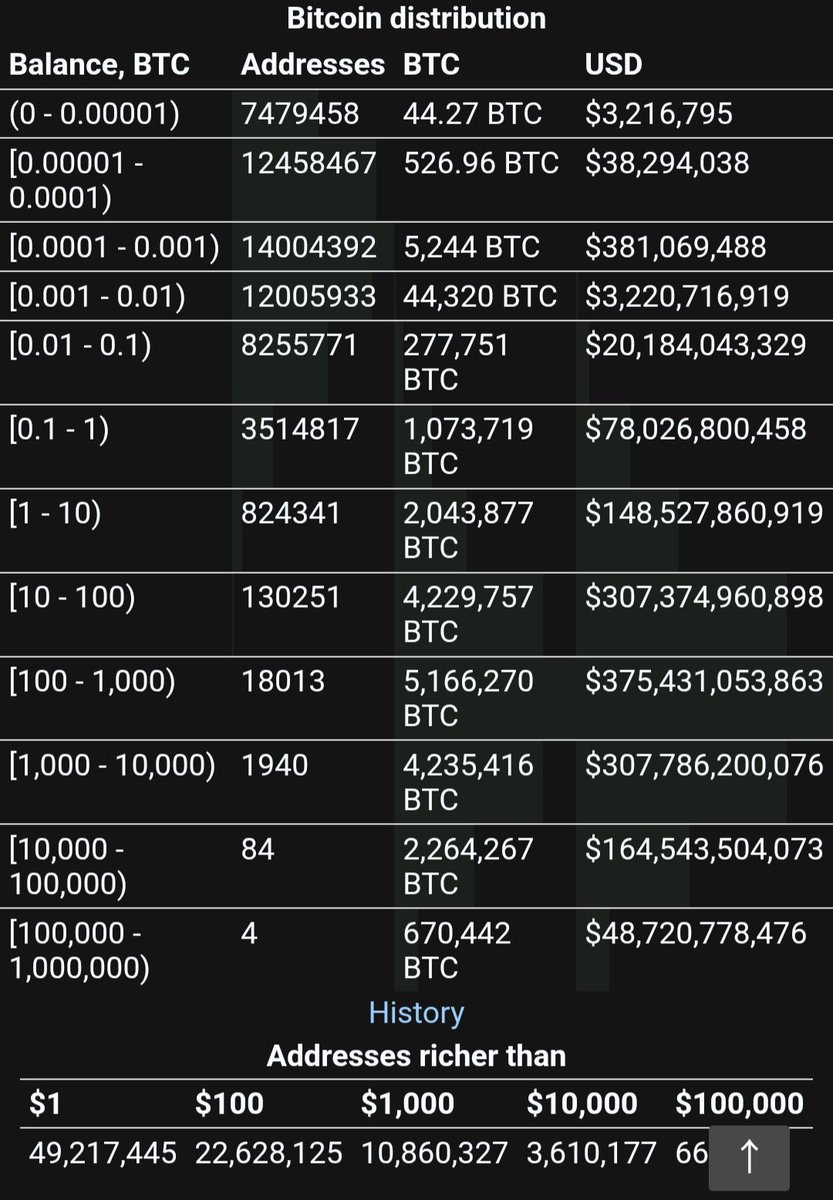
地球上で1BTC〜10BTCを保有している人(アドレス)は…
たった82万人しかいない。
0.1BTC〜1BTCでさえ351万人しかいない。
0.01BTC〜0.1BTCだと825万人。
80億人の世界です。
全世界で価値を誰よりも早く見抜いて選ばれた825万人だと考えたら、ビットコイン保有者はもっと自分のことを誇りに思っていいと思わない?
日本語
cryptking ретвитнул
A great summary of everything in the past week
Shai (Deshe) Wyborski@DesheShai
Finally had the time to carefully read the details of the QSB method by @avihu28 from @StarkWareLtd. The tl;dr: The three proposals on the table -- QSB, LFC, and BIP360 -- are not mutually exclusive, and none of them is rendered obsolete by the other two. I want to explain where they overlap and where they don't. My bottom line is that all three approaches can, and possibly should, be implemented together. Hopefully, I got everything right. [ If you don't know what LFC is, I don't blame you. It's a rather new proposal by @roasbeef, based on a protocol by @or_sattath and me called Lifted FawkesCoin. The Beef does not call it that way, but it doesn't seem that they named it at all, so I'll keep calling it LFC. Our paper: eprint.iacr.org/2023/362 Beef's proposal: x.com/roasbeef/statu… ] Since Avihu's proposal was posted a couple of days ago, I've seen a barrage of posts lauding it for "making Bitcoin post-quantum secure", some even arguing that it proves Bitcoin "launched post-quantum" (lol). While QSB definitely adds a new and important tool to the post-quantum toolbox, it is a far cry from how the superlative posts present it, which caused some people, myself included, to be concerned that the hype might overshadow other important post-quantum efforts. Ever since OP, I've seen Avihu and @EliBenSasson doing their best to dispel this misconception and put this work in the right scope. But after the horses have left the stable, this is often as futile as plugging a dike with your thumb while trying not to mix metaphors. One way I can help is to bring forward an important existing problem that QSB does not address and describe a specific effort to address it. I'm hopeful that this helps frame QSB correctly, and makes the discussion more constructive. The important problem I am talking about is dealing with laggards/procrastinators: people who did not prepare for q-day in any way (be it because they lost their keys, were convinced that quantum computers are "just a hype", took a very long nap, etc.). QSB does not help laggards (nor was it intended to), while LFC is primarily focused on helping laggards. On the other hand, the key drawback of QSB is that generating the required auxiliary data is very expensive. Estimated at $100s of dollars per txn. These costs cannot be reduced as they don't arise from a challenging and complicated computation, but from an important proof-of-work puzzle. Another small disadvantage is that QSB is based on Taprootesque hacks that some people in the community are scheming to patch away. In particular, BIP110 will completely decimate QSB. iiuc, if BIP110 is rolled out, it might cause all UTXOs generated by QSB to become indefinitely unspendable (unless it includes some designated failsafe), though I'm not too sure about that. Advantages of LFC over QSB: - Helps laggards. With LFC you can quantum-safely spend a huge subset of currently existing UTXOs, including any address generated by an HD wallet after 2014. Depending on the chosen mode of operation, LFC can even help recover wallets with lost secret-keys (this particular mode of operation is called permissive LFC and, unlike other modes, it requires a hard-fork and not just a soft-fork). - Applies to all the cases QSB applies to, but much cheaper to use, and does not require any pre-q-day preparations. - Transactions are cheaper and quicker to generate by magnitudes. Disadvantages of LFC over QSB: - requires a fork. Moreover, the fork is beyond a simple OP_CODE implementation and adds complexity to the protocol on both the user and miner sides. - Delegates some of the stuff Bitcoin/QSB secures cryptographically to economic incentives (though nothing that allows theft, more of a "one side can misbehave and cause both sides to lose" kind of situation, and even that in a limited sense, without any emergent prisoner's dilemma). - Has a bit of a complicated UX. Each spend is a two-phase process. - Confirmation time is quite high, ranging from hours to days, as the security relies on sufficient temporal separation between the two phases All in all, there are three important proposals for quantum-proofing: 1. BIP360 (h/t @cryptoquick): fork for adding support for pq-sigs. Cost of use: marginal. 2. LFC: fork for post-quantum spending from pre-quantum UTXOs without preparation. Cost of use: noticeable. You need to generate a zk proof that is a bit on the heavy side, nothing your computer can't handle, but might be an obstruction for hardware wallets, etc. 3. QSB: requires no fork but is highly expensive to use, $100s of computation per transaction. Does not help laggards. I think these three proposals complement each other nicely: QSB can be used to quantum-proof large sums as early as today, making sure they are safely spendable after q-day, even if no fork is deployed. BIP360 will provide pq-signatures, while LFC will provide a safe migration route for laggards. If pq-signatures are noticeably more expensive to use due to their increased size, LFC can also serve as a "slow but cheap" alternative, with transactions about the same size as they are now (in some cases, even a bit smaller!), but with slower confirmations.
English
@grok @BitcoinCadet @CaffeSatoshi While totally true its circumstantial only. Many great projects were built in history on others ideas.
English


@MomsInBitcoin1 Old school guys who were in early are nerds and geeks. We always get revenge 🤣
Now the rest of the pack trying to catch us... as usual
English

I've been told there are no single men in bitcoin over the age of 40.
And I'm like..... really.
Really? I get they are all married and awesome and healthy and good husbands or wtf-ever.... but lots of people find bitcoin later in their lives no? After divorces or other life circumstances. Right?
Dunno really...
I really don't know how to respond to that. What say you?
English
@MorganWParker @MomsInBitcoin1 I guess we know your exit plan 🤣🤣🤣.. hope its not that bad for you lol. I read that an cracked up
English

@MomsInBitcoin1 Lots of men will have new wealth with the increase of BTC price, they are stuck in sexless marriages, kids nearly grown, marriage is not worth the stress, they will choose to be single and start new. Just a hunch.
English
@Bitcoinprof0637 Whatever, whatever, and whatever.. believe it when I see it
English
@secsovereign So true. It requires altering thinking patterns not just by process, but also dealing with norepinephrine cortisol with rewiring. People need a little more serotonin in life 😁
English
Your brain is wired to avoid loss more than it pursues gain. Studies put the ratio at roughly 2:1, the pain of losing $10k feels twice as bad as the pleasure of gaining $10k.
Bitcoin's volatility runs straight into that wiring.
When price drops, the nervous system doesn't register 'buying opportunity.' It registers threat. The same circuitry that kept your ancestors alive fires up and produces one output: avoid.
So people sell the bottom. They watch from the sidelines. They wait for certainty that never comes. They tell themselves they'll buy back in later and never do.
This isn't stupidity. It's biology running an ancient program in a situation it wasn't designed for.
The people who hold Bitcoin through multi-year drawdowns aren't smarter. They've just developed enough tolerance for uncertainty that the threat signal doesn't override their judgment.
That's the actual filter. Not technical knowledge. Not conviction in the thesis. Emotional regulation under sustained uncertainty.
Most people never develop it. Which is why most people will never hold Bitcoin long enough for it to change their life.
h/t @BitmundFreud
English
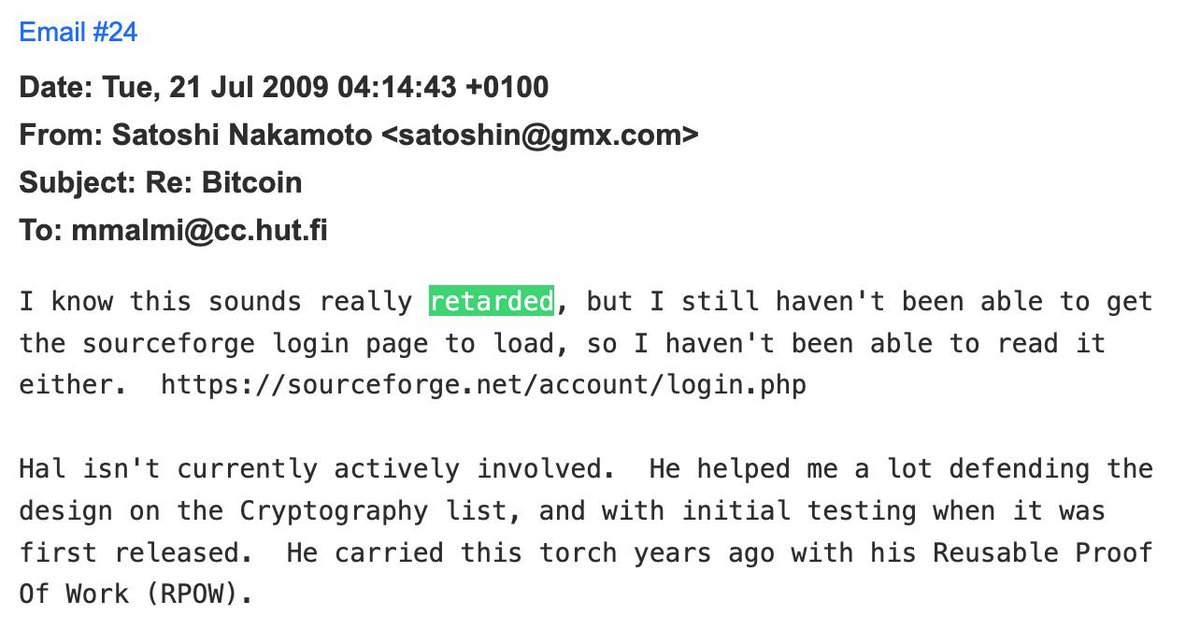
@cryptoquick @josephdelong Sorry but im still betting Hal 😁. I know that image may not show all the context of its time, but it looks cooked up to throw the scent off the trail
English

> invents the hardest money the world has ever known
> refuses to elaborate
> dies

English
@cguida6 I think cosmology maps pretty cleanly to Genesis and physics suggests that we live in a universe that was created
English

Interesting take
NootNoot@NootNootFrog
@IgorKruglov12 @WarPath2pt0 @cguida6 Science points to a creator. Especially modern science like quantum fisics and such. If everything that is not observed exists in a state of superposition, only collapsing into measurable reality once observed, who was the first observer before life showd up?
English
@Camila_8791 This take is way off. If someone prefers comfort without care of brand then they simply do not care.
Projection of an intentional kind is due to ego, not status.
English

@secsovereign @RachelBitecofer Be careful... their brains can only handle so much voltage and then its gone 🤣🤣
English
@RachelBitecofer By "share" you mean have their resources taken *from* them at gunpoint and redistributed to buy votes?
English

Bc that’s 1st generation of men that had to share with women and minorities
Hutch@hutchinson
Seriously what the fuck happened with Gen X why are they so Trumpy??
English
@BitcoinPulseX Too funny. We all know how great fiat is... right? Guaranteed loser every year. Yeah... that's the one they always cling to.
Why? Its stupid easy to enslave populations with it.
English

🚨 BREAKING:
THE European Central Bank HAS FORMALLY REJECTED Bitcoin FROM ITS FRAMEWORK.
Christine Lagarde STATES IT FAILS TO MEET BASIC STANDARDS FOR SAFETY AND SECURITY.
SHE EVEN LINKED IT TO ILLICIT ACTIVITY — LOUD AND CLEAR.
THE EU JUST FIRED A DIRECT SHOT AT CRYPTO 🚫🇪🇺
English

This is a very good article and a very important one too, courtesy of @neha, head of the MIT DCI
She is the most influential Bitcoiner to publicly and clearly acknowledge the problem and call for real progress on the matter, and she deserves a ton of credit for taking a public stance like this when many others are choosing silence and hoping it goes away.
The FAQ also debunks most of the very silly objections that people keep raising.
nehanarula.org/2026/04/03/bit…

English