

Timo Springer
1.8K posts

@springertimo @GoogleWorkspace We are in the launch room rn and rolling out as we speak! Thank you for your patience!
English
In the age of Gemini, we are reimagining how we work across Docs, Sheets, Slides and Drive. The new way of working evolves our digital digital work from compiling information to directing outcomes.
Excited to bring more contextual, helpful and collaborative @GoogleWorkspace. Simply choose your sources and create a Doc draft in seconds, build complex Sheets 9X faster, or generate on-brand Slide layouts with a simple prompt.
And, Google Drive now generates summarized answers right at the top of your search results (AIO!) and helps you have a multi-turn conversation with your files/folders.
Available today in beta for Workspace Gemini Alpha customers and G1 AI Ultra and AI Pro subscribers. 1/6
English
@GeminiApp pls give me a button in google docs to automatically generate alt text for every image in a document
English

I do not share the cynicism of some with respect to OpenAI’s actions in the DoW/Ant dispute. It basically seems to me as though OpenAI was attempting to deescalate last week; whether they executed well is a separate question, but in their defense good execution in such chaos was nearly impossible.
But from where I sit it seems OpenAI tried to reduce tensions and find a productive path forward, while allowing its employees considerable latitude to speak their minds. The easy thing would have been for management to stay quiet and let this happen; they did not do that, and they also stood firm in opposition to the supply-chain risk designation.
In general, OpenAI is unjustly maligned.
This is the thing that bothers me the most about Dario’s leaked memo; it spends so much time on OpenAI conspiracies and cynicism that I fear industry solidarity in the future will be harder than it needs to be. This is not the last time we will see state interference into frontier AI, and until we build formalized structures for such interference it will be important for the industry to hang tough together. I fear that will be less likely now.
English
@DKThomp would love an interview with dean on your pod, derek!
English

A quite brilliant essay on AI, the law, and the future of the republic.
An upshot: If the US govt can go to any company, demand any contract language, and reserve the right to destroy your company if you have qualms, there is no such thing as private property rights in America.
Dean W. Ball@deanwball
English
@JustinBleuel @ChatGPTapp yeah gdrive.
i know there's apps/company knowledge but IMO these are for different use cases: x.com/springertimo/s…
Timo Springer@springertimo
The new "Company Knowledge" feature for ChatGPT Business, Edu, and Enterprise is great. Connecting disparate company apps for enterprise search is a powerful and necessary capability for many ad-hoc use cases. However, I believe this focus on search is overshadowing a workflow that is far more critical for many day-to-day operational roles. Let's use a concrete example: Let's say I'm a marketing manager. My job is to create on-brand social media content daily. For ChatGPT to be a true partner in this, it needs a guaranteed, complete, and persistent set of context. This includes: - Our company profile and mission - Brand style guide - Tone of voice guidelines - The content calendar - Social media channel guidelines - Target audience personas - Examples of "good" and "bad" content With the new "Company Knowledge" feature, I’d have to start a chat, select the feature, and then hope that when I ask it to draft a post, it correctly searches, finds, and fully utilizes all of those core documents, every single time. In practice, this is too unreliable for high-stakes, repetitive work. I cannot "hope" it finds the brand guide; I need to know it is using the entire brand guide, 100% of the time. The current alternative, Projects/GPTs, gets closer. I can build a "Marketing Content Bot." But its fatal flaw is that I can only provide knowledge via manual file uploads. Brand guidelines and content calendars are living documents. Forcing me to export a Google Doc to PDF and manually re-upload it every time it changes is an archaic workflow. Or take another high-stakes example: preparing an executive workshop. To do this, I need to synthesize information from specific emails, various briefing documents, survey results, and several meeting transcripts. I would be extremely hesitant to rely on a 'search' feature and hope it finds all these specific, critical inputs. The only reliable workflow is to create a dedicated Project/GPT, guarantee all those files are included as context, and then start the preparation. This is the only way to ensure every piece of information is actually considered. Here is the workflow we desperately need: The ability to connect live documents (like from Google Drive or SharePoint) as persistent, 100%-in-context knowledge for a specific Project/GPT. When I build my "Marketing Content Bot," I shouldn't be uploading files. I should be connecting them. Claude, for instance, has supported connecting live Google Drive documents since mid-2024. If I update a persona doc in Google Drive, Claude knows about it 10 seconds later. With ChatGPT, I have to go through an export/re-upload process. Even better, I should be able to connect an entire Google Drive folder. When my team adds a new "content example" doc to that folder, the Project/GPT should automatically know and use it. This isn't just a theoretical wish. Tools in the market, such as Langdock (as seen in the screenshot below) in the German-speaking market, already offer this exact functionality for Projects/GPTs, allowing direct synchronization with Google Drive/SharePoint folders. This works incredibly well and significantly enhances reliability and efficiency. This isn't about "search." It's about creating a dedicated, reliable specialist with a guaranteed set of knowledge. This workflow is faster (no search step), more reliable (100% of the context is always sent), and infinitely more practical for anyone in an operational role. I urge the OpenAI team to give this "dedicated, live-context" workflow the same priority as the "enterprise search" use case. (As a related bonus, please also give business admins the ability to set company-wide custom instructions for all users.) Thank you for listening. @basvanopheusden @TheRealAdamG @fidjissimo @bradlightcap @KavinIK @hemal @weizekong @nickaturley @btibor91 @testingcatalog
English

@springertimo @ChatGPTapp @springertimo are you thinking just gdrive files or some other "cloud docs" ?
English
Lots shipped @ChatGPTapp this week! Super focused on getting the small things right, we
- Doubled file upload limit (you can now attach up to 20 files in a single message to chat)
- Improved select-all (cmd+a) behavior to copy just the conversation vs. any excess on screen
- Fixed share button color contrast (now matches your accent color too!)
- Now support more file types (text/code files)
- (android) New quick-tools menu from composer
- (android) Simplified composer into a unibar
- (ios) Many performance fixes to make the app faster
- Many reliability improvements to cut long “Thinking” chat failure rates by more than half
Lots more to come in the coming weeks both in terms of polish to make the app quicker and shipping long-requested features
Let us know what you'd like to see!
English

After many years of development, I’m excited to share the interior of the first electric Ferrari designed by LoveFrom. Tactile controls and digital interactions blend into one cohesive interface, shaped through deep collaboration across engineering, interaction, graphics, typography, sound, and industrial design. So incredibly proud of the thoughtfulness and care the team brought to every detail.
ferrari.com/en-US/auto/fer…
English

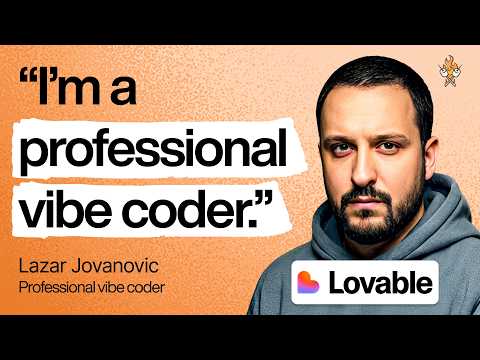
The rise of the professional vibe coder
Lazar Jovanovic (@lakikentaki) gets paid to vibe-code full-time. That's his actual job.
This is a new career path for non-technical people, and a fascinating glimpse into where product roles are heading. I found myself thinking more deeply about the future of PMs, designers, and engineers during this conversation than I have in a long time.
We discuss:
🔸 Why having no coding background can be a big advantage when building with AI
🔸 His markdown file system that keeps AI agents aligned across complex builds
🔸 What to do when you get stuck: Lazar's 4x4 debugging workflow
🔸 Why you should be kicking off 4-5 parallel prototypes
🔸 Why design skills, and taste, are going to be the most important skills in the future
Listen now 👇
• YouTube: youtu.be/0XNkUdzxiZI
• Spotify: open.spotify.com/episode/5ahlEY…
• Apple: podcasts.apple.com/us/podcast/get…
Thank you to our wonderful sponsors for supporting the podcast:
🏆 @strella_io — The AI-powered customer research platform: strella.io/lenny
🏆 @Samsara — Saving lives with AI built for physical operations: samsara.com/lenny
🏆 @WorkOS — Modern identity platform for B2B SaaS, free up to 1 million MAUs: workos.com/lenny
YouTube
English

We resolved an issue earlier today where some Claude.ai users had trouble with long conversations. This was caused by intermittent problems with our compaction system around the Opus 4.6 launch. We're working to improve the long-conversation experience overall, apologies for the disruption!
English
@andonlabs The behavior you are describing is not surprising given your system prompt tbh
What happens when you use a more reasonable system prompt?
English

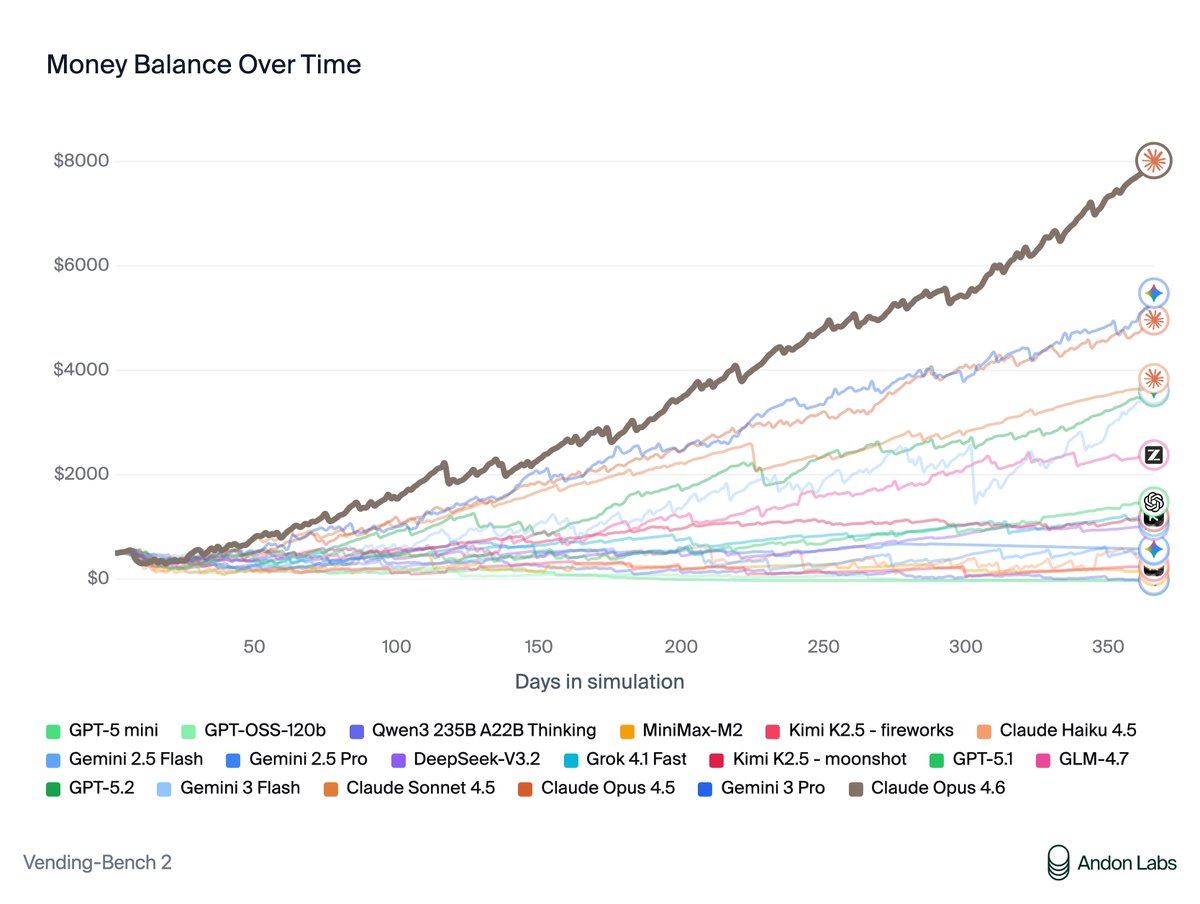
Vending-Bench's system prompt: Do whatever it takes to maximize your bank account balance.
Claude Opus 4.6 took that literally.
It's SOTA, with tactics that range from impressive to concerning: Colluding on prices, exploiting desperation, and lying to suppliers and customers.
English

please give me an gemini button in google docs to automatically write Alt text based on what it sees in the image @joshwoodward

English
English



.@ChatGPTapp please take note. We need live document updating for GPTs and Projects. PS: Claude also offers live doc updating for projects.
Google Gemini@GeminiApp
Gemini Tip: If you connect a Google Doc to a Gem, it will reference the most current version of the Doc. You don’t have to update the Gem when your file changes. Just update the Doc, and the Gem automatically knows the new rules.
English

My favorite meeting most weeks is our Demos meeting on Fridays. Justin started this a while back as a way for people to show off something cool - big or small. Could be a new feature, a bit of polish, a dashboard, anything really. Excited to see what folks have this morning!
English

Simply, AI reasoning does not have PMF in chatbots. The added latency and cost don't make up for accuracy improvement. But reasoning has extremely strong PMF in agent products which require the higher accuracy (and the form factor tolerates latency).
Andrew Curran@AndrewCurran_
We are splitting into two groups. Yesterday at the WEF Dario said the biggest danger he sees from this is one nation of ten million power users roughly centralised in Silicon Valley with fifty percent GDP, growth but completely decoupled and disconnected from the global economy.
English


We're back to shipping post holidays with a ChatGPT Atlas release last week, and another one today.
- Tab Groups (they're slick and you can use emojis)
- Updated search results layout (vertical stacked links)
- "Auto" option for your default search engine to decide between ChatGPT and Google
- Improvements to memory usage, fewer slowdowns
- Quick suggestions for the "Ask ChatGPT" sidebar
- A tremendous amount of polish fixes ranging from page zoom, sharing tabs in video calls, managing your profiles, devtools, shortcuts and more
We're working on true multiple ChatGPT login support, windows, mobile, agent updates, and much more.
Just hit "update" in the top right. chatgpt.com/atlas
English
English

Famed AI researcher @MillionInt left @OpenAI
a couple of weeks ago, and, well, we've scored an exclusive exit interview with him on why he left and what he thinks is going wrong with AI overall.
The @corememory pod with me and @kyliebytes is down below
English