Khan
4.1K posts

Khan
@0xCryptoDG
Moderator/Community Manager/Community Builder. Work at @r3vl_xyz | @REVApay_ai Telegram: https://t.co/hp2t3CDBMC
Pakistan เข้าร่วม Mayıs 2010
179 กำลังติดตาม1.2K ผู้ติดตาม

My first digital art for @get_optimum ❤️🫴
Virtual vibes colorful strings creativity flowing through every note. 🎸
#art #optimum #Web3

English


Forcing every node to store the entire blockchain history drives up hardware costs, pricing out smaller operators and fueling centralization.
@get_optimum fixes this storage crisis with DeRAM (Decentralized Shared Memory), fragmenting and sharing the data load across the network.

English

Good morning CT, life's good. ☀️
Here is a free advice: Surround yourself with friends who are ambitious and successful, their mindset pushes you to stay focused.


ROSAAA@rosa_onchain
INJECTIVE AMBASSADOR PROGRAM: A lot of you have been texting me regarding the @injective Ambassador Program. Here are all the details you need to know: > Injective Ambassador Program never closes; the team is always acquiring good ambassadors. > It is a paid program. > You need to fill out the form to become an ambassador. > The basic requirements are 50k impressions/month and 500 followers. > If you are selected, the team sends you an invitation/DM on X. Reality Check: > The Injective Ambassador Program is highly competitive and promising, so just completing the basic requirements is not a guaranteed selection. Tips: Maximize your chances through Injective Supporter Campaign. > Injective has launched the Injective Supporter Program on Zealy. > A biweekly campaign with 300 $INJ tokens in the pool. > The team notices top users. There is a high chance that top users are selected as ambassadors, and they win from the pool too.
English

@0xCryptoDG This is a fascinating perspective on blockchain scalability. The emphasis on shared storage could genuinely enhance decentralization and accessibility. I look forward to seeing how DeRAM evolves in practice.
English
𝗧𝗵𝗲 𝗛𝗶𝗱𝗱𝗲𝗻 𝗦𝘁𝗼𝗿𝗮𝗴𝗲 𝗖𝗿𝗶𝘀𝗶𝘀 𝗛𝗼𝗹𝗱𝗶𝗻𝗴 𝗕𝗹𝗼𝗰𝗸𝗰𝗵𝗮𝗶𝗻𝘀 𝗕𝗮𝗰𝗸
Most people focus on transaction speed when talking about blockchain scalability.
But there’s another challenge growing quietly in the background:
𝐃𝐚𝐭𝐚 𝐬𝐭𝐨𝐫𝐚𝐠𝐞
The Problem: Every Node Stores Everything
Imagine keeping every photo, video, message, and file you've ever created on a single device.
Sooner or later, that device becomes overloaded.
Blockchains face a similar issue.
To maintain security and verification, network nodes are expected to preserve the complete historical record of every transaction ever processed.
As adoption grows:
🔹 Data requirements expand rapidly
🔹 Storage costs continue rising
🔹 Infrastructure becomes harder to maintain
🔹 Network participation becomes more expensive
𝐖𝐡𝐲 𝐓𝐡𝐢𝐬 𝐈𝐬 𝐃𝐚𝐧𝐠𝐞𝐫𝐨𝐮𝐬
When operating a node requires massive storage resources, smaller participants start dropping out.
The result?
🔹 Fewer independent operators
🔹 Greater reliance on large infrastructure providers
🔹 Increased centralization risk
🔹 Reduced accessibility for everyday users
A decentralized network becomes harder to keep truly decentralized.
𝐎𝐩𝐭𝐢𝐦𝐮𝐦'𝐬 𝐀𝐩𝐩𝐫𝐨𝐚𝐜𝐡: 𝐃𝐞𝐑𝐀𝐌
Instead of forcing every machine to maintain the entire blockchain history, Optimum introduces DeRAM (Decentralized Shared Memory).
The concept is simple:
🔹 Data is fragmented into secure pieces
🔹 Information is distributed across many participants
🔹 Storage responsibility is shared throughout the network
🔹 No single node carries the entire burden
This creates a decentralized layer of shared memory that functions like a collective intelligence system for blockchain data.
A Smarter Way to Access Information
When applications need specific data:
🔹 No need to search through enormous storage archives
🔹 No requirement to maintain excessive local history
🔹 Information can be retrieved directly from the distributed network
The outcome is a lighter and more efficient infrastructure model.
𝐖𝐡𝐲 𝐈𝐭 𝐌𝐚𝐭𝐭𝐞𝐫𝐬
Lower Costs
🔹 Reduced storage requirements for node operators
🔹 More efficient infrastructure utilization
Stronger Decentralization
🔹 Participation remains accessible to a wider range of users
🔹 Less dependence on enterprise-scale hardware
Future-Ready Scaling
🔹 Supports growing blockchain ecosystems without overwhelming storage demands
🔹 Enables networks to expand more sustainably
The future of Web3 isn't about making every machine store more data.
It's about building smarter systems where storage is shared, distributed, and scalable by design.
@get_optimum @aqccapital @blockchainjeff @CryptoSundayz

Khan@0xCryptoDG
𝗢𝗻𝗲 𝗢𝗳 𝗢𝗽𝘁𝗶𝗺𝘂𝗺’𝘀 𝗠𝗼𝘀𝘁 𝗨𝗻𝗱𝗲𝗿𝗮𝗽𝗽𝗿𝗲𝗰𝗶𝗮𝘁𝗲𝗱 𝗔𝗱𝘃𝗮𝗻𝘁𝗮𝗴𝗲𝘀 Most networking systems depend on receiving exact packets in the correct sequence. RLNC works differently. With Random Linear Network Coding, nodes do not need the original packet set to recover information. 𝗧𝗵𝗲 𝗢𝗻𝗹𝘆 𝗧𝗵𝗶𝗻𝗴 𝗧𝗵𝗮𝘁 𝗠𝗮𝘁𝘁𝗲𝗿𝘀 𝗜𝘀 𝗘𝗻𝗼𝘂𝗴𝗵 𝗜𝗻𝗱𝗲𝗽𝗲𝗻𝗱𝗲𝗻𝘁 𝗖𝗼𝗱𝗲𝗱 𝗦𝗵𝗮𝗿𝗱𝘀 That means: 🔹 recovery depends on the information collected, not the arrival order 🔹 missing packets become far less damaging 🔹 networks remain resilient even under unstable conditions 🔹 propagation efficiency improves in distributed environments This is one of the biggest reasons RLNC performs so effectively across large-scale decentralized systems where: 🔹 packet loss is common 🔹 latency fluctuates constantly 🔹 network paths remain unpredictable And this architecture is becoming a core part of what @get_optimum is building. 𝗙𝗿𝗼𝗺 𝗣𝗿𝗼𝗽𝗮𝗴𝗮𝘁𝗶𝗼𝗻 𝗧𝗼 𝗗𝗲𝗰𝗲𝗻𝘁𝗿𝗮𝗹𝗶𝘇𝗲𝗱 𝗗𝗮𝘁𝗮 𝗔𝗰𝗰𝗲𝘀𝘀 The same RLNC foundation powering Optimum’s propagation layer is now being extended into DeRAM. The objective is much bigger than simply accelerating data transmission. It’s about making decentralized data retrieval scalable, reliable, and practical for real-world systems. 𝗪𝗵𝘆 𝗧𝗵𝗶𝘀 𝗠𝗮𝘁𝘁𝗲𝗿𝘀 Future blockchain infrastructure will require: 🔹 continuous real-time data availability 🔹 efficient recovery under network instability 🔹 scalable decentralized storage access 🔹 low-latency communication between distributed nodes And traditional networking models begin struggling as throughput grows. RLNC changes that dynamic by allowing networks to reconstruct information flexibly instead of depending on rigid packet delivery. While most projects focus only on execution scaling. @get_optimum is working on the communication and data-access layer needed to support truly large-scale decentralized systems. @aqccapital @blockchainjeff @CryptoSundayz
English

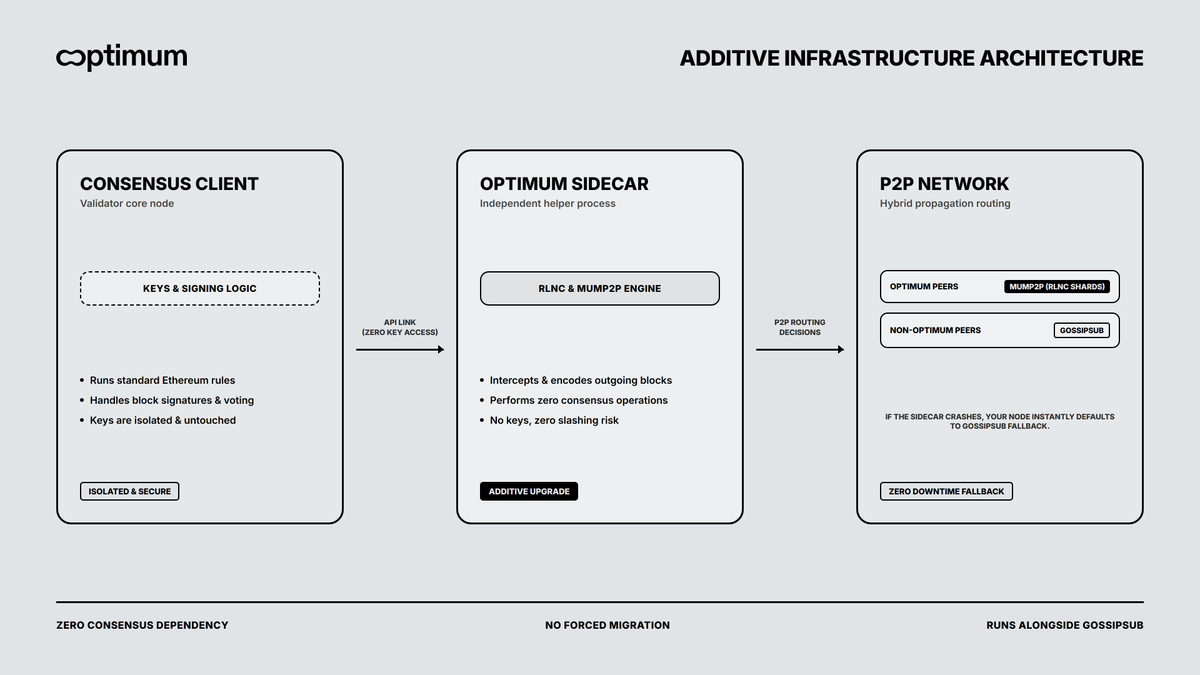
a lot of people assume that upgrading blockchain networking means a forced migration
something that might risk your node setup or validator keys
but optimum is designed differently
its transport layer called mump2p runs alongside gossipsub rather than replacing it
mump2p uses random linear network coding to mix data packets and speed up propagation
if you run the @get_optimum sidecar helper program it uses mump2p to send coded shards to other optimum nodes
but it still uses standard gossipsub to talk to non-optimum nodes
if the sidecar helper program ever goes down your node just falls back to gossipsub instantly
nothing breaks and there is zero consensus dependency because it never touches your validator keys or signing logic
this is how you design additive infrastructure
no forced migration and zero risk to your existing setup
gud tek
Hassan XBT@itsmexbt
everyone's focused on faster execution monad, solana, parallel evm, all racing on compute speed but execution on major L1s is already fast enough the real ceiling is propagation @get_optimum tested this. 72 nodes globally, mump2p vs gossipsub head to head at 8MB blocks gossipsub takes 10.3 seconds. optimum does it in 1.3 seconds at 10MB gossipsub hits a 2000%+ latency spike and fails to deliver consistently. optimum holds at ~1 second ethereum gives validators 4 seconds to attest inside a 12s slot if the block is still traveling at second 5, execution speed means nothing. you can't reach consensus on data that hasn't arrived this is why validators physically move servers into the same data centers (atlantic corridor) just to cut propagation manually a centralization fix for a network problem and builders keep submitting smaller blocks on purpose, leaving MEV on the table because they can't trust the propagation layer to beat the deadline optimum's own data shows 100-150ms faster propagation = 1-2% more staking revenue for operators most teams haven't even started thinking about this layer yet
English
@ilittlejaiswal @BinanceDesi Same here 😭 I am going outside wapis a k BAAT krty han
English



@0xprobeat They are developing a banger infrastructure the base for Blockchain network
English

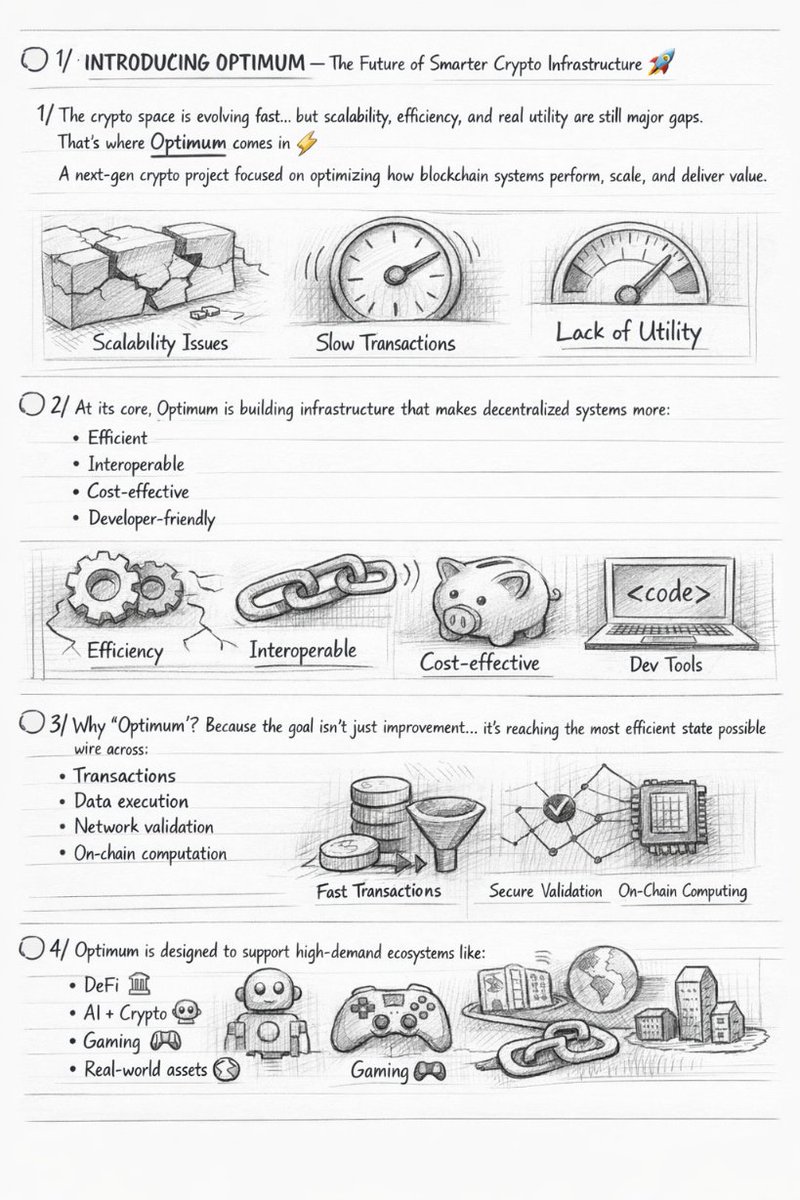
INTRODUCING OPTIMUM, The Future of Smarter Crypto Infrastructure
The crypto space is evolving fast, but scalability, efficiency, and real utility are still major gaps.
That’s where comes in
A next-gen crypto project focused on optimizing how blockchain systems perform, scale, and deliver value.
At its core, Optimum is building infrastructure that makes decentralized systems more:
• Efficient
• Interoperable
• Cost-effective
• Developer-friendly
Because mass adoption needs better rails not just better narratives.
Why “Optimum”?
Because the goal isn’t just improvement… it’s reaching the most efficient state possible across:
• Transactions
• Data execution
• Network validation
• On-chain computation
Optimum is designed to support high-demand ecosystems like:
• DeFi 🏦
• AI + Crypto 🤖
• Gaming 🎮
• Real-world assets 🌍
All requiring fast, reliable, and scalable infrastructure.
Key focus areas include:
⚙️ Performance optimization
🔗 Cross-chain compatibility
📊 Data efficiency
🧠 Intelligent execution layers
Making blockchains work smarter not harder.
For builders, this means:
• Lower deployment costs
• Faster execution
• Better tooling
• Seamless integrations
Optimum isn’t just for users, it’s for developers shaping the future.
An optimized decentralized backbone where networks, apps, and protocols operate at peak efficiency without sacrificing security or decentralization.
Crypto is entering its infrastructure era and projects that optimize performance at the base layer will define the next wave of adoption.
Optimum is positioning itself right at that foundation.
#Crypto #Blockchain #Web3 #Infrastructure
@Amelia175348 @get_optimum
English

@cryptofuture456 Lower fee faster network this combination will win while it's about staking
English

block propagation isn't flashy, but it touches almost every user experience onchain
and honestly...
that’s kind of the point.
when it works, nobody notices.
when it doesn’t?
suddenly the chain feels weird.
the hidden insight is that users rarely experience propagation directly.
they experience the consequences.
⮕ explorers showing different heads
⮕ transactions behaving inconsistently
⮕ confirmed activity getting caught in reorgs
⮕ pending states feeling random during congestion
from the outside it looks confusing.
underneath, it’s usually a coordination problem.
what’s actually happening?
«some validators see a block earlier
others see it later
different parts of the network start building on different views of the chain»
and that’s where the latency tax starts showing up.
◇ more disagreement
◇ more fork pressure
◇ more wasted work across the network
this is why @get_optimum is interesting to me.
not because it changes consensus.
not because it promises some crazy TPS number.
its goal is much simpler:
«help more validators receive the same block on time
keep the network aligned more often
reduce accidental divergence before it becomes a problem»
and when that happens,
the benefits show up everywhere.
for validators:
◇ cleaner view of the head
◇ fewer surprise reorgs
◇ less propagation friction
for users:
◇ more consistent explorer data
◇ fewer weird state changes
◇ a calmer chain experience overall
the funny thing about infrastructure is that success looks boring.
if propagation improves,
most people won't even know why.
they'll just feel like everything works a little better.
starting to think some of crypto’s biggest UX problems are really coordination problems underneath.
am I the only one seeing it that way?
@get_optimum @ada_pegasus @cryptooflashh @CryptoSundayz

Muhammad@cryptofuture456
one question keeps coming up when people look at @get_optimum : “okay… but who actually needs this?” and honestly, that question tells me most people still think propagation is a niche problem. I don't think it is. the hidden insight is that networks rarely break because block times are slow. they break because different parts of the network stop seeing the same reality at the same time. that shows up as: ⮕ fork pressure ⮕ reorg surprises ⮕ inconsistent chain views ⮕ weird UX during busy periods so who benefits from something like Optimum? the obvious answer: «high-throughput chains large validator sets networks where small delays become expensive quickly» those are easy to spot. the more interesting answer is everyone else. ◇ chains that aren't chasing TPS records ◇ teams that care about reliability more than marketing numbers ◇ validators tired of asking "why was my view different?" ◇ operators who want visibility into propagation, not just faster benchmarks because the real issue isn't always speed. sometimes it's coordination. that's where I think people misunderstand Optimum. it's not built only for chains pushing the limits. it's for networks that treat propagation as critical infrastructure instead of an afterthought. the more I learn about distributed systems, the more it feels like scaling is really a coordination challenge wearing a performance mask. raw block time gets all the attention. shared network reality is what actually keeps things running smoothly. @get_optimum @ada_pegasus @cryptooflashh @CryptoSundayz
English

@0xCryptoDG It's about building smarter systems where storage is shared, distributed, and scalable by design.
English
@0xCryptoDG this kind of info we need about optimum khanbhai 🤍
English