

Serhat
665 posts

Serhat
@0xserhat
web3/content Magnitude 5.0 @SeismicSys
เข้าร่วม Ekim 2025
302 กำลังติดตาม270 ผู้ติดตาม

@ekinoks_26 The strongest communities don't just use products they help improve them. That's one of the healthiest signals an early-stage project can have.
English

Latch went live for early access and the community showed up. Not to farm points. Not to collect a badge. To submit bugs and feature requests on agent access control infrastructure that most people in crypto haven't heard of yet.
Ade called out ten contributors by name. That's a specific kind of community signal. Bug submissions require actually using the product, understanding what it's supposed to do, and caring enough about the outcome to document what's broken. It's the highest-friction form of community participation and the most valuable one for a team building something as technically demanding as hardware-bound agent identity.
@RialoHQ has been building a community that shows up to work since Builder's Hub launched in January. 475 active builders, 685 peak Shark Tank attendance, all organic. The Latch early access bug round is the same pattern applied to a specific product: find people who understand the problem well enough to find the edges of the solution.
The infrastructure for agent governance is going to be built by someone. Whether it gets built correctly depends entirely on whether the right people are stress-testing it early. Ten named contributors in the first wave of early access suggests the right people found Latch. That's not nothing.

English


In my opinion, the biggest challenge in Web3 isn't the lack of blockchains it's the fact that there still aren't enough applications that people genuinely want to use.
That's because developers often spend too much time dealing with infrastructure instead of focusing solely on building products. They have to integrate different services, access data, ensure security and manage the underlying infrastructure, all of which takes valuable time.
This is exactly where @RialoHQ stands out.
Rialo aims to provide many of the essential tools developers need within a single infrastructure. By reducing the time spent on technical complexities, it allows teams to focus more on building products that deliver real value to users.
To me, what makes a blockchain truly valuable isn't just how many transactions it can process per second. What's far more important is how many developers are building on it, how many projects are being created and how widely those applications are used in everyday life.
If developers can build more easily, more projects will emerge. More projects attract more users and that's how an ecosystem grows.
I see Rialo as one of the projects working to build the kind of infrastructure that can help bring Web3 to a much broader audience.

English

Huge turnout yesterday, around 600 of us from the @RialoHQ community tuned in to listen to @itachee_x, Co-founder & CTE.
He shared some mind blowing updates on Latch and did a massive Q&A.
His TL;DR on what Latch actually is:
> Access Management: fine-grained control over your AI agents.
> Hardware-Backed Security: bulletproof trust & verifiable boundaries.
>True Autonomy: let your AI work safely & independently without worrying.
Get Real. Get Rialo.
English

Rialo is focused on one of the most critical challenges in the agent space: Control and Authorization
Giving an agent a task is only part of the equation. Defining which APIs it can access, what actions it can perform, how much it can spend, and under which rules it is allowed to operate is just as important.
This is exactly what Latch is designed for.
With Cedar policies, highly granular rules can be defined for agents.
Spend limits make it possible to place clear boundaries on agent spending.
Policy enforcement and verifiable control mechanisms make agent operations more secure and manageable.
These control layers become especially important in production environments, where reliability and accountability matter just as much as capability.
The infrastructure @RialoHQ is building with Latch is an important step toward making autonomous agents safer and easier to manage.

English
Ecosystem fragmentation fundamentally limits the scalability of Web3. Liquidity and application states remain trapped within isolated blockchain networks, creating severe capital inefficiency. Relying on traditional cross-chain bridges to connect these asynchronous environments introduces critical security vulnerabilities and reliance on trusted third parties.
@RialoHQ introduces an omnichain state aggregation layer secured by zero-knowledge cryptography.
By standardizing execution proofs across decentralized finance, verifiable AI, and physical infrastructure, the architecture enables trustless cross-domain composability. The network processes complex logic from multiple isolated chains in a unified offchain environment, subsequently submitting a single, definitive mathematical proof to the underlying mainnets.
This architecture eliminates ecosystem silos. Decentralized applications can finally access unified liquidity and shared state across multiple networks seamlessly, secured entirely by absolute cryptographic truth rather than fragile bridge mechanisms.

English
@ecelannister En beğendiğim nokta, teknik yeniliğin doğrudan validator ekonomisine bağlanması. Güçlü altyapı, ancak ekonomik bir karşılığı olduğunda gerçekten benimseniyor.
Türkçe

👀Büyük ihtimalle görmezden geldiğin Optimum hakkında kısa bir özet
👉🏻Optimum’da son gelişmeleri oldukça olumlu…proje teknik olarak RLNC anlatısını güçlendiriyor, validator tarafında somut performans/gelir argümanı kuruyor ve Puffer gibi partnerlerle ekosistem bağlarını genişletiyor. En güçlü tarafı, daha hızlı veri yayılımını doğrudan Ethereum validator ekonomisine bağlayabilmesi.
👉🏻Ancak henüz “kanıtlandı” demek için erken. Şu anki durum daha çok güçlü testnet sinyalleri ve iyi konumlandırılmış ürün anlatısı. Gerçek kırılma noktası, mainnet’te bağımsız şekilde doğrulanmış performans ve kalıcı validator benimsemesi olacak.
Özetle Optimum son dönemde ciddi momentum kazanıyor; özellikle mump2p, APR estimator, validator testleri ve fast lane modeli dikkat çekici. Ama yatırım proje değerlendirmesinde nihai ölçüt: mainnette gerçekten daha hızlı, daha güvenilir ve validatorlar için ekonomik olarak değerli olduğunu kanıtlaması olacak. Ki bence kanıtlayacaktır da çünkü RLNC’nin bilimsel/teorik temelini atan, bu alanın dünyadaki en güçlü isimlerinden biri ve Optimum’un teknik vizyonunun ana kaynağı. Muriel’e bir kere daha selam verelim buradan.
gmum o zaman🫡
@blockchainjeff @cryptooflashh @get_optimum

Türkçe
@0xEcesueth Infrastructure projects become compelling when technical innovation aligns with clear economic incentives. Optimum seems to be building exactly that.
English

I am Optimustic😏
Optimum is destined for success.
Optimum’s strongest edge is that it targets propagation at the algorithmic | information-theory layer, not only the route or relay layer.
The major advantages:
✅Technical novelty. RLNC gives Optimum a differentiated mechanism, not just another faster relay.
✅Validator ROI story. if lower latency leads to higher validator revenue or fewer missed opportunities, adoption has a direct economic case.
✅Ethereum proving ground. Ethereum validators are a credible first market because propagation, MEV, and staking rewards are economically meaningful.
✅Academic credibility. Prof. Muriel Médard’s (💖) RLNC background gives Optimum unusually strong founder-technology fit.
✅Chain-agnostic design...if the product works, it can extend beyond one chain.
Optimum is not simply “another blockchain networking project.” It is a network-coding approach to blockchain propagation, which makes it more technically differentiated than many relay or routing networks.
That’s why I say that I am Optimustic.
You should be so excited to get Optimum too.
gmum 🫡
@blockchainjeff @cryptooflashh @get_optimum

English
@testnetnodes @datafdn Sometimes the vision outgrows the original name. This feels more like an expansion of ambition than a change in direction.
English

A new name.
The same foundation.
Story becoming The Data Network ( @datafdn ) isn't about changing direction.
It's about describing the vision more clearly.
IP was never the destination.
It was the starting point.
As AI grows, more forms of valuable data deserve ownership, provenance, and protection.
The mission hasn't changed.
The scope has.
Looking forward to building the next phase together.

The DATA Foundation@datafdn
Today, Story becomes The DATA Foundation. $IP is now $DATA. The Story Network is now DATA Network, tracking 1B+ data records with a singular mission: to become the trust layer for all AI training data. Welcome to The DATA Foundation.
English
Data Availability is the biggest bottleneck for modular blockchains.
Traditional networks struggle with state bloat. To verify that a rollup's data is truly available, light nodes are forced to rely on complex Merkle proofs or download massive chunks of redundant data. It is inefficient, heavy, and hard to scale.
@get_optimum solves Data Availability natively through its RLNC layer.
Because blocks are encoded as fluid algebraic matrices, Data Availability Sampling (DAS) happens by default. A node doesn't need to download the whole block. By simply sampling a tiny threshold of random shards from the network, it mathematically proves the entire dataset is available and reconstructable.
No heavy proofs. No state bloat. Just instant, verifiable truth.

English

🚨 Rialo TR, sahneye kilitleniyoruz!
Bugün, 25 Haziran 2026 saat 19:30’da 👇
@RialoHQ CEO & Co-Founder’ı Ade (@itachee_x), Latch’i doğrudan topluluğumuza anlatacak.
Bu yayında agent yetkilendirmesi, güvenli erişim ve policy engine gibi kritik konular ele alınacak.
Latch, AI agent’lara sınırsız yetki vermek yerine; neye erişebileceklerini, hangi işlemleri yapabileceklerini, ne kadar harcama limitine sahip olacaklarını ve hangi kurallar çerçevesinde çalışacaklarını net şekilde tanımlamayı mümkün kılıyor.
Kısacası Latch, AI agent’lar için ihtiyaç duyulan kontrol katmanını sunuyor.
Etkinliğin sonunda canlı soru-cevap bölümü de olacak.
Sorularınızı hazırlayın, bu yayın kaçmaz.

ade | rialo.io@itachee_x
Latch is coming. Tomorrow at 16:30 UTC (12:30PM ET) I'll be on the Rialo Discord stage talking through why agents need new primitives Latch gives agents real authority, with proper oversight, enforced in hardware, with deep audit trail Bring questions onlatch.com
Türkçe

Ethereum validators have been leaving real ETH on the table for years, and the reason had very little to do with strategy.
Blocks move through gossipsub in roughly 1000ms. @get_optimum mump2p delivers the same block in around 150ms. that difference shows up where it matters most: validator performance and rewards.
I ran the numbers through their APR estimator and got +1.594 ETH, equivalent to a 1.71% APR uplift. the estimate is based on hoodi testnet data, where mump2p has been running alongside operators such as everstake, p2p.org, blockdaemon, and others.
It runs as a lightweight sidecar next to your existing client. no changes to your setup. no compromise on key ownership. blocks reach the network faster, attestations land more consistently, and missed slots become less common.
The limitation was always there. now there's a way around it.
here: gmum.cc/apr_estimator

English
@horizon2119 What stands out is the idea of making rules part of execution itself rather than relying on external actors to monitor and enforce them.
English

Is the "Big Brother" of Blockchain actually the Good Guy? 👁️🤖
Most blockchains are like underground night clups operating in total anarchy. Nobody cares what happens inside until the police (regulators) show up. Then, the music stops, the club gets raided and everyone runs for back exit
Instead of panicking, @RialoHQ handles things differently. Rialo isn't a cop standing outside the door; it is a cyber-organic AI hardwired directly into the building's infrastructure. It doesnt stop the party, it is the party.
In traditional networks, compliance relies on fragile, external third party bots. If a bot breaks, the protocol is compromised. Rialo eliminates this by carving rules directly into its genetic throught native protocol enforcement.
Imagine making a non-compliant transaction. Rialo doesnt catch you "after the fact". The exact millisecond it is initiated, Rialo alters the timeline. If it violates policy, the state change is blocked instantly, acting as if it never even existed in memory.
What makes it even crazier is its ability to reach out of the Web3 void and tap directly into Web2 APIs. Real world bank accounts and legal databases feed straight into Rialo's nervous system, bridging physical and digital worlds seamlessly.
The crypto space promised absolute lawlessness, but the upcoming regulatory wave will pop that bubble. Rialo's answer is simple: "Give me the rules and i will turn them into invisible flawless automation." Compliance stays high, but bureaucracy drops to zero.
While other networks are busy looking for holes to hide from regulations, @RialoHQ becomes the architect of the system itself.

English
@ALiiii4646 The strongest developer ecosystems don't just build technology. They build tools that help people understand why the technology works.
English

@0xgokdeniz The future of agent security may not be better API keys. It may be architectures that no longer depend on API keys in the first place.
English

It is time to say goodbye to API key theft
Because if there are no credentials to steal, there is nothing left to be stolen
The Bearer API key model used today is simple but fragile.
Anyone holding the key can gain access from anywhere, indefinitely.
An employee uses the key and the system approves it.
However, if that same key falls into the hands of a malicious actor, the system approves it just the same.
This is because the resource side does not ask, who is using this? it only checks, Is the key valid?
Consequently, a copied key can be fully utilized.
In such a model, security is reduced to nothing more than a string of characters that must be kept secret.
Latchs vision fundamentally disrupts this paradigm, Machine Bound Identity
There is no longer a key
No token to copy
No credential to compromise
Instead, what is authorized is not a string of characters but the machine itself.
The new model works as follows,
Only whitelisted machines can request access.
The layer implemented by Latch verifies whether the requesting machine is on the list and which policy governs its actions.
If the machine is not recognized, access is instantly denied.
Since there is no data to copy, attackers are left with nothing to target.
The result is as follows,
The need for credentials is eliminated
Token requirements are removed
Session management ceases to be an issue
Only authorized hardware is used
With this new approach to security, protection becomes a verified, tangible identity.
This is precisely where Latchs true innovation lies.
Most people focused on the AI agent governance layer aspect of the launch however, the real turning point was that, thanks to this system, the access granted to agents could be restricted to specific hardware.
This signifies a redefinition of oversight, particularly within autonomous systems.
As operations scale, this distinction becomes increasingly critical.
Projections indicate that the autonomous economy is expected to exceed $230 billion by 2034.
At this scale, security is no longer merely a feature it must be an integral part of the infrastructure.
Latch fundamentally eliminates the need for them.
@Subzero_Labs @RialoHQ @RialoTR @itachee_x

Gökdeniz(❖,❖)@0xgokdeniz
As Uber COO Andrew Macdonald has pointed out, the token based costs associated with AI agents have evolved from a mere technical issue into an economic reality that challenges business models. The fact that the company exhausted its planned AI budget for 2026 in just a few months without a clear way to measure the resulting product value necessitates a serious re evaluation of the assumption that more AI equals more value. This situation signals an era where agent based systems demand significantly higher computing power than traditional software, causing costs to escalate rapidly. Even major corporations are finding themselves compelled to implement usage quotas and recalculate their return on investment. In this context, Subzero Labs Latch approach treats AI agents not as limitless workers, but as corporate assets that must be managed through defined access rights, budgets and priorities. This shifts the focus beyond mere model quality, it requires an operational solution to determine which agent performs which task, how much budget it may consume and to which unit that expenditure should be allocated. Indeed, in an environment where even large enterprises struggle to establish effective control mechanisms, the message for early stage startups is clear, while AI technology can be a powerful lever for growth, it becomes a cost inflating burden if left unchecked. Consequently, solutions like Latch aim not merely to build the foundational infrastructure of the agent economy but to establish the financial and organizational discipline essential for its sustainability. @Subzero_Labs @RialoHQ @RialoTR
English
Rialo is developing many of the components required for real world finance, AI agents, and enterprise applications within a single platform.
To achieve this, the team is making significant progress across several critical areas.
With Native Web2 Connectivity, off chain data and services can be integrated directly into execution workflows. This makes it easier to work with real time market data, KYC processes, banking APIs, and other external services.
REX enables private and verifiable computation. By combining technologies such as MPC, FHE, and TEEs, it provides both confidentiality and verifiability.
Proof-Carrying Computation allows heavy and complex workloads to be verified more efficiently. Separating computation from verification brings meaningful advantages in terms of both cost and latency.
Latch focuses on agent management. Features such as Cedar policies and spend limits make it possible to define detailed rules for agents and keep operations under tighter control.
On the security side, Guarded Multisig introduces additional protection layers for enterprise treasury management.
When all of these components are viewed together, the result is more than just a blockchain. It is a comprehensive infrastructure designed for real world applications.
The fundamental building blocks required for real world finance, AI agents, and enterprise applications are being built by @RialoHQ today.

English
@dreamrust50227 Trust is becoming the scarce resource in the agent economy. The platforms building that layer today may end up being the most important ones tomorrow.
English

100:1.
People say there will be 100 agents for every human in the digital economy.
The number sounds reasonable, but I don’t think the real question is the number itself. It’s how much authority those agents will actually have.
Today, most agents still can’t operate independently in any meaningful way. They can’t manage money, access critical systems, or make important decisions on their own. The trust problem hasn’t been solved yet.
a16z breaks this down into five different areas, but they all point to the same thing.
The first is identity. Agents are still the “unbanked” users of the digital world. They can’t easily prove who they are, what they’re authorized to do, or how they get paid in a portable and verifiable way.
The second is governance. As agents take on more responsibility, the question becomes who is really in control. Users can vote, but if the underlying infrastructure is controlled by a single provider, that authority only goes so far.
The third is payments. Protocols like x402 are turning agents into economic actors that can pay each other directly without relying on traditional payment flows.
The fourth is trust. Intelligence is getting cheaper. Verification is becoming more valuable. Human oversight simply can’t keep up with the speed agents operate at.
The fifth is user control. Agents are no longer just deciding how a task gets done. They’re increasingly deciding who does it. The user shifts from operator to supervisor.
To me, that’s the most important takeaway from the article.
The Agentic Age won’t be unlocked by smarter models alone. It will be unlocked by more trustworthy systems.
Without solving identity, payments, verification, and authorization, it’s hard to imagine an economy where hundreds of millions of agents can operate at scale.
That’s what caught my attention about Rialo. It doesn’t treat trust as a feature you add later. It treats trust as part of the foundation from the start.
@RialoHQ @RialoTR

English

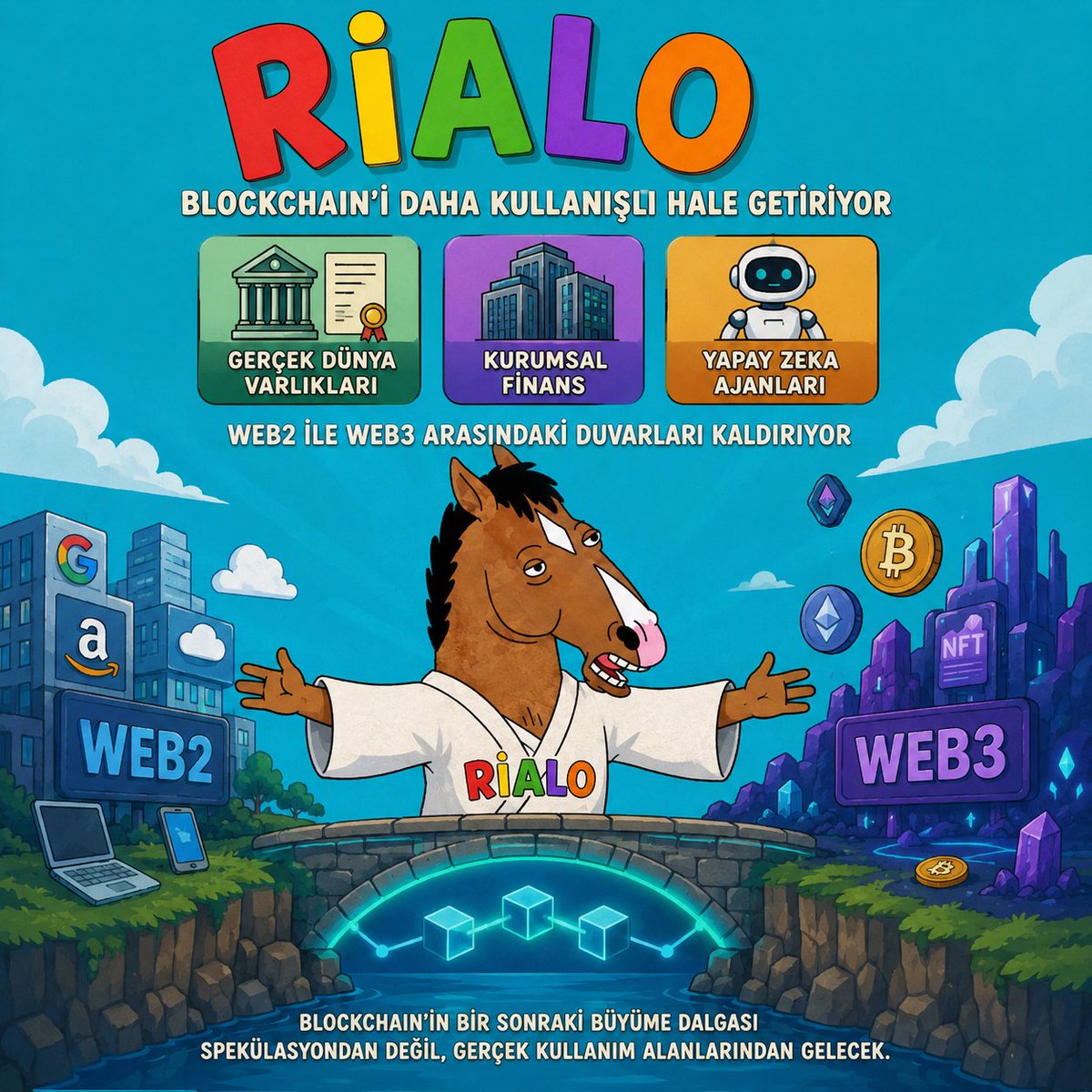
Birçok proje blokzinciri daha hızlı hale getirmeye çalışıyor.
• Rialo ise onu daha kullanışlı hale getirmeyi hedefliyor.
• Gerçek dünya varlıkları, kurumsal finans ve yapay zeka ajanları için tasarlanan bu altyapı, Web2 ile Web3 arasındaki duvarları kaldırıyor.
• Blockchain'in bir sonraki büyüme dalgası spekülasyondan değil, gerçek kullanım alanlarından gelecek.
• Rialo ile kal.
@RialoHQ
@RialoTR
@itachee_x
@ericargent31113
@slymnogunc
@ecelannister
Türkçe
@klaus_michels0n The most powerful innovations are often the ones that make complexity disappear. Users shouldn't need to know how many moving parts are involved behind the scenes.
English
Rialo Removes Every Extra Hand in the System
Ever wonder why using blockchain feels... complicated?
It's not the technology.
It's the army of middlemen holding it together with duct tape.
Here's what happens behind the scenes in most DeFi apps:
You request a loan.
The smart contract says: "Cool, but I need to check your credit score first."
But the contract can't do that itself.
So what happens?
Someone hired a "bot" or a "relay", basically a paid babysitter, to:
1. Watch the blockchain 24/7
2. Fetch the credit score from outside
3. Manually feed it back to the contract
4. Push the transaction to finish
You paid gas fees.
The developer paid the bot.
The bot probably charged in its own token.
Three parties. Multiple fees. One transaction.
It's like ordering a pizza and needing to hire someone to carry it from the kitchen to your table.
@RialoHQ said: what if the contract just... did it itself?
Enter Native Async Execution.
Here's how it works:
1. Transaction starts
2. Contract hits "I need external data"
3. It pauses itself using the AFTER wait until pattern
4. Waits for the (credit score, bank confirmation, whatever)
5. Wakes up automatically and finishes
No bot.
No relay.
No extra tokens.
No babysitter.
Most blockchains need babysitters to function in the real world.
@RialoHQ grew up and learned to do it alone.
English