
ทวีตที่ปักหมุด
Chris Morlock
38.9K posts


Chris Morlock
@CDMorlock
Der Staat ist die Wirklichkeit der konkreten Freiheit
San Francisco, CA เข้าร่วม Şubat 2022
3.7K กำลังติดตาม12.9K ผู้ติดตาม

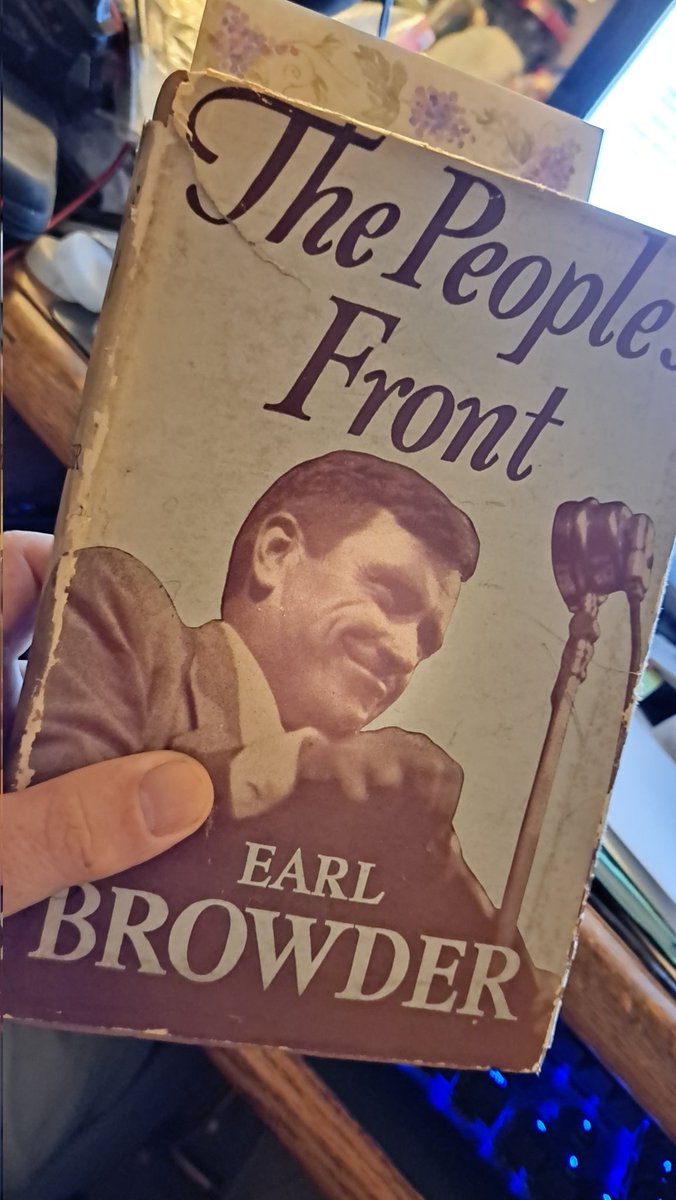
@ColdKalashnikov Don't have a digital version of this but Browders 1938 book is a great place to analyze the worst factor in CPUSA's development and all the pathologies it smuggled in:
English
@ColdKalashnikov Not a more modern work that covers the post 1957 nonsense, but the original history is covered well in Foster's work:
From 1952:
dropbox.com/scl/fi/7d7tplk…
English
You are maturing kid, I am monitoring your progress. You'll be ACP soon, just drop the "de-colonial" pysop. If you read MZT well, eventually, you will cure yourself of westernized "Maoism" pretty quickly.
Bats ☭🔻@BolshevikBeyond
If you take a crude stance against each part of TESCREAL philosophy you’ll wind up on the right side of things far more often than not
English
It's very much a way of judging things. Marx mentions "social relations" 40 times in all of Kapital. He mentions gold 1600. These are kernels of wisdom that will accelerate you to the Hegelian absolute knowing, sans shitty western University mindfuck garbage.
Lenin was investigating financial oligarchy, and emphasized it over everything else, and all of western Marxism is retarded and can't fucking read.
English

@CDMorlock Wow, he mentioned it 58 times? That’s quite a few times. Gee, ranking things based on word counts sure is a weird way to judge theory when every single section is very carefully selected, especially for Lenin who is *known* for wanting people to be precise, isn’t it?
English
The history of Silicon Valley that ultimately produced TESCREALism is deeply tied to colonialism, and they fundamentally cannot be understood as separate projects. I am being precise in calling it the highest stage of fascism, fascism itself being tied to colonialism.
Chris Morlock@CDMorlock
You are maturing kid, I am monitoring your progress. You'll be ACP soon, just drop the "de-colonial" pysop. If you read MZT well, eventually, you will cure yourself of westernized "Maoism" pretty quickly.
English
Here's an insight kid: amount of times Lenin mentions "colonial" in Imperialism, 58. How many times does he mention "finance"?
-96-
Wake up, you've been lead down a dead end.
English
@CDMorlock I take, before any other theorist, after Lenin, who went way out of his way to hear people like M. N. Roy out because he felt there was specific value in Roy’s perspective. This should not be particularly controversial.
English
English

@CDMorlock @israeliens1 @EdbieLigerSmith I never said there was no progress. I said colonial independence is progress.
I said there was no class revolution.
Perhaps you could make an argument for agrarian revolution, but I am doubtful since monoculture in New England and plantation in the south was well established.
English

Bourgeois revolutions were historically progressive at the time they happened because they wiped away the vestiges of feudalism, monarchy, and colonialism in some cases.
This is why Lenin himself praised the American Revolution:
“The history of modern, civilised America opened with one of those great, really liberating, really revolutionary wars of which there have been so few…”
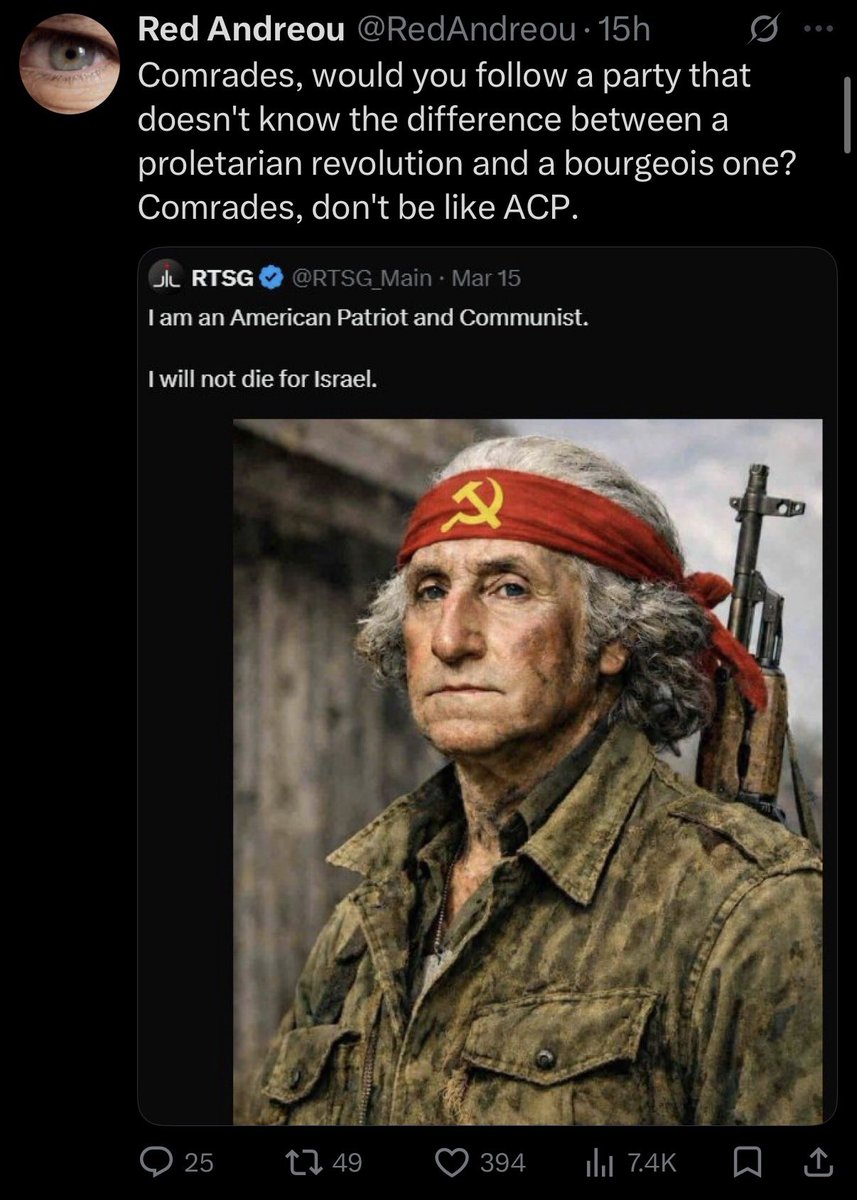
This is very very very basic Marxism. Why are we always being attacked by so called “Marxists” for taking standard Marxist positions?
English

Absolutely cursed chart for the "But humans are going to be a part of this, right?" types. x.com/jonatanpallese…
Jonatan Pallesen@jonatanpallesen
The total number of smart people in the world has just peaked. And now it's about to crash.
English
"The total number of people in the world who have the ability to directly integrate into Nick Land's rentier cyclops doomer cybernetic AI fourth circle hellscape numogram has peaked..." (aka boomer timeout)
Thank God, rejoice.
Jonatan Pallesen@jonatanpallesen
The total number of smart people in the world has just peaked. And now it's about to crash.
English
@Midas1415 @israeliens1 @EdbieLigerSmith So funny you see "progress" in garbage rentier monarchical Britain and non in American revolution, it's pathetic. Just can't stand the British ultimately, even when thry try to be Communists something always goes wrong...
English
@CDMorlock @israeliens1 @EdbieLigerSmith The point about Britain abolishing slavery within the Empire was that it was a class conflict that came about via parliamentary representation of the liberal industrialist interests in the 19th century.
Against the old Tory alliance of landowners, rentiers and slaver owners.
English

@CDMorlock I think it ultimately comes down to the fact that anti-Israel sentiment is building, and the ability for a USG to credibly support the Israelis in the future is dwindling. ZOG had to act, and act now, and now they're going for broke because they won't get another chance.
English
"Why would the US attack Iran now, it makes no sense." - collective American pearl clutching consciousness (especially the leftoids).
Because as soon as the oil crunch lays in and all of Asia (our manufacturing base where everything you use is made) rebels against $20 gallon prices the US can "manufacture consent" on a massive war to put down the rebellion against dollar debt penoage.
Like tge master simultaneously lighting a fire in the plantation slaves quarters and then rolling up in the fire truck.
"We must restore order!" will be everyone's excuse.
unusual_whales@unusual_whales
US Treasury Secretary Bessent: China was the leading sponsor of global terrorism in buying oil from Iran
English


What a fucking nonsense that displays your hidden British pride doc. I do think its hilarious you retain this given your own peoples colonial background. In my family, in the good Irish sense, we hate the British. Maybe working for the Queen's government has you in need of liberation.
Britain did not simply “move on” from slavery after abolition; it shifted from direct ownership to financial command. Before abolition, British merchants in Liverpool and London financed voyages, insured human cargo through Lloyd's of London, and extended credit to Caribbean planters, with enslaved people themselves functioning as collateral. That system did not disappear, it was generalized. After abolition, Britain no longer needed to own slaves when it could own the debt and the trade flows and the massive insurance on the system.
Antebellum American South os the best exampl. The cotton economy there was not some isolated self-financing agrarian system; it was plugged directly into British finance. Southern planters operated on credit advanced through transatlantic merchant houses, many tied back to London capital markets. Cotton factors in New Orleans and New York issued bills of exchange that were discounted in British banks, meaning that British capital was effectively fronting the operating costs of slave plantations. The enslaved workforce was still the underlying asset, but now the claim on that asset was mediated through paper, through credit instruments circulating in the orbit of institutions like the Bank of England and private London banks. In plain terms, British finance monetized slave labor without needing to legally own it.
Then there is the industrial side, which is always presented as somehow morally clean. The mills in Manchester did not run on abstraction, they ran on slave-grown cotton imported at massive scale from the American South. British merchants did not just buy that cotton, they financed its movement, insured its shipment, and extended advance payments against future harvests. This created a cycle where plantation expansion, land seizure, and the intensification of slave labor were all underwritten by anticipated British demand and British credit. The entire system functioned because British finance guaranteed liquidity at every stage, production, shipment, and sale. Without that, the scale of Southern slavery in the 1830s to 1850s simply does not happen.
Even more bluntly, after 1833 Britain injected a massive liquidity event into the system by compensating slave owners, not the enslaved. That money, raised through government borrowing and tied into British public finance, did not sit idle. It was reinvested into global markets, including trade networks that still depended on slave labor abroad. At the same time, British capital flowed into Cuba and Brazil, where slavery expanded after British abolition. So while Britain claimed moral leadership, its financial system was actively reallocating capital into new slave zones and sustaining existing ones through trade credit and insurance.
So the idea that Britain “got rich from industry” in some clean break from slavery is just not serious. Then you go Gerald Horne "settler colonial". Are you a 1619 project aficionado??
Industry was the processing arm, finance was the command structure. Slavery did not need to exist inside Britain anymore because it had been externalized and financialized. British capital sat above it, underwriting it, stabilizing it, and extracting value from it at a distance. If you are looking at the antebellum South and pretending Britain is just a passive buyer, you are missing the core mechanism. Britain was the banker, the insurer, and the market of last resort for a slave system it supposedly abolished.
Oh, and fuck Britain.
English
@CDMorlock @israeliens1 @EdbieLigerSmith Which is to ignore the actual internal class relations that upheld the slave power. US slave holders actually kept slaves. That is not down to UK capital exports.
British involvement was actually to support an independent Texas. Not the expansion of the US.
English
@CDMorlock @israeliens1 @EdbieLigerSmith The slave owners became wealthy from it. But the actual accumulation in England was from waged labour.
It is a nebulous question. Whom financed the southern transcontinental railroad? Whom financed the war on Mexico? Whom financed the flood of migrants into Kansas?
English
@Midas1415 @israeliens1 @EdbieLigerSmith "Settler colonial" 😂 Are you going to go Gerald Thorne on us now doc?
English
@CDMorlock @israeliens1 @EdbieLigerSmith Hence why the situation was so explosive by 1860. The slave-holders dominated government and prevented settler colonial expansion for feeding a growing industrial population.
Like the British were doing, settler colonial ethnic cleansing was the reality of “manifest destiny”.
English
@Midas1415 @israeliens1 @EdbieLigerSmith "Several competing modes of production". But apparently to the Brit who holds Britain in high regard we must reflexively categorized America as a "slave republic" until 1865?
English
@CDMorlock @israeliens1 @EdbieLigerSmith This is obviously quite different to the US where slave produced goods were the major export, and there were several competing modes of production.
English
@CDMorlock @israeliens1 @EdbieLigerSmith The British Empire ended slavery in the empire under conflict between the gentry and the industrial bourgeois. This could take place in parliament as the capitalist classes had grown significantly in power and slavery was not a major component of English economy in 1800.
English
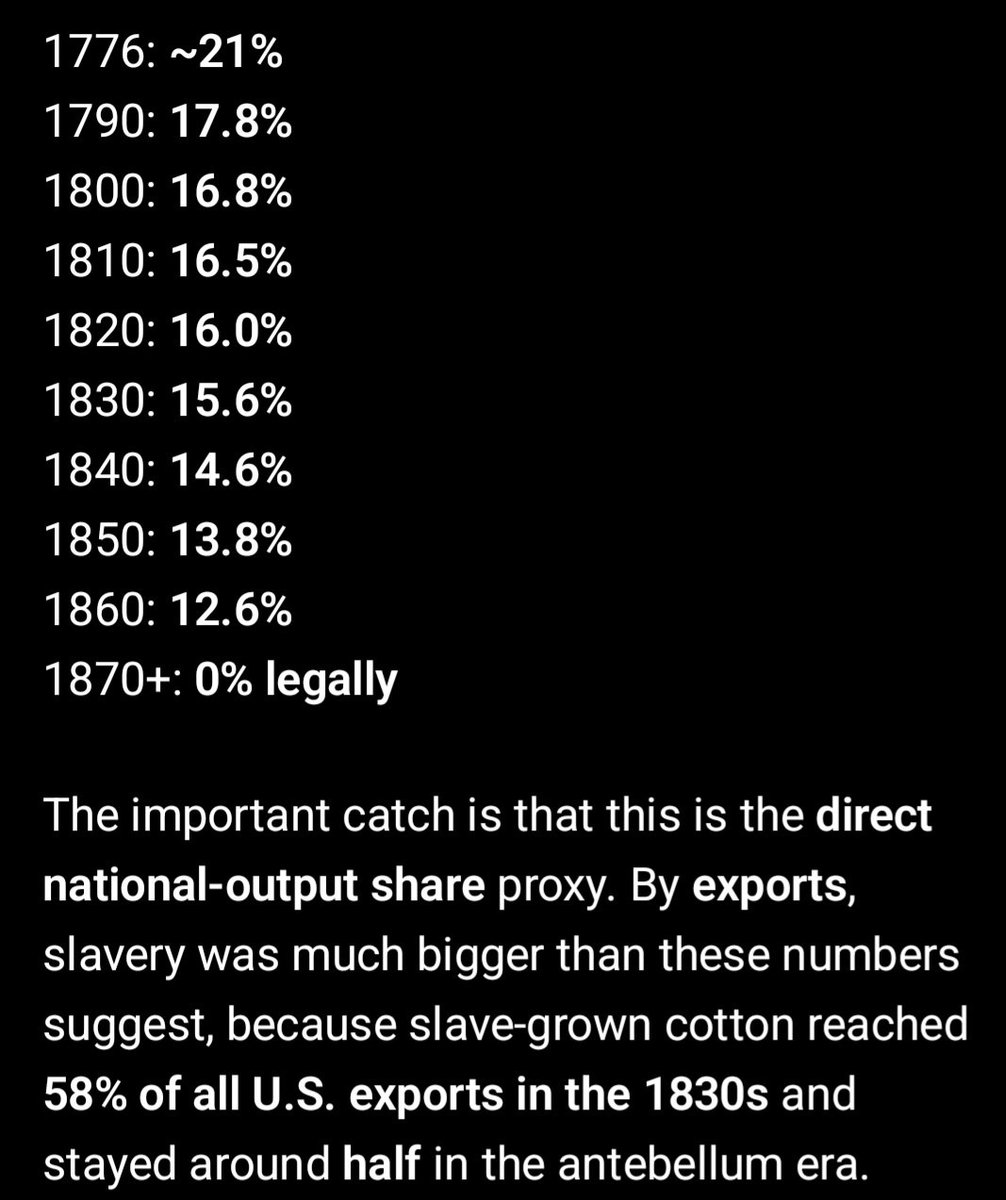
Brits, they always harbor Imperial attitudes towards Americans, lol. And it's not even true the American economy was domestically dominated by chattle slavery. It's export economy post 1800 was, but even then for a 50 year window. You probably think the Brits had a "progressive" attitude about slavery (whilst financing it well beyond 1820). 😂
English
@CDMorlock @israeliens1 @EdbieLigerSmith Well I learned the events at school. And I am not from “the Raj”. I was born in the UK. That is full American degeneracy.
I think learning history about the US from US state departments is a bit more dangerous. Your view lines up with the US state department.
English
@israeliens1 @Midas1415 @EdbieLigerSmith Always fun being lectured about American history from a Brit from the Raj. 😂
English

@Midas1415 @CDMorlock @EdbieLigerSmith French Revolution involved slaveholders too, that's not a distinction in content since both 18th century UK and France were slaveholding colonial empires with nascent bourgeois & aristocracy
English