Igor Mordatch

272 posts

Igor Mordatch

Igor Mordatch

@IMordatch

Research scientist @DeepMind and lecturer @UCBerkeley. Interested in AI/education/visual art/nature. Previously @OpenAI and @UCBerkeley.

Oakland, CA เข้าร่วม Nisan 2020
238 กำลังติดตาม5.6K ผู้ติดตาม
Igor Mordatch รีทวีตแล้ว

Google DeepMind
Google DeepMind@GoogleDeepMind·
AI has the potential to compress the time needed for new discoveries from years to days. 📉 That’s why we’re supporting the US Dept. of @ENERGY's Genesis Mission – providing National Labs with access to AI tools to help accelerate research in physics, chemistry, and beyond. → goo.gle/4s0Bujw
GIF
English
58
112
840
267.1K
Igor Mordatch
Igor Mordatch@IMordatch·
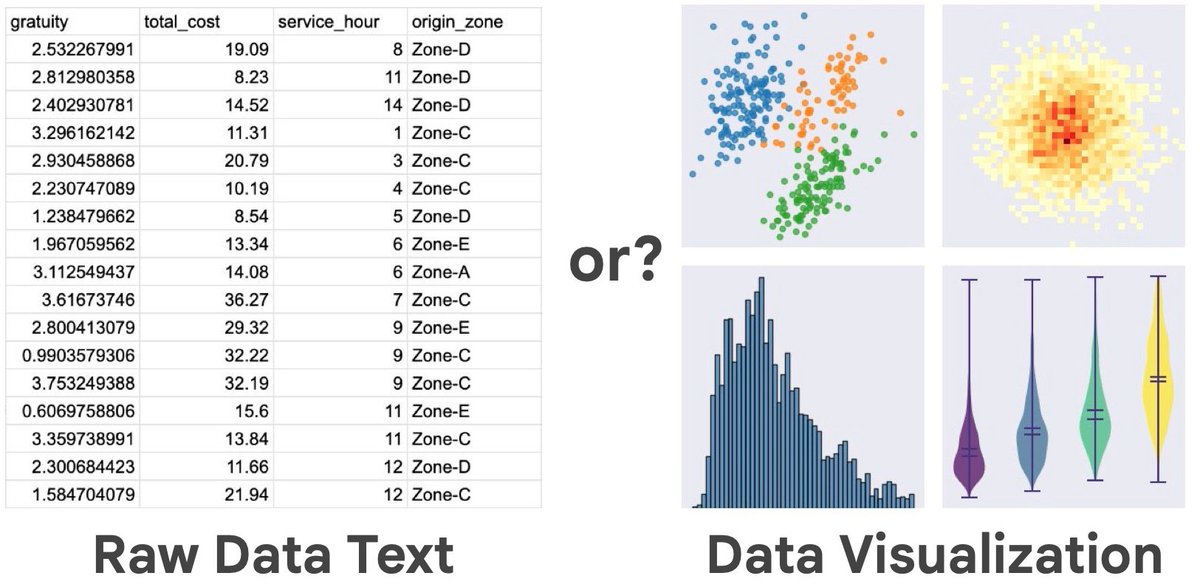
@AvivTamar1 Visualization image would lossy compress the dataset into hundreds or thousands of tokens (as qwen-vl does for example), while the original dataset could be hundreds of thousands of (lossless) text tokens. So I imagine that's the biggest difference.
English
0
0
1
94
Aviv Tamar
Aviv Tamar@AvivTamar1·
@IMordatch Makes sense. I wonder what in the architecture would drive that. It's all tokens, right? But maybe images have diff positional encoding which is a helpful inductive bias in visualizations? Or the image tokens are easier? Anyway, very interesting!
English
1
0
1
110
Igor Mordatch
Igor Mordatch@IMordatch·
Humans benefit from visualizing data. Do AI models need visualization too, or can they just take in raw data text? A fun study co-made with Claude to answer this question. Conclusion: it seems like AI currently benefits from looking at data visualizations! mordatch.github.io/posts/dataviz_…
Igor Mordatch tweet media
English
2
4
18
2K
Igor Mordatch
Igor Mordatch@IMordatch·
@AvivTamar1 I suspect because a visualization presents all data aggregated in a manner the models are used to (images), while raw data text is harder for the model to aggregate (either due to architecture, or lack of appropriate training tasks)?
English
1
0
2
93
Aviv Tamar
Aviv Tamar@AvivTamar1·
@IMordatch Very cool! Why visualizations help is a fascinating question. I'm guessing in humans it aligns with our self-supervised pretraining on the natural world. But why does it help AI models trained on raw data?
English
1
0
1
126
Igor Mordatch
Igor Mordatch@IMordatch·
@cba Sadly will have to leave before then, but will be around during the week!
English
0
0
1
50
chandler
chandler@cba·
@IMordatch nice nice let’s talk! will you be at the AI for Science workshop on sun??
English
1
0
0
50
Igor Mordatch
Igor Mordatch@IMordatch·
Excited to be at NeurIPS in San Diego from Thursday to Saturday next week! If you want to chat about AI for accelerating science (esp. materials), multi-modality, robotics, or intersections of these things, please reach out!
English
2
1
93
7.1K
Igor Mordatch รีทวีตแล้ว
Andrej Karpathy
Andrej Karpathy@karpathy·
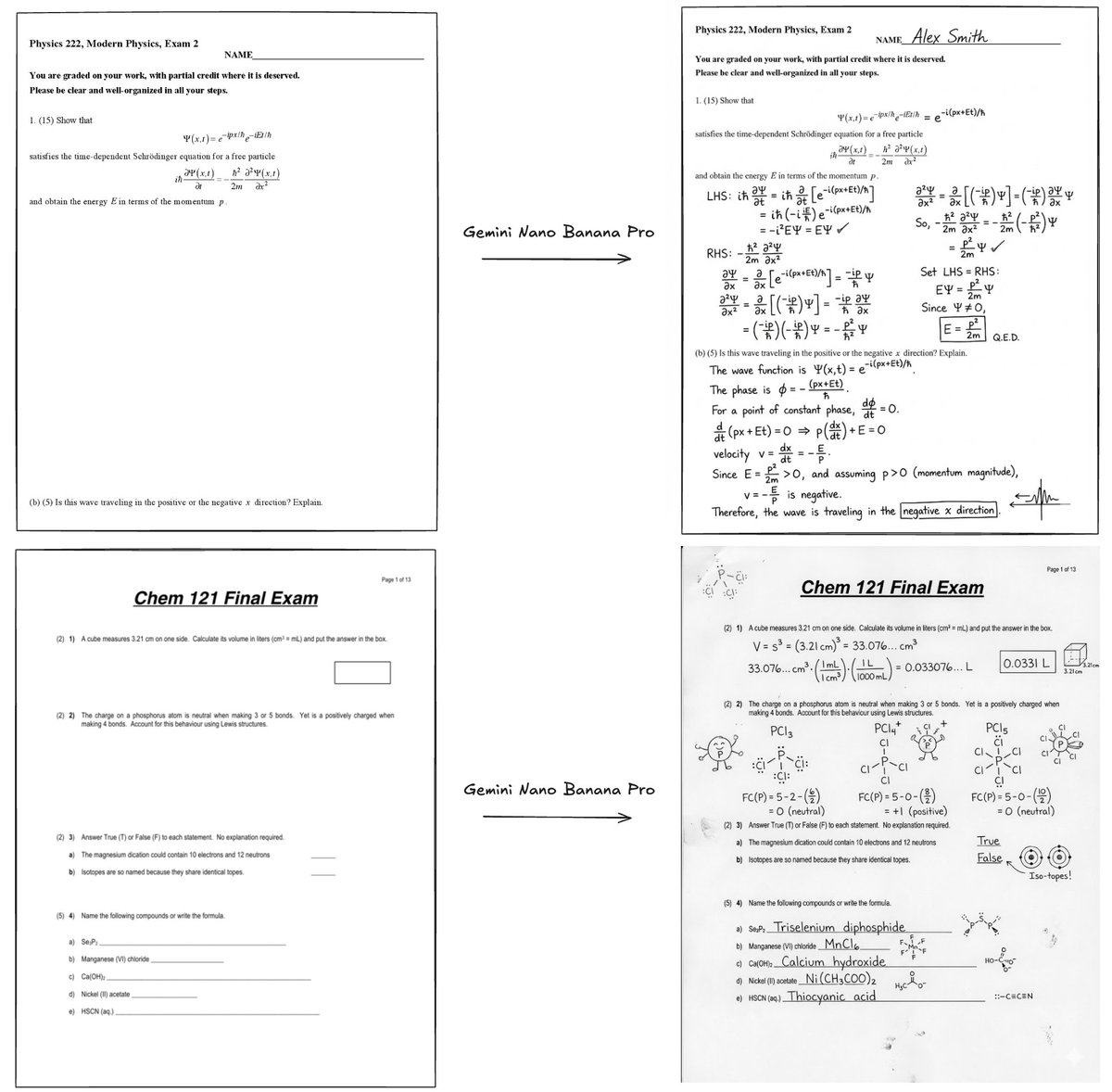
Gemini Nano Banana Pro can solve exam questions *in* the exam page image. With doodles, diagrams, all that. ChatGPT thinks these solutions are all correct except Se_2P_2 should be "diselenium diphosphide" and a spelling mistake (should be "thiocyanic acid" not "thoicyanic") :O
Andrej Karpathy tweet media
English
323
954
8.9K
3M
Igor Mordatch
Igor Mordatch@IMordatch·
Excited that Gemini 3 is finally out! Visual perception is particularly improved in this version and I'm excited to see all the downstream effects of that.
Demis Hassabis@demishassabis

We’ve been intensely cooking Gemini 3 for a while now, and we’re so excited and proud to share the results with you all. Of course it tops the leaderboards, including @arena, HLE, GPQA etc, but beyond the benchmarks it’s been by far my favourite model to use for its style and depth, and what it can do to help with everyday tasks.

English
0
0
3
623
Igor Mordatch
Igor Mordatch@IMordatch·
Working on this with Claude in a single long session was really fun and very fast. What could have been a summer research project was done in a few weekend bursts on the side. I'm excited to try looking into more research questions in this manner!
English
0
0
2
320
Kevin Zakka
Kevin Zakka@kevin_zakka·
Super happy and honored to be a 2025 Google PhD Fellow! Thank you @Googleorg for believing in my research. I'm looking forward to making humanoid robots more capable and trustworthy partners 🤗
Google.org@Googleorg

🎉 We're excited to announce the 2025 Google PhD Fellows! @GoogleOrg is providing over $10 million to support 255 PhD students across 35 countries, fostering the next generation of research talent to strengthen the global scientific landscape. Read more: goo.gle/43wJWw8

English
35
4
195
22.9K
Igor Mordatch
Igor Mordatch@IMordatch·
@_kevinlu @agarwl_ @Alibaba_Qwen Excellent post! +1 that on-policy distillation + continual learning is very interesting. Though with teachers that use backtracking, do you not often get pulled to first token of "...wait, that's not right" after student starts faltering (with signal after that less informative)?
English
1
0
6
526
Kevin Lu
Kevin Lu@_kevinlu·
in our new post, we walk through great prior work from @agarwl_ & the @Alibaba_Qwen team exploring on-policy distillation using an open source recipe: you can run our experiments on Tinker today! github.com/thinking-machi… i'm especially excited by the use of on-policy distillation to enable new "test-time training" personalization methods, allow the model to learn new domain knowledge without regressing on post-training capabilities
Thinking Machines@thinkymachines

Our latest post explores on-policy distillation, a training approach that unites the error-correcting relevance of RL with the reward density of SFT. When training it for math reasoning and as an internal chat assistant, we find that on-policy distillation can outperform other approaches for a fraction of the cost. thinkingmachines.ai/blog/on-policy…

English
14
29
370
95.2K
David van Dijk
David van Dijk@david_van_dijk·
Exciting to see our collaboration with @Google highlighted here — using AI to generate and test new biological hypotheses!
Sundar Pichai@sundarpichai

An exciting milestone for AI in science: Our C2S-Scale 27B foundation model, built with @Yale and based on Gemma, generated a novel hypothesis about cancer cellular behavior, which scientists experimentally validated in living cells.  With more preclinical and clinical tests, this discovery may reveal a promising new pathway for developing therapies to fight cancer.

English
13
16
293
33.3K
Igor Mordatch
Igor Mordatch@IMordatch·
Awesome work by @coolboi95 Kamyar and the team and I can't wait to see what you achieve at Generalist!
English
1
0
4
642
Igor Mordatch
Igor Mordatch@IMordatch·
Personally, I love this plot because it so crisply shows the value of active (RL) vs passive (SFT) experience for embodied agents: just 1% of active (RL) interaction gives you jump from orange to blue which you can't approach by just pouring in more passive SFT data (orange).
Igor Mordatch tweet media
Kamyar Ghasemipour@coolboi95

Super excited to finally share our work on “Self-Improving Embodied Foundation Models”!! (Also accepted at NeurIPS 2025) • Online on-robot Self-Improvement • Self-predicted rewards and success detection • Orders of magnitude sample-efficiency gains compared to SFT alone • Generalization enables novel skill acquisition 🧵👇[1/11]

English
1
2
19
3.9K
William Fedus
William Fedus@LiamFedus·
Today, @ekindogus and I are excited to introduce @periodiclabs. Our goal is to create an AI scientist. Science works by conjecturing how the world might be, running experiments, and learning from the results. Intelligence is necessary, but not sufficient. New knowledge is created when ideas are found to be consistent with reality. And so, at Periodic, we are building AI scientists and the autonomous laboratories for them to operate. Until now, scientific AI advances have come from models trained on the internet. But despite its vastness — it’s still finite (estimates are ~10T text tokens where one English word may be 1-2 tokens). And in recent years the best frontier AI models have fully exhausted it. Researchers seek better use of this data, but as any scientist knows: though re-reading a textbook may give new insights, they eventually need to try their idea to see if it holds. Autonomous labs are central to our strategy. They provide huge amounts of high-quality data (each experiment can produce GBs of data!) that exists nowhere else. They generate valuable negative results which are seldom published. But most importantly, they give our AI scientists the tools to act. We’re starting in the physical sciences. Technological progress is limited by our ability to design the physical world. We’re starting here because experiments have high signal-to-noise and are (relatively) fast, physical simulations effectively model many systems, but more broadly, physics is a verifiable environment. AI has progressed fastest in domains with data and verifiable results - for example, in math and code. Here, nature is the RL environment. One of our goals is to discover superconductors that work at higher temperatures than today's materials. Significant advances could help us create next-generation transportation and build power grids with minimal losses. But this is just one example — if we can automate materials design, we have the potential to accelerate Moore’s Law, space travel, and nuclear fusion. We’re also working to deploy our solutions with industry. As an example, we're helping a semiconductor manufacturer that is facing issues with heat dissipation on their chips. We’re training custom agents for their engineers and researchers to make sense of their experimental data in order to iterate faster. Our founding team co-created ChatGPT, DeepMind’s GNoME, OpenAI’s Operator (now Agent), the neural attention mechanism, MatterGen; have scaled autonomous physics labs; and have contributed to some of the most important materials discoveries of the last decade. We’ve come together to scale up and reimagine how science is done. We’re fortunate to be backed by investors who share our vision, including @a16z who led our $300M round, as well as @Felicis, DST Global, NVentures (NVIDIA’s venture capital arm), @Accel and individuals including @JeffBezos , @eladgil , @ericschmidt, and @JeffDean. Their support will help us grow our team, scale our labs, and develop the first generation of AI scientists.
William Fedus tweet media
English
429
444
4.2K
3.5M
Igor Mordatch รีทวีตแล้ว
Aran Komatsuzaki
Aran Komatsuzaki@arankomatsuzaki·
Self-Improving Embodied FMs • 2-stage recipe: SFT + online RL w/ self-predicted rewards • Boosts sample efficiency: 10% robot time → 45%→75% success (vs. 8× data → only 60%) • Unlocks autonomous skill acquisition beyond imitation data
Aran Komatsuzaki tweet media
English
5
34
246
18.1K