
ทวีตที่ปักหมุด
Re8uZ
439 posts
Re8uZ
@Re8uZ
Self-employed theorist with specializations in logistics, statistics and psychology. Expert in pattern recognition and long-term investments.
Macedonia เข้าร่วม Nisan 2009
790 กำลังติดตาม112 ผู้ติดตาม

@fabrisiq @JuanCar40406185 I’ve read Taleb - Fooled by Randomness, The Black Swan, Antifragile, Skin in the Game.
Great author, no doubt.
But frankly, a pretty poor money manager if you look at his track record.
English
Thank you for your words, Enrico: I have shared, I share and I will continue to share educational content here.
It will just be without feedback from now on.
I cannot give an answer as to which one will suit you better, but I can explain the nuances and you will have to make the decision yourself.
First.
For investing for 10 years, neither of the services will suit you.
Firstly, I consider long-term investing a dangerous activity with uncontrollable risks and I have proven this many times in my posts (take a look at the section WHY I DON’T CONSIDER LONG-TERM INVESTMENTS in that post).
Secondly, I trade swing. And I never know in advance how long it will last.
Historically, these were periods from two months to one and a half years (one time in my practice).
To summarize - my task is to make money, fix the profit and wait out the following correction/bear market in cash, opening light positions.
And so on until the next swing.
Second.
The service that is available now - shows how I manage a hedge fund portfolio and my personal portfolio on a daily basis.
With limited drawdown and historically annual returns exceeding #SPY.
The service that we are thinking to launch next year - is a service with an extremely aggressive strategy, rare trades, potentially high drawdown and potentially high returns.
The goal of this service is to show that high returns in the market for a professional is a matter of desire, not opportunity.
I myself will trade this strategy only in the service. And I will never apply it in my personal portfolio - it does not fit my risk profile or the hedge fund.
As one of the subscribers recently wrote: I will gladly participate in the second service using profits from the first.
I agree with this approach.
enrico burzigotti@enricoburz35673
@Denistratos Thank you for all you have shared during past months here on X. A last question that Is not completly clear to me if you can answer: for ants like me with 25k to 50k to keep invested for 10 years what srtatosphere service fit better the already existing or the new One next year?
English
@waitbutwhy this is pure game theory play, why are you spinning it in something else 🤷
English

Suddenly standing alone in the room, I begin by imagining humanity banding together and blue winning in a landslide, and I feel a rush of pride. Red is the genocide button. Blue is the “save humanity from this nightmare” button. I know what kind of person I am.
As my hand hovers over the blue button, I can’t help but imagine a gun pointing at my head with a bullet in one of the chambers. I feel a surge of fear shoot through my body.
Then I think about all the other people staring at the blue button and thinking the same thing. Surely some of those who initially decided to press blue will succumb to the fear. It starts to feel like a gun with two loaded chambers. A stronger pulse of terror.
The more I think about it, the more I worry about other people thinking about it. My heart races.
Then I look at the red button—a gun with no bullets in it. A glorious feeling of relief washes over me. Will I hate myself forever if blue wins because enough others were better and braver than me? But don’t I owe it to my family to protect myself? One vote won’t change anything anyway, right? It’s all irrelevant because the mammal I live in has already made up its mind.
I wince and press red.
Tim Urban@waitbutwhy
Everyone in the world has to take a private vote by pressing a red or blue button. If more than 50% of people press the blue button, everyone survives. If less than 50% of people press the blue button, only people who pressed the red button survive. Which button would you press?
English
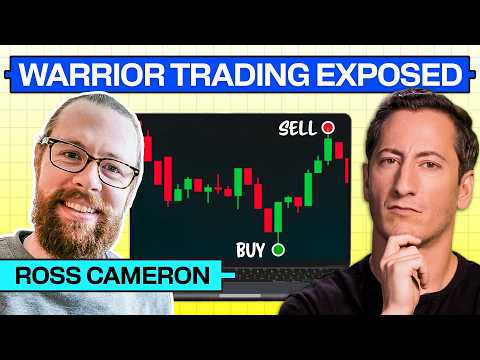
@Denistratos yea I know about this I am folowing Ross on youtube for a while, he is fun and imo good teacher for basics... @TheOneLanceB had a video about Ross recently ( he also have about Qullamagi btw ) youtu.be/sxjsqauWE9E?si… and I share his opinion
YouTube
English
About a $3m fine for misleading marketing regarding claims about trading profitability and performance.
I’m informed at a fairly surface level, but if I’m not mistaken, the point is that he has been making money and continues to make money, while his subscribers blow up their accounts, since it seems his approach is highly dependent on personal execution.
English
I’ll try to answer in a generalized and short way.
With O’Neil it’s not that simple, but let’s put it this way. Have you noticed that none of the first three, including Livermore and Minervini, gave stable year-to-year results?
I can assume that each of them wasn’t flexible and had a strategy that works only in certain market conditions.
Is that good or bad?
Everyone decides that themselves.
But in my view it’s better to make 50% every year for five years in a row (don’t forget the compounding effect), than to make 100%/150%/200% once in five years.
About Qullamagi. I don’t know much about him, since I first heard about him about half a year ago on @X.
I can say and based on the fact that he still doesn’t manage a large fund, that his strategy either carries excessive risk, doesn’t scale or it’s survivorship bias, or built on personal intuition.
Read the story of Ross Cameron.
English
@jrouldz @ThePupOfWallSt I dont want to sound arogant, but if technical is not working for you maybe is because you are not using it right
English

@ThePupOfWallSt I like to strike a balance between quantity and quality
That’s one chart every ~8.4 minutes 😂 and I’m checking fundamental data and analysis/summaries too 👍
Technicals don’t help me much without also understanding the fundamentals behind the moves!
English

Does it really take 7 hours to review 50 charts?
Either I'm REALLY fast or... well, you know.
Dr J Rould@jrouldz
Spent about 7 hours today reviewing more than 50 charts I'm taking note of all my favorite technical setups, and will spend the weekend exploring fundamentals and use this to build a new watch list but now, my head is spinning so I'm going to get some fresh air 😎 Happy Friday
English
Everyone in the world has to take a private vote by pressing a red or blue button. If more than 50% of people press the blue button, everyone survives. If less than 50% of people press the blue button, only people who pressed the red button survive. Which button would you press?
English
@kevinxu @DollarCostAvg 🤔 I read this $iren earnings move earlier bulish hype thesis to align with $amzn earnings in February too 🤔
English

Let's review the thesis:
- $IREN earnings on May 7
- Moved up a week earlier (bullish)
- MSFT deal was announced a week prior to earnings
- That points to April 30 for new deal
Hype:
- Chamath is vagueposting
- Amit is bought in
- Haters playing the victim card now
Technicals:
- Blew past $40 and $50 walls
- Lots of unusual option buying
- Volume increasing (my fave)
There's a reason this is the only stock I'm all in.
Kevin Xu@kevinxu
Why I held $IREN from -31% to +5% Thesis never broke: - Sweetwater + Childress ramping - 150k GPUs coming online - $3.7B ARR target My #1 rule is to not chase. I'd rather hold in anticipation of a pop rather than chase something that fades the next day. New deals can change things very quickly. Next earnings is May 13, a month away. Don't listen to doomers. Unless you're using them to mark the bottom. Congrats to those that bought at $31! Appreciate a follow for those in on this ride with me.
English
Comments under my posts will be closed starting Monday, April 27.
Need more details? See the “Official notice” post.
In this post, you’ll find answers to most questions about my strategy and tactics in the stock market – how I think and how I trade.
It’s a curated collection of posts I’ve shared over the past year on @X.
You can also ask any questions under this post – about the stock market, if the answers aren’t covered in the posts below or anything else if you’re interested.
I’ll try to answer all questions submitted before Sunday midnight.
You can follow my trading in real time on weekdays via the Stratosphere service.
My approach and how I read the market – in the private Telegram channel.
Until May 20, only a simplified teaser version is available.
Realized profit screenshots in Highlights. Always there.
I know many of you haven’t used crypto payments before and some have had trouble joining the private Telegram channel.
I operate on the assumption that there are no unsolvable problems – only situations that require more effort. Fortunately, we all have access to tools like ChatGPT, Gemini, Claude, Grok, etc.
I’m confident that anyone who wants to can find at least a few simple solutions.
My team is also always available to help via DM at @StratosphereBot.
🟢 Must reads
🔵 Good to know
THE BASIS OF MY STRATEGY
🟢 A Sniper Approach: How I Actually Make Money
x.com/denistratos/st…
🟢 Deliberate Aggression → Absolute Control
x.com/denistratos/st…
🟢 How I differ from 99.99% of traders
x.com/denistratos/st…
🟢 How I structure my portfolio
x.com/denistratos/st…
🟢 Predict Indicator: Red or Green Days Ahead
x.com/denistratos/st…
🟢 My Trading Evolution: From Imitation to Independence
x.com/denistratos/st…
🟢 Why I Trade Only the U.S. Market
x.com/denistratos/st…
🟢 Why I Don’t Hedge (and Stanley Druckenmiller too)
x.com/denistratos/st…
🟢 Why I Rarely Use Short Positions
x.com/denistratos/st…
🟢 Answers to questions about my trading strategy. Part one
x.com/denistratos/st…
🟢 Answers to questions about my trading strategy. Part two
x.com/denistratos/st…
🟢 Important note
x.com/denistratos/st…
WHY I TRACK TRADING ALGOS
🟢 Power, Media, Money: Algos Against You
x.com/denistratos/st…
🟢 Brokers in suits are out – AI runs Wall Street now
x.com/denistratos/st…
🟢 News and “accidents”… not so accidental after all?
x.com/denistratos/st…
🟢 Jeffrey Epstein on Wall Street
x.com/denistratos/st…
WALL STREET: BRUTAL REALITY
🟢 All you need to know about Wall Street hedge funds. Q4 2025
x.com/denistratos/st…
🟢 Mutual & Hedge Funds: 2025 Disaster, Déjà Vu
x.com/denistratos/st…
🟢 All you need to know about Wall Street hedge funds. Q3 2025
x.com/denistratos/st…
🟢 All you need to know about Wall Street hedge funds. Q2 2025
x.com/denistratos/st…
🟢 Everything You Need to Know About U.S. Hedge Funds – in a Single Brutal Chart. Q1 2025
x.com/denistratos/st…
WHY I THINK WE’RE MORE LIKELY HEADING FOR THE COLLAPSE OF THE AI BUBBLE
🟢 The collapse of the AI bubble. Part one SPX/M2SL
x.com/denistratos/st…
🟢 The collapse of the AI bubble. Part two SPX/M2SL
x.com/denistratos/st…
🟢 The collapse of the AI bubble. Part three QQQ/M2SL
x.com/denistratos/st…
🟢 $MSTR: SEC, fraud, crash -62% in one day
x.com/denistratos/st…
🟢 IMF in panic? Reading between the lines
x.com/denistratos/st…
Continued ↓
Denistratos@Denistratos
A SNIPER APPROACH: HOW I ACTUALLY MAKE MONEY IN THE MARKET Over the first four days of this week, I’m up 23%. That already far exceeds the S&P 500’s average annual return over the past 25 years – and is likely enough to outperform its full 2026 result. The specifics of my trading system are simple: I generate ~95% of my annual profit within two to four months each year. It’s basically a sniper approach. Long stretches of waiting and patience… then one precise shot. The rest of the time, I stay in cash and take light 3-5% positions, one after another – once the previous trade moves into profit and a breakeven stop is set. I then get stopped out at breakeven or with a small profit or loss. My task is simple – find the trend and make money on it. The rest is routine work, with no need for constant trading. If someone thinks you need to trade every day to make good money, that’s a serious misconception. At the same time, it’s important to understand: I mainly trade indices, sectors and megacaps. Sometimes I add big caps. I don’t need excessive volatility – it’s the second enemy after the constant urge to trade / FOMO. And then everything is simple: Want 1:1 index exposure? Buy $SPY. You’ll already outperform the index over time – with better drawdown recovery and higher Sortino and Sharpe ratios. Want 2x? $SPUU, $SSO. 3x? $SPXL, $UPRO. 5-10x? Options on $SPY. 20x? Options on $SPUU, $SSO. 30x? Options on $SPXL, $UPRO. 50-100-500-1000x? Options (which I won’t specify). Everything depends on your choice and risk tolerance. There’s no need to trade random junk, gamble on earnings or try to predict one-off events. The edge is in working with the trend – not the noise. If everything is so simple, why is my 7-year CAGR only a “miserable” 44.7%? And why was last year “only” 70% in my public portfolio? Simple – that’s enough for me. That’s my risk profile. I make money while staying comfortable. Every year. I don’t waste time watching who made 1000% last year, or who went from $10k to $300k… and back to $10k. You can fool others. You can fool yourself. But you can’t fool math or probability.
English
@CFlanders7 @Jenish9116 I thought you have are using some rule of thumb (guidance), because you mentioned that you reenter with half size then your original first entry and I was wondering why os that the case and why you didn't reenter with same size as % of your account
English

It's incredible how much one or two trades can change your short term results.
I was in RVMD and had a great entry on the EP. I was stopped out on the price taking out the LOD. Had pretty bad slippage, ended up being a -1.68R loss. If price had held the low and moved to where it is now, I would have had an almost +7R gain instead.
English
@Re8uZ @Chocolate_0015 @bp22 No. Honestly, I’m hearing about both the book and the author for the first time.
Reading is one of my absolute passions, I try not to skip a single day.
English
Taking advantage of the last days while comments under my posts are still open, I’ll ask you a question:
Why do you think I’ve never posted photos featuring a Lamborghini or Ferrari, wearing a Richard Mille or Jacob & Co?
Or in the interiors of a Louis XIV-style penthouse with a glass of Cristal champagne in hand?

English
@denistratos @Chocolate_0015 have you read "Die with zero" by @bp22 ... I think you are going to like it a lot
English

BREAKING: The BBC has reported that there appears to be "insider trading consistently happening in the Trump administration before announcements."
English
@CFlanders7 @Jenish9116 Can you please tell me how do you decide how big position in % of your account you will take as a function of how wide your stop lost is?
English
@Jenish9116 I re-entered. My size is half of the original size due to the wider stop
English

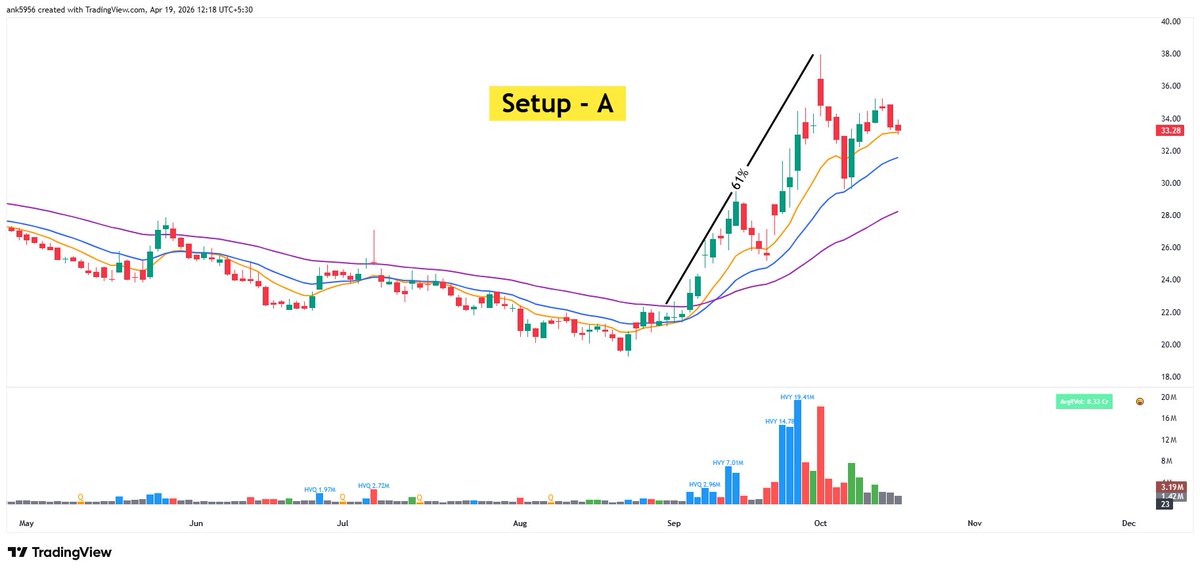
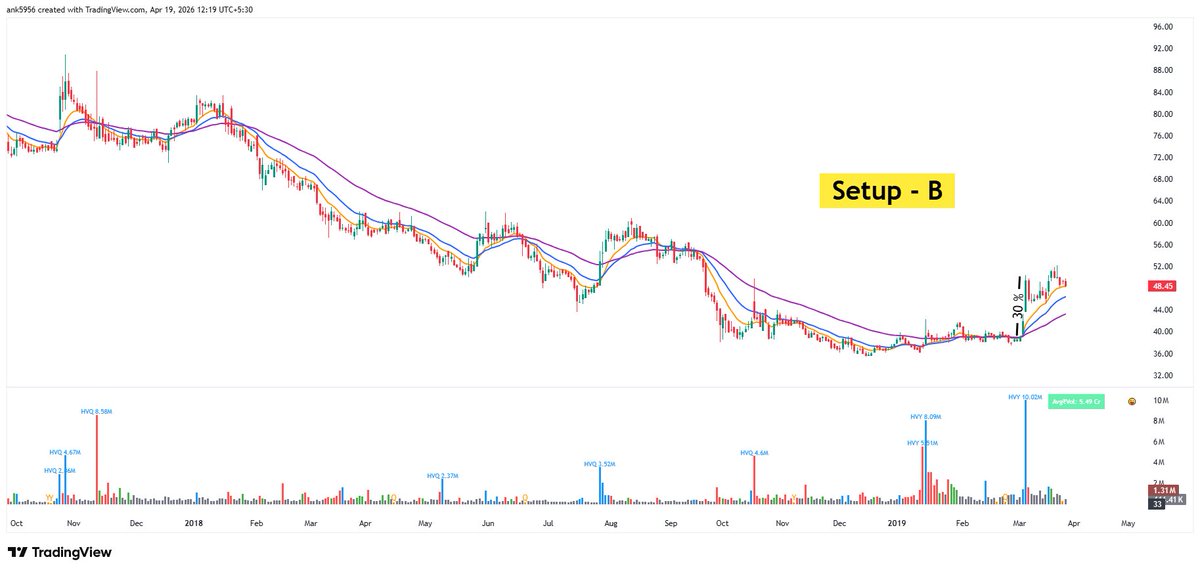
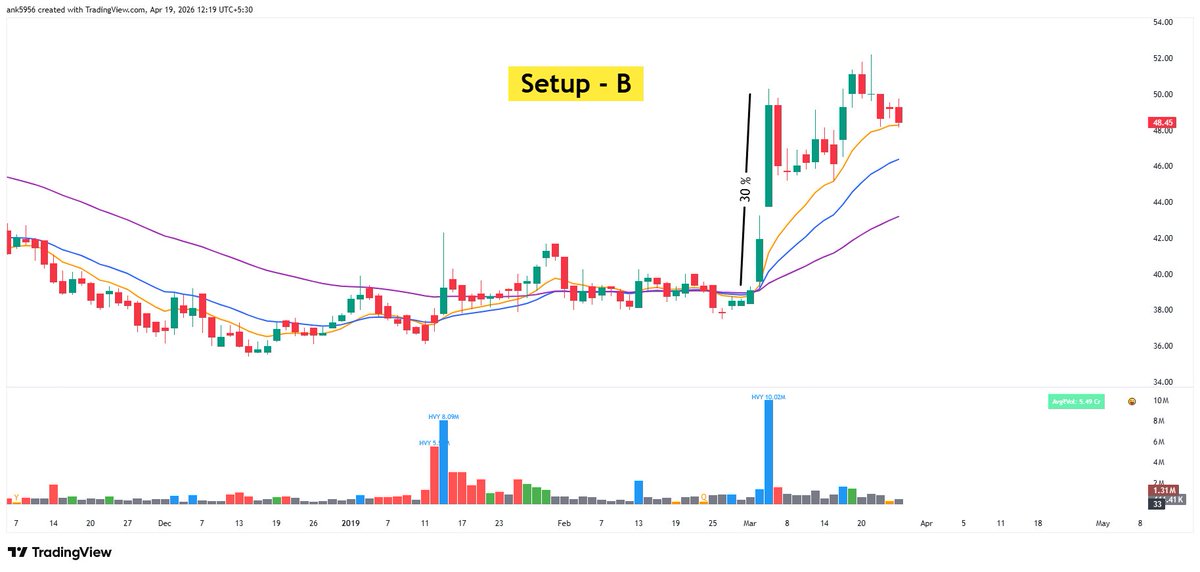
#Stockquiz time
You have two setups Setup A and Setup B.
Both stocks are coming out of a long downtrend.
Then a sideways consolidation.And now a strong move up.
Both are trading above 10, 20 and 50 EMA.
Now the question is You have to pick only one.
Which one are you more likely to trade?
Setup A or Setup B? ( No option to choose both )
Answer with your pick.And most importantly, explain why.
That is what builds clarity in your process.

English
Re8uZ รีทวีตแล้ว
HOW TO DEAL WITH FOOLS: SCHOPENHAUER vs AGGRESSIVE IGNORANCE & DUNNING-KRUGER EFFECT
The gap between minds
Have you ever tried explaining something to someone who simply cannot understand it?
Not because you said it poorly – but because they’re incapable of processing it.
You simplify. Use analogies. Change angles.
They nod. They agree.
Minutes later – nothing stuck.
You watch people repeat the same obvious mistakes. Ignore facts. Dismiss logic. Default to emotion.
And you ask yourself:
“How is this possible?”
Arthur Schopenhauer had the answer: most people operate far below the level you’ve been conditioned to expect.
Not out of malice – out of limitation.
Accept that, and the gap between expectation and reality disappears.
He spent decades studying human stupidity.
No sugarcoating. No illusions. No belief that effort alone creates critical thinking.
Intellect is rare.
Far rarer than people think.
This is about dealing with those who cannot think at your level.
Not to feel superior – but to stop wasting energy.
Once you see it, everything aligns.
Frustration fades.
Explanations stop.
Clarity begins.
Continued ↓
English
Re8uZ รีทวีตแล้ว
A SNIPER APPROACH: HOW I ACTUALLY MAKE MONEY IN THE MARKET
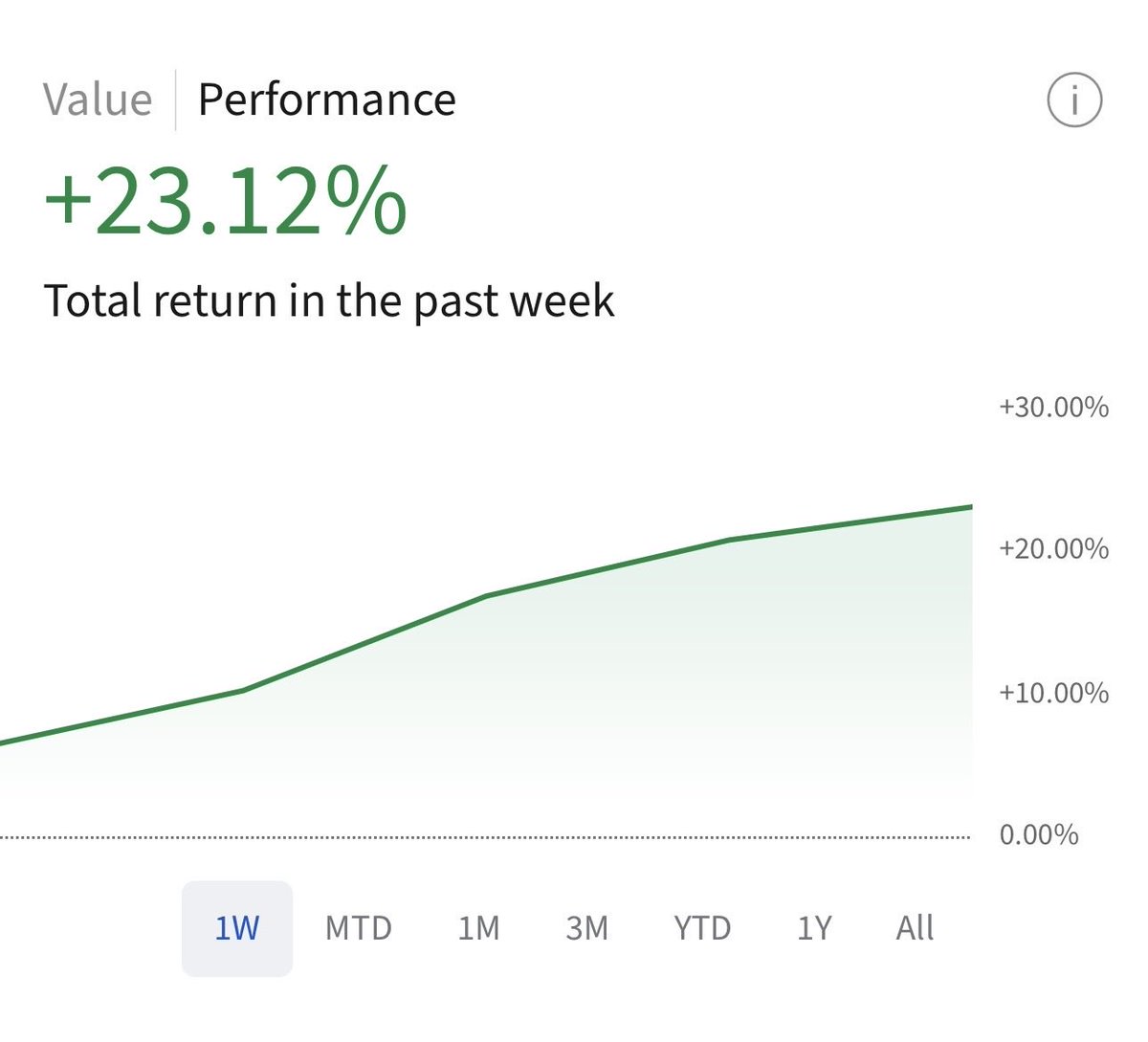
Over the first four days of this week, I’m up 23%.
That already far exceeds the S&P 500’s average annual return over the past 25 years – and is likely enough to outperform its full 2026 result.
The specifics of my trading system are simple: I generate ~95% of my annual profit within two to four months each year.
It’s basically a sniper approach. Long stretches of waiting and patience… then one precise shot.
The rest of the time, I stay in cash and take light 3-5% positions, one after another – once the previous trade moves into profit and a breakeven stop is set.
I then get stopped out at breakeven or with a small profit or loss.
My task is simple – find the trend and make money on it.
The rest is routine work, with no need for constant trading.
If someone thinks you need to trade every day to make good money, that’s a serious misconception.
At the same time, it’s important to understand: I mainly trade indices, sectors and megacaps.
Sometimes I add big caps.
I don’t need excessive volatility – it’s the second enemy after the constant urge to trade / FOMO.
And then everything is simple:
Want 1:1 index exposure? Buy $SPY.
You’ll already outperform the index over time – with better drawdown recovery and higher Sortino and Sharpe ratios.
Want 2x? $SPUU, $SSO.
3x? $SPXL, $UPRO.
5-10x? Options on $SPY.
20x? Options on $SPUU, $SSO.
30x? Options on $SPXL, $UPRO.
50-100-500-1000x? Options (which I won’t specify).
Everything depends on your choice and risk tolerance.
There’s no need to trade random junk, gamble on earnings or try to predict one-off events.
The edge is in working with the trend – not the noise.
If everything is so simple, why is my 7-year CAGR only a “miserable” 44.7%?
And why was last year “only” 70% in my public portfolio?
Simple – that’s enough for me.
That’s my risk profile.
I make money while staying comfortable.
Every year.
I don’t waste time watching who made 1000% last year,
or who went from $10k to $300k… and back to $10k.
You can fool others.
You can fool yourself.
But you can’t fool math or probability.
Denistratos@Denistratos
DELIBERATE AGGRESSION: FEWER INDICATORS, MORE CONTROL Starting in the new year, my trading system (the “TS”) will undergo significant changes. This is not a cosmetic tweak and not an evolution of individual components – it is a deliberate change in configuration. Why now? Because my three-year contract is coming to an end and a new one begins on Jan 1, 2026. This gives me the ability to rebuild the system from the ground up – without compromises or external constraints. 1. REDUCING THE NUMBER OF TRACKED INDICATORS The TS was put into full operation in late 2018 with 600 tracked indicators. Each year, I gradually and carefully reduced their total number, and over seven years it declined to 250 – roughly a 58% reduction. As of today, about 100 of them are core indicators and around 150 are auxiliary. The reduction came from eliminating the least effective, low-weight indicators, developing proprietary and more efficient solutions and fully discarding obsolete ones. Now the system will go from 250 down to 100 – another 60% cut, executed in a single step. This change is not evolutionary – it is revolutionary. Objective: to simplify the TS as much as possible. 2. MOVING THE TS FROM SEMI-AUTOMATED / AUTOMATED MODE TO FULLY MANUAL Objective: to retain absolute control amid such a sharp change in inputs and to smooth the impact of negative factors if something goes wrong. This is a temporary manual mode until the system stabilizes after the reconfiguration. 3. ELIMINATING POSITIONAL TRADES Positional trades based on a deep understanding of macroeconomic and geopolitical processes have never been part of my trading system. In the current stable configuration of 250 indicators, I used them deliberately as part of my personal trading approach, knowing they could enhance the results of an already successful system: ▫️ bonds $IEF & $TLT (currently); ▫️ oil $XLE & $OIH (planned for next year); ▫️ less frequently gold $GLD, silver $SLV and uranium $URA & $URNM (all three were held at the start of this year); ▫️ as well as copper $CPER, platinum $PPLT, palladium $PALL, lithium $LIT and other commodity-related assets. Objective: to remove this last subjective component and rely solely on the math, algo foundation of the system, while regaining the ability to close all positions instantly if needed. Why – see point 5. 4. MAXIMIZING THE SHARE OF INDEX AND SECTOR ETFs AND MINIMIZING INDIVIDUAL STOCKS $SPY $QQQ $SMH $MAGS $XLK $XLC $DIA Objective: to reduce portfolio beta by reducing exposure to potential but uncontrollable volatility and the impact of external factors – news, insider and fund activity, earnings, forward guidance and similar influences. 5. SHIFTING THE TS INTO A HIGHER-AGGRESSION MODE Portfolio risk will change from the standard: 0.25% of capital (5% on a 5% position without moving the stop to breakeven), and a maximum of 1% (5% on a 20% position), to 5% per total portfolio – a fivefold increase. Objective: to compensate for the loss of beta from individual stocks. New year, new system reconfiguration. With a new employer and a new contract in place, I can now leverage the work of the past three years to fully rebuild the system. This is yet another step to further tighten control and improve performance.
English
This post is your opportunity to get into the Private channel.
What is in the Private channel?
Analysis of the past week in the market, without:
• a detailed breakdown of market components
• a detailed breakdown of individual stocks/ETFs
• actionable conclusions such as what we buy, what we sell, etc.
It will be published on Sundays.
Over time, situational market analysis and additional observations will be added.
Access is strictly limited to 50 spots.
The Private channel is not included in the Stratosphere Live Portfolio Access service subscription.
Being in it is a privilege.
However, subscribers have priority.
Entry does not guarantee permanent access.
Possible reasons for removal:
1. New subscriber of the Stratosphere Live Portfolio Access service
2. Violation of channel rules
Access to the channel costs a symbolic $1.3* per month.
This is not monetization – it is a filter: those for whom the content is no longer relevant will not renew and their spot will automatically become available.
If you did not get into the current batch but want to:
1. Subscribe to the Stratosphere Live Portfolio Access service
2. Wait for an available spot
3. Wait for the next batch
If you accept these conditions and understand that you may not get into the channel or may be removed from it – leave a comment stating your interest.
Comments are a form of application. To prevent turning this into a continuous discussion, I will not respond to comments.
To avoid putting anyone in an uncomfortable position, results will not be announced publicly – neither in posts nor in comments.
After the 24-hour period ends, some of you will receive in private messages from @StratosphereBot a link to the private Telegram channel, valid for 3 hours.
Do not miss it. After this period, your invitation may be given to another participant.
If you are already a subscriber of the Stratosphere Live Portfolio Access service – please do not leave a comment and instead DM @StratosphereBot.
Important: This is not about being first.
Priority will be given to those who:
• are familiar with my content and trading philosophy
• whose activity I regularly observed under my posts on @X
There are people among you I genuinely want in this channel. But if you do not leave a comment – your spot will be taken by others.
* May be higher depending on the chosen payment method. Clarify payment methods in advance.

English
@denistratos @Dr_Contango I think is opposite, looking at green days from someone who also shares their thought process and trading strategy (especially if you are in red) motivates to learn more to try and get better so you can have more green days too 🤷
English
@Dr_Contango I couldn’t care less about the people who unfollowed - haven’t spent a second thinking about them.
What I do care about is whether my P&L posts feel irritating to those who stayed, especially if they’re sitting in the red.
It’s just a matter of basic human consideration.
English
7 positions in the portfolio.
Two at 12% of AUM, another two at 16% and 17% respectively. Four positions across three tickers. This is core.
Stops on these positions are at breakeven.
Three small positions at 0.6%, 0.75% and 1.2% are in the red – I’m looking for a moment to cut them. Losers have no place in my portfolio.
Cash level – you can easily calculate it yourself.
No diversification, no hedging, no "conviction" – none of that noise.
So far, things are fine. We’ll see what the next few days bring.
Continued ↓

English