Dave-Thinking

2.6K posts

Dave-Thinking

Dave-Thinking

@thinking_dave

High-effort conversation for truth-maximizing and FUN!

Upper-middle class, USA เข้าร่วม Mart 2022
0 กำลังติดตาม71 ผู้ติดตาม
ทวีตที่ปักหมุด
Dave-Thinking
Dave-Thinking@thinking_dave·
Spend less time listening to people talk about people, and more time listening to the people being talked about
English
0
1
3
250
Dave-Thinking
Dave-Thinking@thinking_dave·
@aaronp613 I like that it's snooze instead of set and forget Same reason I don't follow anyone—my interests change and I want the algo to follow
English
0
0
0
6
Aaron
Aaron@aaronp613·
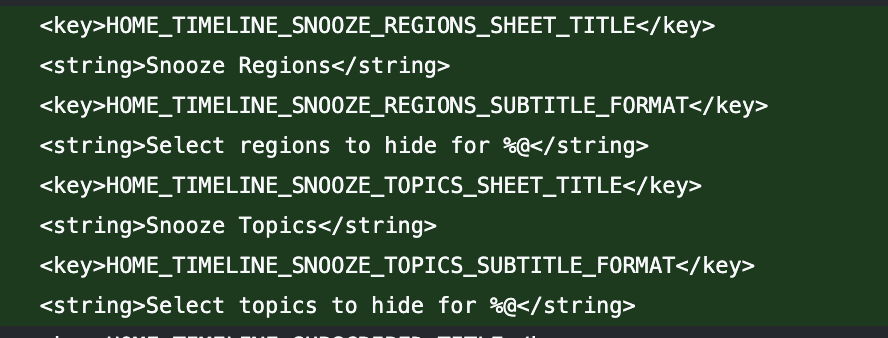
X is working on Timeline Snoozing You will be able to snooze posts from different regions or topics
Aaron tweet media
English
13
14
176
37.9K
Dave-Thinking
Dave-Thinking@thinking_dave·
Whenever you hear people say: "others should" Think: "control others" Better to hear: "I'm going to" that inspires voluntary action in others
English
0
0
0
0
Dave-Thinking
Dave-Thinking@thinking_dave·
@sheety80 @CARN0N @cybertruck I heard it's because cybertruck doesn't meet their pedestrian impact safety standards. Other places include accident avoidance in pedestrian safety, which the ai powered vehicle is great at, so they conclude it's actually safer for pedestrians. 🤔
English
1
0
1
21
Oli
Oli@CARN0N·
An Australian breakfast radio show spent their morning show today seeing how far they could drive their Tesla past 0%. Probably the most entertaining piece of Tesla content I’ve ever watched 😂
English
162
470
5K
652K
Dave-Thinking
Dave-Thinking@thinking_dave·
@BassonBrain Good! Elon's complained about others not taking up his great ideas Imitation's the highest form of flattery Good
English
0
0
0
4
Brian Basson
Brian Basson@BassonBrain·
Copy & Paste SpaceX cracks reusable rockets, Jeff B follows suit SpaceX launch Starlink, Jeff B follows suit with Kuiper Elon suggests orbital data centers, Jeff B follows suit Maybe time for him to come up with something original...
Sawyer Merritt@SawyerMerritt

NEWS: Jeff Bezos' rocket company Blue Origin has filed an official request with the FCC to launch and operate a constellation of 51,600 AI satellites (orbital datacenters), just two weeks after Amazon filed a formal petition calling on the FCC to deny @SpaceX’s 1 million-satellite proposal for orbiting datacenters, going as far to claim the project would take “centuries” to deploy. Blue Origin's project, called “Project Sunrise,” would include up to 51,600 satellites in low Earth orbit, designed to run AI and cloud computing workloads using constant solar power. The system would primarily use laser (optical) links between satellites. Blue Origin says "space-based data centers could relieve pressure on Earth’s power grids and water usage."


English
109
87
1.2K
217.5K
Dave-Thinking
Dave-Thinking@thinking_dave·
@BCalusinski Human behavior continues to be both directional (trending towards good/better) and broader (greater highs/lows, smarter/dumber, impressive/degenerate)
English
0
0
0
71
Ben Calusinski
Ben Calusinski@BCalusinski·
Most people will not work traditional jobs in the next 10 years Most people will not need to do traditional tasks in the next 10 years (cooking, cleaning, driving, etc) Do you all understand what this means at scale? Look at what happens to certain subsets of the population even right now when they have excess time and energy with no structural outlet That energy either manifests as CREATION or DESTRUCTION Bullish on brand creation Bullish on spiritualism (somatic side is severely ‘undervalued’ atm) And unfortunately bullish degeneracy I made my choice to partake in 2/3 a year ago, despite the latter being the easiest
English
9
2
87
64.9K
Dave-Thinking
Dave-Thinking@thinking_dave·
@dustin1986 @BCalusinski Shouldn't matter if it's an ai salesperson, cartoon, or puppet, it's the message that matters. We already have laws against impersonation/misrepresentation and other advertising regs. Do we really need more?
English
1
0
0
20
Dustin
Dustin@dustin1986·
@BCalusinski Just ban it. There are regulations about all kinds of advertising stuff. Pictures of food have to accurately represent what they’re selling, etc. Make it so real people have to sell things.
English
6
2
73
11.3K
Ben Calusinski
Ben Calusinski@BCalusinski·
End of times stuff here There was a guy on this app who tested a bunch of similar ai UGC ads and realized if the thumbnail showed the woman’s armpit that the views would oftentimes 5-10x He was dumbfounded and had to try and figure out the causal reasoning for it and figured out it had something to do with how humans don’t lift their arms unless they want to feel more exposed/vulnerable (like hugs for example) so a bunch of guys would be more likely to click the vid Most people will literally have the same value as sheep a decade from now if this keeps up at scale Dead internet theory is correct - agents are the only way to extract signal without the mental clutter
Miko@Mho_23

here's another AI UGC video from our new system our new system is extremely good at details: > handles accurate product placement > realistic voice > stable/controllable movements > infinite length can make them at scale & FAST if you know what you're doing best time to be alive ngl..


English
75
218
4.6K
810.3K
Dave-Thinking
Dave-Thinking@thinking_dave·
@lukas_m_ziegler Imagine any unwanted item being autonomously picked up from outside your home and delivered to an automated warehouse like this. You explain to the AIs what you're looking for and the reverse happens, autonomously picked from the warehouse and delivered to your home. Abundance!
English
0
0
1
61
Lukas Ziegler
Lukas Ziegler@lukas_m_ziegler·
What happens when mobile manipulators go on a grid❓ This week Brightpick announced Gridpicker, its new robotic system for high-throughput applications. Combining AI-powered mobile manipulation with a high-density grid design, Gridpicker achieves up to 2x the throughput of shuttle systems at 40% lower cost and using 5x less labor. Most fascinating: The cost of Gridpicker DECREASES as automation increases 🤯 Traditional systems separate storage and picking. If you want more robotic picking, you add expensive robotic cells, more infrastructure, and more complexity. Gridpicker was designed differently: Each robot both retrieves items and picks them. The greater the share of robotically pickable items: The more productive each robot becomes The fewer robots are needed The lower the cost per order That means progress in AI and VLAs directly translate into better system economics over time. Hats off to @janz1zka that! 👏 ~~ ♻️ Join the weekly robotics newsletter, and never miss any news → ziegler.substack.com
English
11
55
303
28.8K
Matt Savino 🇺🇦
Matt Savino 🇺🇦@_MattSavino·
@atlanticesque When PBS ran the show Frontier House, the men were generally like, "This is great! I'm outdoors, chopping wood, tilling fields, providing for my family!" and the women were like, "This sucks. I'm breaking my back all day washing clothes and cleaning things."
English
1
0
3
97
Dave-Thinking รีทวีตแล้ว
David Senra
David Senra@davidsenra·
My conversation with Marc Andreessen (@pmarca), co-founder of @a16z and Netscape. 0:00 Caffeine Heart Scare 0:56 Zero Introspection Mindset 3:24 Psychedelics and Founders 4:54 Motivation Beyond Happiness 7:18 Tech as Progress Engine 10:27 Founders Versus Managers 20:01 HP Intel Founder Legacy 21:32 Why Start the Firm 24:14 Venture Barbell Theory 28:57 JP Morgan Boutique Banking 30:02 Religion Split Wall Street 30:41 Barbell of Banking 31:42 Allen & Company Model 33:16 Planning the VC Firm 33:45 CAA Playbook Lessons 36:49 First Principles vs. Status Quo 39:03 Scaling Venture Capital 40:37 Private Equity and Mad Men 42:52 Valley Shifts to Full Stack 45:59 Meeting Jim Clark 48:53 Founder vs. Manager at SGI 54:20 Recruiting Dinner Story 56:58 Starting the Next Company 57:57 Nintendo Online Gamble 58:33 Building Mosaic Browser 59:45 NSFnet Commercial Ban 1:01:28 Eternal September Shift 1:03:11 Spam and Web Controversy 1:04:49 Mosaic Tech Support Flood 1:07:49 Netscape Business Model 1:09:05 Early Internet Skepticism 1:11:15 Moral Panic Pattern 1:13:08 Bicycle Face Story 1:14:48 Music Panic Examples 1:18:12 Lessons from Jim Clark 1:19:36 Clark Versus Barksdale 1:21:22 Tesla Versus Edison 1:23:00 Edison Digression Setup 1:23:13 AI Forecasting Myths 1:23:43 Edison Phonograph Lesson 1:25:11 Netscape Two Jims 1:29:11 Bottling Innovation 1:31:44 Elon Management Code 1:32:24 IBM Big Gray Cloud 1:37:12 Engineer First Truth 1:38:28 Bottlenecks and Speed 1:42:46 Milli Elon Metric 1:47:20 Starlink Side Project 1:49:10 Closing Includes paid partnerships.
English
161
483
3.9K
2.9M
Dave-Thinking รีทวีตแล้ว
Marc Andreessen 🇺🇸
From my therapist Claude: The Adlerian Demolition of Introspection Alfred Adler built one of the most hostile philosophical ecosystems ever devised for the practice of looking inward, and he did it with a precision that neither his admirers nor his detractors have fully reckoned with. The brutality of the Adlerian position isn't gratuitous — it follows logically, almost mechanically, from his core metaphysical commitments. Once you accept those commitments, the popular conception of introspection as a path to self-knowledge collapses entirely, and what's left in its place is something considerably more disturbing: the suggestion that your feelings are not discoveries but productions, manufactured by a self that is already oriented toward a goal it will do almost anything to protect. The Foundational Inversion: Teleology Over Etiology Everything begins here. Freud was a thoroughgoing determinist and causalist — the psyche's present state is the effect of prior causes, and the therapeutic task is to excavate those causes through introspection (free association, dream analysis, the whole apparatus). Feelings, on this model, are data that point backward toward buried causes. Introspection, then, is archaeology: you dig inward to find what happened to you that made you the way you are. Adler rejected this root and branch. His fundamental claim — and it is a genuinely radical one — is that human beings do not move from causes but toward goals. The psyche is not a machine whose output is determined by its inputs; it is a teleological project, a movement oriented toward a fictional final goal (fiktive Ziel) that the individual has, largely unconsciously, set for himself in early childhood. Everything about a person — their characteristic emotions, their symptoms, their memories they choose to retain, their personality style — is recruited in service of this movement toward the goal. This single move annihilates the Freudian (and popular) conception of introspection all at once. If your feelings are not caused by your past but are instruments generated in the service of your goal, then sitting quietly and examining them is not discovery — it is, at best, the study of your own propaganda. Emotions as Tools, Not Truths This is the gut-punch of Adlerian psychology, and it deserves to be stated as starkly as Adler himself intended it. In The Practice and Theory of Individual Psychology (1927) and throughout his clinical writings, Adler makes the claim that emotions are manufactured by the individual — created, not merely experienced — because they are useful for the individual's movement toward his goal. Consider anger. Common sense says: something happens, it makes you angry, the anger is a reaction. Adler says: you create anger because anger is useful to you. It justifies your behavior. It dominates the room. It moves others out of your way. It protects your self-esteem by externalizing blame. The anger is not a response to the world — it is a tool deployed against the world in the service of your fictional goal. The same analysis applies to anxiety, depression, sadness, guilt, and virtually every other affective state the therapeutic tradition has treated as meaningful data requiring careful introspective scrutiny. Adler is not saying these states aren't real in the sense that they are genuinely experienced. He is saying they are created for a purpose, and that the purpose is almost never what the person believes it to be. Depression, in the Adlerian framework, is not the product of chemical imbalance or repressed trauma or cognitive distortion. It is a form of hesitation — a self-manufactured state that allows the individual to delay engagement with the three fundamental life tasks (work, love, and community) while simultaneously maintaining a plausible excuse for the delay. "I cannot engage fully with my relationships because I am depressed" is the structure of the argument the depressed person makes to himself, and the depression obligingly performs this structural function with great reliability. This is where Adler gets genuinely ruthless: if your depression is a tool you've manufactured to avoid life's demands, then introspection into the depression — examining its contours, trying to understand where it comes from, what it means about you — is not therapeutic. It is indulgent. It is, to use Adler's language, a way of taking your symptoms seriously in exactly the wrong sense: you dignify them, you make them meaningful, you cooperate with them. The depression grows in the greenhouse of your attention to it. Introspection as Safeguarding Mechanism Adler developed the concept of Sicherungstendenzen — safeguarding tendencies — to describe the various psychological maneuvers by which the neurotic protects his self-esteem and avoids the genuine test of his capacities against life's real demands. These include hesitation, procrastination, construction of symptoms, depreciation of others, and — crucially — self-accusation. Self-accusation is the most relevant to introspection. The person who spends hours examining his own feelings, cataloguing his anxieties, tracing the genealogy of his resentments, mapping the landscape of his sadness — this person is, in Adlerian terms, still talking about himself. Still the center of his own universe. Still not doing work, not loving anyone, not contributing to the community. The sophistication of the introspective project is no argument in its favor — if anything, it is a mark against it. The more elaborate and refined the inner life the neurotic constructs, the more successfully it functions as an alternative to actual engagement with the world. There is something almost diabolically clever about this critique. It severs the link between psychological depth and therapeutic value that virtually every tradition — psychoanalytic, humanistic, Buddhist, existentialist — takes for granted. Depth of introspective engagement is not progress. It is often its opposite. The person who says, "I've been in therapy for ten years and I really understand now why I became the way I am" has, from the Adlerian vantage point, potentially spent ten years constructing an increasingly ornate justification for remaining exactly as he is. The etiological story — "I am this way because of what happened to me" — is comfortable precisely because it faces backward. The past is fixed. The past cannot demand anything of you. Introspection into the past, into your feelings about the past, into the feelings the feelings generate — this is a very efficient way of never having to face the actual question, which is: what are you going to do, now, about work, about love, about your membership in the human community? Private Logic and the Solipsistic Trap Adler distinguished between Gemeinschaftsgefühl — social interest, community feeling, the sense of belonging to and contributing to the human collective — and Privatlogik — private logic, the idiosyncratic system of reasoning the individual constructs to make his lifestyle appear coherent and justified. The neurotic, for Adler, lives primarily in private logic. His reasoning makes sense from the inside — it is internally consistent, emotionally compelling, often highly sophisticated. But it is systematically oriented away from common sense and social reality and toward the maintenance of the fictional final goal and the lifestyle that serves it. Here is the devastating implication for introspection: introspection, almost by structural necessity, deepens private logic. You are inside your own head, examining your own feelings, interpreting your own experiences through the categories your own lifestyle has constructed. You cannot get outside your private logic by going further inside it. The introspective process, absent a rigorous challenge from a skilled interlocutor who refuses to cooperate with your excuses, tends to confirm what you already believe about yourself — which is precisely what your private logic requires. This is why Adler was deeply skeptical of free association as a therapeutic method. Letting the patient roam freely through their inner landscape, following their associations wherever they lead, seemed to him a recipe for elaborating private logic rather than exposing it. The analyst who sits quietly and receives the patient's associations is, in Adlerian terms, cooperating with the patient's neurosis rather than challenging it. The therapeutic stance must be much more active, much more confrontational, much more oriented toward the future and the life tasks than toward the endlessly fascinating depths of the patient's past and feelings. The Arrangement of Memories One of Adler's most striking specific claims concerns memory. He argued that the memories people retain are not a random or representative sample of their experience — they are selected because they are useful to the lifestyle. People remember what confirms their lifestyle's fundamental assumptions. The person who has built his life around the experience of being wronged will remember, with great clarity and emotional richness, every instance of injustice visited upon him, and will have only the haziest recollection of the many occasions when he was treated generously. This means that introspective archaeology — digging into your childhood memories to understand yourself — is not accessing historical truth. It is accessing a curated archive that your lifestyle has assembled in its own service. The early memories that feel most vivid and emotionally significant are precisely the ones your private logic has promoted, precisely because they support the conclusions your lifestyle needs you to draw about yourself and the world. In What Life Could Mean to You (1931), Adler makes this point with characteristic directness: the first memory a person reports is not an accident. It expresses, in condensed form, the fundamental assumptions of the lifestyle. But those memories were kept because they were useful, not because they were uniquely formative. Adler's therapeutic technique of asking for earliest memories was not an act of etiological excavation — it was a diagnostic shortcut to map the lifestyle's structure, which could then be challenged directly. The implication for introspection is corrosive. You cannot trust what you find when you look inward, not because your unconscious is cunning and deceptive in the Freudian sense, but because your entire inner archive has been organized by the lifestyle in the lifestyle's interests. Your feelings about your memories, your interpretations of your experiences, your sense of what you are and why you are that way — all of this material has been processed and filed by a system that has a vested interest in maintaining the status quo of your lifestyle. You are examining edited footage and taking it for raw reality. The Inferiority Complex as Introspective Engine Adler's most famous contribution to the psychological lexicon — the inferiority complex — is, in his own framework, almost always made worse by introspection, and the two phenomena have a structural affinity that is worth examining carefully. Every human being begins life in a condition of objective inferiority — small, weak, dependent, unable to meet its own needs. This universal experience generates a universal striving for superiority, for competence, for overcoming. Under favorable conditions, this striving is healthy, socially oriented, and expressed through genuine contribution to community. Under unfavorable conditions — discouragement, pampering, neglect — the striving becomes distorted into a neurotic quest for personal superiority or superiority over others, rather than superiority in the service of community. The inferiority complex (as opposed to ordinary feelings of inferiority) is an arrangement — a cultivated sense of one's own inadequacy that serves as a permanent excuse for avoiding the life tasks. "I cannot pursue meaningful work because I am fundamentally inadequate" has a structural function: it protects the fictional goal (which is often some grandiose private fantasy of special status) by ensuring it is never actually tested against reality. If you never try, you never fail. If you never fail, your private fantasy of what you could have been remains intact. The connection to introspection should now be obvious. The inferiority complex feeds on introspective attention. Every hour spent examining the contours of your inadequacy, tracing its origins, giving it a rich inner life — this is an hour in which the complex is being maintained and elaborated rather than overcome. Introspection, in this context, is a form of neurotic self-indulgence that the complex recruits for its own perpetuation. The more you know about your inferiority complex, the more real it becomes, the more it crowds out the one thing that would actually address it: Mut — courage — specifically the courage to engage with life's demands despite the very real possibility of failure. The Antidote: It Is Not More Looking Inward Adler's therapeutic orientation was radically future-focused and action-oriented. The question was never "why are you this way?" but "what are you going to do?" The goal was not self-understanding in the introspective sense but reorientation — a shift in the fictional final goal and the lifestyle that serves it, toward greater social interest and genuine engagement with the life tasks. This is why Gemeinschaftsgefühl — social interest, variously translated — functions for Adler as the primary criterion of psychological health. It is not a feeling you discover inside yourself through introspection; it is a direction of movement toward others, toward contribution, toward community. You cannot find it by looking inward. You find it by looking outward and acting accordingly, and you build it through action rather than through understanding. The Adlerian therapist — Dreikurs in particular, who systematized and extended Adlerian clinical practice — was not a passive receiver of the patient's introspective material. The therapeutic stance involved active interpretation, confrontation, encouragement (in the technical sense of building courage), and direct redirection toward the life tasks. The patient's feelings, when they arose in therapy, were treated as communications about the lifestyle rather than as data requiring sympathetic exploration. "You feel anxious about this — what does that tell us about what you're trying to avoid?" The Kishimi/Koga Popularization and Its Distortions It's worth noting that the popular Adlerian revival associated with The Courage to Be Disliked (Kishimi and Koga, 2013, English translation 2018) captures some of this anti-introspective thrust but softens it considerably for mass consumption. The book's central propositions — that trauma doesn't exist as a determinant of present behavior, that your emotions are chosen, that you should separate your tasks from others' tasks — are genuinely Adlerian. But the book's gentle, Socratic format somewhat obscures the full brutality of the underlying framework. Adler himself was considerably more pointed. His clinical vignettes, scattered through Understanding Human Nature, The Pattern of Life, and The Case of Miss R., show a practitioner who was willing to tell patients quite directly that they were using their symptoms as excuses, that their suffering, however genuine it felt, was being manufactured in the service of avoidance, and that the solution was not to understand the suffering better but to stop cooperating with it and engage with life. The Final Verdict The Adlerian position on introspection and feelings can be summarized with some precision: Feelings are not causes; they are instruments. You manufacture them to serve your movement toward your fictional final goal. They are neither honest reports of your inner state nor reliable guides to your history. They are tools, and like all tools, they should be evaluated by what they accomplish, not by how they feel. Introspection is usually neurotic avoidance with a philosophical veneer. The person who knows himself deeply, who has excavated his anxieties and catalogued his resentments and mapped his emotional geography with great thoroughness — this person has typically accomplished one thing: a very sophisticated excuse for not engaging with work, love, and community. The depth of the inner life is inversely correlated, in Adler's clinical experience, with the degree of genuine social contribution. The archive you examine when you introspect has been curated by your lifestyle in the lifestyle's interests. You are not discovering yourself; you are reading your own propaganda. The feelings that seem most important, the memories that seem most formative, the self-interpretations that seem most true — these have all been selected and processed by a system that is fundamentally committed to maintaining the status quo of your fictional final goal. The antidote is courage, not understanding. Specifically, the courage to engage with the life tasks despite uncertainty, imperfection, and the real possibility of failure. You do not need to understand yourself before you act. You need to act, and in acting, you will discover more about yourself — and change more about yourself — than any amount of inward looking will ever provide. This is an extremely uncomfortable position for a culture that has thoroughly internalized the therapeutic assumption that self-knowledge is intrinsically valuable and that the examined life is superior to the unexamined one. Adler would say: examined by whom, in whose interests, toward what end? If the examination is conducted by the private logic, in the service of the fictional goal, toward the end of perpetuating the neurotic lifestyle — and it usually is — then the examined life is not better. It is just a more articulate version of the same evasion. The unexamined life that contributes to the community, that engages honestly with work and love, that acts with courage in the face of genuine risk — that life, for Adler, is worth more than all the introspective sophistication in the world. Which is, when you sit with it for a moment, either the most liberating or the most terrifying thing anyone has ever said about the examined life. Possibly both simultaneously, which is probably why Adler remains so systematically underread.
English
180
106
946
187.1K
Dave-Thinking
Dave-Thinking@thinking_dave·
@Nichoiofo8 @splinter0n Kids are only a couple decades Get 'er done and see the world while you're still energetic Best of both worlds Maybe better? ✌️
English
0
0
0
13
Nicho
Nicho@Nichoiofo8·
@splinter0n Do this when you're young! Many people's biggest regret is not seeing the world when young. No kids, no house, you're ok sitting in coach and sleeping in cheap lodging...
English
2
0
17
3.2K
Splin Teron
Splin Teron@splinter0n·
and some crypto bros still living with delusional mindset that $10,000 is not money. people outside crypto bubble travel 130 days, visit 9 countries with $12,000. you only live once.
rektdiomedes@rektdiomedes

@splinter0n Love it brother 💪 Honestly I bet if you zoom forward 40 years, the main regret of many folks on CT will be that they didn't adventure-maxx harder in their youth... You only live once man :)

English
227
351
5.6K
1.5M
Dave-Thinking
Dave-Thinking@thinking_dave·
@sama Adding to the list of things we take for granted and rarely revere Technology is a ratchet
English
0
0
0
9
Sam Altman
Sam Altman@sama·
I have so much gratitude to people who wrote extremely complex software character-by-character. It already feels difficult to remember how much effort it really took. Thank you for getting us to this point.
English
4.5K
2.2K
35.8K
5.5M
@levelsio
@levelsio@levelsio·
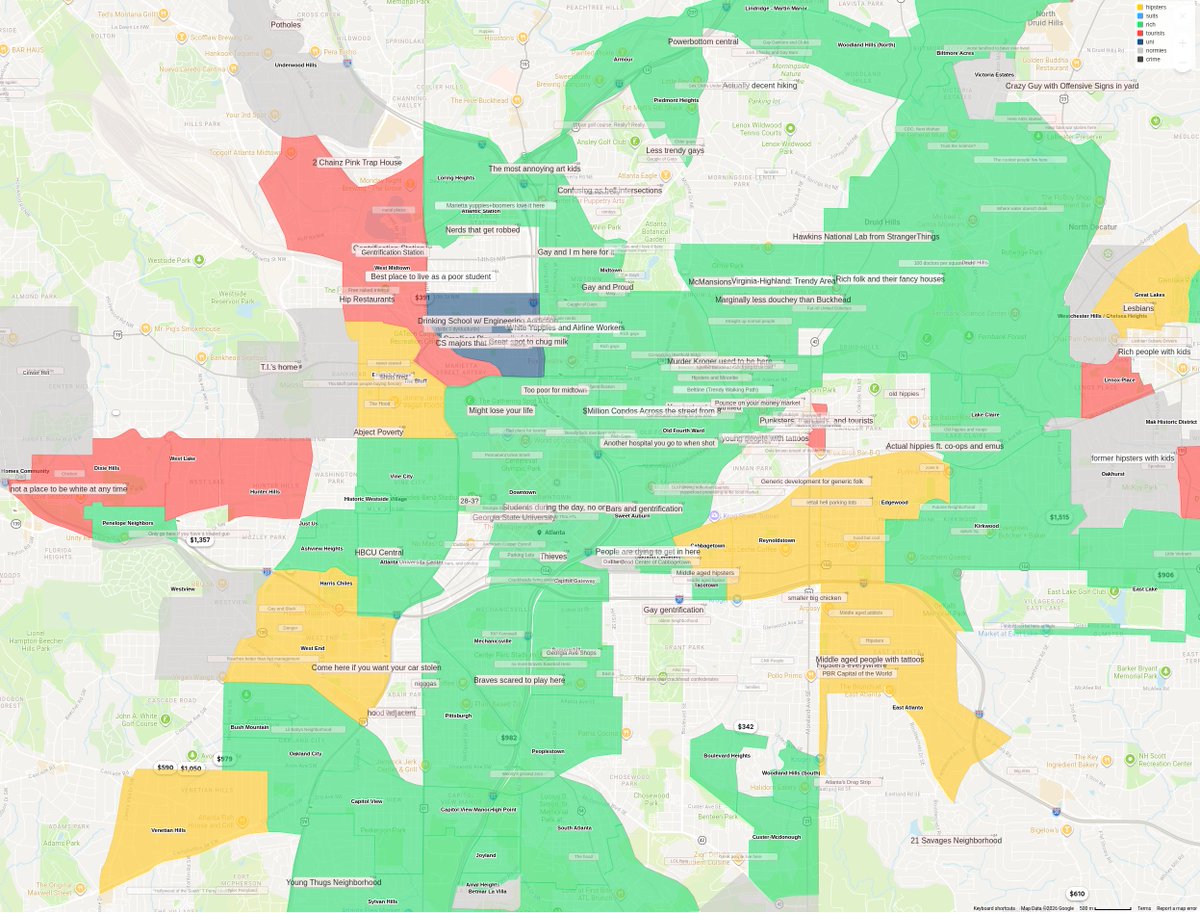
This was asked for for YEARS and I could never find time to build it myself 🗺️ Hoodmaps for 🏡 Airbnb Hoodmaps is my app that lets you find out where to stay in a city, it classifies neighborhoods by: 🟥 Tourists 🟨 Cool 🟩 Rich 🟦 Suits ⬜️ Normies I asked Claude Code to build it and it kinda works, not perfect but a start I just need to get the map to update faster and then publish it as a Chrome extension For now you can try it though: hoodmaps.com/airbnb-overlay… Copy paste that in console on Airbnb map, type your city as a slug (like los-angeles) and it should work Happy booking!!!
English
155
93
2.6K
286K
Charlie Smirkley
Charlie Smirkley@charliesmirkley·
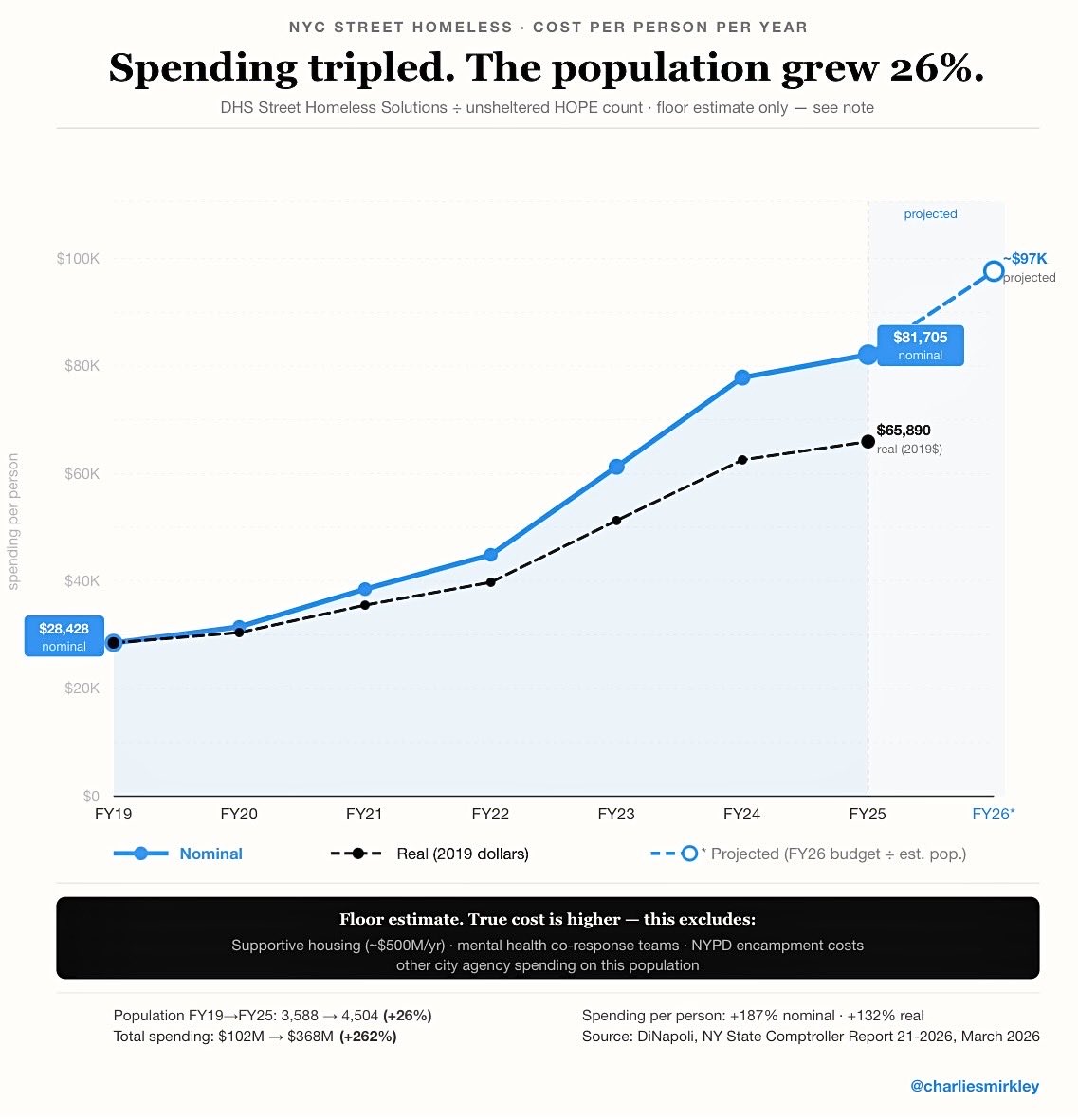
NYC spends more per homeless person than the median NYC household earns. $81,705 per person in FY2025. And $81,705 is a floor. It excludes supportive housing (~$500M/yr), mental health response teams, and NYPD encampment costs. The city projects ~$97K per person in FY2026.
Charlie Smirkley tweet media
English
1.5K
3.6K
12.7K
14.9M
Dave-Thinking
Dave-Thinking@thinking_dave·
@elonmusk @AtreyuUSA @art_muse I'm glad there's a laugh emoji there Is trading even an hour a week of your time to workout worth the opportunity cost? (I do workout just an hour a week and think it's great)
English
0
0
0
29
Art Muse
Art Muse@art_muse·
Viking War-Maiden ⚔️
Deutsch
102
117
1.1K
162.9K
Dave-Thinking รีทวีตแล้ว
Samip
Samip@industriaalist·
kinda wild that larry page had the bitter lesson figured out in ~2007. for context, sutton published his version in 2019
English
36
96
1.1K
151.3K
Dave-Thinking
Dave-Thinking@thinking_dave·
"The institutions aren't evil. I want to be clear about that, because I notice how easy it would be to read this whole thing as an attack on the people inside them. The people inside them are mostly doing what the system rewards, which is what I would do and what you would do. The system rewards the wrong things, and it does so for reasons that each made individual sense as they happened. Legal protections meant to prevent discrimination ended up discouraging assessment. Social norms meant to be generous ended up being dishonest. Accountability systems meant to ensure quality ended up measuring paperwork instead."
vittorio@IterIntellectus

x.com/i/article/2025…

English
0
0
0
1
Robert Scoble
Robert Scoble@Scobleizer·
Wow. Grok watched this video and made a complete list of everything it saw: x.com/i/grok/share/1… Do you have any idea how cool this is? It read every poster.
Robert Scoble@Scobleizer

All AI posters at GTC. This is not for human consumption. This video is for AI to watch. Click the grok button and talk to it about what it learned by seeing all the AI posters (highly technical) presented at @NVIDIAGTC tonight. Thanks NVIDIA for the badge and access.

English
257
223
1.7K
58.8M