Terra API

519 posts

Terra API banner
Terra API

Terra API

@TerraAPI

Connect your app to health data and AI. @YCombinator W21, @generalcatalyst

Tham gia Kasım 2021
16 Đang theo dõi1.7K Người theo dõi
Tweet ghim
Terra API
Terra API@TerraAPI·
That’s a wrap-up for the first Terra Health Day in San Francisco. Hundreds of @ycombinator founders got their morning workout kick with Pickleball games and some pull-ups. @bryan_johnson, the world’s most measured man, then took the stage to speak about the philosophy of longevity: Don’t Die @lancearmstrong then, in discussion with @kyriakosel, spoke about the early days, the Tour De France, the winning mindset, and the secrets of investing. More details soon!
English
4
4
30
311.4K
Terra API
Terra API@TerraAPI·
We have partnered with @perplexity_ai to let users securely connect their consented health and wearable data. From today onwards, people are able to understand and act on their health, continuously and in real-time. Your sleep Your stress Your activity Your workouts Your patterns over time All unified, securely consented and in your control. This opens up an entirely new layer of understanding: - Ask questions grounded in your real, continuous data - See how your body actually responds over days, months, years - Understand cause and effect across habits, recovery, and performance - Build personalized insights, tools, and agents on top of your own physiology
Terra API tweet media
English
1
1
22
1.3K
Kyriakos Eleftheriou
Kyriakos Eleftheriou@kyriakosel·
Perplexity is now powering health connectivity for millions of users through @TerraAPI Given that the best AI labs are moving into the health space, here's what I think is coming: You make thousands of daily decisions that change by the second Biomarkers, workouts, meals, sleep cycles, and stressors We are not meant to hold all this information No matter how brilliant your physician is, they see you for 15 minutes and work from a snapshot. The human brain doesn't scale to this problem AI does The doctor becomes the person you go to for surgery, and for judgment under uncertainty No doctor will ever know you better than your AI And software will be written for you daily Today, a doctor looks at a snapshot and puts you in a bucket. "Pre-diabetic", "at risk". These are population labels applied to an individual They tell you where you are. They don't tell you where you're going With continuous, full-context reasoning, the system doesn't label you, it tracks you. Your testosterone has drifted 10% over 10 months, your performance is dropping, here's exactly what to change this week to reverse it Medicine finally gets a feedback loop Chronic means we caught it too late. By the time you get the label - diabetes, heart disease, autoimmune - the damage has been accumulating for years. The disease isn't the problem. The delay is A system that monitors continuously doesn't wait for symptoms. It sees the drift at month 2, not year 10. The intervention is early, precise, and adjusts as your data changes. The feedback loop confirms it's working in days, not decades Chronic disease is a timing failure. The timing problem is solved
Kyriakos Eleftheriou tweet media
English
10
12
62
10.2K
Terra API đã retweet
Alistair Brownlee
Alistair Brownlee@AliBrownleetri·
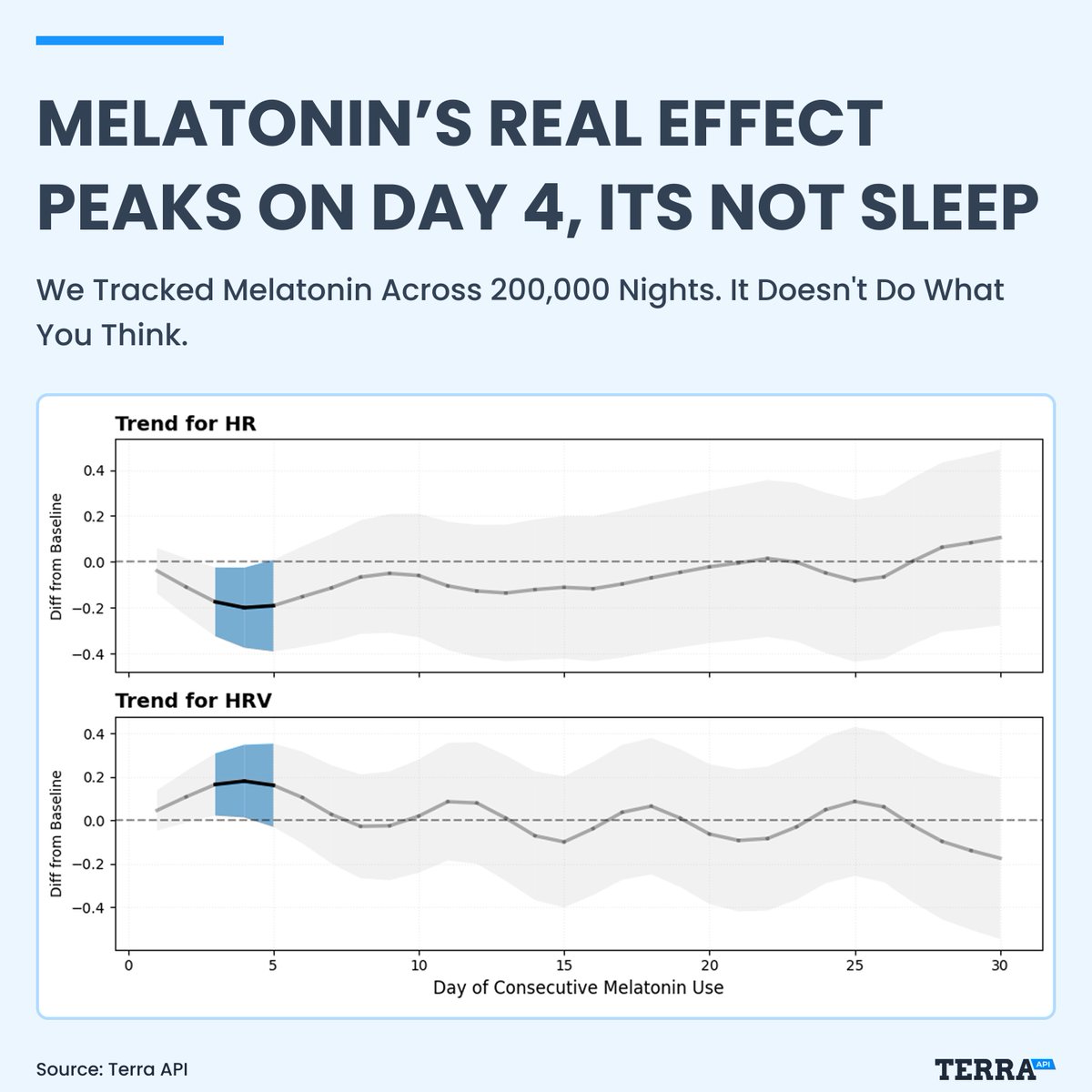
We tracked melatonin across 200,000 nights. It doesn't do what you think. Most people, including me, take melatonin to sleep better. When I travel, cross time zones, and sleep in unfamiliar beds, I’m convinced it helps me get a better night's sleep. Our latest data analysis at Terra API suggests it doesn’t. We analysed 200,000+ sleep records, excluded nights with alcohol, late caffeine, and illness, and compared melatonin nights to non-melatonin nights using mixed-effects models. There was no measurable effect on sleep duration, latency, or onset. But we did detect physiological impacts of melatonin on our users. Overnight heart rate dropped, and HRV rose, peaking around days 3–5. After a week, the effect fades. That's probably a sign that, for many, Melatonin helps your body find its rhythm, then steps back as it adjusts (attenuates) it. And we found no evidence of withdrawal. When users stopped, metrics returned to baseline within 2 days, with no rebound or worsening. So why doesn't it show up in sleep? Probably because people reach for it on their hardest nights. Travel, stress, early alarms, I certainly do. The context overwhelms whatever benefit melatonin provides. Full research blog in comments. Great work by the @TerraAPI research team on this one.
Alistair Brownlee tweet media
English
5
9
84
20.4K
Terra API đã retweet
Kyriakos Eleftheriou
Kyriakos Eleftheriou@kyriakosel·
How does a health app with 80M users build one of the best medical AIs? @rbugaev (CTO) and @nedosekinvlad (Dir. of Eng) at @flotracker broke it down: (0:00) Introduction (4:31) Neural networks for cycle prediction — before GPT existed (18:14) "Whenever it's possible, we are NOT doing AI" (32:34) Three-person blind test: when AI disagrees with a clinician (35:10) AI is more consistent than doctors — but biased against women (43:09) AI router that works like a GP triage system (47:29) "Evaluation, evaluation, evaluation" — how they pick models (51:01) Anonymous mode: privacy that enables AI instead of blocking it (59:45) 100,000-token prompts: the hidden cost of medical AI (1:20:52) LLM-as-a-Judge became a self-serve tool for non-technical teams (1:36:48) Flo is becoming an FDA-certified medical device
English
2
4
15
2.6K
Terra API đã retweet
Alistair Brownlee
Alistair Brownlee@AliBrownleetri·
If you are anything like me, you are already missing all that winter sport, so I thought I’d dive into the @TerraAPI data vaults for some insights. Norway's performance was pretty amazing: 41 total medals (18 gold) —the most golds ever at a single Winter Games and the top of the medal table. With a population of just ~5.65 million, that's roughly 0.73 medals per 100,000 people—a per-capita dominance that leaves giants like the US (~0.009 per 100,000 with 349 million people) in the dust. Johannes Høsflot Klæbo stole the show, sweeping all six cross-country events he entered for an unprecedented six golds at one Games, pushing his career total to 11. But what drives this sustained excellence? Diving into activity data from fitness trackers across Europe reveals Norway's secret could be a deeply embedded cultural approach to movement. Norwegians average 512 minutes of activity per month (39% more than peers in the UK, Germany, France, Austria, and Italy), with massive emphasis on outdoor, nature-based pursuits: 183 minutes on walking/hiking (64% more) and 29 minutes on cross-country skiing (over 20x more than others, where it's virtually absent). They seem to favor sustainable, endurance-focused training, more time building an aerobic base, and less max-intensity. Even more telling: activity diversity is highest in Norway at 3.39 types per user (vs. the UK's 1.53), possibly pointing to a grassroots philosophy of multi-sport participation, delayed specialisation, and a fun-first approach to training. What can we learn from this? Does analysing the data uncover the secrets of success? Read the blog to find out…
Alistair Brownlee tweet media
English
2
10
73
9.4K
Terra API đã retweet
Alistair Brownlee
Alistair Brownlee@AliBrownleetri·
One of the most common questions we get from female athletes is “Should I train lighter during my period?”. Our research team led by Rocio Mexia Diaz investigated ~ 3 million nights of sleep data from wearables to find out. The short answer is that on average your training capacity probably doesn’t change. HR at a given work load stays the same across cycle phases. However, the key finding is that recovery costs more during the luteal phase; lower HRV, lighter sleep, and elevated HR during the night. And, of course the vast differences between individuals may be hidden by population level data. In layman’s terms, your body’s not weaker, but you do pay more for the same effort. The graph below shows just how dominant this monthly rhythm is. It’s not a subtle signal - it completely overpowers weekly patterns entirely. Full research blog below. @TerraAPI
Alistair Brownlee tweet media
English
1
3
8
3.1K
Terra API
Terra API@TerraAPI·
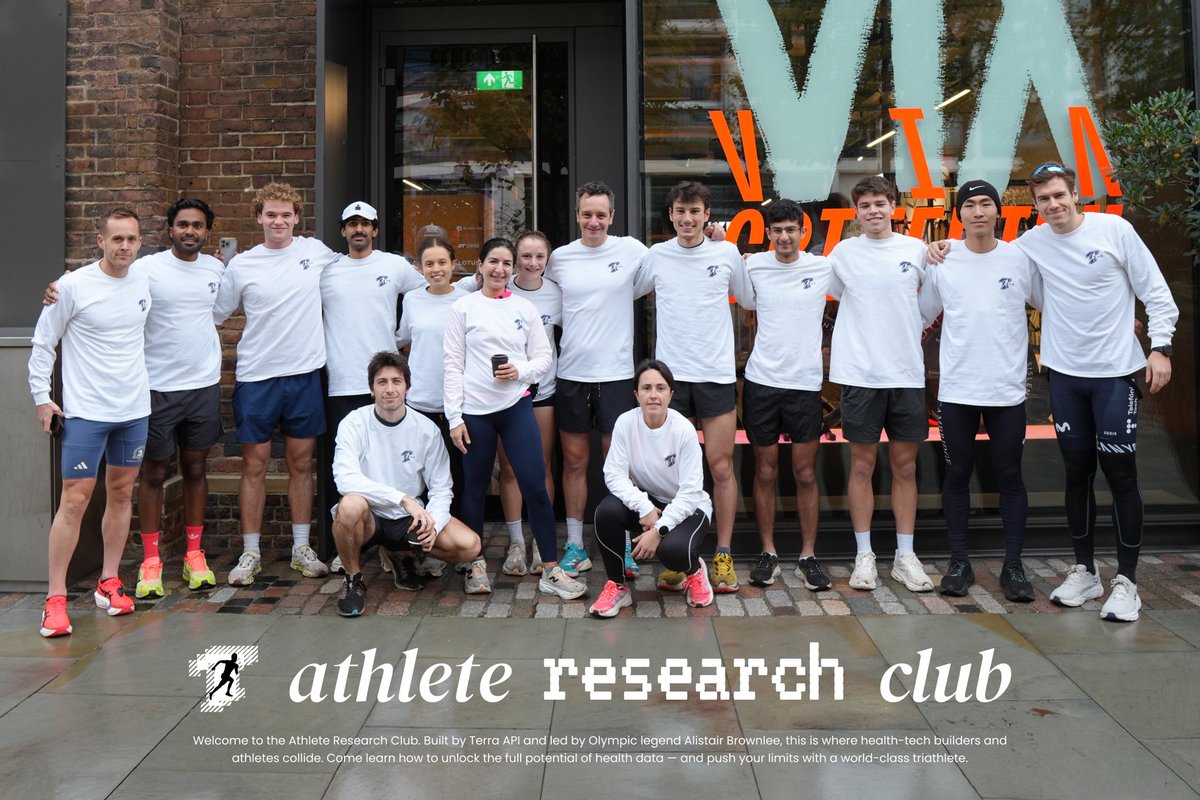
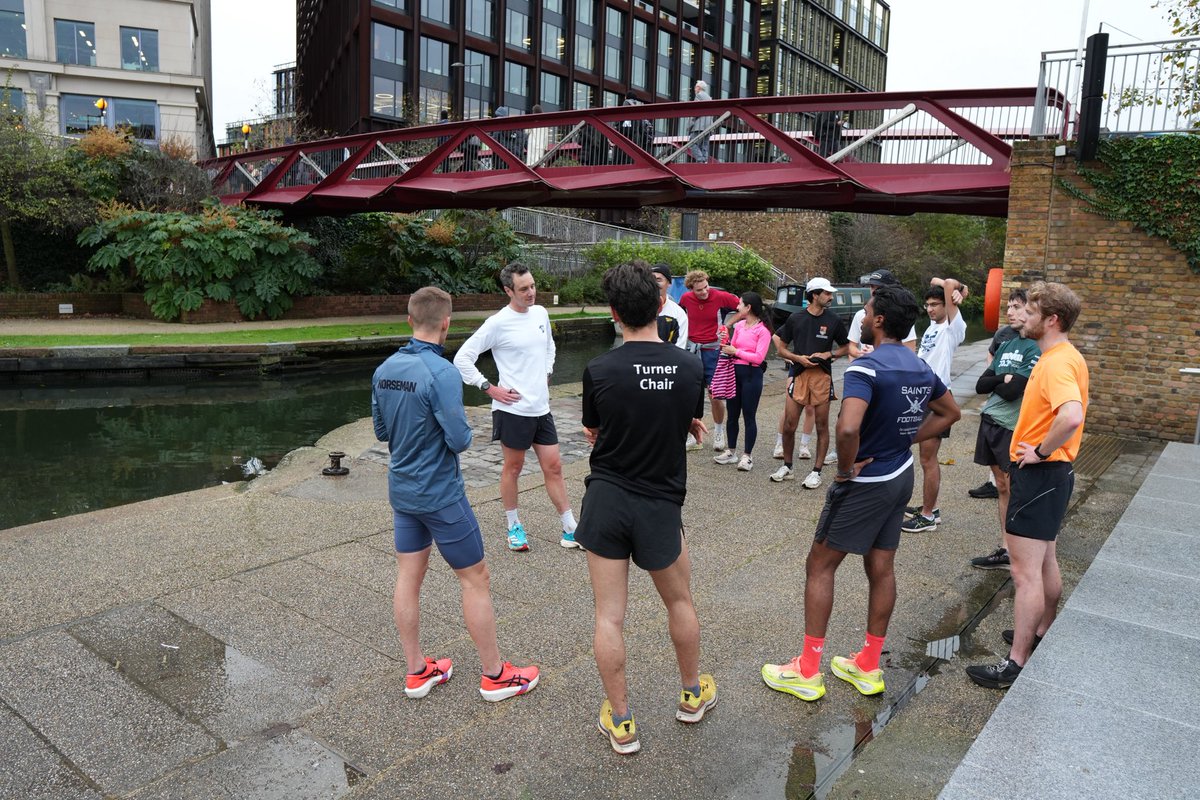
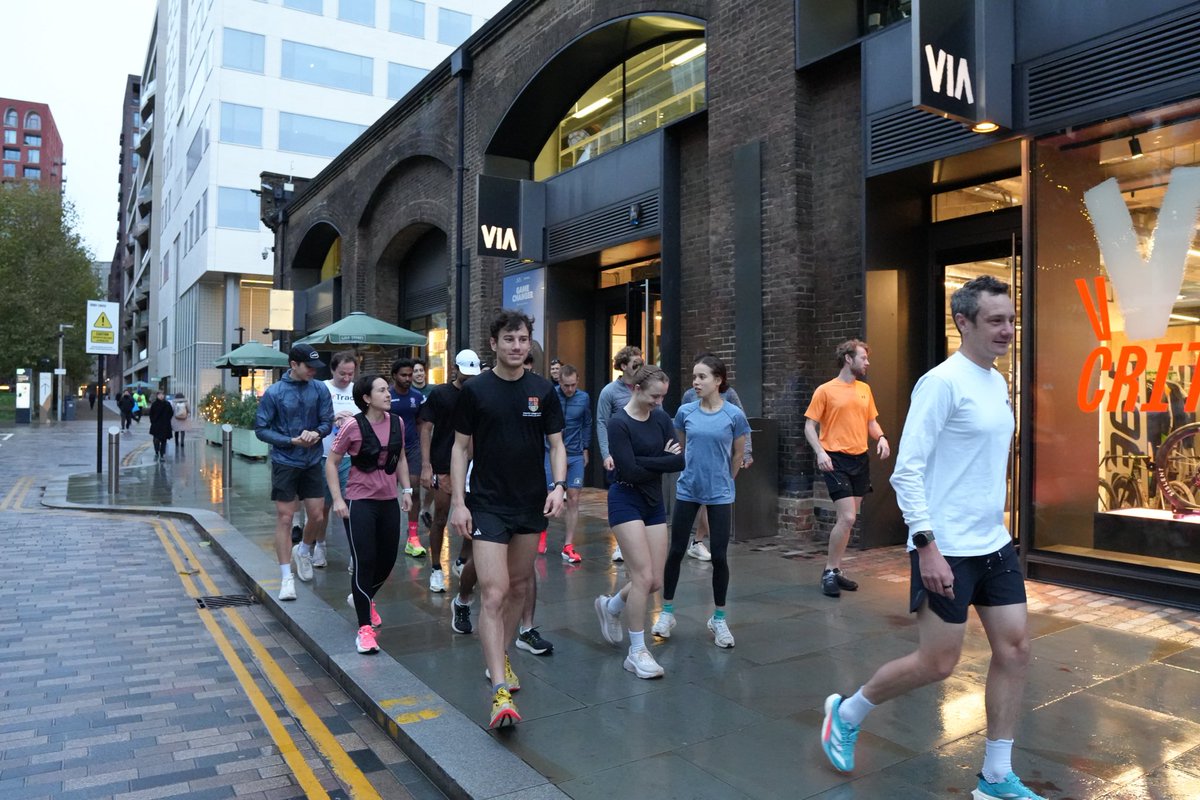
30 elite runners, researchers, students and founders in KX, London last week, for the Athlete Research Club 7.30 am in gusty rain and freezing conditions people connected their wearables, ran intervals with @AliBrownleetri and participated in stress-testing two new scoring models under load developed by our research team
English
1
2
3
2.5K
Terra API đã retweet
Kyriakos Eleftheriou
Kyriakos Eleftheriou@kyriakosel·
sat down with @SachaMichaud, co-founder of @glovo, the $2.6b tech company out of Barcelona, and yellow.vc, an early stage fund. Some of the learnings: On Peter Thiel’s monopoly argument They deliberately didn’t focus on one category. “We always wanted everything and anything. The wow moments were important - that’s what people talked about.” Your first product doesn’t need a business model “Our first version of the app was two text buttons. not very scalable, no business model. people suddenly had the whole city in their hand.” Organic growth is the strongest validation signal If people share it without incentives, it’s working. “We didn’t have any marketing money the first year. people were just telling each other. to grow organically shows you’re onto something.” Multi-category was a conviction, not an accident They ignored investor pressure and stuck to their vision. “Many investors suggested we drop everything else and double down on restaurant food. we kept firm. COVID changed the game.” Kill markets fast when you’re losing Staying too long can kill the whole company. “We spent nearly 30 million euros in like six months. this is going to kill us. so we closed it down.” Being market leader beats being global It’s better to dominate a few markets than fight everywhere. “We avoided very competitive markets. there’s a lot of advantage in being market leader. we focused where we could win.” Don’t bend culture to attract people Changing culture to hire faster breaks the company. “Skills can be learned. culture and values are more important. if you don’t fit, that’s okay - but this isn’t for you.” Introduction The Birth of Glovo: From Idea to Launch Viral Growth and Initial Operations Realizing the Potential of Glovo Expanding into New Markets and Lessons Learned Navigating Competition and Strategic Decisions The Acquisition and Future of Glovo The Role of AI and Future Trends in Delivery
English
1
2
3
459
Terra API đã retweet
Alistair Brownlee
Alistair Brownlee@AliBrownleetri·
Have you ever heard the saying: "Intensity is vanity; volume is sanity"? Probably not! I just made it up, but I do think it contains more than a kernel of truth. We all associate January with new health goals and increased activity. But how many of us actually make a meaningful change? I thought of this when writing up our latest research at @TerraAPI We analysed activity data from 3,000+ wearable users through January 2025 to measure if we could identify a "resolution effect" of increased activity. Steps jumped 13.3% on January 1st. However, active minutes only increased by 1.3% and distance by 2.6%. The finding here, New Year's Day walks seem to be a thing. This boost was short-lived. Median elevated activity lasted just two days. Only 1 in 4 users sustained it past day 4 (which correlates with our previous blog post on sleep resolutions). What surprised me the most was who actually changed. The least-active quartile increased by 25%, while the most active increased by just 2%. Resolutions seem to reach the people who weren't already in a routine. Full analysis below. Did you change your activity habits this January?
English
1
1
8
3.5K
Terra API đã retweet
Alistair Brownlee
Alistair Brownlee@AliBrownleetri·
We’ve just published our first preprint at @TerraAPI Research! While reviewing the sleep literature, we identified a clear gap: almost no large-scale, global studies on year-round variation in sleep. Existing research suggested seasonal effects on sleep duration, but most studies were limited by small sample sizes, single-country focus, narrow latitude ranges, or subjective self-reports. We are in a unique position in that we have access to a large, diverse, and globally distributed data set, but we just had to find a way to tie nights to a location. The Terra research team had a brilliant, collaborative, and innovative approach. We combined 185,000 anonymous, objectively measured nights of sleep from 697 individuals across 49 countries, with location data from activity sessions. Bayesian hierarchical models were applied to disentangle individual, country-level, and environmental effects. Key findings: - Sleep duration decreases consistently with increasing daylight (~4–5 minutes less per additional hour of daylight) - After accounting for individual and country baselines, calendar season explains surprisingly little - Despite vast differences in seasonal light exposure across latitudes, people at higher latitudes show no greater sensitivity to day-length changes - A large portion of the remaining variation appears at the country level — pointing to sociocultural factors playing a bigger role than latitude alone These results suggest that global sleep patterns are driven more by stable individual and national differences than by broad seasonal categories. This has real implications for interpreting seasonal effects in smaller, geographically limited studies and highlights the value of large-scale wearable data for circadian research. A massive thank you to the team, Faraaz and Cameron. Looking forward to seeing what we can do next! Preprint link in comments. Curious to hear your thoughts: do you notice seasonal changes in your own sleep? #SleepResearch #WearableTechnology #BayesianModeling #GlobalHealth @kyriakosel
English
1
1
3
3.1K
Terra API đã retweet
Alistair Brownlee
Alistair Brownlee@AliBrownleetri·
Have you ever thought about how different cultures sleep differently? In our latest research at @TerraAPI , we found some remarkably contrasting sleep patterns depending on geography, even when looking at the same month across thousands of records. We analyzed 8,000+ nights of sleep throughout 2025 using wearable data, linking activity locations to where people were likely sleeping. What stood out immediately was how much sleep length varied by country within the same month. Ireland averaged just over 7.3 hours of sleep per night, while Indonesia averaged under 5.8 hours. That’s a difference of more than ninety minutes (!), without changing the calendar. What’s interesting isn’t just that the gap exists, but that it’s remarkably consistent within countries and shows up across thousands of sleep records. That raises obvious questions about what’s driving it, including climate, daylight, culture, seasonality, and how people structure their days. Our research blog this week explores what might be behind these differences, from latitude and seasonality to cultural timing and daily structure. Full analysis in link below. Keep an eye out for further research on this subject, we’ve got some very exciting and fascinating insights coming soon!
English
1
2
9
4K
Terra API đã retweet
Kyriakos Eleftheriou
Kyriakos Eleftheriou@kyriakosel·
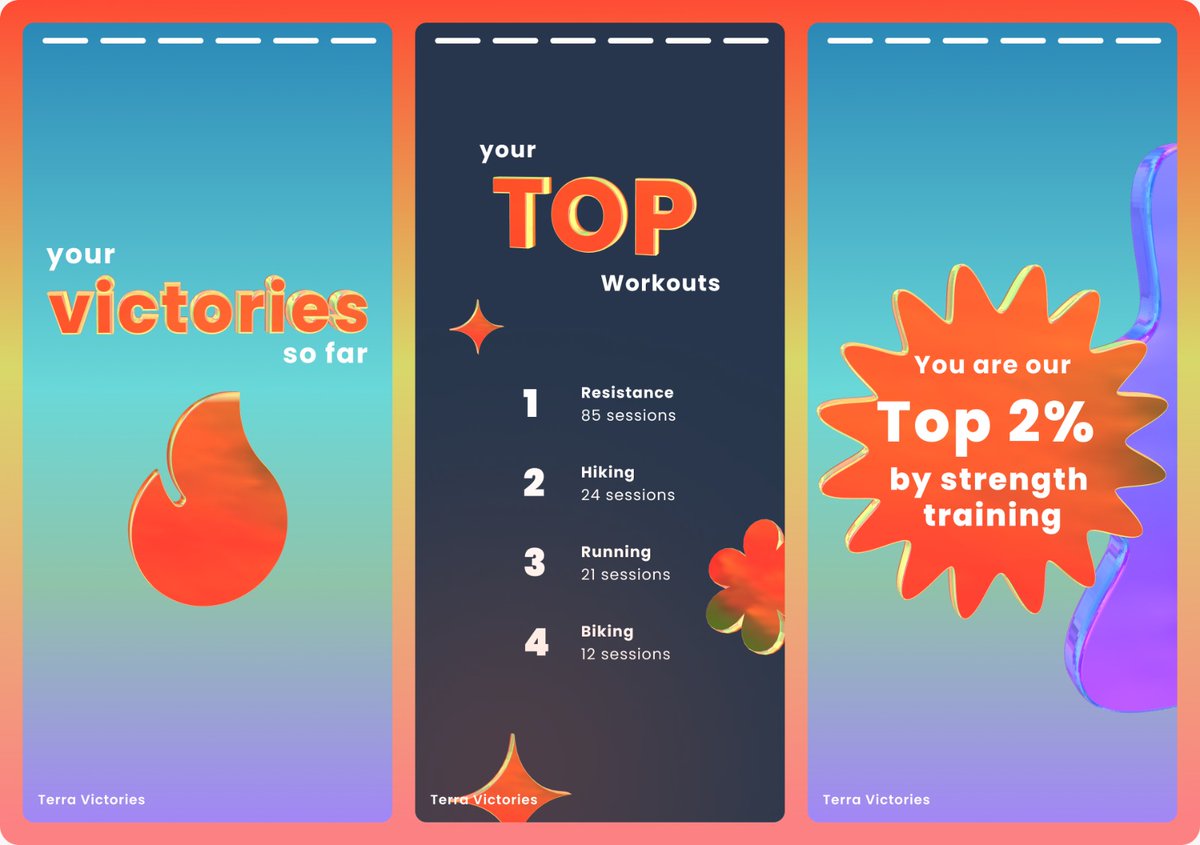
You want a Spotify-like yearly fitness wrapped? There's nothing from Apple Garmin's behind a paywall Strava's behind a paywall We made one for free Download Terra Victories from Testflight, connect any health source, and see your year in review
Kyriakos Eleftheriou tweet media
English
2
3
9
802
Terra API đã retweet
Alistair Brownlee
Alistair Brownlee@AliBrownleetri·
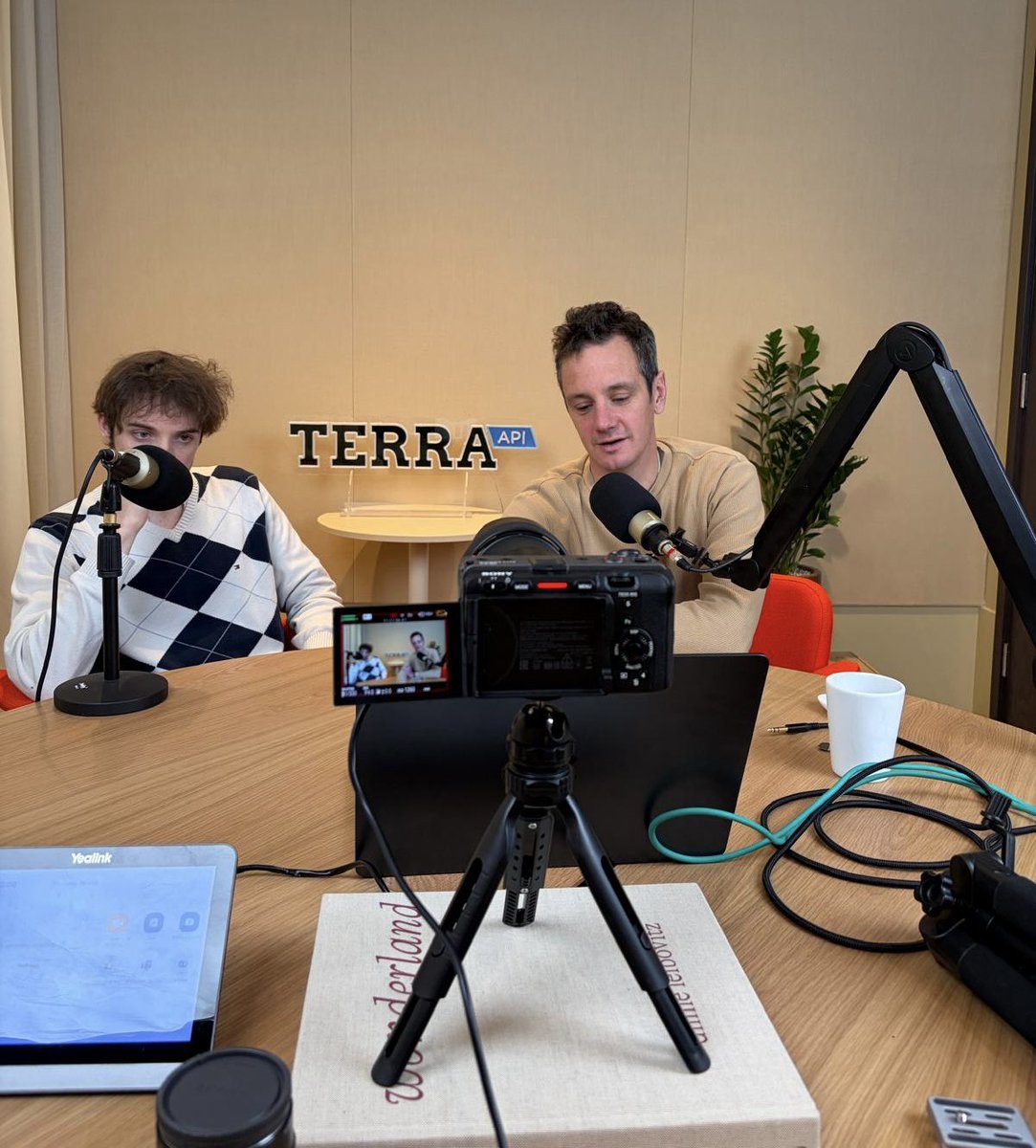
This morning we held the Terra API athlete research club in London. A great run, lots of health data chat and meeting new people. The ideal way to start a Thursday. More importantly we integrated everyone’s wearable to test out two of the new exercise scores we are developing. Real world science and product testing! #healthdata #fitness #atheleteresearchclub
Alistair Brownlee tweet mediaAlistair Brownlee tweet mediaAlistair Brownlee tweet media
English
1
2
11
5.5K
Terra API
Terra API@TerraAPI·
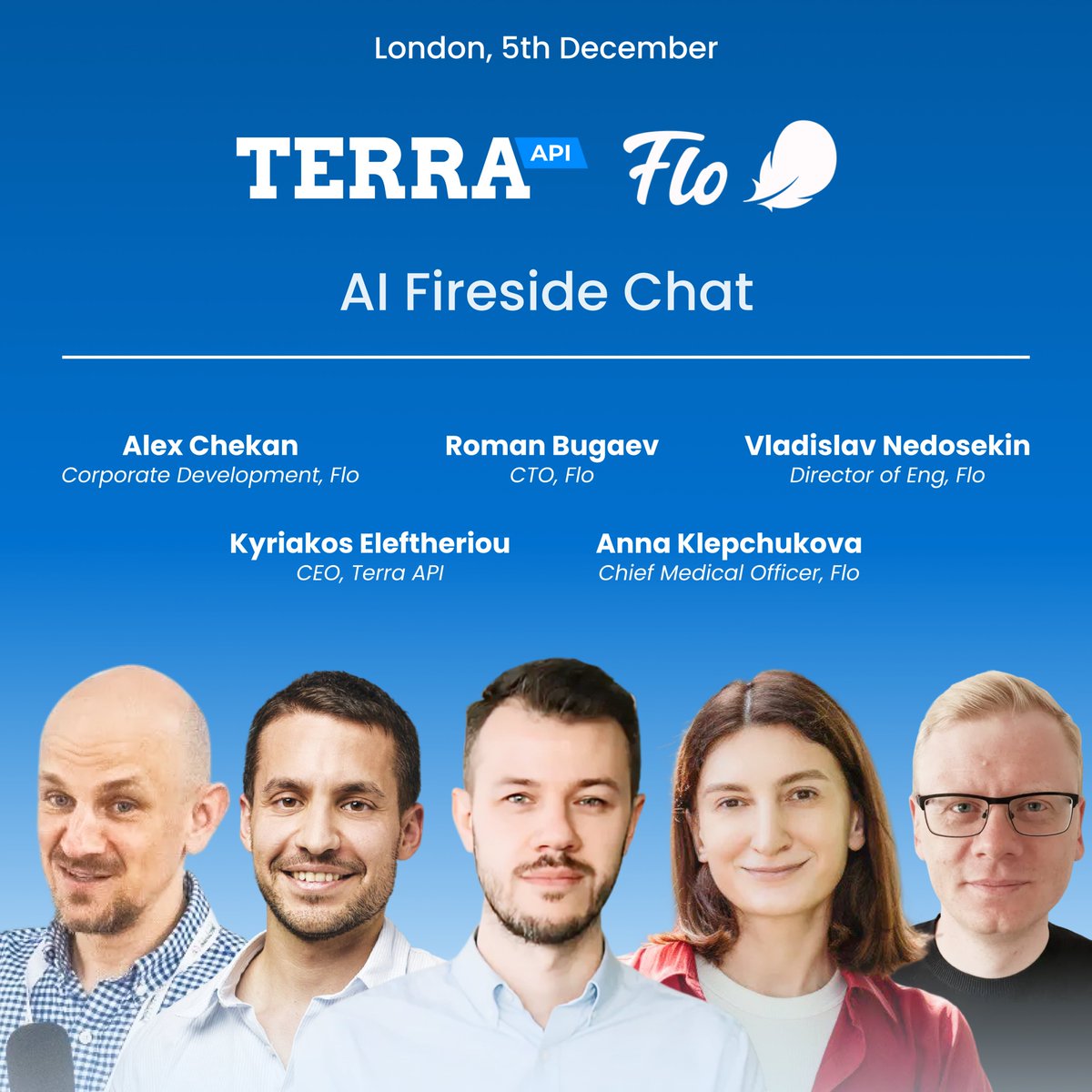
@flotracker is one of the fastest-growing health companies in the world hitting $1B valuation. They built some of the most sophisticated AI systems for predicting women's health outcomes. In two weeks, we are doing a fireside chat with their team; - Roman Bugaev (CTO), - Vladislav Nedosekin (AI Director), - Alexander Chekan (Corporate Development), and - Anna Klepchukova (Chief Medical Officer) to get all the practical insights and learnings on how they are approaching AI and predictions in healthcare. December 5 Terra HQ in Kings Cross Very limited seats - apply early (link in comments)
Terra API tweet media
English
1
1
3
651
Terra API đã retweet
Alistair Brownlee
Alistair Brownlee@AliBrownleetri·
We’ve found that the best way to test new products @TerraAPI is through live customer feedback. Last month we live tested two new scores at a cycling event and have continued to iterate them. Our next event is on Nov 27th, in Kings Cross, London. Come and be part of our live research lab. Sign up below if you love running and want to be a part of cutting edge research.
Alistair Brownlee tweet media
English
1
3
5
5.4K