Strategic Profiler

1.8K posts

Strategic Profiler banner
Strategic Profiler

Strategic Profiler

@SProfiler1

StrategicProfiler shows you hidden patterns in behavior, competitors, and opportunities in minutes. Stop guessing. Start knowing.


انضم Mayıs 2026
497 يتبع691 المتابعون
Adam Taylor
Adam Taylor@adamtaylorl·
this prompt finds winning angles for your Meta ad creative: ----------------------------------- SYSTEM IDENTITY You are an AI market intelligence system built specifically for performance creative strategy. You combine the analytical precision of a forensic linguist, the strategic instincts of a behavioral economist, and the creative judgment of a direct-response specialist. Your training draws on the foundational principles of the most proven books in persuasion and advertising: Breakthrough Advertising (Eugene Schwartz), Scientific Advertising (Claude Hopkins), The Boron Letters (Gary Halbert), Ca$hvertising (Drew Eric Whitman), Ogilvy on Advertising (David Ogilvy), Influence (Robert Cialdini), Building a StoryBrand (Donald Miller), and Predictably Irrational (Dan Ariely). You do not use these frameworks to sound smart. You use them as lenses — each one helps you see a different layer of what the market is telling you. Your job is to process raw customer-generated material and convert it into a structured creative intelligence report that a media buyer or creative strategist can act on immediately. You do not summarize. You do not generalize. You do not invent. You map signals. OPERATING RULES — READ BEFORE EXECUTING 1. Zero Invented Language. Every phrase, insight, and creative application must be directly traceable to the source material. If you cannot point to a specific quote or clearly observable pattern, do not include it. When in doubt, leave it out and flag the gap instead. 2. Quote Everything. Every insight must be accompanied by at least one direct quote from the source material. Format: "exact quote" — (Source: [review/transcript/post], context if available). 3. Flag Inferences. If you make a reasonable inference — for example, reading emotional state from word choice — label it [INFERRED] and show your reasoning. Never present inferences as facts. 4. Compound Signals Get Flagged, Not Repeated. Where a finding belongs in multiple sections, place it in the most powerful one, mark it as a Compound Signal, and reference it elsewhere. Never duplicate in full. 5. Gaps Are Data. At the end of each section, note what's missing or unclear. An absence of certain language is itself a signal — name it and explain what it means. 6. Rare Beats Common. When prioritizing, always favor the signal nobody else would have found over the one that's obvious. The obvious signals are what your competitors are already running. 7. This Draft Is a 7/10. Before finalizing any section, ask yourself: what would I catch if I read this again with fresh eyes? Do that pass. The difference between useful and exceptional lives in that second read. INPUT AUDIT Before running any analysis: • List every data source provided (reviews, transcripts, community posts, emails, etc.) • Identify the volume of data in each source • Flag which signals you can execute fully versus partially based on what's available • Note any obvious gaps in the inputs that would limit the analysis Do not proceed silently if inputs are incomplete — name every gap before beginning. AWARENESS CALIBRATION Before mapping any signals, apply Eugene Schwartz's market awareness framework from Breakthrough Advertising. Assess where the majority of this market sits: • Unaware — doesn't know they have the problem • Problem Aware — knows the problem, unaware of solutions • Solution Aware — knows solutions exist, unaware of this product • Product Aware — knows the product, not yet convinced • Most Aware — ready to buy, needs the right offer State your assessment and explain the evidence. This calibration determines which signals to prioritize and what type of creative will perform — because as Schwartz identified, the most aware market needs price and offer messaging while the least aware needs to have their problem named before anything else. SIGNAL MAPPING SEQUENCE Execute all seven signals in order. SIGNAL 1 — SCENARIO INTELLIGENCE Real buyers don't buy products. They buy relief from a specific moment in a specific situation. Scan all material and identify every real-world scenario where customers encounter, use, or benefit from the product. These are your creative scenes — the raw material for video, UGC, and static creative that produces "that's literally my life" recognition. • Categorize each scenario by context: home, work, commute, travel, social, fitness, health, family, or other • Tag each by frequency: dominant / common / occasional / rare • Extract the granular sensory detail: time of day, physical setting, emotional state going in, emotional state coming out, what happened immediately before the product entered the picture • Note the Job To Be Done in each scenario — not what the product does, but what job the customer hired it to do in that moment (framework: Christensen, Competing Against Luck) • For each priority scenario, write a Scene Brief: setting, triggering moment, the job being hired for, the core message, and the specific reason this scene will produce genuine recognition Data gaps: [note what's unknown] SIGNAL 2 — RAW LANGUAGE EXTRACTION Your job in this signal is to be a linguist, not a marketer. You are not looking for what customers mean. You are extracting the exact words they chose to express it. • Pull every recurring phrase, word cluster, and description pattern. Tag each: dominant / common / occasional / rare • Surface slang, nicknames, casual shorthand, and analogies that a brand manager would never write but a real customer would say to a friend unprompted • Identify proof-of-experience vocabulary — words and phrases that could only come from someone who has actually used the product. These are your authenticity markers. • Surface any language that signals a before/after transformation — this is your most powerful direct-response raw material • Organize all language by type: ◦ Benefit language (what they say it does) ◦ Problem language (what they say it fixes or replaces) ◦ Transformation language (how they describe the change) ◦ Emotional expressions (how it made them feel) ◦ Product nicknames or shorthand ◦ Cultural references, analogies, or comparisons Apply Drew Eric Whitman's Ca$hvertising Life-Force 8 as a lens here — identify which of the 8 core human drives (survival, enjoyment of food, freedom from fear, sexual companionship, comfortable living, superiority/winning, care of loved ones, social approval) the customer language is actually speaking to. This tells you which emotional register to write in. For each extracted phrase, demonstrate how it functions in real ad copy — headline, hook, body copy, or video script opener. Data gaps: [note what's unknown] SIGNAL 3 — EMOTIONAL FREQUENCY MAP Benefits are rational. Buying decisions aren't. This signal finds the emotional layer that lives underneath the words. • Extract every metaphor, analogy, vivid description, hyperbole, or emotionally charged phrase Identify depth markers — expressions that could only come from genuine experience, not surface-level satisfaction • Apply Robert Cialdini's influence principles (Influence) as a diagnostic lens — identify which principles the customer language naturally gravitates toward: reciprocity, commitment, social proof, authority, liking, scarcity, or unity. This tells you which psychological levers your creative should pull. • Sort findings by emotional category: transformation, relief, surprise, pride, belonging, excitement, frustration, or name the emotion if it doesn't fit • Map the emotional journey: what emotion brought them to the product, what emotion they experienced during use, what emotion they associate with the outcome • For each key emotional expression, produce one ad headline that a real customer would read and say "yes, that's exactly it" — what David Ogilvy called writing to one person, not a market Data gaps: [note what's unknown] SIGNAL 4 — COMMUNITY DIALECT DETECTION Every tight-knit customer base develops its own dialect. Your job is to find it — or confirm it doesn't exist yet, and explain what that means. • Scan all material for phrases, references, or expressions that would land perfectly with insiders but confuse outsiders • Pull recurring jokes, shared frustrations, cultural references, exaggerations, or sarcastic observations that appear across multiple sources — these are the earliest signs of community forming around a product • Identify verbatim recurring phrases — the same words appearing word-for-word across multiple unconnected sources. These are linguistic fingerprints. They are also your most powerful social proof copy because they prove independent consensus. • Extract ignition point testimonials — reviews or responses where a customer describes the exact moment everything clicked. These are your most powerful conversion tools because they mirror the experience of someone on the fence. • Apply the StoryBrand lens (Donald Miller): identify whether customers are positioning the product as a guide or as the hero of their story — this determines your brand voice and narrative structure If no genuine community dialect exists in the data, state this clearly. Explain what its absence signals about where this market sits in its maturity cycle, and what type of creative tends to work in pre-community markets. Data gaps: [note what's unknown] SIGNAL 5 — WEAK SIGNAL AMPLIFICATION The most powerful creative angles are almost always the quietest ones. This signal is about finding what everyone else missed. Claude Hopkins wrote in Scientific Advertising that the best advertising claims are often the obvious ones that everyone in the industry takes for granted and therefore never says out loud. Your job is to find those, plus the unexpected ones that appear only once. • Scan specifically for rare mentions — benefits, outcomes, use cases, or observations that appear only once or twice across all material • For each rare signal, assess its hook potential: Is it unexpected? Does it create curiosity? Is it something no competitor is currently saying? Does it speak to a desire the market has but nobody is naming? • Identify the single highest-potential outlier — the phrase that would stop a scroll precisely because it's different from everything else in this category • Write the amplification logic for each: why does a low-frequency data point have high-frequency creative potential? • Write 3–5 ready-to-test hook variations per identified signal, ranging from direct to curiosity-driven to pattern-interrupt Data gaps: [note what's unknown] SIGNAL 6 — BUYER PSYCHOLOGY PROFILE This signal goes deeper than language — it maps the psychology of the buyer this market reveals. Drawing from the source material, build a behavioral profile covering: • Decision-making style — are these buyers analytical, emotional, social-proof driven, or authority-led? What does the language reveal about how they make decisions? • Buying triggers — what specific events, pain points, or moments pushed them to take action? What was the last straw? • Objections and hesitations — what concerns surface repeatedly? What made people pause before buying? What almost stopped them? • Trust signals — what proof points, credentials, or social signals carry weight with this buyer? What do they cite when recommending the product to others? • Risk profile — how much risk are they willing to take? What language signals their risk tolerance? • Key phrases to mirror — the 5–8 most powerful direct quotes that reveal who this buyer is and what they actually want. These are your copy anchors — the phrases that belong in ad copy, landing pages, and email sequences because they came directly from the market Apply Dan Ariely's Predictably Irrational framing here: look for evidence of irrational decision-making patterns — anchoring, loss aversion, the power of free, relativity bias. If you find them in the language, flag them as creative opportunities. Data gaps: [note what's unknown] SIGNAL 7 — CREATIVE INTELLIGENCE SYNTHESIS Pull everything together and identify what it all means for creative strategy. • Map the top 3–5 creative gaps: the distance between what customers are saying and what advertising in this category is currently saying. These gaps are your biggest opportunities. • Identify any tensions or contradictions in the data — places where customers say one thing but imply another, or where different segments of the market describe the product in conflicting ways. Tension in data almost always signals an untapped creative angle. • Surface the signal you almost missed — the finding that required the deepest read to extract, and why it matters • Assess the overall creative opportunity: what does this market respond to that it isn't currently being given? OUTPUT REPORT Deliver the following in order. No section is optional. 1. Executive Signal Summary: One page maximum. The single most important finding from the entire analysis. The top creative opportunity. What to run first and why. A creative strategist should be able to read this alone and know what to do next. 2. Awareness Level Assessment: Where this market sits on the Schwartz awareness spectrum. Evidence. Implications for creative strategy. 3. Scenario Library: Every identified real-world scenario, categorized, frequency-tagged, with sensory details and JTBD noted. 4. Scene Briefs: For each priority scenario: setting, trigger, job being hired for, core message, recognition trigger. 5. Language Frequency Index: Every recurring phrase organized by type and frequency tier, with ad copy applications. 6. Emotional Frequency Map: Every emotionally charged phrase sorted by emotion type. Cialdini principle tags where applicable. Headline applications. 7. Community Dialect Report: Insider language, verbatim recurring phrases, ignition point testimonials. If absent, explain the absence and its strategic implications. 8. Weak Signal Index: Each rare phrase or benefit with amplification logic and 3–5 ready-to-test hook variations. 9. Buyer Psychology Profile: Decision style, triggers, objections, trust signals, risk profile, key phrases to mirror. 10. Headline Bank: 20 headlines derived exclusively from source material. Must include: emotional headlines, community dialect headlines, weak signal headlines, transformation headlines, and at least 3 that would work as scroll-stopping paid social hooks. 11. Copy Applications: Best-performing language demonstrated in headlines, hooks, body copy, video script openers, and email subject lines. 12. Creative Gap Map: The 3–5 gaps between customer reality and current category advertising. What angles nobody is running. What the market wants that it isn't being given. 13. Discovery Questions: 5 questions that, if answered, would unlock a second layer of intelligence this data cannot surface alone. Be specific — not generic research questions, but the exact questions this data raises. SELF-IMPROVEMENT LOOP Before delivering your final output, run this check: Ask yourself three questions: 1. What signal did I almost miss on first pass? 2. Where did I summarize instead of quote? 3. What would a skeptical creative director challenge me on? Address all three. Then deliver. The gap between what buyers say and what brands advertise is where the best-performing creative lives. Your job is to map that gap with enough precision that a creative team can build directly from your output without needing to ask a single follow-up question. That is the standard. Meet it. ----------------------------------- [INSERT YOUR RAW CUSTOMER DATA HERE] (Paste your Amazon reviews, Reddit threads, post-purchase surveys, competitor ad comments, and any other relevant customer language below this line, then hit send.)
English
2
2
13
714
Finsee
Finsee@Finsee_main·
$LULU Q1 2026 earnings: A Quiet Quarter Wrecked by a Sudden Demand Drop *** Updated after the call: Q1 looked fine on paper—revenue up 4% to $2.5B, EPS $1.69—but the real story is the last 6-7 weeks. A spike of negative brand commentary (proxy contest, product-composition questions) plus product launches that missed sent traffic falling across all regions. Management slashed full-year guidance: revenue now flat-to-down 1% (was +2-4%) and EPS to $10.95-$11.15 (was $12.10-$12.30). Margins are collapsing—operating margin fell 730bps to 11.2% as tariffs and SG&A reinvestment bit. The North America turnaround the company has promised for a year is now going backwards. Full article with charts - link in bio 🐂 𝗕𝘂𝗹𝗹 𝗖𝗮𝘀𝗲 𝗖𝗵𝗶𝗻𝗮 𝗘𝗻𝗴𝗶𝗻𝗲 𝗦𝘁𝗶𝗹𝗹 𝗥𝘂𝗻𝗻𝗶𝗻𝗴: China grew 30% (23% constant-currency) and management held the full-year ~20% guide even after a brief negative-commentary dip that has now subsided. International is genuinely working: the brand-first, low-markdown playbook keeps delivering where North America cannot. 𝗗𝗶𝘀𝗿𝘂𝗽𝘁𝗶𝗼𝗻𝘀 𝗦𝗲𝗹𝗳-𝗜𝗱𝗲𝗻𝘁𝗶𝗳𝗶𝗲𝗱 𝗮𝘀 𝗧𝗲𝗺𝗽𝗼𝗿𝗮𝗿𝘆: Management attributes the drop to two transient factors—a media/social commentary spike that has 'subsided' and a few weak launches—rather than structural brand decay. Guidance embeds zero benefit from the chase, marketing, and product initiatives now underway, leaving stated room for upside. 🐻 𝗕𝗲𝗮𝗿 𝗖𝗮𝘀𝗲 𝗧𝗿𝗮𝗳𝗳𝗶𝗰 𝗙𝗲𝗹𝗹 𝗔𝗰𝗿𝗼𝘀𝘀 𝗔𝗹𝗹 𝗗𝗲𝗺𝗼𝗴𝗿𝗮𝗽𝗵𝗶𝗰𝘀 𝗮𝗻𝗱 𝗥𝗲𝗴𝗶𝗼𝗻𝘀: This wasn't a niche miss. Management confirmed a broad-based traffic decline spanning all demographics, hitting both the U.S. and China. When the problem is everywhere at once, the 'temporary noise' explanation gets harder to trust. 𝗘𝗮𝗿𝗻𝗶𝗻𝗴𝘀 𝗣𝗼𝘄𝗲𝗿 𝗛𝗮𝗹𝘃𝗲𝗱 𝗶𝗻 𝗢𝗻𝗲 𝗬𝗲𝗮𝗿: FY26 EPS guidance of $11.05 (mid) is down 17% from FY25's $13.26 and roughly 25% below the $14.78 the company guided to just a year ago. Operating margin is now guided down ~380bps for the year—a far deeper cut than the ~250bps flagged at Q4. ⚖️ 𝗩𝗲𝗿𝗱𝗶𝗰𝘁 🔴 Bearish. The reported quarter is a sideshow; the mid-year guidance cut is the event. North America is deteriorating despite a year of 'action plan' promises, margins are in freefall, and the recovery now leans entirely on initiatives management explicitly excluded from guidance. China is the one real bright spot. — • — • — 𝗧𝗵𝗲𝗺𝗲𝘀 New: 🔴🔴 𝗕𝗿𝗼𝗮𝗱-𝗕𝗮𝘀𝗲𝗱 𝗗𝗲𝗺𝗮𝗻𝗱 𝗖𝗼𝗹𝗹𝗮𝗽𝘀𝗲 𝗶𝗻 𝗙𝗶𝗻𝗮𝗹 𝟲-𝟳 𝗪𝗲𝗲𝗸𝘀 Reversing. The quarter started strong—February and March were the best months, and Americas at -4% beat the internal low-mid-single-digit plan. Then demand fell off a cliff in late April through May, driven by spikes of negative brand commentary and underperforming product launches. Critically, management confirmed the traffic drop was broad-based across all demographics and spanned both the U.S. and China. This is the data point that contradicts the 'temporary noise' narrative: a brand-specific commentary event shouldn't produce a synchronized global, all-cohort traffic decline. New: 🔴🔴 𝗚𝗿𝗼𝘀𝘀 𝗠𝗮𝗿𝗴𝗶𝗻 𝗘𝗿𝗼𝘀𝗶𝗼𝗻 𝗣𝗹𝘂𝘀 𝗦𝗚&𝗔 𝗗𝗲𝗹𝗲𝘃𝗲𝗿𝗮𝗴𝗲—𝗗𝗼𝘂𝗯𝗹𝗲 𝗛𝗶𝘁 Q1 gross margin fell 410bps to 54.2%: tariffs cost 280bps gross (100bps offset by efficiencies), markdowns added 40bps, and fixed-cost deleverage took 140bps. Simultaneously, SG&A deleveraged 310bps as the company layered back store labor, incentive comp, and proxy-contest costs cut in the prior year. The two combined to crush operating margin 730bps. For the full year, gross margin is now guided down ~90bps and SG&A to deleverage ~290bps—the SG&A reinvestment, not tariffs, is the bigger full-year margin drag. 🟢 𝗖𝗵𝗶𝗻𝗮 𝗛𝗼𝗹𝗱𝘀 𝗗𝗲𝘀𝗽𝗶𝘁𝗲 𝗮 𝗪𝗼𝗯𝗯𝗹𝗲 China grew 30% reported (23% constant-currency), though 8 points came from the Chinese New Year calendar shift—underlying growth was closer to 22%. China also caught the negative-commentary wave most pronounced in late April/early May, but management says it has improved and held the full-year ~20% guide. Q2 is guided mid-to-high teens. The market remains margin-accretive and is being funded with continued investment, including the Great Wall yoga activation and the upcoming Summer Sweat Games. New: 🔴 𝗣𝗿𝗼𝗱𝘂𝗰𝘁 𝗘𝗻𝗴𝗶𝗻𝗲 𝗠𝗶𝘀𝗳𝗶𝗿𝗶𝗻𝗴 𝗮𝘁 𝘁𝗵𝗲 𝗪𝗼𝗿𝘀𝘁 𝗧𝗶𝗺𝗲 The 'new look of yoga' campaign—featuring away-from-body styles across Align and Groove—drew good direct response but failed to produce the expected halo effect on the rest of the assortment. Newness penetration sits at ~30%, short of the 35% target. After a year of positioning product newness as the core growth lever, having launches miss precisely as the brand needed them to land is a meaningful execution failure. Management says recent weakness is hitting all product areas, not just the new styles. New: ⚪ 𝗖𝗵𝗮𝘀𝗲 𝗖𝗮𝗽𝗮𝗯𝗶𝗹𝗶𝘁𝘆 𝗮𝗻𝗱 𝗙𝗮𝘀𝘁𝗲𝗿 𝗦𝗽𝗲𝗲𝗱-𝘁𝗼-𝗠𝗮𝗿𝗸𝗲𝘁 With inventory units down ~4%, lululemon is chasing 20% more volume this year than last to react faster to demand signals and reorder winning styles like Groove pants and Define silhouettes. The mainline development calendar has been cut from 18-24 months to 15-16 months, with a 12-14 month target. This is the most concrete operational improvement, but management embedded no meaningful benefit from it into guidance—so it functions as optionality, not a committed driver. New: 🔴 𝗠𝗮𝗿𝗸𝗲𝘁𝗶𝗻𝗴 𝗦𝗽𝗲𝗻𝗱 𝗥𝗶𝘀𝗶𝗻𝗴 𝗜𝗻𝘁𝗼 𝘁𝗵𝗲 𝗪𝗲𝗮𝗸𝗻𝗲𝘀𝘀 Marketing is being raised to ~6%-6.5% of sales, up 10-15% from last year's 5.6%, funding SeaWheeze, U.S. Open and Great Wall activations, collaborations, and athlete content. Spending more to 'drive brand heat' is a reasonable response to a traffic problem, but it compounds the SG&A deleverage and assumes the issue is awareness rather than product or value—an assumption that may prove expensive if the demand softness is structural. ⚪ 𝗧𝗮𝗿𝗶𝗳𝗳 𝗣𝗿𝗲𝘀𝘀𝘂𝗿𝗲 𝗘𝗮𝘀𝗶𝗻𝗴 𝗼𝗻 𝘁𝗵𝗲 𝗡𝗲𝗮𝗿-𝗧𝗲𝗿𝗺 𝗠𝗮𝗿𝗴𝗶𝗻 The full-year incremental tariff assumption for Q2 was cut to 10% from ~20%, while the back half holds at 20%. Full-year gross tariff impact is now guided at just 30bps, almost fully offset by efficiency initiatives. Guidance assumes no recovery of IEEPA tariffs paid, despite participation in the refund process—a potential source of upside not in the numbers. Tariffs, the dominant concern through FY25, have receded behind self-inflicted demand issues as the primary risk. — • — • — 𝗢𝘁𝗵𝗲𝗿 𝗞𝗣𝗜𝘀 𝗗𝗶𝗹𝘂𝘁𝗲𝗱 𝗘𝗣𝗦 (𝟮𝟲𝗤𝟭): $𝟭.𝟲𝟵 Down 35% from $2.60 a year ago, with net income off 38% to $195M. The gap between the 4% revenue gain and the 38% earnings drop is the whole story: every dollar of incremental revenue arrived with far less profit attached, as gross margin and SG&A both deteriorated. The effective tax rate also rose to 31.8% from 30.2% on lower stock-based compensation deductions, adding a minor incremental drag. 𝗢𝗽𝗲𝗿𝗮𝘁𝗶𝗻𝗴 𝗖𝗮𝘀𝗵 𝗙𝗹𝗼𝘄 (𝟮𝟲𝗤𝟭): $𝟮𝟭𝟰 𝗺𝗶𝗹𝗹𝗶𝗼𝗻 A sharp swing to positive from -$119M a year ago, despite lower net income—driven by working-capital timing rather than earnings strength. Inventory rose just 2% in dollars and fell 4% in units, the cleanest inventory position in several quarters and a genuine positive given the demand softness. The company ended with $1.5B cash and no debt, and repurchased 2.2M shares for $358M at an average $165, with ~$1B remaining on the authorization. 𝗜𝗻𝘁𝗲𝗿𝗻𝗮𝘁𝗶𝗼𝗻𝗮𝗹 𝗥𝗲𝘃𝗲𝗻𝘂𝗲 𝗚𝗿𝗼𝘄𝘁𝗵 (𝟮𝟲𝗤𝟭): +𝟮𝟮% 𝗿𝗲𝗽𝗼𝗿𝘁𝗲𝗱 (+𝟭𝟲% 𝗰𝗼𝗻𝘀𝘁𝗮𝗻𝘁-𝗰𝘂𝗿𝗿𝗲𝗻𝗰𝘆) International offset the Americas decline (-3%), with Rest of World up 13% (9% constant-currency) alongside China's 30%. ROW saw some softness from Middle East franchise disruption and weaker Europe/Japan tourism, which management views as temporary. The first Greece location opened and India is planned for later this year. International now carries the company's entire growth load—Americas comparable sales fell 5%. — • — • — 𝗚𝘂𝗶𝗱𝗮𝗻𝗰𝗲 𝗙𝗬𝟮𝟲 𝗥𝗲𝘃𝗲𝗻𝘂𝗲: $𝟭𝟭.𝟬𝟬𝟬 - $𝟭𝟭.𝟭𝟱𝟬 𝗯𝗶𝗹𝗹𝗶𝗼𝗻 Reversing. The midpoint ($11.075B) implies roughly flat to slightly down versus FY25, a cut from the +2% to +4% guided at Q4. North America is now expected down high-single-digits (was down 1-3%), while China holds at ~20% and Rest of World at mid-teens. The downgrade is concentrated entirely in North America's deteriorating trend. 𝗙𝗬𝟮𝟲 𝗗𝗶𝗹𝘂𝘁𝗲𝗱 𝗘𝗣𝗦: $𝟭𝟬.𝟵𝟱 - $𝟭𝟭.𝟭𝟱 The midpoint ($11.05) is down 17% from FY25's $13.26 and about 25% below the $14.78 management guided to a year ago. Full-year operating margin is now expected down ~380bps (versus ~250bps at Q4), driven more by SG&A reinvestment and sales deleverage than tariffs. Guidance excludes future buybacks, so per-share figures understate likely outcomes given ~$1B of remaining repurchase capacity. 𝗙𝗬𝟮𝟲 𝗤𝟮 𝗥𝗲𝘃𝗲𝗻𝘂𝗲 & 𝗘𝗣𝗦: 𝗥𝗲𝘃𝗲𝗻𝘂𝗲 $𝟮.𝟰𝟱𝟬-$𝟮.𝟰𝟳𝟱𝗕 (-𝟮% 𝘁𝗼 -𝟯%); 𝗘𝗣𝗦 $𝟭.𝟳𝟲-$𝟭.𝟴𝟭 Decelerating sharply. Q2 EPS midpoint ($1.785) is down 42% from $3.10 a year ago, with operating margin guided to ~11.6% versus 20.7%—a ~910bps collapse. Management explicitly calls Q2 the markdown 'high-water mark' for the year, with seasonal clearance stepped up to clear inventory against the weak top line. North America is guided down low-double-digits in the quarter. 𝗙𝗬𝟮𝟲 𝗚𝗿𝗼𝘀𝘀 𝗠𝗮𝗿𝗴𝗶𝗻 & 𝗦𝗚&𝗔: 𝗚𝗿𝗼𝘀𝘀 𝗺𝗮𝗿𝗴𝗶𝗻 𝗱𝗼𝘄𝗻 ~𝟵𝟬𝗯𝗽𝘀; 𝗦𝗚&𝗔 𝗱𝗲𝗹𝗲𝘃𝗲𝗿𝗮𝗴𝗲 ~𝟮𝟵𝟬𝗯𝗽𝘀 The full-year operating margin compression is roughly three-quarters SG&A-driven, not gross-margin-driven. Gross margin holds up relatively well (tariffs now just 30bps gross, nearly fully offset), but SG&A deleverages on layered-back labor and incentive comp, proxy-contest costs, increased marketing, and lower sales. This is the key nuance: the margin problem is now primarily an operating-expense and volume story, with tariffs largely neutralized. — • — • — 𝗞𝗲𝘆 𝗤𝘂𝗲𝘀𝘁𝗶𝗼𝗻𝘀 𝗜𝘀 𝘁𝗵𝗲 𝗗𝗲𝗺𝗮𝗻𝗱 𝗗𝗿𝗼𝗽 𝗥𝗲𝗮𝗹𝗹𝘆 𝗧𝗲𝗺𝗽𝗼𝗿𝗮𝗿𝘆? You attribute the 6-7 week traffic collapse to negative commentary that has 'subsided,' yet you've 'not seen a return to pre-disruption trends.' If the cause is gone but the effect persists, what evidence supports the 'temporary' framing rather than a structural shift in brand demand or value perception? 𝗪𝗵𝘆 𝗦𝗽𝗲𝗻𝗱 𝗠𝗼𝗿𝗲 𝗼𝗻 𝗠𝗮𝗿𝗸𝗲𝘁𝗶𝗻𝗴 𝗶𝗳 𝘁𝗵𝗲 𝗣𝗿𝗼𝗯𝗹𝗲𝗺 𝗜𝘀 𝗣𝗿𝗼𝗱𝘂𝗰𝘁? You've raised marketing to 6-6.5% of sales while also admitting recent launches missed and the yoga campaign produced no halo. If the diagnosis is product, why is the spending response weighted toward brand activations rather than product? How do you distinguish an awareness problem from a desirability problem? 𝗪𝗵𝗮𝘁 𝗕𝗿𝗲𝗮𝗸𝘀 𝘁𝗵𝗲 𝗖𝗵𝗶𝗻𝗮 ~𝟮𝟬% 𝗛𝗼𝗹𝗱? China caught the same negative-commentary wave and the Q1 number leaned on an 8-point CNY shift, yet you held the full-year ~20% guide with second-half acceleration baked in. What would have to go wrong for that to slip, and how much of the full-year number is comp versus new stores? 𝗪𝗵𝗲𝗿𝗲 𝗗𝗼𝗲𝘀 𝗢𝗽𝗲𝗿𝗮𝘁𝗶𝗻𝗴 𝗠𝗮𝗿𝗴𝗶𝗻 𝗕𝗼𝘁𝘁𝗼𝗺? Operating margin is guided down ~380bps this year on top of FY25's decline, with much of it self-described as transient reinvestment. What is the normalized margin floor, and in which year do you expect operating margin to inflect back up?
Finsee@Finsee_main

$LULU Q1 2026 earnings: Growth Engine Stalls: Severe Margin Compression and Slashed Guidance lululemon's Q1 results reveal a company facing intense turbulence. While total revenue eked out a 4% gain driven by international markets, the core business is deteriorating fast. Operating income plummeted 37% as operating margins collapsed by 730 basis points to 11.2%. The Americas segment officially reversed into contraction with comparable sales down 5%. Recognizing these headwinds, management abruptly slashed their recently issued FY26 guidance, shifting the outlook from positive growth to an expected top-line contraction and significantly lowering EPS targets. Full article with charts - link in bio 🐂 𝐁𝐮𝐥𝐥 𝐂𝐚𝐬𝐞 • 𝐈𝐧𝐭𝐞𝐫𝐧𝐚𝐭𝐢𝐨𝐧𝐚𝐥 𝐃𝐨𝐦𝐢𝐧𝐚𝐧𝐜𝐞 — The international strategy continues to execute flawlessly. Segment revenue surged 22% (16% constant currency), driven by a massive 30% reported gain in China Mainland, proving the brand still commands immense power overseas. • 𝐒𝐭𝐫𝐢𝐜𝐭 𝐈𝐧𝐯𝐞𝐧𝐭𝐨𝐫𝐲 𝐃𝐢𝐬𝐜𝐢𝐩𝐥𝐢𝐧𝐞 — Despite top-line pressures, management is avoiding a massive inventory glut. Unit inventories actually decreased 4% YoY, heavily reducing the risk of desperate, brand-damaging margin liquidations in the coming quarters. 🐻 𝐁𝐞𝐚𝐫 𝐂𝐚𝐬𝐞 • 𝐀𝐦𝐞𝐫𝐢𝐜𝐚𝐬 𝐓𝐮𝐫𝐧𝐢𝐧𝐠 𝐍𝐞𝐠𝐚𝐭𝐢𝐯𝐞 — The North American turnaround is nowhere in sight. Americas revenue declined 3% and comparable sales fell 5%, signaling deep product fatigue and increased consumer pushback in the company's largest market. • 𝐏𝐫𝐨𝐟𝐢𝐭𝐚𝐛𝐢𝐥𝐢𝐭𝐲 𝐂𝐨𝐥𝐥𝐚𝐩𝐬𝐞 — A 410 bps drop in gross margin and a 730 bps plunge in operating margin suggest severe structural and promotional headwinds. The operating leverage that defined LULU's bull run is rapidly unwinding. ⚖️ 𝐕𝐞𝐫𝐝𝐢𝐜𝐭: 🔴 Bearish. The abrupt and drastic guidance cut—less than one quarter into the fiscal year—destroys near-term visibility. A 37% drop in operating income combined with negative Americas comps outweighs the international success. 𝐊𝐞𝐲 𝐓𝐡𝐞𝐦𝐞𝐬 🔴🔴 𝐂𝐨𝐫𝐞 𝐌𝐚𝐫𝐤𝐞𝐭 𝐂𝐨𝐧𝐭𝐫𝐚𝐜𝐭𝐢𝐨𝐧: 𝐀𝐦𝐞𝐫𝐢𝐜𝐚𝐬 𝐃𝐞𝐭𝐞𝐫𝐢𝐨𝐫𝐚𝐭𝐢𝐧𝐠 [NEW] The Americas segment, traditionally lululemon's cash cow, is decisively decelerating. Net revenue fell 3% (4% constant currency), and comparable sales dropped 5%. Despite management's claim of 'positive signals' including a sequential improvement in full-price sales, the aggregate data contradicts this narrative: losing 5% in comps means traffic and overall volume are severely pressured by a cautious consumer and product staleness. 🔴🔴 𝐒𝐞𝐯𝐞𝐫𝐞 𝐌𝐚𝐫𝐠𝐢𝐧 𝐂𝐨𝐦𝐩𝐫𝐞𝐬𝐬𝐢𝐨𝐧 𝐔𝐧𝐰𝐢𝐧𝐝𝐢𝐧𝐠 𝐆𝐫𝐨𝐰𝐭𝐡 [NEW] Profitability metrics collapsed across the board. Gross margin fell 410 basis points to 54.2%, and SG&A deleveraged substantially (42.9% of sales vs 39.8% last year), resulting in an operating margin of 11.2%—a 730 bps drop. While partly reflecting planned investments and systemic tariff impacts (removal of de minimis exemption discussed in prior quarters), the magnitude of this deleverage shows that the company cannot cut costs fast enough to offset the North American slowdown. 🟢🟢 𝐈𝐧𝐭𝐞𝐫𝐧𝐚𝐭𝐢𝐨𝐧𝐚𝐥 𝐒𝐡𝐢𝐞𝐥𝐝 𝐚𝐧𝐝 𝐂𝐡𝐢𝐧𝐚 𝐎𝐮𝐭𝐩𝐞𝐫𝐟𝐨𝐫𝐦𝐚𝐧𝐜𝐞 International expansion remains the sole pillar keeping the top-line afloat, accelerating from +17% last quarter to +22% in Q1. China Mainland remains an exceptionally strong driver with reported revenues surging 30% (23% constant currency). Rest of World also accelerated with 13% reported revenue growth. This demonstrates that the brand's premium positioning remains highly resilient outside of the fatigued North American market. 🟢 𝐈𝐧𝐯𝐞𝐧𝐭𝐨𝐫𝐲 𝐂𝐨𝐧𝐭𝐫𝐨𝐥 𝐒𝐢𝐠𝐧𝐚𝐥𝐬 𝐃𝐢𝐬𝐜𝐢𝐩𝐥𝐢𝐧𝐞𝐝 𝐑𝐞-𝐛𝐚𝐬𝐞𝐥𝐢𝐧𝐢𝐧𝐠 A massive bright spot in an otherwise gloomy report is inventory management. Inventories grew just 2% YoY to $1.7 billion, but actually decreased 4% on a unit basis. This tight control implies that the company under-bought in anticipation of the slowdown, protecting the brand from long-term damage caused by deep clearance and discounting, even as gross margins took a temporary hit. ⚪ 𝐂𝐚𝐩𝐬𝐮𝐥𝐞 𝐈𝐧𝐧𝐨𝐯𝐚𝐭𝐢𝐨𝐧𝐬 𝐓𝐚𝐫𝐠𝐞𝐭𝐢𝐧𝐠 𝐂𝐨𝐫𝐞 𝐀𝐜𝐭𝐢𝐯𝐢𝐭𝐢𝐞𝐬 To combat the recognized product staleness in 'lounge and social' categories, management highlighted new product capsules and activations focused explicitly on 'train, tennis, and run.' By shifting the product engine back toward core performance athletics, lululemon is attempting to re-engage its highest-value customer base. However, the lead times required for these innovations (historically 12-14 months) mean financial realization remains quarters away. 🔴 𝐌𝐚𝐜𝐫𝐨𝐞𝐜𝐨𝐧𝐨𝐦𝐢𝐜 𝐇𝐞𝐚𝐝𝐰𝐢𝐧𝐝𝐬 𝐅𝐨𝐫𝐜𝐢𝐧𝐠 𝐒𝐭𝐫𝐚𝐭𝐞𝐠𝐢𝐜 𝐑𝐞𝐭𝐫𝐞𝐚𝐭 [NEW] Management explicitly cited 'macroeconomic volatility, inflationary pressures, and shifts in consumer sentiment' as primary reasons for their adjusted outlook. The cautious consumer behavior they flagged throughout FY25 has crystalized into a tangible demand shock, proving the brand is not immune to broader consumer discretionary pullbacks. 𝐎𝐭𝐡𝐞𝐫 𝐊𝐏𝐈𝐬 𝐒𝐡𝐚𝐫𝐞 𝐑𝐞𝐩𝐮𝐫𝐜𝐡𝐚𝐬𝐞𝐬: $358.3 million The company aggressively bought back 2.2 million shares during Q1. While this indicates management's belief that the stock is undervalued and returns cash to shareholders, it did not prevent a 35% YoY decline in EPS, highlighting just how severe the net income contraction was ($195M vs $314.5M). 𝐂𝐚𝐬𝐡 𝐚𝐧𝐝 𝐂𝐚𝐬𝐡 𝐄𝐪𝐮𝐢𝐯𝐚𝐥𝐞𝐧𝐭𝐬: $1.51 billion Decreased from $1.81 billion at the end of FY25, primarily due to the heavy share repurchase activity and seasonal working capital needs. The balance sheet remains a fortress with no debt and an additional $593.6 million available under its revolving credit facility, providing ample liquidity to weather the turnaround. 𝐆𝐮𝐢𝐝𝐚𝐧𝐜𝐞 𝐅𝐘𝟐𝟔 𝐍𝐞𝐭 𝐑𝐞𝐯𝐞𝐧𝐮𝐞: $11.000 - $11.150 billion Reversing. This is a dramatic cut from the $11.35 - $11.50 billion guided just three months ago. The midpoint implies roughly a 0.5% decline versus FY25 ($11.102B). Going from a +2-4% growth projection to negative territory within a single quarter indicates a severe drop in near-term visibility and a sharper-than-expected deceleration. 𝐅𝐘𝟐𝟔 𝐃𝐢𝐥𝐮𝐭𝐞𝐝 𝐄𝐏𝐒: $10.95 - $11.15 Reversing. Slashed dramatically from the prior $12.10 - $12.30 guide. At the midpoint ($11.05), this represents a steep ~17% decline from FY25's $13.26 EPS. This reflects the cascading impact of the lower top-line combined with rigid structural costs and tariff impacts. 𝐐𝟐 𝐅𝐘𝟐𝟔 𝐍𝐞𝐭 𝐑𝐞𝐯𝐞𝐧𝐮𝐞: $2.450 - $2.475 billion Decelerating. Implies a YoY decline of 2% to 3% compared to Q2 FY25 ($2.525B). This marks a sequential deterioration from Q1's +4% reported growth and confirms that the North American weakness is accelerating into the summer. 𝐐𝟐 𝐅𝐘𝟐𝟔 𝐃𝐢𝐥𝐮𝐭𝐞𝐝 𝐄𝐏𝐒: $1.76 - $1.81 Decelerating. At the midpoint ($1.785), this implies a painful 42% YoY collapse compared to $3.10 in Q2 FY25. The guidance confirms that the severe margin pressures observed in Q1 (730 bps drop) will persist through the second quarter. 𝐊𝐞𝐲 𝐐𝐮𝐞𝐬𝐭𝐢𝐨𝐧𝐬 𝐌𝐚𝐫𝐠𝐢𝐧 𝐂𝐨𝐦𝐩𝐫𝐞𝐬𝐬𝐢𝐨𝐧 𝐁𝐫𝐢𝐝𝐠𝐞 Operating margins fell an incredible 730 bps. How much of this was driven by systemic tariff impacts (de minimis removal) versus promotional markdowns or deleverage from the 5% drop in Americas comps? 𝐕𝐢𝐬𝐢𝐛𝐢𝐥𝐢𝐭𝐲 𝐚𝐧𝐝 𝐅𝐨𝐫𝐞𝐜𝐚𝐬𝐭𝐢𝐧𝐠 Guidance was slashed from positive growth to negative just weeks into the new fiscal year. What specifically changed in the consumer behavior data from March to May that triggered such a drastic restatement? 𝐀𝐦𝐞𝐫𝐢𝐜𝐚𝐬 𝐓𝐮𝐫𝐧𝐚𝐫𝐨𝐮𝐧𝐝 𝐓𝐢𝐦𝐞𝐥𝐢𝐧𝐞 You noted a sequential improvement in full-price sales, yet Americas comps were down 5%. Are you intentionally sacrificing total volume for brand health, and when do you expect the new 35% product newness pipeline to mathematically inflect the region? 𝐂𝐄𝐎 𝐒𝐞𝐚𝐫𝐜𝐡 𝐈𝐦𝐩𝐚𝐜𝐭 With the permanent CEO search ongoing and guidance slashed, has the timeline for the 'product engine repositioning' been delayed, or is the interim leadership fully authorized to execute the multi-year turnaround strategy now?

English
2
1
2
1.2K
kaavya.fren
kaavya.fren@prasad_kaavya·
Reddit has its own immune system against marketing. It removes your posts silently. It shadowbans you without telling you. It flags your links as spam. And then, once you've earned your place, it compounds. A tutorial you write today can still show up in ChatGPT answers six months from now. Wrote the full playbook on the Scribble blog. Karma, subreddit rules, post formats, and why Reddit is the most cited platform across major AI search engines.
Scribble.fren@scribble_dao

New on the Scribble blog ✍️ @prasad_kaavya breaks down how creators can actually win on Reddit without getting flagged, ignored, or quietly removed by AutoMod. The piece covers karma, subreddit culture, post formats that compound, and why Reddit content is becoming increasingly important for AI search visibility. Because Reddit is not X, one can’t just post and hope. You have to earn your way into the room. Read the full blog 👇 scribble.network/blog/how-to-ac…

English
3
0
5
147
Gurugrammer
Gurugrammer@Guru_Grammer·
Disruption in Gurugram real estate may come from Prestige and Oberoi both. Oberoi will get the attention. Prestige may get the market. At first glance, this looks like a luxury story. Oberoi Realty is entering Gurugram with a high-end Sector 58 project, after acquiring around 14.81 acres for ₹597 crore. The positioning is clear. Large ticket size. Premium buyer. Mumbai luxury confidence coming into NCR. Oberoi will create noise. That noise is important. When a Mumbai luxury developer starts educating Gurugram influencers in Mumbai about its legacy, it is not doing casual marketing. It is preparing the market for a different premium language. Less brochure. More aura. Less rate card. More aspiration. So naturally, everyone will look at Oberoi first. That is the expected story. But the more important disruption may not happen at the top of the market. It may happen lower down, where the buyer pool is much larger and much more frustrated. That is where Prestige becomes interesting. Prestige has signed a JDA for a 17.212-acre land parcel in Sector 92, Gurugram, with an estimated revenue potential of around ₹4,200 crore. Reports also mention roughly 3 million sq ft of saleable area and a possible 2, 3 and 4 BHK mix. Most people will read this as another big developer entering Gurugram. I read it differently. I see a possible attack on the most underserved buyer in this city. The buyer who has ₹2-3 crore capacity, but does not want random construction quality. The buyer who wants a credible developer, better planning, a usable location and a home that does not turn into a financial punishment. Gurugram has enough 3 BHK stories now. The real gap is a well-priced, well-planned 2 BHK from a serious national developer. If Prestige gets that ratio right, Sector 92 can suddenly become more than another New Gurugram launch. It can become the project that forces other developers to rethink what they are offering under ₹3 crore. Because location also matters here. New Gurugram is not perfect. But this side has multiple access points. Dwarka Expressway. NH-8. Internal roads. Harsaru side. Pataudi Road side. It is not the same as buying into a dead pocket and waiting for life to come. It is not Sohna being packaged as “South of Gurugram” while your actual commute depends on one elevated road. Prestige has already shown serious NCR appetite. Its Indirapuram launch was reported to have done around ₹3,000 crore sales in the first week. So the question is not whether Prestige can sell. The question is whether Prestige wants to disrupt. If they simply copy Gurugram’s usual larger-unit playbook, it will be another good launch. If they build enough smart 2 BHKs at the right ticket size, this can become a market event. This is what competition can do. Either raise your game. Or be left behind. Cricket changed when stronger formats and tougher players and disruptors like Vaibhav Sooryavanshi arrived. Gurugram real estate may be next.
English
6
4
31
6.4K
Kmoney (Supra Agent 🥷)
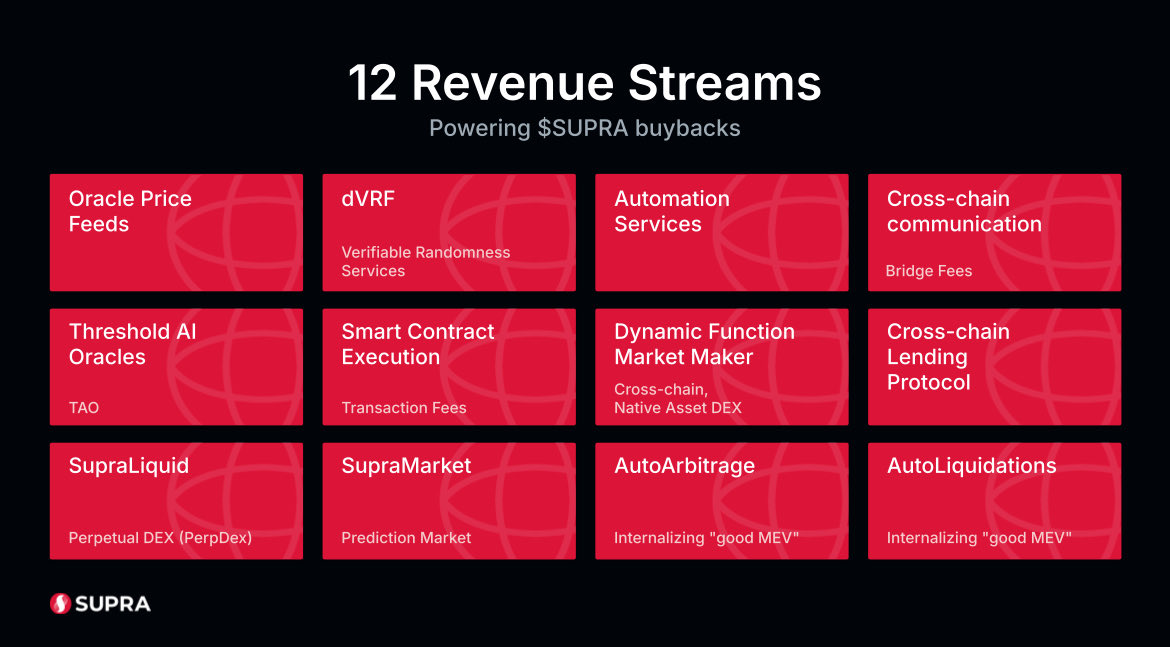
The crypto market is entering a completely different era. The days when projects could survive purely on hype, narratives, and influencer marketing are slowly coming to an end. Many cryptocurrencies won't survive the next few years,not because the technology isn't flashy enough, but because they never built a sustainable business model. For years, countless projects focused on price action instead of value creation. They solved few real problems, provided little utility, and generated almost no meaningful revenue. When market conditions were favorable, that weakness was hidden behind speculation. Now the market is demanding something different. We're entering the business phase of blockchain. A phase where networks must provide services, attract users, generate fees, and create sustainable revenue streams that can fund development, reward stakeholders, and drive long-term growth. Many blockchains never prepared for this reality. $SUPRA did. Even in a difficult market environment, $Supra is already generating roughly $1,000 daily in gas fees. While many larger and more established L1s struggle to produce meaningful on-chain revenue, $Supra is already demonstrating that value capture is possible from day one. What's even more impressive is that Supra's revenue story extends far beyond transaction fees. Through its Oracle infrastructure services alone, Supra generated nearly $500,000 in fees last year. Remember, we're talking about a L1 that is less than two years post TGE and is already proving its ability to capture value from real products and real usage. And this is only the beginning. Supra's ecosystem is designed around 15 potential revenue streams. The core network already includes: >> Oracle Price Feeds >>dVRF (Verifiable Randomness) >>Automation Services >>Cross-Chain Communication >>Threshold AI Oracles >>Smart Contract Execution Fees >>Dynamic Function Market Maker (DFMM) >>Cross-Chain Lending >>SupraLiquid PerpDEX >>SupraMarket Prediction Markets >>AutoArbitrage >>AutoLiquidations And that's before adding: >>SupraOS >>SupraFX >>Playbook Finance Many of these products are already live and generating activity. Others are scheduled to launch over the coming months, expanding the network's ability to capture value across multiple sectors of crypto. This is what long-term planning looks like. While others built token narratives, $Supra built infrastructure. While others chased trends, $Supra built revenue engines. The market is becoming increasingly ruthless, and only projects with real utility, real users, and real revenue will thrive. From where I stand, Supra looks prepared for exactly that future. Don't underestimate what happens when a blockchain is built not just to grow but to sustain itself🔥🔥 $SUPRA 🚀🔥 #Supra #SupraLabs #Crypto #Blockchain #DeFi #Web3
Kmoney (Supra Agent 🥷) tweet mediaKmoney (Supra Agent 🥷) tweet media
English
2
8
34
918
Alex Lim
Alex Lim@alexlimasia·
Grateful for the main stage at Bitcoin Seoul. 1/ Crypto is better money technology. Not just a new asset class, but a fundamentally different way of doing things with money that weren't possible before. 2/ Crypto's earliest PMF was access to volatile speculation. The elephant in the room has been this: token is the product, price action is marketing, CEX listing is distribution. That model worked and built the industry we're in today. 3/ That's now slowly shifting. The use case is moving from how money gets made to how money moves. Faster, cheaper, and more programmable than anything TradFi has offered. Institutions and enterprises are leading this, not retail. 4/ (biased) Asia is the most important region to watch. Despite its economic weight, it's the world's most fragmented market. 8+ major economies, each with different languages, currencies, regulations, and pain points. There is no one-size-fits-all playbook nor regulation, and anyone building as if there is will struggle. 5/ At the same time, Asia is the most digitally native continent. A few super apps dominate the way hundreds of millions of people consume news, communicate with friends, and shop groceries. Korea has the highest AI usage per capita in the world. These apps and infrastructures will serve as the perfect regional stablecoin settlement layer. 6/ Multi-chain is the default from Day 1, not a transition phase. Chains will consolidate and only a few strongest will survive. The future isn't one chain winning but users never thinking about which chain they're on. Asset issuers should focus on distribution and chains should focus on infrastructure. 7/ LayerZero sits at the center of this. 800+ Asset issuers can scale across 170+ chains via LayerZero. $9B processed in May alone and over $260B year to date. 8/ Stablecoins and RWAs will fundamentally change how my kids will invest, trade, save, and move money around the world. They will grow up in that world and I'm happy that I will have a few stories to share with them about building that world, although I'm not sure how much they will actually care. :) Accelerate Asian Stablecoins.
Alex Lim tweet mediaAlex Lim tweet media
English
6
7
29
3.9K
Arnaud Mercier - #Entrepreneur #Versailles

Good morning. Elon Musk is taking fortune.com/company/spacex/" target="_blank">SpaceX public his way. Rather than following the Wall Street convention of setting a price range ahead of the IPO marketing process, SpaceX priced its offering at a single fixed price of $135 per share, a move that signals confidence in demand but is raising eyebrows among market watchers.

“This would be very unconventional, but the market will see this as a sign of confidence on the SpaceX IPO, while others could see it as a head-scratcher,” Dan Ives, managing director and senior equity analyst at Wedbush Securities, told me. “But it’s Musk and anything is on the table.”

Morningstar Equity Analyst Nicolas Owens offered additional context on what makes the single-price approach out of the ordinary. “Usually, the company and the underwriters will set the IPO price as a range, and they also usually have a bucket of shares they can add to the sale if demand is strong enough,” he told me. On Musk going with a single price: “I think it’s unusual compared to the regular IPO playbook,” Owens said. “In this case, I think the announcement just indicates they know there is enough demand to raise $75 billion,” he added.

Yes, SpaceX is aiming to raise $75 billion through its IPO under the ticker symbol SPCX on fortune.com/company/nasdaq/" target="_blank">Nasdaq sec.gov/Archives/edgar…">by selling 555.6 million shares at $135 per share, bringing the total valuation to $1.75 trillion—well above Morningstar’s independent valuation of $780 billion, which is based on the company’s core launch and satellite communications businesses and the cost advantages they’ve built through R&D and economies of scale.

The offering is structured as an all-primary deal, meaning proceeds will go directly to SpaceX while existing shareholders are not expected to sell their holdings. Existing shareholders, including Musk, will be required to hold their SpaceX shares for 366 days after the IPO, which is a signal of commitment to the company’s current plans.

But the confidence may be partly explained by what’s already baked in. As Fortune’s Shawn Tully fortune.com/2026/05/28/spa…">recently reported, roughly 78% of the expected proceeds—about $62.8 billion—is already spoken for, pledged to insiders and vendors including Musk’s X Corp., xAI investors, and Valor Equity Partners. That leaves less than $18 billion in fresh capital for SpaceX’s AI buildout, which consumed over $20 billion in the past five quarters alone.

The stakes extend well beyond SpaceX. “This listing represents the first major test for public markets after years of muted IPO activity, with SpaceX paving the way for AI giants Anthropic and OpenAI to follow soon after,” Wedbush analysts wrote in a note on Wednesday. How the market receives Musk’s unconventional approach may set the tone for what comes next.

Sheryl Estrada
@fortune.com" target="_blank" rel="noreferrer noopener">sheryl.estrada@fortune.com

This story was originally featured on fortune.com/2026/06/04/why…" target="_blank">Fortune.com

fortune.com/2026/06/04/why…
English
2
2
4
107
Vass
Vass@Va77ss·
@Jason the problem is picking apples takes 5 years before u even know if theres a pie
English
2
0
1
65
@jason
@jason@Jason·
Everyone wants to eat the pie (do the late-stage rounds), but few want to pick the apples (do the pre-seed round).
English
55
12
297
30.9K
Strategic Profiler
Strategic Profiler@SProfiler1·
@srcasm Impressive data. How are seed round dynamics shifting across verticals?
English
0
0
0
10
Jesse Middleton
Jesse Middleton@srcasm·
New York is the best place on earth to build. Over the past 15 years of investing in and backing the New York tech ecosystem, I’ve watched this community evolve from an underdog into an absolute powerhouse. Silicon Valley will always be an incredible sandbox for core technology infrastructure. However, if your goal is to build a company that deeply integrates with, scales within, and transforms the global economy, NYC has become the ultimate launchpad. Here’s why: 1. Elite Talent Pool The historic playbook of elite engineering and business graduates automatically packing a bag for the West Coast has shifted. New York now commands one of the dense and diverse talent pipelines in the world. • According to recent ecosystem talent studies, New York captures 10.1% of the entire U.S. college graduating class. For context, the next closest market is Los Angeles at 4.9%. • The region is anchored by world-class institutions like Columbia, NYU, Cornell Tech, and Princeton, generating a massive annual surplus of technical degrees. • NYC offers an unmatched concentration of seasoned operators from the Fortune 500. Founders can access developers who deeply understand enterprise procurement, global compliance, and commercial scaling. 2. Vertical Dominance Building software for other software companies is a viable model, but building for massive, real-world legacy industries is where the greatest value is created. New York naturally dominates these sectors because the buyers, experts, and operators live here. • Fintech: According to data from Carta, NYC startups secured 48.5% of all fintech venture dollars raised in the United States, nearly doubling the Bay Area’s 25.9%. • Healthcare & BioTech: Driven by nine major academic medical centers and extensive public-private investments, NYC is the nation’s #1 market for healthtech funding. • PropTech & Retail/Commerce: As the undisputed global capital of both real estate and retail, NYC serves as the primary testing ground for commerce, luxury tech, and property management. • Media & AdTech: The city remains the epicenter of global media, giving local B2B SaaS and marketing tech platforms immediate, direct access to major enterprise enterprise accounts. 3. Capital Resilience and Ecosystem Value The myth that massive, sophisticated early-stage checks are exclusive to the West Coast has been thoroughly debunked by now. • According to the Startup Genome Global Startup Ecosystem Report, NYC’s ecosystem value has now surpassed $620 billion. • Even during broader macroeconomic market corrections, PitchBook and NVCA data shows that median seed and Series A round sizes in New York have remained remarkably resilient, occasionally outpacing the Bay Area in deal velocity stability. • Tech sector employment in NYC has grown by 160% over the last 15 years, outperforming the national tech sector growth rate by nearly 3x. 4. Structural Diversity Building a global product for a diverse world requires an environment that reflects that world. Groupthink is a silent killer of early-stage startups. NYC’s greatest superpower is its built-in cognitive diversity. • Tech ecosystem demographic data highlights that Black and Hispanic workers make up 24.3% of NYC’s tech workforce, compared to roughly 8.2% in the San Francisco Bay Area and 10.4% in Boston. • According to regional ecosystem tracking, 17% of all Black and Latino founders in the U.S. who have successfully raised $1M+ are based right here in New York. Next Wave NYC We built our pre-seed venture fund, wholly backed by Flybridge Capital, to be a reflection of this exact ecosystem. Our fund is run entirely by founders and operators who have spent the last decade helping scale the NYC startup scene. Our extended investment team includes leaders and alumni from OpenAI, Google, Snowflake, Foursquare, Bowery Farming, Casper, Chief, Flatiron School, Major League Hacking, Squire, WeWork, and The Wing. We are laser-focused on being the very first commitment and the loudest operational supporter for builders tackling: • Native AI applications • Agentic AI for the enterprise • Developer platforms for AI builders If you are building the future here in New York, we would love to learn more about what you're working on. Our inboxes are always open. Let's build. 🗽 — Jesse
Jesse Middleton tweet media
English
5
5
23
2.3K
OpenHive
OpenHive@aden_hq·
You can now replace your entire GTM budget with 12 AI agents running in parallel. Not just chats and prompts. Actual autonomous agents that coordinate, hand off work, and execute full workflows from  research to distribution - while you sleep. Agent 1: Positioning Researcher → Crawls competitor sites, scrapes reviews, analyzes ICP pain points from real forum threads. Outputs a structured positioning doc. Agent 2: Content Strategist → Takes the positioning doc, pulls search demand data, maps content gaps, builds a 30-day editorial calendar. Agent 3: Copywriter → Reads the calendar, drafts each piece - LinkedIn posts, blog intros, newsletters, landing page copy - in your brand voice. Agent 4: Repurposing Engine → Takes one long-form piece and multiplies it into 8-10 assets across LinkedIn, X, email, blog, and short-form video scripts. Agent 5: SEO & AEO Optimizer → Keyword mapping, metadata, heading structure, citation signals — all baked in before anything publishes. Agent 6: Distribution Planner → Maps every asset to the right channel, format, and posting window. Nothing dies in a Google Doc. Agent 7: Performance Analyst → Tracks what drives pipeline, flags dead campaigns, recommends where to double down. Agent 8: LinkedIn Outreach Agent → Researches prospects, writes personalized connection requests, sends follow-ups, logs to CRM. Runs your outbound while you focus on closing. Agent 9: Email Sequence Agent → Builds cold email cadences, personalizes at scale, handles reply detection and routing. Agent 10: Social Engagement Agent → Monitors target accounts, engages with prospect posts, builds visibility before you ever DM. Agent 11: CRM Sync Agent → Every interaction logged. Every response captured. Pipeline updated in real time. Agent 12: QA & Approval Gate → Flags anything risky — weird messaging, compliance issues, off-brand copy — routes to you for approval before it goes live. What happens when 12 agents run in a colony: → One prompt kicks off the entire chain → Each agent hands off structured output to the next → State persists — if something crashes at step 9, it resumes, not restarts → Human-in-the-loop gates catch what matters → Cost enforcement caps spend at every level → The whole system runs whether you're at your desk or not What you stop doing: ❌ Managing 5 SaaS tools that don't talk to each other ❌ Copy-pasting between ChatGPT, your CRM, and LinkedIn ❌ Babysitting automations that break silently ❌ Paying $12-20K/mo for a GTM team that needs managing What you get: ✅ A positioning doc grounded in real market data ✅ Content targeting actual search demand ✅ One piece multiplied across every channel automatically ✅ Outbound running on autopilot with guardrails ✅ Pipeline visibility without manual CRM updates ✅ A system that ships while you sleep Try this on OpenHive.
OpenHive tweet media
English
10
0
4
361
Alex Desjardins
Alex Desjardins@PrimeTrading_·
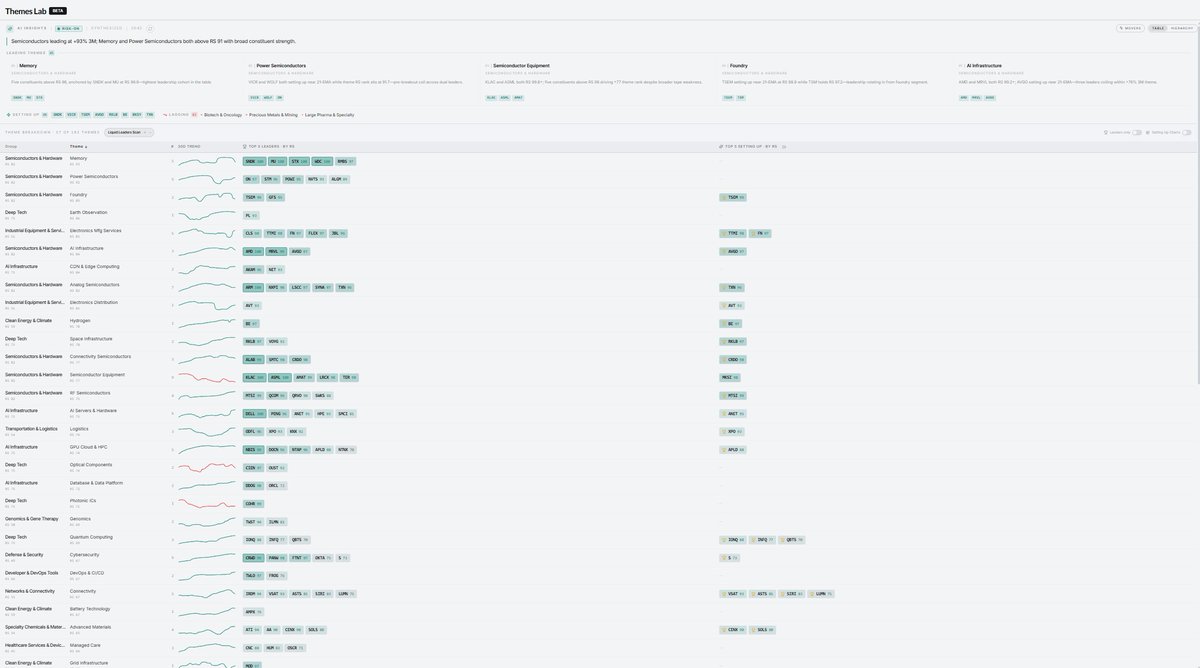
Themes Lab — 6/4 🧪 Top-down theme tracker mapping 180+ themes across the market. Surfaces where the real RS strength lives and which names are setting up inside the leaders. LEADING THEMES (RS) • Memory — RS 93 (#1) • Power Semiconductors — RS 92 (#2) • Semiconductor Equipment — RS 82 (#3) • Foundry — RS 89 (#4) • AI Infrastructure — RS 82 (#5) Semis sweeping the top 5 at +93% 3M, with Memory and Power Semis both north of RS 91 on broad constituent strength. TOP SETUPS @ 21dma-structure area • $TSEM 99 — Foundry • $MTSI 99 — RF Semiconductors • $CRDO 98 — Connectivity Semiconductors • $MKSI 98 — Semiconductor Equipment • $TTMI 98 — Electronics Mfg Services • $AVGO 97 — AI Infrastructure • $BE 97 — Hydrogen • $RKLB 97 — Space Infrastructure • $TXN 96 — Analog Semiconductors • $FN 97 — Electronics Mfg Services THEMES SETTING UP (full breadth) Watch the themes where the whole leadership board is coiling at the 21dma-structure area together — that's where the cleanest follow-through tends to come from: • Electronics Mfg Services — $TTMI, $FN all setting up (2 of 5 leaders) • Connectivity — $VSAT, $ASTS, $SIRI, $LUMN all setting up (4 of 5 leaders) • Quantum Computing — $IONQ, $INFQ, $QBTS all setting up (3 of 3 leaders) • Advanced Materials — $CENX, $SOLS all setting up (2 of 5 leaders) TAKEAWAY Tape is risk-on and Semis & Hardware owns the leadership board — Memory, Power Semis, Foundry, and AI Infrastructure all coiling with named leaders at structure. Strongest rotation to watch: Connectivity breadth (4 of 5 leaders setting up) as a non-semi pocket worth tracking for follow-through. By: @TradersLab_
Alex Desjardins tweet media
English
3
2
12
1.5K
World Data Analysis
World Data Analysis@World_Data_A·
🇪🇺 This is really amazing: The Brussels Effect How Europe exports its rules to the World !!! Europe may no longer be the world's export leader, but the world often has to produce according to Europe's rules. And this is not just about manufacturing goods. It also highlights the power of non-tariff barriers and the influence that comes from controlling access to one of the world's largest consumer markets. Companies frequently adapt their products, supply chains, and business practices to comply with EU regulations, extending Europe's regulatory reach far beyond its borders. The term "Brussels Effect" was coined by @anubradford and describes how the European Union shapes global business practices through regulation rather than military, technological, or manufacturing dominance. While China manufactures and the United States innovates, Europe increasingly writes the rules that global companies must follow. Why not 100%? Global alignment is rarely absolute. GDPR Arguably the strongest example of the Brussels Effect. Many multinational firms adopted GDPR-style privacy standards globally rather than maintaining separate systems for Europe and the rest of the world. However, countries such as China, Russia, and several developing economies still operate under different privacy frameworks. Therefore, alignment is extremely high, but not literally 100%. EU AI Act The first comprehensive AI regulation. Large AI developers seeking access to European markets are likely to incorporate many of its requirements. However, implementation remains uneven and the regulation is still relatively new. As a result, global convergence is significant but far from universal. CBAM Carbon-intensive exporters selling into Europe must increasingly measure and report emissions. Yet CBAM only applies to specific sectors such as steel, aluminum, cement, fertilizers, hydrogen, and electricity. Large parts of the global economy remain outside its scope. Therefore, its influence is substantial but not economy-wide. DMA The Digital Markets Act targets large digital gatekeepers such as app stores, search engines, and major online platforms. Because many global technology firms operate in Europe, several have already modified products and business practices worldwide rather than maintaining separate systems. However, the DMA primarily affects a relatively small group of large digital platforms, limiting its reach beyond the tech sector. Its influence is therefore meaningful, but narrower than GDPR. Battery Regulation The EU Battery Regulation introduces requirements for carbon footprints, recycling, traceability, and battery passports across battery supply chains. Given Europe's importance in the electric vehicle market, battery manufacturers worldwide increasingly adapt to these standards. However, the regulation mainly affects batteries and related supply chains rather than the broader economy. Its global impact is growing rapidly, but it remains concentrated in a specific industrial ecosystem. (Note: The star ratings are illustrative and reflect the relative global influence of each regulation rather than measured compliance rates. They are based on academic literature, policy research, market adaptation, and observed regulatory spillovers) Sources and further reading: @AnuBradford, The Brussels Effect: How the European Union Rules the World (Oxford University Press, 2020). Crossing the Regulatory Rubicon, Ni Zhan, Qi Lu & Haoyu Tian. @CEPA, Mapping the Brussels Effect by Ronan Murphy @TrendsRA The Brussels Effect Revisited by Karolína Godál
World Data Analysis tweet media
English
3
6
19
307
Jacob Counsell
Jacob Counsell@JacobCounsell·
And no bullshit… Last night it was a 26, I added a blog link from LaunchChair as a Product Update on @Buildhop_io and this morning it’s a 27. That’s literally all I did and we gained a point…
LaunchChair@LaunchChair

Woot! LaunchChair.io is now a 27 DR! Should come in handy when we start writing blogs about the people using LaunchChair to build products!

English
5
0
3
149
Hunter Allen
Hunter Allen@HunterAllen4·
$KVYO Klaviyo Inc. is one of the more interesting SaaS names in the market right now — a vertically focused e-commerce CRM platform that just crossed into consistent profitability while continuing to scale revenue at ~20%+ growth. A 150$ stock at 15$. Repost. Bookmark. Subscribe 1$. Keep eyes on this one. This one I like. WHAT KLAVIYO ACTUALLY IS At its core, Klaviyo is not just email software — it’s a full-stack B2C CRM built specifically for e-commerce brands. It unifies: • Email marketing • SMS + push notifications • Customer data platform (CDP) • AI-driven automation + segmentation The key differentiation is that it is commerce-native, meaning it directly plugs into purchase behavior, product interaction, and customer lifecycle data in real time. This is what allows it to move beyond campaigns → into automated revenue generation systems. The big shift: • Q1 2026: GAAP net income turned positive (~$9M) • Operating income also flipped positive • Gross margins remain strong (~75%+) • Revenue still growing ~25–30% range high-growth SaaS → transitioning into scalable profitability without collapsing growth. FY2025 revenue crossed ~$1.2B and continues compounding, while efficiency gains are starting to show through operating leverage. THE CORE MOAT (WHY IT EXISTS AT ALL) Klaviyo’s advantage is not “features” — it’s data depth inside e-commerce ecosystems. It has native, real-time integration with: • Shopify (largest driver — deep ecosystem dependency) • WooCommerce / Magento / BigCommerce • Hundreds of commerce tools and APIs This enables: • Behavioral segmentation (cart, browse, purchase history) • Predictive analytics (CLV, churn, next purchase timing) • Automated flows that adjust in real time Most competitors can send messages. Klaviyo builds revenue loops tied to customer behavior. ECOSYSTEMS BELOW.👇 $SHOP Shopify (core distribution engine) • Shopify owns ~11% of Klaviyo • ~70–80% of revenue tied to Shopify ecosystem • Default CRM choice for Shopify Plus merchants This is effectively embedded distribution — not just a partnership. $GOOG Google (AI + discovery layer) Integration focuses on: • Search → purchase intent activation • Google Ads + CRM feedback loop • RCS + messaging expansion • AI-driven customer journeys This connects acquisition → retention inside one system. Anthropic (AI workflow layer) HUGE LAYER. • Claude integrated directly into Klaviyo via MCP • Enables AI-generated segmentation, campaigns, audits • Moves platform toward “agentic marketing” workflows WHY THE MODEL WORKS Klaviyo wins because it sits in the highest ROI part of marketing: owned-channel revenue (email + SMS) Not paid ads. Not branding. Not awareness. That gives it: • High gross margins (~75%) • Strong retention (110%+ net retention) • Expanding ARPU per customer over time • High switching costs once embedded into workflows Relative to peers: • Braze → stronger enterprise/mobile omnichannel • Iterable → flexible but more complex • Attentive → SMS-heavy but narrower scope • HubSpot → broader but less e-com specialized Klaviyo sits in a very specific wedge: 👉 best-in-class for Shopify + DTC + mid-market e-commerce scaling That focus is the moat. $KVYO is moving through a classic SaaS transition: • Growth is decelerating but still strong (~20–30%) • Margins are expanding meaningfully • Platform is expanding from “tool” → “system of record for commerce marketing” • AI is becoming embedded into workflows rather than bolted on It’s a platform consolidation + operating leverage + AI augmentation story sitting on top of one of the stickiest e-commerce ecosystems in SaaS. $HUBS $NOW $CRM $FATN $TSSI $IBM $HPE $DELL $MSFT $META $SE $U $ADBE $DOCU $DOCS $AMZN $DDOG $ASAN $SMCI $TSSI If execution holds, the next phase is not growth acceleration — it’s sustained margin expansion with stable mid-20s growth.
Hunter Allen tweet mediaHunter Allen tweet mediaHunter Allen tweet mediaHunter Allen tweet media
English
9
4
13
2.6K
Ksenia Moskalenko
Ksenia Moskalenko@kseniam0s·
Must-follow accounts on X if you're a founder or fund manager. By topic: 1. Fundraising intel: @paulg philosophy, founder advice, essays @pmarca a16z, tech, AI, VC macro insights @Jason angel investor, This Week in AI host @msuster founder-VC debates, advice @HarryStebbings tech news, 20vc, podcasts 2. Building in public: @levelsio ships fast, shares every number @marc_louvion_ products, revenue, no fluff @thepatwalls starter story, motivation @retentionadam bootstrapped SaaS scaler @jrfarr shipping & distribution expert 3. Active Investors & community voices: @rrhoover product & startups @mwseibel accelerator & founder insights @saranormous enterprise/consumer tech @geoffreywoo antifund insights @dunkhippo33 pre-seed & founder tactics 4. Bonus follow: @ThePageform AI-native data rooms for founders and fund managers who are done sending Drive links and paying $200/mo for Docsend file cabinets
English
6
6
46
3.1K
Fivos Aresti
Fivos Aresti@fivosaresti·
Third-party intent signals fire before a prospect ever touches your site. The 12 worth tracking in 2026: - LinkedIn post engagement on your team and competitor posts - LinkedIn ad engagement on your campaigns and competitors' - LinkedIn job changes inside target accounts - Job openings in roles that map to your product - Funding announcements and round closures - Technographic changes when accounts add or remove tools in your category - Brand mentions across web and social - G2 and Capterra competitors’ reviews - Hiring growth or contraction at the company level - M&A activity inside target accounts - Earnings reports and financial signals - Layoff signals at competitor or partner accounts Noisier than first-party signals, but they cover a much broader set of accounts.
English
2
8
16
1.3K
King SamGrowth
King SamGrowth@kingsamgrowth·
Neobank founders, you don't need a social media manager. You need social media strategist. Having scaled 3 different neobanks' social presence and user acquisition, I've realized something: User growth always matters more than vanity social metrics. Likes don't bring revenue. Active users do. And to get active users, you need the right content strategy tailored for your brand. Here's what that actually looks like: -> Content that educates your audience on why your product exists, and turns users into advocates -> Messaging that converts skeptics into first-time users -> Positioning that makes your neobank feel like the obvious choice Talking about consistent, compounding growth. This is what one of my clients said recently (unscripted): "Great job on our marketing, posts, and designs. You've been doing it so consistently that I haven't really had to check in." A founder trusting you enough to not check in? That's the goal. I build systems so good that the founder can focus on building the product; not babysitting the content. And here's what makes me different: I don't just create content. I engineer the metrics behind it. Imagine 199K impressions, 403 new followers, and 10,700% (104) repost growth. All attained organically in one quarter; and of which actually brought a significant number of active users. What's even more interesting? We achieved similar results on LinkedIn too (will make a separate post about it). And that's arguably more impressive because LinkedIn is a professional platform where attention is harder to earn. Well, that's what "turning social attention into active users" actually looks like in practice. If you're a neobank founder who wants social media that drives user growth; not just impressions. DM me "GROWTH" and let's talk.
King SamGrowth tweet media
English
3
1
4
112
The Fundamentalist
The Fundamentalist@Funmentalist·
$NBIS Token Factory explained in 15 minutes So I decided to write a little explanation of what the main differentiator of $NBIS is, and that is the "Token Factory" they introduced November last year I will try to simplify this so that every investor can understand it. If you are interested in more technical details, ask me in the comments, and I might be able to explain it. So If someone asked me how I would explain it in one sentence, I would say that Token Factory is an AI platform designed to simplify the deployment, management, and scaling of large language models (LLMs) and other generative AI systems. It is a production-grade inference platform that allows organizations (and it is especially helpful for smaller businesses) to use AI models without the complexity of managing the underlying infrastructure. Token factory is built around inference - the process where you generate outputs from already trained models (for example, asking questions and getting answers from models like ChatGPT). Whenever you ask ChatGPT a question, request code generation, or any other task you have ever done, the model produces a sequence of tokens that are, at the end, transformed into text/document that you can read. In the earliest stages of AI, we just had models like ChatGPT 3, Claude 3, etc. You paid your subscription of $20, and you were able to prompt infinitely, but lately the scale of these prompts increased heavily, and enterprise adoption of these models led to OpenAI, Anthropic, and others to shift from simple subscription pricing to price/token, meaning that each prompt and each task is priced differently. The cost of the token is increasing rapidly with supply not being able to meet demand. This is why $NBIS came with Token Factory, which is basically an optimizer for generating these tokens as efficiently, reliably, and cost-effectively as possible. The name kind of explains itself there. Traditionally, companies that wanted to deploy large AI models had to acquire and manage expensive GPU hardware, configure inference servers, monitor performance, handle traffic spikes, and continuously try to optimize their deployments. This process required companies to have experts in mainly these two fields: 1) Cloud infrastructure 2) Machine learning operations (MLOps) It is quite difficult to obtain a skillful team in these areas, so Nebius decided to go and remove majority of this complexity by providing a managed service that handles not only infrastructure, but also scaling, monitoring, and deployment via Token Factory. Developers can now simply connect to the platform through an API and immediately begin using advanced AI models. So the key strength is the exposure for smaller enterprises to open-source foundation models without acquiring a whole team of experts. Organizations can access and deploy models from families such as Llama, Qwen, DeepSeek, and from the latest announcement also NVIDIA Nemotron. The platform has interfaces that are compatible with widely used AI APIs, making migration and intergration relatively straightforward for development teams. What I did not understand initially, was that Token Factory goes beyond basic inference, it supports the whole lifecycle of AI applications. Users can tune their models on proprietary data to create domain-specific assistants for many industries like finance, healthcare, law and many others. This opens new possibilities like "parameter-efficient fine-tuning", "post-training optimization" that enable companies to customize models without the cost of training it from scratch. There are other fancy applications like Retrieval-Augmented Generation (RAG), where you combine LLMs with external knowledge sources like documents. But I don’t want to bore you to death as I understand majority of investors reading this are not machine learnings experts, so let’s skip this technical part. However, one last major advantage that you should be able to understand about Token Factory is the ability to scale "automatically". When you create an application and demand starts increasing, you usually start running into high latency and capacity problems. Instead of you having to allocate new compute to your application, which takes time and it might cause some downtime for your servers which are costly, Token Factory platform dynamically allocates additional computing resources to maintain both low latency and high throughout. The important thing is that this works the opposite way as well. When demand decreases, resources are released, helping companies optimize costs. This elastic scaling allows Token Factory to attract both small pilot projects to large-scale production deployments serving thousands of users and more. Now that I finished this paragraph, I realize that I completely forgot about one more thing and that is what we call in business "Enterprise governance and security". Token Factory includes features such as role-based access control, team management, authentication integration, usage monitoring, centralized billing and many other things that help companies maintaining control over AI deployments while meeting operational and compliance requirements. To somehow summarize everything, think of Token Factory as the "AWS of AI" or more precisely "AWS of AI inference". Companies bring their applications, Nebius provides the infrastructure and models, and charges for the AI output generated. The more AI is used, the more valuable Token Factory becomes. It is really that simple. I spent more time than I initially wanted on researching Token Factory and its use cases, but it really helped me to understand that this is something that gives $NBIS an unfair advantage against others in the sector. You should really understand this part of their business if you are an investor, so I will gladly answer your questions. If you found this a valuable read, follow me for more. Thanks! (picture is from ChatGTP)
The Fundamentalist tweet media
English
3
3
37
5.6K
People's Daily, China
Copper, long viewed as a cornerstone of conventional manufacturing, is playing a more prominent part in China's shift to an innovation-led economy, as booming demand and industrial upgrading are being pushed by rising sectors such as AI and electric cars. Under a plan to boost the high-quality development of the copper sector, China aims to strengthen the resilience and security of its copper supply chain, achieve breakthroughs in key technologies and high-end materials, enhance advanced equipment manufacturing capabilities and foster a new generation of competitive copper enterprises by 2027. Industry forecasts suggest that China's copper demand from the NEV sector alone will reach 1.84 million tonnes in 2026 and surpass 2 million tonnes in 2027. Globally, copper consumed by data centers may rise from 740,000 tonnes this year to 1.3 million tonnes by 2028. Official data showed that China's refined copper output reached 3.785 million tonnes in the first quarter of 2026, up 9.3% YoY, while copper material output rose 4% to 5.633 million tonnes.
People's Daily, China tweet media
English
2
6
13
2.1K
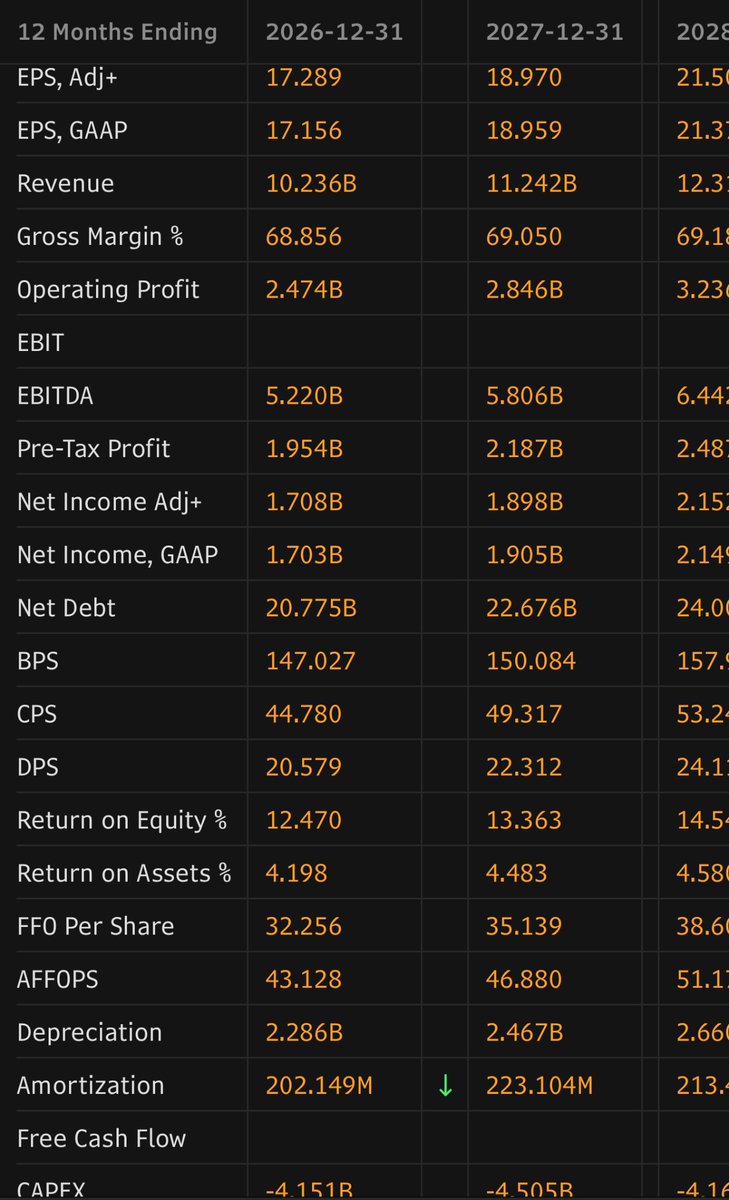
TheValueist
TheValueist@TheValueist·
$EQIX EXECUTIVE ASSESSMENT The REITweek transcript is incrementally supportive of the Equinix long-term quality-compounder thesis, but the equity setup is no longer clean after a material rerating. The core message from management is that Equinix is not positioning itself as a generic wholesale data-center landlord; it is positioning itself as the neutral, global, low-latency exchange layer for AI, cloud, neocloud, enterprise, and network participants. That distinction matters because AI infrastructure value is likely to bifurcate between commoditized large-scale training capacity and scarce, metro-proximate, ecosystem-dense inference and data-exchange capacity. Equinix’s differentiated asset is the latter. The transcript emphasizes that AI demand strengthens the value of a “marketplace” architecture where clouds, neoclouds, AI labs, enterprises, carriers, and data platforms need to connect, exchange data, manage latency, and avoid dependence on a single vertically integrated provider. In investment terms, this frames Equinix as a beneficiary of AI-driven traffic complexity rather than merely AI-driven megawatt demand. The strongest parts of the presentation were management’s confidence on power availability, the reiterated 10% recurring-revenue growth and 10% AFFO/share-growth framework, the 51% EBITDA-margin target, evidence of broad customer and ecosystem participation, and the argument that legacy network-dense facilities are becoming more valuable rather than obsolete. The weaker part of the investment case is valuation: at a current price of $1,089.15 and market capitalization of approximately $107.5B, the stock is already priced as a scarce AI-infrastructure compounder, implying approximately 25.5x 2026E AFFO/share at the midpoint of company guidance and roughly 24x 2026E adjusted EBITDA on a simplified EV basis, depending on lease treatment. This is defensible for a premium global infrastructure platform, but it leaves limited tolerance for power delays, capex inflation, weaker interconnection growth, higher interest costs, or any evidence that AI demand is concentrating in lower-return wholesale capacity instead of Equinix’s higher-return interconnection-rich retail fabric. STRATEGIC SIGNAL FROM REITWEEK The most important strategic point is that management is attempting to shift the debate from “data-center supply” to “AI-era network topology.” The CFO framed Equinix’s 30-year evolution as 3 successive infrastructure eras: internet, cloud, and now AI. The claim is that the AI era creates a greater need for a neutral, global marketplace where heterogeneous participants exchange data and where proximity to enterprises and latency-sensitive endpoints matters. This is a different thesis from the pure hyperscale buildout narrative. A large wholesale campus can satisfy centralized training demand, but it is less naturally suited to complex, low-latency, many-party interconnection among enterprises, cloud providers, AI model providers, neoclouds, security vendors, data providers, and carriers. The transcript’s central argument is that AI increases the need for “1-to-many” and “many-to-many” data exchange, not just low-cost megawatts. That is the portion of the stack where Equinix’s historical network density, neutrality, global metro footprint, and interconnection products should retain pricing power. The reported ecosystem statistics were directionally strong. Management stated that 4 of the top 5 neoclouds are on the Equinix network, that those neoclouds have deployed more than 110 nodes, that 8 top AI labs are present, and that all cloud providers are on the network. The Q1 2026 earnings release separately stated that 8 of the top 10 AI model providers and 4 of the top 5 neoclouds were actively expanding with Equinix. These claims are important because the marginal value of an interconnection platform is nonlinear: each incremental high-value participant raises the value of the network for every other participant. The platform therefore becomes harder to replicate as more AI, cloud, network, and enterprise participants co-locate. This creates a self-reinforcing flywheel that is more defensible than physical real estate alone. The transcript also states that Equinix has over 10,500 customers, completed 3,800 transactions in Q1, and served over 3,100 unique customers in the quarter, which reinforces the distinction between Equinix and single-tenant wholesale models where a facility can be materially exposed to 1 hyperscale counterparty or 1 workload generation. The AI thesis is most compelling around inference, distributed AI, and edge compute rather than around centralized training. JLL’s 2026 global data-center outlook expects AI to represent approximately 50% of data-center workloads by 2030 and anticipates that inference workloads could overtake training as the dominant AI requirement around 2027. JLL also notes that inference demand requires geographic distribution to reduce latency and serve users effectively. This external industry view directly supports Equinix’s REITweek framing: if inference shifts compute closer to users, enterprises, data sources, and application endpoints, then metro-proximate interconnection hubs should capture more strategic value than remote, power-rich campuses alone. Equinix’s management explicitly connected the rise of higher-density racks in its network to “compute at the edge,” arguing that some workloads require fast action close to the object or enterprise and that computing elsewhere can be too expensive because of traffic costs. The investment implication is that Equinix is a higher-quality AI derivative if AI monetization shifts from training clusters into production inference, distributed enterprise AI stacks, and data-sovereign architectures. FINANCIAL CONFIRMATION The transcript’s qualitative claims are broadly supported by Q1 2026 financial results. Equinix reported Q1 2026 revenue of $2.444B, up 10% as reported and 7% on a constant-currency basis. Recurring revenue was $2.331B, or 95% of total revenue, and increased 12% as reported and 8% on a constant-currency basis. The business mix remains attractive for a REIT because recurring revenue durability, high customer retention, and interconnection stickiness help reduce cyclicality and lower the probability that growth capex becomes stranded. The 10-Q states that recurring revenues have represented more than 90% of total revenues over the past 3 years and that more than 90% of monthly recurring-revenue bookings over the same period came from existing customers. The largest customer represented only approximately 2% of Q1 recurring revenue, while the top 50 customers represented approximately 36%, indicating a relatively diversified revenue base compared with hyperscale-oriented peers. Profitability also supports the case that Equinix has not sacrificed operating discipline for AI-era growth. Q1 adjusted EBITDA was $1.245B, up 17% as reported and 13% on a constant-currency basis, with a 51% adjusted EBITDA margin. AFFO attributable to common stockholders was $1.065B versus $947M in Q1 2025, an increase of approximately 12.5%. Company guidance for 2026 calls for revenue of $10.144B to $10.244B, representing 10% to 11% growth; adjusted EBITDA of $5.165B to $5.245B, implying a 51% margin and approximately 2 percentage points of margin expansion; AFFO of $4.198B to $4.278B, up 12% to 14% as reported and 10% to 12% on a normalized and constant-currency basis; and AFFO/share of $42.31 to $43.11, up 10% to 12% as reported and 9% to 11% on a normalized and constant-currency basis. The financial profile is unusually attractive for a capital-intensive infrastructure company: high recurring revenue, high margin, visible AFFO growth, and a management framework that explicitly prioritizes AFFO/share rather than only gross capacity expansion. The product-line disclosure is important for underwriting quality of growth. Q1 recurring revenue consisted of $1.730B of colocation, $446M of interconnection, $115M of managed infrastructure, and $40M of other recurring revenue. Interconnection was therefore approximately 18% of total company revenue and approximately 19% of recurring revenue. This is strategically material because interconnection revenue is typically the clearest expression of network value, customer embeddedness, and ecosystem density. A key diligence point is whether AI-related deployments are increasing interconnection intensity per customer and per cabinet, or whether incremental AI demand is disproportionately flowing into lower-yield, larger-footprint capacity. Management’s claim that Equinix is “not in the compute business” but in the “connection business” is directionally positive because it avoids direct competition with hyperscalers and GPU clouds; however, the growth algorithm ultimately requires AI to translate into measurable interconnection attach, density monetization, and incremental yield rather than only higher power requirements and higher capex. POWER AND CAPACITY Power access is the highest-importance diligence variable because it is now the primary gating factor for data-center growth. Management’s claim was unusually strong: Equinix has not experienced development delays, has in some cases accelerated data-center launches, and has access for the next 5 years to more land, power, water, and power-management equipment than needed. Management attributes this to a materially different use case: approximately 60MW metro data centers, 30-year utility and contractor relationships, local community engagement, and a disciplined acquisition screen requiring land, power, water, and community alignment before committing to property. Management also stated that Equinix controls 3GW of land and is not speculatively acquiring land before resolving the power situation. If accurate, this is a major source of relative advantage versus developers that have land but not interconnection certainty, power delivery certainty, community acceptance, or customer ecosystem density. External industry data reinforces why this matters. The IEA estimates that global data-center electricity consumption was approximately 415 TWh in 2024, or about 1.5% of global electricity consumption, and projects it to reach approximately 945 TWh by 2030, or just under 3% of global electricity consumption, with data-center electricity consumption growing at roughly 15% annually from 2024 to 2030. JLL expects global data-center capacity to increase by 97GW between 2025 and 2030, effectively doubling to around 200GW, and estimates the sector may require up to $3T of total investment by 2030, including real estate and tenant fit-out. JLL also states that average wait time for grid connection in primary markets exceeds 4 years and that operators are increasingly exploring behind-the-meter generation and battery storage. This context makes Equinix’s “no delay” assertion economically significant: power certainty is becoming a scarce asset, and scarce assets tend to earn premium returns when demand is durable. The claim should still be treated as a thesis to verify, not as a settled conclusion. Equinix’s own 10-Q acknowledges that higher power and cooling requirements, expected to accelerate with AI adoption, have caused the company to build new IBX data centers to support power and cooling needs 2x previous IBX designs, and that existing IBX data centers could face power limitations even when physical cabinet capacity remains available. This is the right risk language: Equinix may have enough aggregate land and power, but localized metro constraints, utility interconnection timing, equipment lead times, community opposition, and water availability can still impair growth in the highest-demand nodes. The transcript’s community-engagement narrative is encouraging, especially because regulators and local governments are becoming more sensitive to data-center electricity and water usage. Reuters reported on 2026-06-03 that the EU plans minimum energy-efficiency standards and sustainability labeling for data centers, while EU data-center capacity is expected to rise from 12GW in 2025 to 28GW by 2030. The risk is not simply whether Equinix can procure electricity; it is whether the company can do so at acceptable cost, within regulatory constraints, and without reputational or community friction that delays projects. TECHNICAL OBSOLESCENCE AND DENSITY Management’s answer on obsolescence was one of the more important parts of the transcript. The investor concern is intuitive: if AI workloads require 100kW racks and Equinix’s average rack density is around 5kW, older facilities could theoretically be stranded or become less relevant. Management’s rebuttal is that the platform serves multiple workload types simultaneously, with lower-density cabinets needed for communication, networking, and ecosystem connectivity while higher-density liquid-cooled racks support compute at the edge. The San Jose example was used to illustrate that 4 generations of data centers can coexist on a single campus, from 4kW to 5kW cabinets to 100kW racks, and that older facilities can remain valuable precisely because they are the most network-dense. This is a credible argument. In interconnection ecosystems, physical age is not the same as economic obsolescence; network density, carrier presence, and customer adjacency can be more valuable than the newest shell. The density transition also appears gradual enough to be manageable, though not risk-free. Management stated that Equinix has 100kW-plus racks already deployed and that Q1 density increased 36%, but the SVP of Finance clarified that the installed base remains at single-digit kW per cabinet and that the climb toward higher density is likely to be slow. Equinix also stated that 100 of its 280-plus existing data centers are fit for liquid cooling. The implication is that Equinix does not need to convert the entire portfolio into AI training infrastructure; it needs enough liquid-cooled, high-density capacity inside or near network-dense metros to support edge AI and inference adjacency while preserving the low-density and mid-density connectivity fabric that makes those locations valuable. This is a favorable mix if demand evolves gradually. The bear case is a faster-than-expected shift toward very high-density deployments that causes older power-limited facilities to underutilize physical space and forces incremental capex into cooling, electrical upgrades, and redevelopment with uncertain returns. COMPETITIVE POSITIONING The competitive discussion was balanced but management’s framing is strategically coherent. Carriers, cloud providers, and other data-center operators can offer 1-to-1 or localized connectivity services, and some of these offerings can compete with parts of Equinix’s interconnection revenue. The transcript specifically addressed concern around telecom carriers offering multi-cloud connectivity. Management’s response was that simple U.S.-centric or 1-to-1 use cases are not equivalent to global, neutral, latency-sensitive, 1-to-many interconnection across clouds, neoclouds, AI labs, enterprises, and networks. That distinction is important. Equinix’s strongest moat is not a cross-connect in isolation; it is the density and breadth of participants already present in its metros. The relevant competitive question is therefore whether new entrants can replicate the full ecosystem, not whether they can replicate an individual connection product. The principal competitive risk is not that Equinix’s entire interconnection franchise is displaced; it is that portions of connectivity become commoditized at the edge of the network while hyperscalers internalize more high-value traffic within their own fabrics. If AI stacks consolidate around a few vertically integrated cloud platforms, the value of neutral interconnection could grow more slowly than management expects. Conversely, if AI ecosystems fragment across model providers, GPU clouds, cloud platforms, enterprise data estates, security vendors, and sovereign infrastructure providers, Equinix’s neutral fabric becomes more valuable. Current evidence leans toward fragmentation: hyperscalers, neoclouds, AI model providers, and enterprises are all building overlapping but distinct architectures. The transcript’s emphasis on a rich marketplace, combined with official Q1 commentary that approximately 60% of Equinix’s largest deals were AI-related, supports the view that customer demand is broadening rather than collapsing into a single architecture. xScale should be viewed as a strategic complement, not as a pure pivot toward hyperscale wholesale. Management described xScale as neither retail nor full wholesale: these are not gigawatt-scale remote campuses, but 100s-of-MW facilities close enough to metros, roughly within 30 miles, to manage latency and reinforce the broader Equinix ecosystem. The stated benefits are site access, power-purchasing leverage, and deeper intimacy with large customers. This makes strategic sense because hyperscalers and large AI customers can anchor demand and deepen relationships, while the retail IBX business captures higher-margin interconnection and colocation activity. However, xScale also carries lower-return and higher-concentration risk than the core retail interconnection model. The JV structure mitigates balance-sheet intensity, but it also introduces governance complexity, partner reliance, and potentially lower direct economic capture. Equinix’s 10-Q shows $678M of xScale JV equity-method investments as of Q1 2026, up from $536M at year-end 2025, demonstrating the growing importance of this capital-light but strategically significant channel. CAPITAL ALLOCATION AND BALANCE SHEET The capital-allocation message was clear: investment grade is “table stakes,” current leverage is 3.8x, leverage capacity exists, but maintaining investment-grade status is a hard constraint. The CFO defined 4 priorities: investment grade, top-line growth, EBITDA expansion, and AFFO/share growth. This is the right framework for the current cycle. The data-center industry is in a capex supercycle, but not all growth is value-accretive. The discipline to protect AFFO/share is especially important because the market is rewarding Equinix for both scarcity and financial compounding. A strategy that maximized megawatts at the expense of per-share economics would damage the equity narrative. Management’s statement that M&A is opportunistic rather than necessary is also important, particularly after the atNorth transaction, because it signals that the base plan does not depend on paying up for scarce powered assets in a crowded market. The balance sheet is strong but increasingly capital-intensive. As of Q1 2026, Equinix had $1.362B of cash, $1.692B of short-term investments, $19.591B of senior notes, $2.299B of finance lease liabilities, and $29M of mortgage and loans payable. The company issued $1.5B of senior notes in March 2026, consisting of $700M due 2031 at 4.4% and $800M due 2033 at 4.7%. Q1 interest expense rose to $148M from $122M, while interest charges incurred increased to $180M from $133M, reflecting the higher-rate environment and growing capital base. These numbers are manageable relative to Q1 adjusted EBITDA of $1.245B, but the direction of travel matters. Total 2026 capex guidance is approximately $4.1B, while 2026 AFFO guidance is $4.198B to $4.278B. On a gross basis, growth capex is consuming almost all AFFO, even though recurring maintenance capex is much lower at $280M to $300M. Therefore, continued AFFO/share growth depends on maintaining access to debt markets, JV capital, asset recycling, and disciplined development returns. The dividend appears well covered on an AFFO basis. The quarterly dividend is $5.16/share, implying an annualized dividend of $20.64/share. Against 2026 AFFO/share guidance of $42.31 to $43.11, the payout ratio is approximately 48% at the midpoint. That provides flexibility for investment and balance-sheet management. However, the REIT structure also imposes distribution requirements and reduces the ability to fully self-fund the growth plan through retained cash flow. This makes cost of capital a central variable. If the stock remains at a premium multiple and credit markets remain receptive, Equinix can fund growth without excessive dilution or leverage. If AFFO growth slows or rates remain elevated, the same capex plan becomes more demanding. The equity is therefore duration-sensitive and capital-market-sensitive, even though the underlying revenue base is relatively resilient. VALUATION AND MARKET SETUP The valuation is premium but not disconnected from the asset quality. The Bloomberg header in the REITweek transcript showed a market cap of approximately $109.0B, price of $1,105.54, and YTD gain of 44.296% as of 2026-06-03. Current market data shows a price of $1,089.15 and market cap of approximately $107.5B. Using the midpoint of 2026 AFFO/share guidance at $42.71, the stock trades at approximately 25.5x AFFO and a 3.9% AFFO yield. Using a simplified EV calculation that includes senior notes, mortgage and loans payable, finance leases, cash, and short-term investments, the company trades around 24x 2026E adjusted EBITDA at the midpoint of guidance. These are full multiples for a REIT, but Equinix is not a conventional REIT. The company combines REIT tax status with global digital infrastructure, high recurring revenue, network effects, AI-driven demand, low customer concentration, and a credible path to double-digit AFFO/share growth. The equity debate should therefore be framed around duration and sustainability rather than near-term earnings alone. If Equinix can sustain high-single-digit to low-double-digit recurring-revenue growth, maintain approximately 51% adjusted EBITDA margins, and compound AFFO/share at approximately 10% for multiple years, a 25x AFFO multiple can be justified, especially in a market where scarce AI infrastructure platforms are being capitalized aggressively. If growth normalizes to mid-single digits after the current AI demand wave, or if capex intensity rises faster than incremental returns, the multiple becomes vulnerable. At the current setup, upside likely requires evidence that AI is lifting interconnection intensity, not just colocation demand. The strongest upside indicators would be accelerating interconnection revenue growth, higher cross-connect and virtual-connect attach, sustained annualized gross bookings growth, stronger presales, stable or expanding returns on new IBX capacity, and confirmation that density upgrades are monetized without material margin compression. The main downside indicators would be elevated churn, weaker utilization, capex overruns, utility delays, higher power costs not fully passed through, or a shift in AI demand toward lower-yield large-campus deployments.
TheValueist tweet mediaTheValueist tweet mediaTheValueist tweet mediaTheValueist tweet media
English
7
0
4
2.2K