SteveDisc

1.7K posts

SteveDisc

SteveDisc

@Steve12code

Interests: Economics of Conflict, Econometrics, OSINT

Texas, USA انضم Mayıs 2015
752 يتبع628 المتابعون
SteveDisc
SteveDisc@Steve12code·
@2pasc @DCinvestor Could be true, but if so says volumes about Trumps ability to chooose qualified personnel.
English
1
0
0
52
DCinvestor
DCinvestor@DCinvestor·
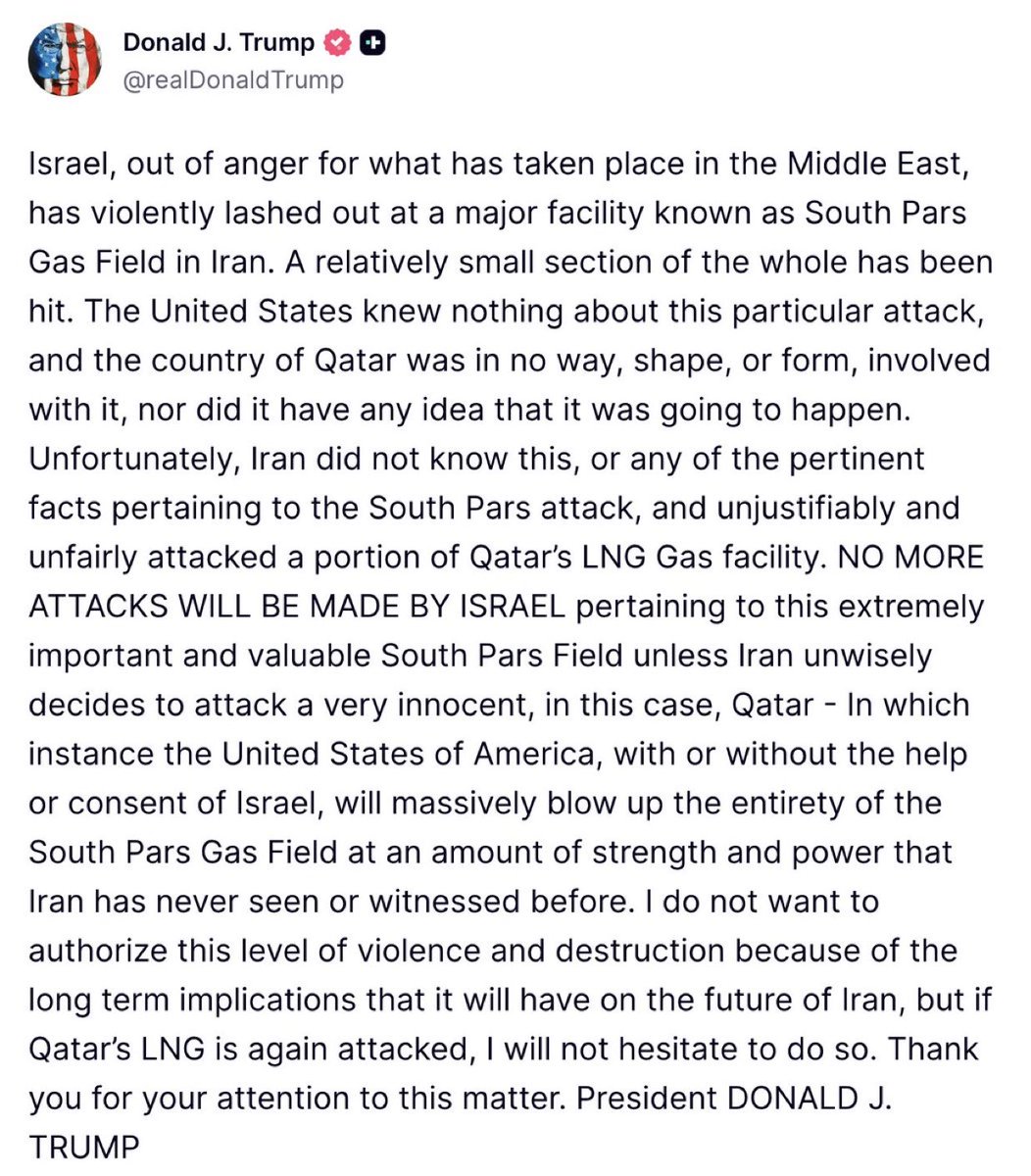
i am no Tucker Carlson super fan, but this is one of the most important interviews in American history all citizens who care about the future of the republic should watch it he will be demonized ad nauseam by the powers that be, but Joe Kent is thoughtful, and he is a patriot who has given everything to his country
Tucker Carlson@TuckerCarlson

Joe Kent on why we actually went to war with Iran.
English
62
125
1.5K
141.2K
SteveDisc
SteveDisc@Steve12code·
@DCinvestor Does he even read his own bleats? He admits the attack on Qatar occurred due to Isreals attack on Irans infrastructure...then threatens Iran. Shouldn't the threat be directed at Iran itself?
English
0
0
2
401
DCinvestor
DCinvestor@DCinvestor·
this is such chicken shit, accountability-passing BS, and everyone knows it but if we were in fact fighting a war alongside a party initiating rogue attacks without our authorization, very likely using weaponry we provided them then we should cease any and all support to them immediately but we all know that won’t happen
DCinvestor tweet media
English
32
35
420
20.4K
SteveDisc
SteveDisc@Steve12code·
@GrimmVeronika What would you have Europe do? Send small warships so Trump can use them as cannon fodder to shield US warships from harm?
English
0
0
0
2
Veronika Grimm
Veronika Grimm@GrimmVeronika·
I fear that Europeans don‘t get what is at stake. Failure of US/Israel in the middle east is of MUCH higher cost to us in Europe than to almost anyone else. (This holds independently of what one thinks about the escalation - it is already there)
Lindsey Graham@LindseyGrahamSC

Just spoke to @POTUS about our European allies’ unwillingness to provide assets to keep the Strait of Hormuz functioning, which benefits Europe far more than America. I have never heard him so angry in my life. I share that anger given what’s at stake. The arrogance of our allies to suggest that Iran with a nuclear weapon is of little concern and that military action to stop the ayatollah from acquiring a nuclear bomb is our problem not theirs is beyond offensive. The European approach to containing the ayatollah’s nuclear ambitions have proven to be a miserable failure. The repercussions of providing little assistance to keep the Strait of Hormuz functioning are going to be wide and deep for Europe and America. I consider myself very forward-leaning on supporting alliances, however at a time of real testing like this, it makes me second guess the value of these alliances. I am certain I am not the only senator who feels this way.

English
577
292
1.9K
233.5K
Lindsey Graham
Lindsey Graham@LindseyGrahamSC·
Just spoke to @POTUS about our European allies’ unwillingness to provide assets to keep the Strait of Hormuz functioning, which benefits Europe far more than America. I have never heard him so angry in my life. I share that anger given what’s at stake. The arrogance of our allies to suggest that Iran with a nuclear weapon is of little concern and that military action to stop the ayatollah from acquiring a nuclear bomb is our problem not theirs is beyond offensive. The European approach to containing the ayatollah’s nuclear ambitions have proven to be a miserable failure. The repercussions of providing little assistance to keep the Strait of Hormuz functioning are going to be wide and deep for Europe and America. I consider myself very forward-leaning on supporting alliances, however at a time of real testing like this, it makes me second guess the value of these alliances. I am certain I am not the only senator who feels this way.
English
19.8K
4.3K
21K
7M
SteveDisc
SteveDisc@Steve12code·
@SpencerGuard Eh? Before this 'defensive mission' there was no need to defend shipping in the Straits of Hormuz.
English
0
0
0
40
John Spencer
John Spencer@SpencerGuard·
Defending international shipping in the Strait of Hormuz is a coalition responsibility. That is not an offensive campaign. It is a defensive mission to protect freedom of navigation, global commerce, and the stability of a maritime chokepoint that carries roughly 20 percent of the world’s energy flows. When allies choose not to contribute, the burden shifts to fewer nations and the credibility of collective security is weakened. Putin benefits from that decision in multiple ways. Higher oil prices strengthen Russia’s war economy. Reduced coalition presence creates more space for Iran to threaten shipping, reinforcing Moscow’s partnership with Tehran. Most importantly, it offers a real-time test of NATO’s will and cohesion. Adversaries are not just watching capabilities. They are measuring resolve. IMO.
Open Source Intel@Osint613

Keir Starmer: "It's vital that we continue to focus on supporting Ukraine, we cannot allow the war in the Gulf to turn into a windfall for Putin."

English
292
264
1.1K
67.6K
SteveDisc
SteveDisc@Steve12code·
@Greiser It's more about the amount if only $50 is at stake, and not $50,000.
English
0
0
0
35
Ryan Greiser, CFP®
Most families think inheritance is about the amount. It's not. It's about the decade it arrives. The same $50,000 at 30 vs. 60 doesn't just feel different — it performs differently: ↓
English
17
5
53
19.3K
T. Martin
T. Martin@Tmandolfan·
@ilangoldenberg @MalcolmNance As an avg American without the context you have as an insider I have 2 questions. 1. why can’t the U.S. form a blockade beyond the SOH in the Gulf of Oman to prevent Iran from selling their oil? 2. Why cant the U.S. carpetbomb the SOH to eliminate the mines?
English
5
0
0
3.2K
Ilan Goldenberg
Ilan Goldenberg@ilangoldenberg·
Three weeks into the war with Iran, a number of observations as someone who spent years war-gaming this scenario. 1. The U.S. and Israel may have produced regime transition in the worst possible way. Ali Khamenei was 86 and had survived multiple bouts of prostate cancer. His death in the coming years would likely have triggered a real internal reckoning in Iran, potentially opening the door to somewhat more pragmatic leadership, especially after the protests and crackdown last month. Instead, the regime made its most consequential decision under existential external threat giving the hardliners a clear upperhand. Now we appear to have a successor who is 30 years younger, deeply tied to the IRGC, and radicalized by the war itself – including the killing of family members. Disastrous. 2. About seven years ago at CNAS, I helped convene a group of security, energy, and economic experts to walk through scenarios for a U.S.--Iran war and the implications for global oil prices. What we’re seeing now was considered one of the least likely but worst outcomes. The modeling assumed the Strait of Hormuz could close for 4–10 weeks, with 1–3 years required to restore oil production once you factored in infrastructure damage. Prices could spike from around $65 to $175–$200 per barrel, before eventually settling in the $80–$100 range a year later in a new normal. 3. One surprising development: Iran is still moving oil through the Strait of Hormuz while disrupting everyone else. In most war games I participated in, we assumed Iran couldn’t close the Strait and still use it themselves. That would have made the move extremely self-defeating. But Iran appears capable of harassing global shipping while still pushing some of its own exports through. That changes the calculus. 4. The U.S. now finds itself in the naval and air equivalent of the dynamic we faced in Iraq and Afghanistan. It’s a recipe for a quagmire where we win every battle and lose the war. We have overwhelming military dominance and are exacting a tremendous cost. But Iran doesn’t need to win battles. They just need occasional successes. A small boat hitting a tanker. A drone slipping through defenses in the Gulf. A strike on a hotel or oil facility. Each incident creates insecurity and drives costs up while remind everyone that the regime is surviving and fighting. 5. The deeper problem is that U.S. objectives were set far too high. Once “regime change” becomes the implicit or explicit goal, the bar for American success becomes enormous. Iran’s bar is simple: survive and keep causing disruption. 6. The options for ending this war now are all bad. You can try to secure the entire Gulf and Middle East indefinitely – extremely expensive and maybe impossible. You can invade Iran and replace the regime, but nobody is seriously going to do that. Costs are astronomical. You can try to destabilize the regime by supporting separatist groups. It probably won’t work and if it does you’ll most likely spark a civil war producing years of bloody chaos the U.S. will get blamed for. None of these are good outcomes. 7. The other escalatory options being discussed are taking the nuclear material out of Esfahan or taking Kargh Island. Esfahan is not really workable. Huge risk. You’d have been on the ground for a LONG time to safely dig in and get the nuclear material out in the middle of the country giving Iran time to reinforce from all over and over run the American position. 8. Kharg Island can be appealing to Trump. He’d love to take Iran’s ability to export oil off the map and try to coerce them to end the war. It’s much easier because it’s not in the middle of IRan. But it’s still a potentially costly ground operation. And again. Again, the Iranian government only has to survive to win and they can probably do that even without Kargh. 9. The least bad option is the classic diplomatic off-ramp. The U.S. declares that Iran’s military capabilities have been significantly degraded, which is how the Pentagon always saw the purpose of the war. Iran declares victory for surviving and demonstrating it can still threaten regional actors. It would feel unsatisfying. But this is the inevitable outcome anyway. Better to stop now than after five or ten more years of escalating costs. Remember in Afghanistan we turned down a deal very early in the war with the Taliban that looked amazing 20 years later. Don’t need to repeat that kind of mistake. 10. The U.S. and Israel are not perfectly aligned here. Trump just needs a limited win and would see long-term instability as a negative whereas for Netanyahu a weak unstable Iran that bogs the U.S. down in the MIddle East is a fine outcome. If President Trump decided he wanted Israel to stop, he likely has the leverage to push it in that direction just as he pressured Netanyahu to take a deal last fall on Gaza. 11. When this is over, the Gulf states will have to rethink their entire security strategy. They are stuck in the absolute worst place. They didn’t start this war and didn’t want it and now they are taking with some of the worst consequences. Neither doubling down with the U.S. and Israel nor placating the Iranians seems overwhelmingly appealing. 12. One clear geopolitical winner so far: Russia. Oil prices are rising. Sanctions are coming off. Western attention and military resources are shifting away from Ukraine. From Moscow’s perspective, this war is a win win win. 13. At some point China may have a role to play here. It is the world’s largest oil importer, and much of that supply comes from the Middle East. Yes they are still getting oil from Iran. But they also buy from the rest of the Middle East, and a prolonged disruption in the Gulf hits Beijing hard. That gives China a real incentive to help push toward an end to the conflict.
English
457
2.3K
7.3K
2M
SteveDisc
SteveDisc@Steve12code·
@VJF3Guns @ianbremmer It hurts ever oil exporter bordering the gulf. You know...all those countries where we have bases...
English
0
0
0
9
VJF3Guns
VJF3Guns@VJF3Guns·
@ianbremmer Closing Hormuz only hurts two countries: Iran and China. 90% of Iran's production is bought by China and comprises 40%-50% of China's total oil imports. The U.S. gets 2% of its energy through Hormuz and 0% from Iran. Mine it, close it, doesn't put a dent in us but kills China
English
3
0
1
688
ian bremmer
ian bremmer@ianbremmer·
as of today, the united states has no capacity to reopen the straits of hormuz / defend tanker traffic. if president trump is correct and there are no more targets to hit in iran, i’d say that’s a rather serious dilemma.
English
129
493
3.1K
194.3K
SteveDisc
SteveDisc@Steve12code·
@tdoggyholhol Good luck enjoying a meal at a restaurant when there any only 5 people of the right age for service industry job within a 10 mile radius
English
0
0
1
39
Tom Hollands
Tom Hollands@tdoggyholhol·
why is no rich tech person gathering 1000 of their best friends and buying one of these decaying italian towns? weather, food, community -> all solved why move to austin or miami when you and the boys could all have villas in sicily
English
188
22
1.4K
99.1K
SteveDisc
SteveDisc@Steve12code·
@ImLunaHey Plus those M1/M2s will roll off software support much sooner…those new Neos have at least 7 or 8 years befote thats an issue
English
0
0
1
7
luna
luna@ImLunaHey·
@JonEriksson_ refurbished macs dont come with the same warranty.
English
2
0
47
2.3K
luna
luna@ImLunaHey·
i don’t get why all the software engineers on my feed are acting like the macbook neo is aimed at them. it’s a entry level laptop for college kids. how is this not obvious?
English
179
217
9.7K
150.5K
SteveDisc
SteveDisc@Steve12code·
@DCinvestor Well the christians don't support Israel out of the goodness of their heart, they are egging on the end times.
English
0
0
0
77
DCinvestor
DCinvestor@DCinvestor·
i wake up and find out we are doing this because they want to start The Rapture? wtf is going on rn??
English
232
514
9.9K
204.7K
SteveDisc
SteveDisc@Steve12code·
@Ry5775533 @Osinttechnical Shooting down 3 foreign aircraft over your airspace is a fantastic job. Not his problem the higher-ups aren't talking.
English
0
0
17
337
Ronny
Ronny@Ry5775533·
@Osinttechnical This is absolutely ridiculous who game the ok for this moronic pilot to be allowed to fly?
English
10
0
161
16K
OSINTtechnical
OSINTtechnical@Osinttechnical·
A Kuwaiti F/A-18 fighter jet was responsible for shooting down 3 USAF F-15E Strike Eagles over Kuwait on Sunday. The Kuwaiti Hornet launched 3 missiles, scoring 3 friendly fire shootdowns.
OSINTtechnical tweet media
English
1.6K
1.4K
15.5K
4.2M
1kenthomas2 🇺🇦🇮🇱
1kenthomas2 🇺🇦🇮🇱@1kenthomas2·
The question is how many more days can Iran keep firing things, before it depletes its holistic missile stock, or has it destroyed by our roaming patrols? I'm guessing 5 to 7. If you actually want to educate yourself on this issue, which is in fact very complex due to replenishment schedules etc, there are plenty of sources easily found on Twitter.
English
5
0
11
1.2K
Michael McFaul
Michael McFaul@McFaul·
How many more weeks/months can we remain at war with Iran before we begin to deplete our interceptors on Patriot and THAAD missile defense systems? What are good sources to read on this issue?
English
118
42
431
46.8K
SteveDisc
SteveDisc@Steve12code·
@DCinvestor Perhaps Trump could have just told Netanyahu that if you send in an attack on Khomeini we will shoot down the Israeli aircraft, rather than start a war with Iran in 'self defense'
English
0
0
0
101
DCinvestor
DCinvestor@DCinvestor·
this may be the most stunning statement ever made by a Secretary of State in history
Rapid Response 47@RapidResponse47

.@SecRubio: "The president made the very wise decision—we knew that there was going to be an Israeli action, we knew that that would precipitate an attack against American forces, and we knew that if we didn’t preemptively go after them before they launched those attacks, we would suffer higher casualties."

English
43
124
3.3K
437.1K
SteveDisc
SteveDisc@Steve12code·
@DCinvestor If a week from now Iran still has the capability to attack, our troops are screwed. We don't have endless magazines.
English
0
0
0
36
DCinvestor
DCinvestor@DCinvestor·
would seriously like to know: why do we not have counter-drone swarms to fight against the drones with bombs on them and instead have fire missiles which cost much more and are more limited? are we even prepared for an era of drone warfare being waged by asymmetrically weak (or strong) opponents who just spam tf out of them on us?
English
54
2
103
18.9K
Darrell Aden
Darrell Aden@darrelltalksfi·
My friend and his wife have 3 kids He makes $90k working construction She makes $250k in sales She wants him to stay home with the kids because it’s cheaper than daycare But he wants to keep working and pay for daycare What would you do?
English
1.9K
33
5.8K
2.2M
SteveDisc
SteveDisc@Steve12code·
@DallasAptGP @moseskagan Because the insurance companies price based on the actual data they see, not Teslas press releases.
English
0
0
6
64
Barrett Linburg
Barrett Linburg@DallasAptGP·
Why isn't Elizabeth Warren yelling about this?! Tesla just published their latest safety data. Cars running Full Self-Driving have 1 major collision every 5.3 million miles. The average American car: 1 major collision every 660,000 miles. 8x safer. I drive a Model Y. 99% of my miles are on FSD. My odds of a major collision are 0.28% per year. If I drove the average American car? 2.3%. Over a decade that's 1-in-36 versus 1-in-5. And yet my $45K Model Y costs more to insure than a $90K SUV. The safest driving technology ever measured gets priced like a luxury risk. Middle-class families buying a Tesla to be safer are paying more for the privilege. That's exactly the kind of "system rigged against regular people" story Elizabeth Warren would normally be all over. But she won't touch it. Because it would mean giving Elon a win. It'll fix itself eventually.
English
134
235
2.4K
109.8K
SteveDisc
SteveDisc@Steve12code·
@markcecchini My feeling is that things are so bad you NEED to sell everything for cash, they are probably so bad the only good use for cash will be to burn it for heating!
English
0
0
0
16
Mark Cecchini, CFP®
Mark Cecchini, CFP®@markcecchini·
"Dave, if this is what you want, we'll place the trades to liquidate everything tomorrow. It's your money. I'll send an email so this is in writing. Things seem bleak, but this could ruin your retirement. Let's chat before pulling the trigger." In this line of work, things can get real. Quickly. In March of 2020, I helped convince a 65-year-old client out of selling his entire portfolio to cash at the bottom of the COVID stock market flash crash... At the time, the pandemic was causing one of the most rapid and severe stock market downturns ever. In just 35 days: ...The S&P 500 fell by about 34% from peak to trough. ...The Dow dropped over 10,000 points. ...The VIX (volatility index) reached its highest level since 2008. Fear and uncertainty were absolutely dominating our collective consciousness. Dave was quite literally about to retire from a long working career when the world started unraveling. It's every retiree's worst fear. A significant market crash at the worst time. His life savings were managed by my firm, and we had just helped him and his wife consolidate assets and work through a comprehensive financial plan. As his Fidelity portfolio value dropped, Dave emailed me: "I'm thinking of selling everything to cash. Call me ASAP." "It looks like we might lose it all." "This is clearly different this time." "If you don't place the trades to sell out, I will go into Fidelity and sell myself." I understood the stakes of the moment, so I cleared my calendar for the rest of the day. At the time, I had been working mostly with retiree clients as a comprehensive wealth advisor for just 7 years. I was in high school during 2008/2009... But I had worked for multi-billion dollar independent RIAs, served HNW/UHNW clients, and been in hundreds of live client meetings. I also knew the facts about what happened in the '01-'02 and '08-'09 crashes. Selling to cash toward the bottom of those downturns was devastating to your resulting long-term portfolio returns. (not many who sold were able to plow back into the market before the majority of the recovery was already in full flight) As we know, the behavioral aspects of investing can be powerful. Anyone can sell when things are bad. Maybe they'll miss the majority of the drawdown if they time it right (luck or otherwise). But it's VERY hard to know when to get back in (and actually do it). I prepared our comments, gathered a bit of historical market data, and pulled up Dave's financial plan for a call to decide on what to do. I even brought in one of my firm's founders to help with the messaging on the call. We both acknowledged the market's volatility (and the human toll the virus was taking), and we admitted that we were unsure of what would happen from a global health crisis perspective. No one did. If you weren't at least *little* uneasy during that time, you are built different. Kudos to you. We also emphasized the importance of a long-term perspective, even on retirement's doorstep. We reviewed the resilience of the financial markets with historical context (World Wars, Terrorist Attacks, Debt Crisis). We also revisited Dave's financial plan. Despite the market downturn, his plan showed that his retirement goals were still very much achievable. His risk tolerance had been calibrated correctly and was reflected in his portfolio mix. Dave was already nearing a 60/30/10 allocation (equities, bonds, alternatives), and he had at least 7-10 years of cash withdrawal needs stored up in "dry powder". This would very likely allow him and his wife to ride out an extended bear market cycle or recession. "You're right." Dave conceded. "We did seemingly plan for this." "It just feels really different this time, and I told myself in 2008/2009 I'd never ride the market down like that again." Could we blame him? Absolutely not. He lived through at least 2 major market crashes to this point and was witnessing a 3rd play out in real time. The timing couldn't have been worse, as he was about to turn off his employment income stream for life. Ultimately the meeting ended with a revised strategy that retained the core of Dave's portfolio while making very minor adjustments to asset class weightings. Over the next year, as the world adapted to the pandemic and the markets began to recover. By August 2020, the S&P 500 had fully recovered its losses. One of the fastest recoveries in market history. By the end of the year, the S&P 500 was +16% for the year, the Dow +7%, and the NASDAQ +43%. Dave's portfolio not only regained its original losses, but it continued to grow and compound for the next several months and years. Cashing out at the bottom would have very likely ruined his plans to retire when and how he wanted. Hindsight is 20/20, but I'm sure glad I didn't have to write up that email for compliance. ...and so is Dave.
Mark Cecchini, CFP® tweet media
English
10
0
42
7.8K