freedom

11.1K posts

freedom

freedom

@peakcorruption

انضم Temmuz 2020
1.3K يتبع214 المتابعون
vitalik.eth
vitalik.eth@VitalikButerin·
Some of my perspective on where the @ethereumfndn is going. First of all, this is only my own view. The board is not just me, and I have no extra special powers on the board that the other board members do not. @aerugoettinea is the one executing much of this transition. My input has been largely on technical questions. The board is in the process of expanding, and my own power within the org will continue to decrease, which is honestly what I want. The 2025 era brought many important improvements to EF and its ability to execute. Many issues were resolved, and EF continues to benefit from its improved efficiency and greater focus on concrete goals to this day. And so with those problems resolved, early this year, the largest remaining hole that I perceived was something different nagging at me: I would regularly spot people saying things like "vitalik says these beautiful things about ethereum needing to be decentralized, and have privacy, and be a sanctuary technology, but why do the EF's actions not reflect that?" Now, you may have been hearing something different. You may not have been sensing a feeling of crisis at all, and maybe were hearing people saying that finally we were taking execution and BD seriously and the main task for us is to keep going that way and be even better and faster. Then probably there is genuine difference between you and me, in what kinds of criticism I take most seriously, and what kinds of critics through their criticism are most able to make me feel pain. As an analogy, let's briefly switch over to a different domain. One belief you can have about Google is that it is a success story, and has brought a lot of good to humanity in organizing the world's information. Another belief you can have about Google is that they had a beautiful idealistic beginning, but at some point the corruption of mainstream corporate attitudes seeped in, and they slowly bit by bit completely abandoned the "don't be evil" slogan. My belief on Google specifically is probably somewhere between the two. BUT, if you had taken me back in time to ~2008, and offered me a button to press to make Google one or two standard deviations more "dogmatic", eg. give Richard Stallman permanent veto power over some key policies, I would immediately press it. Why? Because a choice for one company is not a choice for the world, or even one country. Google existed and exists in the context of a technology industry generally drifting away from early idealistic don't-be-evil roots and toward greed for financial gain, totalizing visions of accelerated superintelligence, infiltration by sociopaths, and craven capitulation to (or worse, active participation in) government pressure for ideological control, surveillance and war. And so *one company* doing something different, positioning itself to be what George Bernard Shaw calls the Unreasonable Man, resisting the trend of the times, would have been better for freedom, balance of power and stability of society as a whole, than *all* large companies bending to dominant trends. This is a part of my version of pluralism. This line of thinking is not just mine, but I also is not too far off from what Aya and others had in mind with the Mandate. Now how does this all get to the role of the EF? EF is not a "center of Ethereum", rather EF is "one node, with a defined purpose, alongside other nodes". We've always said that the EF should be the latter, but many in the Ethereum ecosystem (and even within the EF) wanted us to be the former. Now, we are taking action to ensure that we will be the latter. This is particularly important because EF is a limited organization, with limited resources and limited organizational capacity. The EF has only ~0.16% of all ETH (less than many other individual ETH holders), whereas among other blockchains it's common for "the central foundation" to have 10-50%. Fiscally, the EF was originally designed to fulfill a limited work scope defined in the token sale docs and other pre-launch materials (building the chain software; getting through Frontier, Homestead, Metropolis, Serenity), which was fully completed in 2022; it was not designed to be an eternal steward. And so today, the EF is choosing to use its remaining resources to pursue longevity over breadth (yes, this means we sell less ETH). The EF focuses *specifically* on those activities critical to the success of ethereum as a censorship/capture-resistant, open, private and secure system, that would not happen otherwise. This means making hard choices, and in some cases even activities that we highly approve of and people that we highly respect becoming outside of the EF. People of great technical talent, public respect and even alignment with the mission and CROPS being outside of the EF is in fact necessary if we want important tasks to be able to attract outside capital. This also means the EF taking opinionated stands culturally. This is all intended in cooperation with all other parts of ethereum. We recognize that many other parts of the ethereum world highly respect CROPS and related values. But highly respecting is not the same as choosing to specialize and totally dedicate to a domain (Compare in a different domain: I think reducing animal cruelty is important, and I like vegan food, but am not full unconditional vegan myself) EF is still in a transition period, and we expect its new long-term form to stabilize over the next few months. What are the guiding principles of this new form? Again, I am only one person, but I can give my answer from a technical perspective (there are also critical non-technical aspects). At the core, *Ethereum must be impressive*. We are living in an age of highly intelligent AI and all kinds of other technological acceleration. "Status quo EVM, with a hard fork or two a year to optimize for short-term needs of users" is not interesting. To some, "impressive" means: 250ms latency and 1M TPS. I think Ethereum trying to go that route is a mistake. Being as fast and as scalable as possible, and only a small epsilon more decentralized than the others, is a route to mediocrity, and if we try it we will lose. I think Ethereum should scale. But I think Ethereum should strive the hardest to be deeply impressive in a different dimension: the CROPS dimension. This means things like: * Provably bug-free Ethereum. This is a goal that all cybersecurity researchers would have thought is absurd and impossible, up until roughly 6 months ago. Now, it's on the cusp of being possible, thanks to AI-assisted formal verification. So we should be frontrunners in doing this. * Available chain consensus. Ethereum is, and with lean consensus will cotninue to be, the ONLY chain that has both (i) traditional-BFT style properties that it's safe under asynchrony up to a high level of fault tolerance, and (ii) the bitcoin PoW-style property that under synchrony it's safe up to 49% attackers. As far as I can tell, literally no other chain has this or is planning for it; bitcoin goes for (ii) only and most other chains go for (i) only. Some will remember I fought hard for this, Unreasonably insisting that it is not OK for ethereum to rely on social consensus and hard forks to rescue ethereum from 34% of nodes going offline. It's OK for chains like hyperledger, bnb, solana, tempo, etc. It's not OK for bitcoin or ethereum or eg. zcash. * Intermediary minimization. The fact that smart contract wallets, protocols like railgun, etc have to send transactions through intermediaries to get included onchain is honestly embarrassing, and it's a constant point of fragility. Hence the work on FOCIL and EIP-8141 (and 7701 and years of work before) to make transaction sending intermediary-minimized with public mempool and strong inclusion properties, in a truly general-purpose way, that covers not just eg. secp256r1, but also privacy protocols and much more. Kohaku is pushing intermediary minimization at the user layer, pulling Ethereum away from the dystopian status quo world where our wallets don't even verify the chain, send our private data out to a dozen third-party servers, and toward a brighter CROPS future. Some of these goals are Unreasonable - maybe Ethereum would be "fine" getting only 50% of the way - what if we depend on intermediaries, but make it easy to switch? But going 50% of the way would not make Ethereum Deeply Impressive in the CROPS way. So we push for 100%. Fortunately all these goals are compatible with high TPS, this is a major focus of research (esp. on scaling the state). Well-designed L2s can also help, especially L2s optimized for specific applications (eg. high-volume trading, privacy...). These goals are even compatible with significantly lower slot times, thanks to Raul's work on erasure-coded P2P, and many other optimizations. The most high-value "product" of the ethereum blockchain, financially speaking, is ETH the asset. Ethereum secures $250 billion of ETH. The types of properties of Ethereum that I mentioned above are very good for ETH the asset. Nearly 90% of my net worth is in ETH, and most of the remainder is ~$40m of onchain fiat of which every dollar has already been allocated for some open-source biotech or software or hardware initiative. That said, there are aspects of supporting ETH the asset - *necessary* aspects even - that are outside the scope of the EF. This is where we need other heroes (some of whom hold more ETH than the EF does) to step in and help. EF has been recently thinking more about how it will relate to other such organizations, and give them needed initial support. EF will be a smaller ship than in previous years, a more opinionated one - in some cases more opinionated in ways that might be difficult to comprehend - but a longer-lasting one, and one suited to making sure that ethereum brings something meaningful to the world. We are grateful to all those inside and outside the EF who are helping to make this happen.
English
1.6K
1.6K
7.9K
4.1M
freedom
freedom@peakcorruption·
@dankrad you mostly have only one Lever, raise L2 prices to L1..other than that it sounds like you want a marketing organization to talk up the token..
English
0
0
0
96
Dankrad Feist
Dankrad Feist@dankrad·
The way to save Ethereum: The community needs to create an organization that's economically aligned with Ethereum and accountable to it. The EF now holds less than 0.1% of all ETH. There is no flow of Ethereum staking or fee revenues to it. If we want to get Ethereum back to winning: - create an organisation with credible funding, minimum $1b as a start. That's very reasonable for an ecosystem with $250b market cap - find a leader who is competent and wants to fight - make it accountable: a board of people who want ETH to go up, and a charter that holds the org accountable to it - fund it permanently: A significant amount of staking revenue needs to go to it. A governance mechanism that can adjust it (also part of accountability). Very hard to imagine now, but I think this is the only way (and it will probably happen, but it might take a long time before it is consensus).
English
267
126
1.3K
329.2K
freedom
freedom@peakcorruption·
@CedarStResearch @BillAckman I presume this is a USA-only arrangement? Globally, does Uber do this as well or probably is restricted by domestic regulators? If so one would have to adjust the above 'analysis' by the % of business in the USA vs International. Uber does lots of international business.
English
0
0
0
42
Cedar Street Research
Cedar Street Research@CedarStResearch·
Heads up this is a @BillAckman length thread. UBER INSURANCE RESERVES - LIKELY UNDERREPORTED $UBER insurance reserves SEC disclosures are a complete and utter joke. It's impossible to fully verify due to the lack of transparency and data (which I believe is intentional by $UBER), but I strongly feel as though $UBER insurance reserves are completely inadequate based their lack of basic disclosures they provide in their SEC filings, lack of independent actuarial reviews and historical adverse development trends with James River in their prior life. I believe $UBER market cap could be as much as 50% overvalued as these reserves are (1) likely understated and (2) synthetically boost their free cash flow that many investors value use a valuation standard. If UBER disagrees, your more than welcome to show me the data. If none of this was clear I have a modest short position in the company. UBER – Insurance Reserves Overview: Uber provides insurance for auto liability, uninsured and underinsured motorist, auto physical damage, general liability and workers compensation Uber retains +98% of their insurance risk with their Hawaii domiciled Captive Insurance Company (Managed by Aon) called Aleka Insurance. This Captive was setup after UBER nearly bankrupted James River Insurance Company in 2021 (article attached), which was the original insurance partner for UBER. Per Hawaii regulators, Uber is not required to file “any” financials to regulators - great job regulators! No one is checking/verifying the adequacy of these reserves except for management. Their auditors even cite this is a critical audit matter. Insurance Reserves - As of Q3 2025: $3,268B - Short Term Reserves $8,611B - Long Term Reserves $11,879B -Total Insurance Reserves 63% - Reserves as a % of Capital $14,849B Reserves - 25% Sensitivity Test Applied 78% - Reserves as a % of Capital $4,127 - Remaining Uber Capital Capital for the purposes of this analysis is shareholder equity less goodwill and intangibles State insurance regulators at a "minimum" perform a 25% sensitivity test on any regulated carriers reserves to determine how much a 25% reserve movement could impact their capital position. As such, Uber has considerable reserves at nearly $12 billion and a small 25% movement in their reserves would result in a one-time $2.97 billion reserve charge. We believe this would result in an accumulation of adverse development and thus would not be a one-time charge, but likely a repeating charge in the future if their reserve methodology hasn’t changed. If you will recall, James River auto reserves were off by >40% when they finally conceded in 2021 and sold the reserves back to Aleka Insurance (Uber Captive). The reserves did not magically get better once in Aleka. I believe the reserves experienced considerable adverse development following this loss portfolio transaction and are merely being masked by excessive growth in revenue by Uber… which would only delay the inevitable outcome of further adverse development. Sensitivity Analysis: 25% Sensitivity Test Reserve Charge (2,970) 50% Sensitivity Test Reserve Charge (5,940) 100% Sensitivity Test Reserve Charge (11,879) We believe it would be reasonable to conclude that their reserves could be off by as much as ~$6 billion to ~$12 billion. “While management believes that the insurance reserve amount is adequate, the ultimate liability may be in excess of, or less than, the amount provided. All estimates of ultimate losses and allocated loss adjustment expenses, and of resulting reserves, are subject to inherent variability caused by the nature of the insurance claim settlement process. Such variability is increased for us due to limited historical experience and the nature of the coverage provided. Actual results depend upon the outcome of future contingent events and can be affected by many factors, such as claims settlement processes and changes in the economic, legal, and social environments. As a result, the net amounts that will ultimately be paid to settle the liability and when these amounts will be paid may vary from the estimate provided on the consolidated balance sheets.” Uber Cedes a tiny % of their Reserves to 3rdParty Reinsurers (Likely due to lack of profitability): Uber states they use “a combination of third-party insurance and self-insurance mechanisms” but when you review how little they actually cede to 3rd party carriers you realize their captive insurance company is retaining +98% of the risk. Per their SEC Filings, “$248 million and $264 million of the insurance reserve is covered by third-party insurance and is included as a component of prepaid expenses and other current assets and other assets as of December 31, 2023 and 2024, respectively.” Based on the disclosure provided, we are unable to determine if an independent 3rd party actuary reviews Uber reserve methodology and/or provides a statement of actuarial opinion regarding the adequacy of their reserves. This is a basic due diligence checklist that any insurance company would be required to comply with and disclose. Uber states “These reserves are continually reviewed and adjusted as experience develops and new information becomes known.” But by who? Well they disclose that is only reviewed by management “These reserves are continually reviewed by management and adjusted as experience develops, and new information becomes known.” There are no checks and balances on these reserves. Uber auditors go on to state that their reserve valuation methodology is deemed “a critical audit matter” as there are “significant judgment by management when developing the estimate of the insurance reserves”. Effectively saying, we can't verify if these figures are correct at all. Where are the loss triangles? We have absolutely no way of modeling Ubers reserves as they have a complete lack of appropriate disclosures surrounding their insurance reserves. For starters, Uber does not disclose how much earned premium they are collecting each accident year, they do not disclose their initial reserves estimates, they do not disclose their development (adverse and/or favorable) although we assume it’s all adverse. These are basic disclosures that any insurance company would be required to comply with. The fact that they don’t even do the common courtesy of supplying a basic loss triangle so at a bare minimum we can do a chain ladder reserve model is triggering red flags galore. Uber has $11.879 billion in reserves as of Q3 2025. This is not a small figure, it’s likely a very inaccurate figure and makes some property and casualty insurance companies look small. As an example, the 8th largest commercial auto liability carrier in the country is Auto-Owners Insurance Company. They have $11 bullion of reserves on their balance sheet. This goes to show you how massive UBER reserves really are at nearly $12 billion. UBER is a Free Cash Flow Mirage: Uber free cash flow is a complete mirage - this was picked up by @Aureliusltd28 and he did a great write up on this topic. UBER cash flow is bolstered by (1) stock-based compensation and (2) insurance reserves in their net working capital. If you deduct their SBC and Insurance Reserves from their free cash flow (which you absolutely should), then their $7.2 billion in operating cash flow they produced through Q3 2025 would reduce to $3.8 billion. Insurance companies are never measured on free cash flow as their net working capital movements can go up and down like a yo-yo. Uber is effectively an un-rated and effectively unregulated insurance company at this point due to the size of their insurance operation and we believe measuring this company on free cash flow is highly misleading. LTM Operating Cash Flow was $4.435B. Their current market cap is $175B putting their LTM operating cash flow multiple at ~40x. That is quite the multiple for a livery company. Again, we believe their reserves are understated, so we believe this multiple is actually much higher than our adjusted amount. insurancejournal.com/news/national/…
English
25
5
83
54.1K
freedom
freedom@peakcorruption·
@DratchCap seems its even better, just ignore working capital changes. 12b off the top.
English
0
0
0
54
Matt Dratch
Matt Dratch@DratchCap·
$uber cash flow (properly adjusted) is also nowhere near the $12bn referenced. Normal carriers refused to write rideshare commercial auto at profitable rates (see James River, Allstate). So uber spun up a Hawaiian captive (Hawaii requires no disclosure… convenient…). Reserves accrue from that captive, which support a large buyback that mechanically offsets stock comp dilution. Net of both, cash flow is much, much lower (44%) and the stock trades at ~30x that adj number. Is someone going to pay 40-50x? 🤔 The unadjusted number is also currently capitalized at an asset light aggregator multiple while uber is shifting to a more balance sheet intensive / competitive AV future. Btw, that insurance reserve line collapses as we shift to AV. No drivers paying uber for insurance to float the buyback. Uber will have to insure their owned fleet directly, with no float lag. Also worth noting are 3,000+ sex assault cases pending in MDL, with $8.5M verdicts already landing. None of this is visible to tech analysts unfamiliar with insurance biz. And this certainly is not a clean acquisition, regardless of the AV winner or not debate.
Matt Dratch tweet media
English
12
4
88
45.8K
My View is Best
My View is Best@JoeyG11290699·
@SGhasseminejad Who gives a shit?? Just fucking end this nonsense or bomb the hell out of them! My little car was $50 to fill up yesterday and my groceries are 5x higher than last year! I'm trying to retire someday! Enough!!!
English
13
0
11
4.7K
Saeed Ghasseminejad
Saeed Ghasseminejad@SGhasseminejad·
Iranian sources are now saying that US has agreed to give $25 billion to the regime, lift the blockade, lift the oil sanction during negotiations, allow the regime to enrich uranium at 3.67 percent level in exchange for removal of 400 kg of highly enriched uranium and opening of Strait of Hormuz. It is basically return to prewar condition plus buying enriched uranium at 62,500,000 per Kg from Iran. Sounds like nonsense to me.
English
913
991
5K
851.3K
freedom
freedom@peakcorruption·
@cryptorover it probably will fall until 1350, that is what is required to get yields competitive with USD...but maybe there is a monetary premium on it as well?
English
0
0
0
30
Crypto Rover
Crypto Rover@cryptorover·
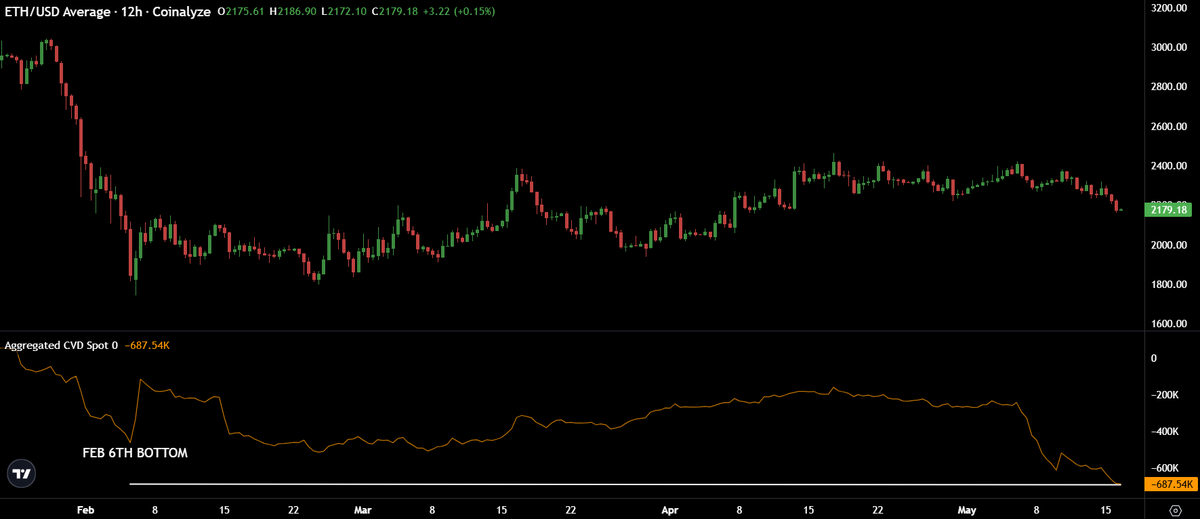
THIS IS REALLY BAD. $ETH spot demand has fallen to a yearly low, even lower than the Feb 6th bottom. Historically, low spot demand results in a new price low.
Crypto Rover tweet media
English
102
64
412
63.2K
Gucci_Clarity
Gucci_Clarity@Gucci_Clarity·
Completely different dynamics. Ukraine has continuously received assistance through weapons and money to help sustain the war of attrition. Iran has found itself pitted against not just the US and Israel, but also the entire middle east region. They recognize that and are now apologizing to its neighboring countries
English
1
0
0
43
*Walter Bloomberg
*Walter Bloomberg@DeItaone·
*IRAN READY TO CONTINUE WAR FOR FOR AT LEAST 6 MONTHS: STATE TV
English
210
201
1.9K
295K
Vectorial Data
Vectorial Data@VectorialData·
You're right banks can't change Bitcoin's code. But they don't need to. They control the on-ramps, the custody, the ETFs, and the liquidity. You can own Bitcoin without a bank. But the PRICE of Bitcoin is now set by banks. That's the difference between controlling the protocol and controlling the market
English
1
0
1
86
Michael Saylor
Michael Saylor@saylor·
Bitcoin has won. Global consensus is that $BTC is digital capital. The four-year cycle is dead. Price is now driven by capital flows. Bank and digital credit will determine Bitcoin’s growth trajectory. The biggest risk is bad ideas driving iatrogenic protocol changes.
English
3.3K
4.1K
28.8K
3.5M
freedom
freedom@peakcorruption·
@AgnesCallamard this is war. all bets are off. Iran has been terrorizing the world for 47 years, but now the one who does something about it is the villain? This is typical leftist propaganda to make the criminal, the victim and the victim the criminal! This is why leftism is a global disease.
English
2
0
1
240
Agnes Callamard
Agnes Callamard@AgnesCallamard·
Running out of language to denounce and condemn. Iranian Civilians will be the first to suffer from the destruction of power plants and bridges. No heat, no electricity, no water, no capacity to move or to flee, and all that it means for their right to life. A revolting statement
Agnes Callamard tweet media
English
65
436
951
33.8K
freedom
freedom@peakcorruption·
@LindseyGrahamSC Chose is the past tense of Choose. Can Americans spell?
English
0
0
0
9
Lindsey Graham
Lindsey Graham@LindseyGrahamSC·
As I have been saying for the last several days, President Trump is intent on restoring freedom of navigation in the Strait of Hormuz. He is deadly serious when it comes to his ultimatum to Iran to open the Strait of Hormuz or face a massive military response against vital infrastructure. It is still my hope Strait of Hormuz can be reopened and the enriched uranium can be secured through diplomacy. That would be the best outcome for the region and the world. To say the window on diplomacy is closing would be an understatement. To Iran, chose wisely and chose quickly.
English
4.4K
1.1K
5.9K
730K
Kenny Miller
Kenny Miller@Kenny_J_Miller·
That's because so many of you people don't know how to read Trumps posts. You don't pay attention. You don't realized every word has a purpose and it carefully chosen. If you have watched his wording, you will see what he means. In this instance, he said he was talking to Iranian leadership. He did not say the Islamic regime.
English
1
0
1
20
freedom
freedom@peakcorruption·
@plumrova Are you offering these? If so I'm interested!
English
1
0
1
9
freedom
freedom@peakcorruption·
@shanaka86 what happens if this headless command runs out of money or resources? I would imagine it can stop even without any command from the top?
English
0
0
0
16
Shanaka Anslem Perera ⚡
Shanaka Anslem Perera ⚡@shanaka86·
Iran built a military designed to fight without a head. Now it cannot stop fighting because the head is gone. The Mosaic Doctrine divides the IRGC into 31 autonomous provincial commands, one per province, each with pre-delegated authority, local weapons stockpiles, independent decision-making, and sealed orders that activate upon central command failure. The doctrine was formalised after the Iran-Iraq War for one purpose: ensure that the decapitation of Iranian leadership does not stop the Iranian military from fighting. It was designed to survive exactly what happened on 28 February. The Supreme Leader is dead. His successor cannot stand. The defence industrial base is rubble. The communication infrastructure that would transmit a ceasefire has been degraded by 15,000 strikes. And the 31 commands are still firing. Not because someone is ordering them to fire. Because the doctrine orders them to fire until someone orders them to stop, and the someone who would order them to stop is in a hospital bed issuing written statements through a television anchor. The Quds Force overlays the Mosaic with a second network: the proxy architecture. Hezbollah in Lebanon launches hundreds of rockets at Israel. The Houthis in Yemen attack Red Sea shipping and fire at Saudi Arabia and the UAE. Iraqi PMF militias, Kata’ib Hezbollah and Asa’ib Ahl al-Haq, strike American bases in Iraq and Syria. The coordination flows through secure fibre-optic lines, satellite backups, encrypted applications, and physical couriers carrying cash and operational directives. Funding: $100 to $350 million annually through tunnel smuggling, cryptocurrency wallets, and Hezbollah intermediaries. The proxies have hit American diplomatic facilities. A missile struck the US Embassy helipad in Baghdad. Two Iranian drones hit the US Embassy compound in Riyadh, starting fires. A drone struck near the US Consulate in Dubai. The Kuwait Embassy closed under threat. Three to four verified diplomatic incidents across the region, each producing limited damage but each crossing a line that has governed international conflict since the 1961 Vienna Convention: you do not strike embassies. And then Hamas, the proxy Iran armed and funded for seventeen years, issued a public statement asking Iran to stop targeting neighbouring countries. The organisation that started the war the Mosaic Doctrine is now perpetuating told its patron to stand down. The Axis of Resistance is arguing in public for the first time since its creation. The fracture reveals the Mosaic Doctrine’s fatal design flaw. The system was built for survival, not termination. It ensures that 31 commands continue fighting after decapitation. It does not contain a mechanism for 31 commands to simultaneously stop. Each command fires under sealed orders with local authority. No central node can broadcast a ceasefire because the central node was the target of the first strike. The doctrine that makes Iran impossible to defeat also makes Iran impossible to negotiate with because the entity that would accept terms does not control the entities that would implement them. Hezbollah fires because its orders predate the ceasefire that does not exist. The Houthis fire because their funding pipeline operates independently of any command they would obey. The Iraqi PMF fires because the militias answer to local commanders who answer to a Quds Force whose leader is in a bunker. And the 31 provincial commands fire because the doctrine says fire and nobody with authority has said stop. The war’s most dangerous feature is not what Iran can still launch. It is what Iran can no longer recall. The machine was built to run without an operator. The operator is gone. The machine is running. And the off switch was never installed because the doctrine’s designers believed the machine should never be turned off. open.substack.com/pub/shanakaans…
English
198
526
1.5K
533K
freedom
freedom@peakcorruption·
@PierrePoilievre Canada is a terrorist loving regime. It harbours so many bad people and criminal money. Canada does nothing. like it does nothing about anything. no laws, no contracts. corruption as bad as any failed state.
English
0
0
0
2
Pierre Poilievre
Pierre Poilievre@PierrePoilievre·
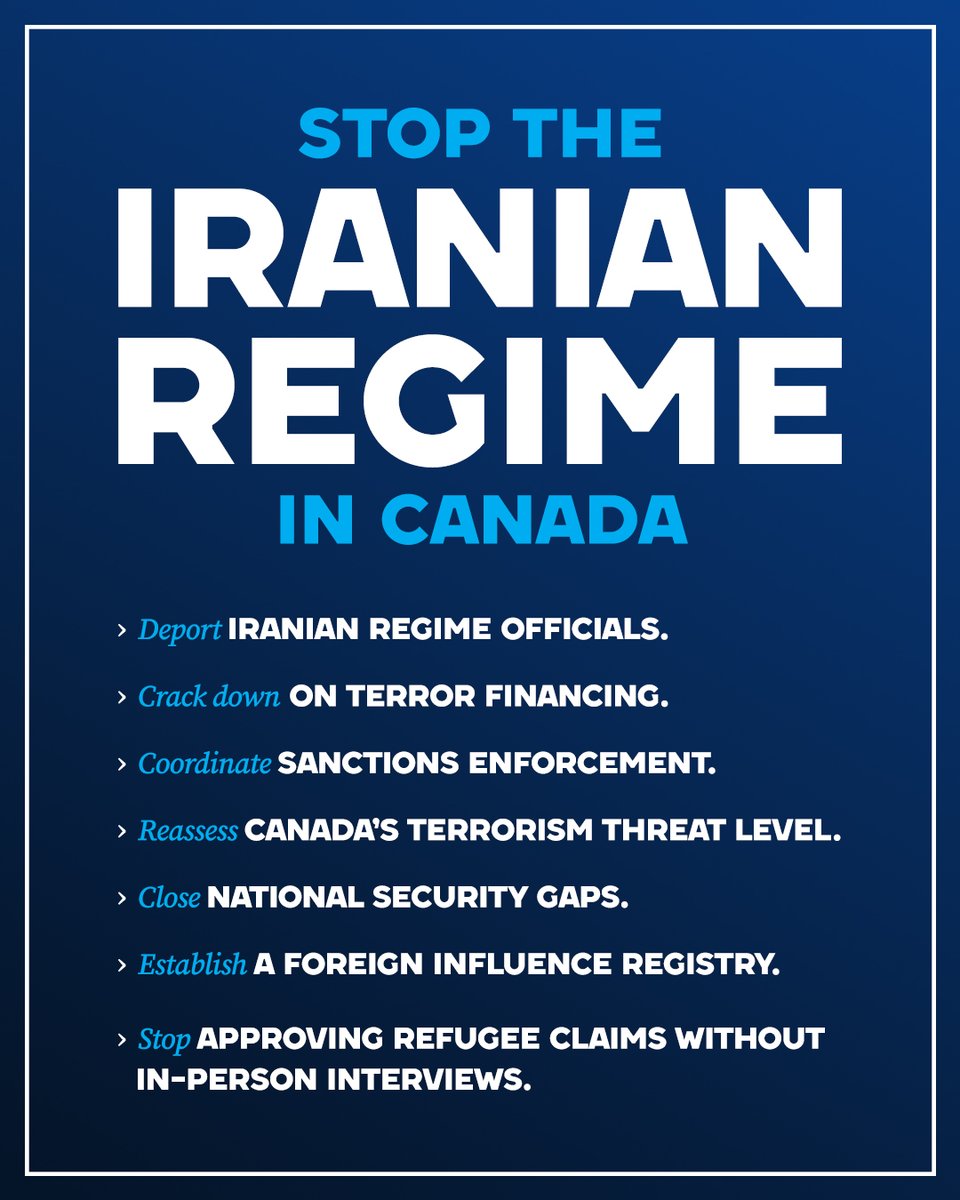
There is no place in Canada for anyone acting on behalf of the terrorist Iranian regime. Every terror operative must be identified, arrested, charged, and deported. Here’s the Conservative plan to protect our people.
Pierre Poilievre tweet media
English
2.6K
5.3K
14.8K
332.5K
Gucci_Clarity
Gucci_Clarity@Gucci_Clarity·
@DeItaone Talk is cheap. They are hanging on by a thread. There is internal dissention. Infrastructure is crumbling. Lebanon has pushed them out. 6 months? They wont sustain another 6 weeks of this. Its only day 8 and they are falling apart.
English
1
0
1
200
freedom
freedom@peakcorruption·
@antonioguterres the UN is a dead , irrelevant entity..and no sir, Iran is a threat to global Peace and security.
English
0
0
0
47
António Guterres
António Guterres@antonioguterres·
I condemn today’s military escalation in the Middle East. The use of force by the United States & Israel against Iran, and the subsequent retaliation by Iran across the region, undermine international peace & security.   All Member States must respect their obligations under international law, including the Charter of the @UN. The Charter clearly prohibits “the threat of the use of force against the territorial integrity or political independence of any state, or in any other manner inconsistent with the Purposes of the United Nations.”   I call for an immediate cessation of hostilities & de-escalation. Failing to do so risks a wider regional conflict with grave consequences for civilians & regional stability. I strongly encourage all parties to return immediately to the negotiating table.   I reiterate that there is no viable alternative to the peaceful settlement of international disputes, in full accordance with international law, including the UN Charter. The Charter provides the foundation for the maintenance of international peace and security.
António Guterres tweet media
English
13.7K
7.4K
18K
3M
freedom
freedom@peakcorruption·
@jimmy_wales try travelling for 10 years ...nations control renewal of your id...if they don't renew it or force hardship on you to renew you can't access your money. no government or bank can force you to lose your life's work if you don't jump through their corrupt hoops with BTC
English
0
0
0
305
Jimmy Wales
Jimmy Wales@jimmy_wales·
People who think that Bitcoin is going to zero are likely mistaken. The design is robust enough that it will continue to exist in perpetuity, barring some currently unforeseen breakdown in cryptography or a surprise 51% attack (even then, a fork would carry on I would imagine). What is can do, though, is decline to a price consistent with hobbyist tinkering. Because it is a complete failure as a currency, as a store of value, etc., it isn't going to become the dominant money of the future. So I'd suggest a 2050 price target of under $10,000 in today's dollars. Possibly much lower.
English
70
13
118
25.6K
freedom
freedom@peakcorruption·
@IranIntl_En @UNWatch @HillelNeuer that's why Trump started the board of Peace because the UN is a dysfunctional, hypocritical mess that should be abolished.
English
1
0
0
12
freedom
freedom@peakcorruption·
@ndaxio how idiotic is Ndax to keep using sumsub? change it for God's sake.
English
0
0
1
52
Ndax
Ndax@ndaxio·
Ndax security update: a third-party KYC provider (SumSub) reported a security incident. Only basic contact information (name, phone number, email) may have been accessed. No Ndax systems were compromised, and no passwords, 2FA codes, ID documents, banking or payment details were exposed. We’ve launched an investigation with external cybersecurity experts and added enhanced security checks. Please stay alert for phishing. Ndax will never ask for your password, 2FA, or to move funds. Questions? support@ndax.io
English
27
2
30
3.7K