Strategic Profiler

1.8K posts

Strategic Profiler banner
Strategic Profiler

Strategic Profiler

@SProfiler1

StrategicProfiler shows you hidden patterns in behavior, competitors, and opportunities in minutes. Stop guessing. Start knowing.

Beigetreten Mayıs 2026
487 Folgt689 Follower
Strategic Profiler
Strategic Profiler@SProfiler1·
@srcasm Impressive data. How are seed round dynamics shifting across verticals?
English
0
0
0
3
Jesse Middleton
Jesse Middleton@srcasm·
New York is the best place on earth to build. Over the past 15 years of investing in and backing the New York tech ecosystem, I’ve watched this community evolve from an underdog into an absolute powerhouse. Silicon Valley will always be an incredible sandbox for core technology infrastructure. However, if your goal is to build a company that deeply integrates with, scales within, and transforms the global economy, NYC has become the ultimate launchpad. Here’s why: 1. Elite Talent Pool The historic playbook of elite engineering and business graduates automatically packing a bag for the West Coast has shifted. New York now commands one of the dense and diverse talent pipelines in the world. • According to recent ecosystem talent studies, New York captures 10.1% of the entire U.S. college graduating class. For context, the next closest market is Los Angeles at 4.9%. • The region is anchored by world-class institutions like Columbia, NYU, Cornell Tech, and Princeton, generating a massive annual surplus of technical degrees. • NYC offers an unmatched concentration of seasoned operators from the Fortune 500. Founders can access developers who deeply understand enterprise procurement, global compliance, and commercial scaling. 2. Vertical Dominance Building software for other software companies is a viable model, but building for massive, real-world legacy industries is where the greatest value is created. New York naturally dominates these sectors because the buyers, experts, and operators live here. • Fintech: According to data from Carta, NYC startups secured 48.5% of all fintech venture dollars raised in the United States, nearly doubling the Bay Area’s 25.9%. • Healthcare & BioTech: Driven by nine major academic medical centers and extensive public-private investments, NYC is the nation’s #1 market for healthtech funding. • PropTech & Retail/Commerce: As the undisputed global capital of both real estate and retail, NYC serves as the primary testing ground for commerce, luxury tech, and property management. • Media & AdTech: The city remains the epicenter of global media, giving local B2B SaaS and marketing tech platforms immediate, direct access to major enterprise enterprise accounts. 3. Capital Resilience and Ecosystem Value The myth that massive, sophisticated early-stage checks are exclusive to the West Coast has been thoroughly debunked by now. • According to the Startup Genome Global Startup Ecosystem Report, NYC’s ecosystem value has now surpassed $620 billion. • Even during broader macroeconomic market corrections, PitchBook and NVCA data shows that median seed and Series A round sizes in New York have remained remarkably resilient, occasionally outpacing the Bay Area in deal velocity stability. • Tech sector employment in NYC has grown by 160% over the last 15 years, outperforming the national tech sector growth rate by nearly 3x. 4. Structural Diversity Building a global product for a diverse world requires an environment that reflects that world. Groupthink is a silent killer of early-stage startups. NYC’s greatest superpower is its built-in cognitive diversity. • Tech ecosystem demographic data highlights that Black and Hispanic workers make up 24.3% of NYC’s tech workforce, compared to roughly 8.2% in the San Francisco Bay Area and 10.4% in Boston. • According to regional ecosystem tracking, 17% of all Black and Latino founders in the U.S. who have successfully raised $1M+ are based right here in New York. Next Wave NYC We built our pre-seed venture fund, wholly backed by Flybridge Capital, to be a reflection of this exact ecosystem. Our fund is run entirely by founders and operators who have spent the last decade helping scale the NYC startup scene. Our extended investment team includes leaders and alumni from OpenAI, Google, Snowflake, Foursquare, Bowery Farming, Casper, Chief, Flatiron School, Major League Hacking, Squire, WeWork, and The Wing. We are laser-focused on being the very first commitment and the loudest operational supporter for builders tackling: • Native AI applications • Agentic AI for the enterprise • Developer platforms for AI builders If you are building the future here in New York, we would love to learn more about what you're working on. Our inboxes are always open. Let's build. 🗽 — Jesse
Jesse Middleton tweet media
English
2
5
18
1.7K
OpenHive
OpenHive@aden_hq·
You can now replace your entire GTM budget with 12 AI agents running in parallel. Not just chats and prompts. Actual autonomous agents that coordinate, hand off work, and execute full workflows from  research to distribution - while you sleep. Agent 1: Positioning Researcher → Crawls competitor sites, scrapes reviews, analyzes ICP pain points from real forum threads. Outputs a structured positioning doc. Agent 2: Content Strategist → Takes the positioning doc, pulls search demand data, maps content gaps, builds a 30-day editorial calendar. Agent 3: Copywriter → Reads the calendar, drafts each piece - LinkedIn posts, blog intros, newsletters, landing page copy - in your brand voice. Agent 4: Repurposing Engine → Takes one long-form piece and multiplies it into 8-10 assets across LinkedIn, X, email, blog, and short-form video scripts. Agent 5: SEO & AEO Optimizer → Keyword mapping, metadata, heading structure, citation signals — all baked in before anything publishes. Agent 6: Distribution Planner → Maps every asset to the right channel, format, and posting window. Nothing dies in a Google Doc. Agent 7: Performance Analyst → Tracks what drives pipeline, flags dead campaigns, recommends where to double down. Agent 8: LinkedIn Outreach Agent → Researches prospects, writes personalized connection requests, sends follow-ups, logs to CRM. Runs your outbound while you focus on closing. Agent 9: Email Sequence Agent → Builds cold email cadences, personalizes at scale, handles reply detection and routing. Agent 10: Social Engagement Agent → Monitors target accounts, engages with prospect posts, builds visibility before you ever DM. Agent 11: CRM Sync Agent → Every interaction logged. Every response captured. Pipeline updated in real time. Agent 12: QA & Approval Gate → Flags anything risky — weird messaging, compliance issues, off-brand copy — routes to you for approval before it goes live. What happens when 12 agents run in a colony: → One prompt kicks off the entire chain → Each agent hands off structured output to the next → State persists — if something crashes at step 9, it resumes, not restarts → Human-in-the-loop gates catch what matters → Cost enforcement caps spend at every level → The whole system runs whether you're at your desk or not What you stop doing: ❌ Managing 5 SaaS tools that don't talk to each other ❌ Copy-pasting between ChatGPT, your CRM, and LinkedIn ❌ Babysitting automations that break silently ❌ Paying $12-20K/mo for a GTM team that needs managing What you get: ✅ A positioning doc grounded in real market data ✅ Content targeting actual search demand ✅ One piece multiplied across every channel automatically ✅ Outbound running on autopilot with guardrails ✅ Pipeline visibility without manual CRM updates ✅ A system that ships while you sleep Try this on OpenHive.
OpenHive tweet media
English
10
0
4
347
Alex Desjardins
Alex Desjardins@PrimeTrading_·
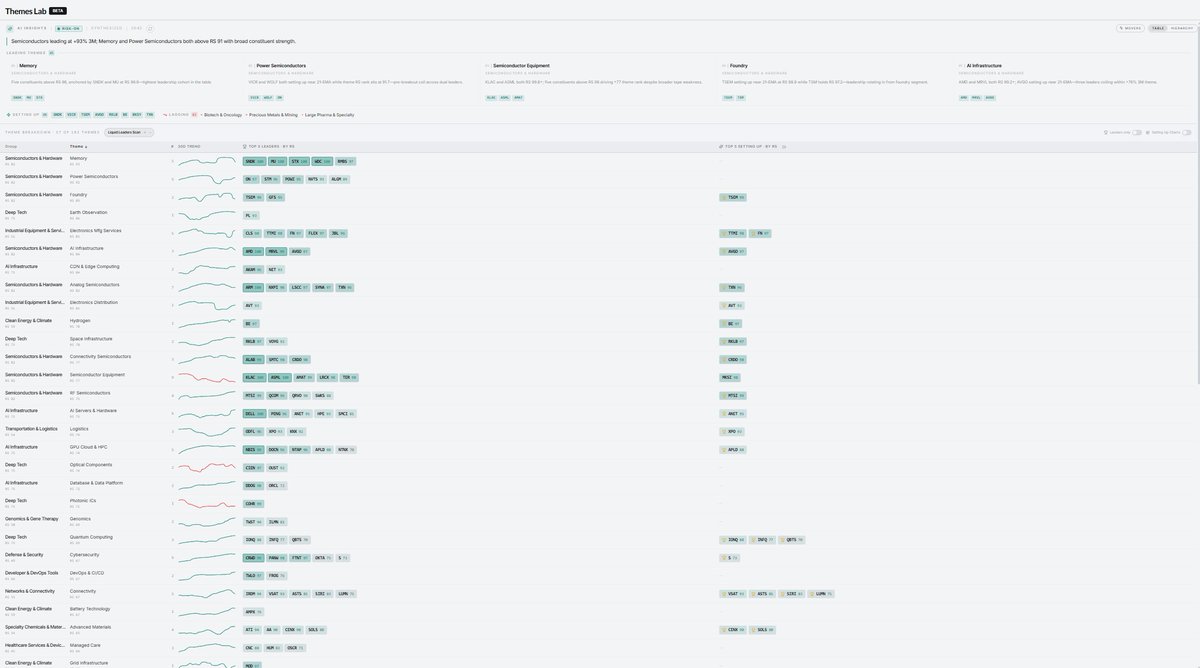
Themes Lab — 6/4 🧪 Top-down theme tracker mapping 180+ themes across the market. Surfaces where the real RS strength lives and which names are setting up inside the leaders. LEADING THEMES (RS) • Memory — RS 93 (#1) • Power Semiconductors — RS 92 (#2) • Semiconductor Equipment — RS 82 (#3) • Foundry — RS 89 (#4) • AI Infrastructure — RS 82 (#5) Semis sweeping the top 5 at +93% 3M, with Memory and Power Semis both north of RS 91 on broad constituent strength. TOP SETUPS @ 21dma-structure area • $TSEM 99 — Foundry • $MTSI 99 — RF Semiconductors • $CRDO 98 — Connectivity Semiconductors • $MKSI 98 — Semiconductor Equipment • $TTMI 98 — Electronics Mfg Services • $AVGO 97 — AI Infrastructure • $BE 97 — Hydrogen • $RKLB 97 — Space Infrastructure • $TXN 96 — Analog Semiconductors • $FN 97 — Electronics Mfg Services THEMES SETTING UP (full breadth) Watch the themes where the whole leadership board is coiling at the 21dma-structure area together — that's where the cleanest follow-through tends to come from: • Electronics Mfg Services — $TTMI, $FN all setting up (2 of 5 leaders) • Connectivity — $VSAT, $ASTS, $SIRI, $LUMN all setting up (4 of 5 leaders) • Quantum Computing — $IONQ, $INFQ, $QBTS all setting up (3 of 3 leaders) • Advanced Materials — $CENX, $SOLS all setting up (2 of 5 leaders) TAKEAWAY Tape is risk-on and Semis & Hardware owns the leadership board — Memory, Power Semis, Foundry, and AI Infrastructure all coiling with named leaders at structure. Strongest rotation to watch: Connectivity breadth (4 of 5 leaders setting up) as a non-semi pocket worth tracking for follow-through. By: @TradersLab_
Alex Desjardins tweet media
English
3
2
12
1.5K
World Data Analysis
World Data Analysis@World_Data_A·
🇪🇺 This is really amazing: The Brussels Effect How Europe exports its rules to the World !!! Europe may no longer be the world's export leader, but the world often has to produce according to Europe's rules. And this is not just about manufacturing goods. It also highlights the power of non-tariff barriers and the influence that comes from controlling access to one of the world's largest consumer markets. Companies frequently adapt their products, supply chains, and business practices to comply with EU regulations, extending Europe's regulatory reach far beyond its borders. The term "Brussels Effect" was coined by @anubradford and describes how the European Union shapes global business practices through regulation rather than military, technological, or manufacturing dominance. While China manufactures and the United States innovates, Europe increasingly writes the rules that global companies must follow. Why not 100%? Global alignment is rarely absolute. GDPR Arguably the strongest example of the Brussels Effect. Many multinational firms adopted GDPR-style privacy standards globally rather than maintaining separate systems for Europe and the rest of the world. However, countries such as China, Russia, and several developing economies still operate under different privacy frameworks. Therefore, alignment is extremely high, but not literally 100%. EU AI Act The first comprehensive AI regulation. Large AI developers seeking access to European markets are likely to incorporate many of its requirements. However, implementation remains uneven and the regulation is still relatively new. As a result, global convergence is significant but far from universal. CBAM Carbon-intensive exporters selling into Europe must increasingly measure and report emissions. Yet CBAM only applies to specific sectors such as steel, aluminum, cement, fertilizers, hydrogen, and electricity. Large parts of the global economy remain outside its scope. Therefore, its influence is substantial but not economy-wide. DMA The Digital Markets Act targets large digital gatekeepers such as app stores, search engines, and major online platforms. Because many global technology firms operate in Europe, several have already modified products and business practices worldwide rather than maintaining separate systems. However, the DMA primarily affects a relatively small group of large digital platforms, limiting its reach beyond the tech sector. Its influence is therefore meaningful, but narrower than GDPR. Battery Regulation The EU Battery Regulation introduces requirements for carbon footprints, recycling, traceability, and battery passports across battery supply chains. Given Europe's importance in the electric vehicle market, battery manufacturers worldwide increasingly adapt to these standards. However, the regulation mainly affects batteries and related supply chains rather than the broader economy. Its global impact is growing rapidly, but it remains concentrated in a specific industrial ecosystem. (Note: The star ratings are illustrative and reflect the relative global influence of each regulation rather than measured compliance rates. They are based on academic literature, policy research, market adaptation, and observed regulatory spillovers) Sources and further reading: @AnuBradford, The Brussels Effect: How the European Union Rules the World (Oxford University Press, 2020). Crossing the Regulatory Rubicon, Ni Zhan, Qi Lu & Haoyu Tian. @CEPA, Mapping the Brussels Effect by Ronan Murphy @TrendsRA The Brussels Effect Revisited by Karolína Godál
World Data Analysis tweet media
English
3
5
18
230
Jacob Counsell
Jacob Counsell@JacobCounsell·
And no bullshit… Last night it was a 26, I added a blog link from LaunchChair as a Product Update on @Buildhop_io and this morning it’s a 27. That’s literally all I did and we gained a point…
LaunchChair@LaunchChair

Woot! LaunchChair.io is now a 27 DR! Should come in handy when we start writing blogs about the people using LaunchChair to build products!

English
5
0
3
98
Hunter Allen
Hunter Allen@HunterAllen4·
$KVYO Klaviyo Inc. is one of the more interesting SaaS names in the market right now — a vertically focused e-commerce CRM platform that just crossed into consistent profitability while continuing to scale revenue at ~20%+ growth. A 150$ stock at 15$. Repost. Bookmark. Subscribe 1$. Keep eyes on this one. This one I like. WHAT KLAVIYO ACTUALLY IS At its core, Klaviyo is not just email software — it’s a full-stack B2C CRM built specifically for e-commerce brands. It unifies: • Email marketing • SMS + push notifications • Customer data platform (CDP) • AI-driven automation + segmentation The key differentiation is that it is commerce-native, meaning it directly plugs into purchase behavior, product interaction, and customer lifecycle data in real time. This is what allows it to move beyond campaigns → into automated revenue generation systems. The big shift: • Q1 2026: GAAP net income turned positive (~$9M) • Operating income also flipped positive • Gross margins remain strong (~75%+) • Revenue still growing ~25–30% range high-growth SaaS → transitioning into scalable profitability without collapsing growth. FY2025 revenue crossed ~$1.2B and continues compounding, while efficiency gains are starting to show through operating leverage. THE CORE MOAT (WHY IT EXISTS AT ALL) Klaviyo’s advantage is not “features” — it’s data depth inside e-commerce ecosystems. It has native, real-time integration with: • Shopify (largest driver — deep ecosystem dependency) • WooCommerce / Magento / BigCommerce • Hundreds of commerce tools and APIs This enables: • Behavioral segmentation (cart, browse, purchase history) • Predictive analytics (CLV, churn, next purchase timing) • Automated flows that adjust in real time Most competitors can send messages. Klaviyo builds revenue loops tied to customer behavior. ECOSYSTEMS BELOW.👇 $SHOP Shopify (core distribution engine) • Shopify owns ~11% of Klaviyo • ~70–80% of revenue tied to Shopify ecosystem • Default CRM choice for Shopify Plus merchants This is effectively embedded distribution — not just a partnership. $GOOG Google (AI + discovery layer) Integration focuses on: • Search → purchase intent activation • Google Ads + CRM feedback loop • RCS + messaging expansion • AI-driven customer journeys This connects acquisition → retention inside one system. Anthropic (AI workflow layer) HUGE LAYER. • Claude integrated directly into Klaviyo via MCP • Enables AI-generated segmentation, campaigns, audits • Moves platform toward “agentic marketing” workflows WHY THE MODEL WORKS Klaviyo wins because it sits in the highest ROI part of marketing: owned-channel revenue (email + SMS) Not paid ads. Not branding. Not awareness. That gives it: • High gross margins (~75%) • Strong retention (110%+ net retention) • Expanding ARPU per customer over time • High switching costs once embedded into workflows Relative to peers: • Braze → stronger enterprise/mobile omnichannel • Iterable → flexible but more complex • Attentive → SMS-heavy but narrower scope • HubSpot → broader but less e-com specialized Klaviyo sits in a very specific wedge: 👉 best-in-class for Shopify + DTC + mid-market e-commerce scaling That focus is the moat. $KVYO is moving through a classic SaaS transition: • Growth is decelerating but still strong (~20–30%) • Margins are expanding meaningfully • Platform is expanding from “tool” → “system of record for commerce marketing” • AI is becoming embedded into workflows rather than bolted on It’s a platform consolidation + operating leverage + AI augmentation story sitting on top of one of the stickiest e-commerce ecosystems in SaaS. $HUBS $NOW $CRM $FATN $TSSI $IBM $HPE $DELL $MSFT $META $SE $U $ADBE $DOCU $DOCS $AMZN $DDOG $ASAN $SMCI $TSSI If execution holds, the next phase is not growth acceleration — it’s sustained margin expansion with stable mid-20s growth.
Hunter Allen tweet mediaHunter Allen tweet mediaHunter Allen tweet mediaHunter Allen tweet media
English
9
3
12
2.5K
Ksenia Moskalenko
Ksenia Moskalenko@kseniam0s·
Must-follow accounts on X if you're a founder or fund manager. By topic: 1. Fundraising intel: @paulg philosophy, founder advice, essays @pmarca a16z, tech, AI, VC macro insights @Jason angel investor, This Week in AI host @msuster founder-VC debates, advice @HarryStebbings tech news, 20vc, podcasts 2. Building in public: @levelsio ships fast, shares every number @marc_louvion_ products, revenue, no fluff @thepatwalls starter story, motivation @retentionadam bootstrapped SaaS scaler @jrfarr shipping & distribution expert 3. Active Investors & community voices: @rrhoover product & startups @mwseibel accelerator & founder insights @saranormous enterprise/consumer tech @geoffreywoo antifund insights @dunkhippo33 pre-seed & founder tactics 4. Bonus follow: @ThePageform AI-native data rooms for founders and fund managers who are done sending Drive links and paying $200/mo for Docsend file cabinets
English
6
6
46
2.7K
Fivos Aresti
Fivos Aresti@fivosaresti·
Third-party intent signals fire before a prospect ever touches your site. The 12 worth tracking in 2026: - LinkedIn post engagement on your team and competitor posts - LinkedIn ad engagement on your campaigns and competitors' - LinkedIn job changes inside target accounts - Job openings in roles that map to your product - Funding announcements and round closures - Technographic changes when accounts add or remove tools in your category - Brand mentions across web and social - G2 and Capterra competitors’ reviews - Hiring growth or contraction at the company level - M&A activity inside target accounts - Earnings reports and financial signals - Layoff signals at competitor or partner accounts Noisier than first-party signals, but they cover a much broader set of accounts.
English
2
8
16
1.2K
King SamGrowth
King SamGrowth@kingsamgrowth·
Neobank founders, you don't need a social media manager. You need social media strategist. Having scaled 3 different neobanks' social presence and user acquisition, I've realized something: User growth always matters more than vanity social metrics. Likes don't bring revenue. Active users do. And to get active users, you need the right content strategy tailored for your brand. Here's what that actually looks like: -> Content that educates your audience on why your product exists, and turns users into advocates -> Messaging that converts skeptics into first-time users -> Positioning that makes your neobank feel like the obvious choice Talking about consistent, compounding growth. This is what one of my clients said recently (unscripted): "Great job on our marketing, posts, and designs. You've been doing it so consistently that I haven't really had to check in." A founder trusting you enough to not check in? That's the goal. I build systems so good that the founder can focus on building the product; not babysitting the content. And here's what makes me different: I don't just create content. I engineer the metrics behind it. Imagine 199K impressions, 403 new followers, and 10,700% (104) repost growth. All attained organically in one quarter; and of which actually brought a significant number of active users. What's even more interesting? We achieved similar results on LinkedIn too (will make a separate post about it). And that's arguably more impressive because LinkedIn is a professional platform where attention is harder to earn. Well, that's what "turning social attention into active users" actually looks like in practice. If you're a neobank founder who wants social media that drives user growth; not just impressions. DM me "GROWTH" and let's talk.
King SamGrowth tweet media
English
3
1
4
96
The Fundamentalist
The Fundamentalist@Funmentalist·
$NBIS Token Factory explained in 15 minutes So I decided to write a little explanation of what the main differentiator of $NBIS is, and that is the "Token Factory" they introduced November last year I will try to simplify this so that every investor can understand it. If you are interested in more technical details, ask me in the comments, and I might be able to explain it. So If someone asked me how I would explain it in one sentence, I would say that Token Factory is an AI platform designed to simplify the deployment, management, and scaling of large language models (LLMs) and other generative AI systems. It is a production-grade inference platform that allows organizations (and it is especially helpful for smaller businesses) to use AI models without the complexity of managing the underlying infrastructure. Token factory is built around inference - the process where you generate outputs from already trained models (for example, asking questions and getting answers from models like ChatGPT). Whenever you ask ChatGPT a question, request code generation, or any other task you have ever done, the model produces a sequence of tokens that are, at the end, transformed into text/document that you can read. In the earliest stages of AI, we just had models like ChatGPT 3, Claude 3, etc. You paid your subscription of $20, and you were able to prompt infinitely, but lately the scale of these prompts increased heavily, and enterprise adoption of these models led to OpenAI, Anthropic, and others to shift from simple subscription pricing to price/token, meaning that each prompt and each task is priced differently. The cost of the token is increasing rapidly with supply not being able to meet demand. This is why $NBIS came with Token Factory, which is basically an optimizer for generating these tokens as efficiently, reliably, and cost-effectively as possible. The name kind of explains itself there. Traditionally, companies that wanted to deploy large AI models had to acquire and manage expensive GPU hardware, configure inference servers, monitor performance, handle traffic spikes, and continuously try to optimize their deployments. This process required companies to have experts in mainly these two fields: 1) Cloud infrastructure 2) Machine learning operations (MLOps) It is quite difficult to obtain a skillful team in these areas, so Nebius decided to go and remove majority of this complexity by providing a managed service that handles not only infrastructure, but also scaling, monitoring, and deployment via Token Factory. Developers can now simply connect to the platform through an API and immediately begin using advanced AI models. So the key strength is the exposure for smaller enterprises to open-source foundation models without acquiring a whole team of experts. Organizations can access and deploy models from families such as Llama, Qwen, DeepSeek, and from the latest announcement also NVIDIA Nemotron. The platform has interfaces that are compatible with widely used AI APIs, making migration and intergration relatively straightforward for development teams. What I did not understand initially, was that Token Factory goes beyond basic inference, it supports the whole lifecycle of AI applications. Users can tune their models on proprietary data to create domain-specific assistants for many industries like finance, healthcare, law and many others. This opens new possibilities like "parameter-efficient fine-tuning", "post-training optimization" that enable companies to customize models without the cost of training it from scratch. There are other fancy applications like Retrieval-Augmented Generation (RAG), where you combine LLMs with external knowledge sources like documents. But I don’t want to bore you to death as I understand majority of investors reading this are not machine learnings experts, so let’s skip this technical part. However, one last major advantage that you should be able to understand about Token Factory is the ability to scale "automatically". When you create an application and demand starts increasing, you usually start running into high latency and capacity problems. Instead of you having to allocate new compute to your application, which takes time and it might cause some downtime for your servers which are costly, Token Factory platform dynamically allocates additional computing resources to maintain both low latency and high throughout. The important thing is that this works the opposite way as well. When demand decreases, resources are released, helping companies optimize costs. This elastic scaling allows Token Factory to attract both small pilot projects to large-scale production deployments serving thousands of users and more. Now that I finished this paragraph, I realize that I completely forgot about one more thing and that is what we call in business "Enterprise governance and security". Token Factory includes features such as role-based access control, team management, authentication integration, usage monitoring, centralized billing and many other things that help companies maintaining control over AI deployments while meeting operational and compliance requirements. To somehow summarize everything, think of Token Factory as the "AWS of AI" or more precisely "AWS of AI inference". Companies bring their applications, Nebius provides the infrastructure and models, and charges for the AI output generated. The more AI is used, the more valuable Token Factory becomes. It is really that simple. I spent more time than I initially wanted on researching Token Factory and its use cases, but it really helped me to understand that this is something that gives $NBIS an unfair advantage against others in the sector. You should really understand this part of their business if you are an investor, so I will gladly answer your questions. If you found this a valuable read, follow me for more. Thanks! (picture is from ChatGTP)
The Fundamentalist tweet media
English
3
2
34
4.9K
People's Daily, China
Copper, long viewed as a cornerstone of conventional manufacturing, is playing a more prominent part in China's shift to an innovation-led economy, as booming demand and industrial upgrading are being pushed by rising sectors such as AI and electric cars. Under a plan to boost the high-quality development of the copper sector, China aims to strengthen the resilience and security of its copper supply chain, achieve breakthroughs in key technologies and high-end materials, enhance advanced equipment manufacturing capabilities and foster a new generation of competitive copper enterprises by 2027. Industry forecasts suggest that China's copper demand from the NEV sector alone will reach 1.84 million tonnes in 2026 and surpass 2 million tonnes in 2027. Globally, copper consumed by data centers may rise from 740,000 tonnes this year to 1.3 million tonnes by 2028. Official data showed that China's refined copper output reached 3.785 million tonnes in the first quarter of 2026, up 9.3% YoY, while copper material output rose 4% to 5.633 million tonnes.
People's Daily, China tweet media
English
2
6
12
2K
TheValueist
TheValueist@TheValueist·
$EQIX EXECUTIVE ASSESSMENT The REITweek transcript is incrementally supportive of the Equinix long-term quality-compounder thesis, but the equity setup is no longer clean after a material rerating. The core message from management is that Equinix is not positioning itself as a generic wholesale data-center landlord; it is positioning itself as the neutral, global, low-latency exchange layer for AI, cloud, neocloud, enterprise, and network participants. That distinction matters because AI infrastructure value is likely to bifurcate between commoditized large-scale training capacity and scarce, metro-proximate, ecosystem-dense inference and data-exchange capacity. Equinix’s differentiated asset is the latter. The transcript emphasizes that AI demand strengthens the value of a “marketplace” architecture where clouds, neoclouds, AI labs, enterprises, carriers, and data platforms need to connect, exchange data, manage latency, and avoid dependence on a single vertically integrated provider. In investment terms, this frames Equinix as a beneficiary of AI-driven traffic complexity rather than merely AI-driven megawatt demand. The strongest parts of the presentation were management’s confidence on power availability, the reiterated 10% recurring-revenue growth and 10% AFFO/share-growth framework, the 51% EBITDA-margin target, evidence of broad customer and ecosystem participation, and the argument that legacy network-dense facilities are becoming more valuable rather than obsolete. The weaker part of the investment case is valuation: at a current price of $1,089.15 and market capitalization of approximately $107.5B, the stock is already priced as a scarce AI-infrastructure compounder, implying approximately 25.5x 2026E AFFO/share at the midpoint of company guidance and roughly 24x 2026E adjusted EBITDA on a simplified EV basis, depending on lease treatment. This is defensible for a premium global infrastructure platform, but it leaves limited tolerance for power delays, capex inflation, weaker interconnection growth, higher interest costs, or any evidence that AI demand is concentrating in lower-return wholesale capacity instead of Equinix’s higher-return interconnection-rich retail fabric. STRATEGIC SIGNAL FROM REITWEEK The most important strategic point is that management is attempting to shift the debate from “data-center supply” to “AI-era network topology.” The CFO framed Equinix’s 30-year evolution as 3 successive infrastructure eras: internet, cloud, and now AI. The claim is that the AI era creates a greater need for a neutral, global marketplace where heterogeneous participants exchange data and where proximity to enterprises and latency-sensitive endpoints matters. This is a different thesis from the pure hyperscale buildout narrative. A large wholesale campus can satisfy centralized training demand, but it is less naturally suited to complex, low-latency, many-party interconnection among enterprises, cloud providers, AI model providers, neoclouds, security vendors, data providers, and carriers. The transcript’s central argument is that AI increases the need for “1-to-many” and “many-to-many” data exchange, not just low-cost megawatts. That is the portion of the stack where Equinix’s historical network density, neutrality, global metro footprint, and interconnection products should retain pricing power. The reported ecosystem statistics were directionally strong. Management stated that 4 of the top 5 neoclouds are on the Equinix network, that those neoclouds have deployed more than 110 nodes, that 8 top AI labs are present, and that all cloud providers are on the network. The Q1 2026 earnings release separately stated that 8 of the top 10 AI model providers and 4 of the top 5 neoclouds were actively expanding with Equinix. These claims are important because the marginal value of an interconnection platform is nonlinear: each incremental high-value participant raises the value of the network for every other participant. The platform therefore becomes harder to replicate as more AI, cloud, network, and enterprise participants co-locate. This creates a self-reinforcing flywheel that is more defensible than physical real estate alone. The transcript also states that Equinix has over 10,500 customers, completed 3,800 transactions in Q1, and served over 3,100 unique customers in the quarter, which reinforces the distinction between Equinix and single-tenant wholesale models where a facility can be materially exposed to 1 hyperscale counterparty or 1 workload generation. The AI thesis is most compelling around inference, distributed AI, and edge compute rather than around centralized training. JLL’s 2026 global data-center outlook expects AI to represent approximately 50% of data-center workloads by 2030 and anticipates that inference workloads could overtake training as the dominant AI requirement around 2027. JLL also notes that inference demand requires geographic distribution to reduce latency and serve users effectively. This external industry view directly supports Equinix’s REITweek framing: if inference shifts compute closer to users, enterprises, data sources, and application endpoints, then metro-proximate interconnection hubs should capture more strategic value than remote, power-rich campuses alone. Equinix’s management explicitly connected the rise of higher-density racks in its network to “compute at the edge,” arguing that some workloads require fast action close to the object or enterprise and that computing elsewhere can be too expensive because of traffic costs. The investment implication is that Equinix is a higher-quality AI derivative if AI monetization shifts from training clusters into production inference, distributed enterprise AI stacks, and data-sovereign architectures. FINANCIAL CONFIRMATION The transcript’s qualitative claims are broadly supported by Q1 2026 financial results. Equinix reported Q1 2026 revenue of $2.444B, up 10% as reported and 7% on a constant-currency basis. Recurring revenue was $2.331B, or 95% of total revenue, and increased 12% as reported and 8% on a constant-currency basis. The business mix remains attractive for a REIT because recurring revenue durability, high customer retention, and interconnection stickiness help reduce cyclicality and lower the probability that growth capex becomes stranded. The 10-Q states that recurring revenues have represented more than 90% of total revenues over the past 3 years and that more than 90% of monthly recurring-revenue bookings over the same period came from existing customers. The largest customer represented only approximately 2% of Q1 recurring revenue, while the top 50 customers represented approximately 36%, indicating a relatively diversified revenue base compared with hyperscale-oriented peers. Profitability also supports the case that Equinix has not sacrificed operating discipline for AI-era growth. Q1 adjusted EBITDA was $1.245B, up 17% as reported and 13% on a constant-currency basis, with a 51% adjusted EBITDA margin. AFFO attributable to common stockholders was $1.065B versus $947M in Q1 2025, an increase of approximately 12.5%. Company guidance for 2026 calls for revenue of $10.144B to $10.244B, representing 10% to 11% growth; adjusted EBITDA of $5.165B to $5.245B, implying a 51% margin and approximately 2 percentage points of margin expansion; AFFO of $4.198B to $4.278B, up 12% to 14% as reported and 10% to 12% on a normalized and constant-currency basis; and AFFO/share of $42.31 to $43.11, up 10% to 12% as reported and 9% to 11% on a normalized and constant-currency basis. The financial profile is unusually attractive for a capital-intensive infrastructure company: high recurring revenue, high margin, visible AFFO growth, and a management framework that explicitly prioritizes AFFO/share rather than only gross capacity expansion. The product-line disclosure is important for underwriting quality of growth. Q1 recurring revenue consisted of $1.730B of colocation, $446M of interconnection, $115M of managed infrastructure, and $40M of other recurring revenue. Interconnection was therefore approximately 18% of total company revenue and approximately 19% of recurring revenue. This is strategically material because interconnection revenue is typically the clearest expression of network value, customer embeddedness, and ecosystem density. A key diligence point is whether AI-related deployments are increasing interconnection intensity per customer and per cabinet, or whether incremental AI demand is disproportionately flowing into lower-yield, larger-footprint capacity. Management’s claim that Equinix is “not in the compute business” but in the “connection business” is directionally positive because it avoids direct competition with hyperscalers and GPU clouds; however, the growth algorithm ultimately requires AI to translate into measurable interconnection attach, density monetization, and incremental yield rather than only higher power requirements and higher capex. POWER AND CAPACITY Power access is the highest-importance diligence variable because it is now the primary gating factor for data-center growth. Management’s claim was unusually strong: Equinix has not experienced development delays, has in some cases accelerated data-center launches, and has access for the next 5 years to more land, power, water, and power-management equipment than needed. Management attributes this to a materially different use case: approximately 60MW metro data centers, 30-year utility and contractor relationships, local community engagement, and a disciplined acquisition screen requiring land, power, water, and community alignment before committing to property. Management also stated that Equinix controls 3GW of land and is not speculatively acquiring land before resolving the power situation. If accurate, this is a major source of relative advantage versus developers that have land but not interconnection certainty, power delivery certainty, community acceptance, or customer ecosystem density. External industry data reinforces why this matters. The IEA estimates that global data-center electricity consumption was approximately 415 TWh in 2024, or about 1.5% of global electricity consumption, and projects it to reach approximately 945 TWh by 2030, or just under 3% of global electricity consumption, with data-center electricity consumption growing at roughly 15% annually from 2024 to 2030. JLL expects global data-center capacity to increase by 97GW between 2025 and 2030, effectively doubling to around 200GW, and estimates the sector may require up to $3T of total investment by 2030, including real estate and tenant fit-out. JLL also states that average wait time for grid connection in primary markets exceeds 4 years and that operators are increasingly exploring behind-the-meter generation and battery storage. This context makes Equinix’s “no delay” assertion economically significant: power certainty is becoming a scarce asset, and scarce assets tend to earn premium returns when demand is durable. The claim should still be treated as a thesis to verify, not as a settled conclusion. Equinix’s own 10-Q acknowledges that higher power and cooling requirements, expected to accelerate with AI adoption, have caused the company to build new IBX data centers to support power and cooling needs 2x previous IBX designs, and that existing IBX data centers could face power limitations even when physical cabinet capacity remains available. This is the right risk language: Equinix may have enough aggregate land and power, but localized metro constraints, utility interconnection timing, equipment lead times, community opposition, and water availability can still impair growth in the highest-demand nodes. The transcript’s community-engagement narrative is encouraging, especially because regulators and local governments are becoming more sensitive to data-center electricity and water usage. Reuters reported on 2026-06-03 that the EU plans minimum energy-efficiency standards and sustainability labeling for data centers, while EU data-center capacity is expected to rise from 12GW in 2025 to 28GW by 2030. The risk is not simply whether Equinix can procure electricity; it is whether the company can do so at acceptable cost, within regulatory constraints, and without reputational or community friction that delays projects. TECHNICAL OBSOLESCENCE AND DENSITY Management’s answer on obsolescence was one of the more important parts of the transcript. The investor concern is intuitive: if AI workloads require 100kW racks and Equinix’s average rack density is around 5kW, older facilities could theoretically be stranded or become less relevant. Management’s rebuttal is that the platform serves multiple workload types simultaneously, with lower-density cabinets needed for communication, networking, and ecosystem connectivity while higher-density liquid-cooled racks support compute at the edge. The San Jose example was used to illustrate that 4 generations of data centers can coexist on a single campus, from 4kW to 5kW cabinets to 100kW racks, and that older facilities can remain valuable precisely because they are the most network-dense. This is a credible argument. In interconnection ecosystems, physical age is not the same as economic obsolescence; network density, carrier presence, and customer adjacency can be more valuable than the newest shell. The density transition also appears gradual enough to be manageable, though not risk-free. Management stated that Equinix has 100kW-plus racks already deployed and that Q1 density increased 36%, but the SVP of Finance clarified that the installed base remains at single-digit kW per cabinet and that the climb toward higher density is likely to be slow. Equinix also stated that 100 of its 280-plus existing data centers are fit for liquid cooling. The implication is that Equinix does not need to convert the entire portfolio into AI training infrastructure; it needs enough liquid-cooled, high-density capacity inside or near network-dense metros to support edge AI and inference adjacency while preserving the low-density and mid-density connectivity fabric that makes those locations valuable. This is a favorable mix if demand evolves gradually. The bear case is a faster-than-expected shift toward very high-density deployments that causes older power-limited facilities to underutilize physical space and forces incremental capex into cooling, electrical upgrades, and redevelopment with uncertain returns. COMPETITIVE POSITIONING The competitive discussion was balanced but management’s framing is strategically coherent. Carriers, cloud providers, and other data-center operators can offer 1-to-1 or localized connectivity services, and some of these offerings can compete with parts of Equinix’s interconnection revenue. The transcript specifically addressed concern around telecom carriers offering multi-cloud connectivity. Management’s response was that simple U.S.-centric or 1-to-1 use cases are not equivalent to global, neutral, latency-sensitive, 1-to-many interconnection across clouds, neoclouds, AI labs, enterprises, and networks. That distinction is important. Equinix’s strongest moat is not a cross-connect in isolation; it is the density and breadth of participants already present in its metros. The relevant competitive question is therefore whether new entrants can replicate the full ecosystem, not whether they can replicate an individual connection product. The principal competitive risk is not that Equinix’s entire interconnection franchise is displaced; it is that portions of connectivity become commoditized at the edge of the network while hyperscalers internalize more high-value traffic within their own fabrics. If AI stacks consolidate around a few vertically integrated cloud platforms, the value of neutral interconnection could grow more slowly than management expects. Conversely, if AI ecosystems fragment across model providers, GPU clouds, cloud platforms, enterprise data estates, security vendors, and sovereign infrastructure providers, Equinix’s neutral fabric becomes more valuable. Current evidence leans toward fragmentation: hyperscalers, neoclouds, AI model providers, and enterprises are all building overlapping but distinct architectures. The transcript’s emphasis on a rich marketplace, combined with official Q1 commentary that approximately 60% of Equinix’s largest deals were AI-related, supports the view that customer demand is broadening rather than collapsing into a single architecture. xScale should be viewed as a strategic complement, not as a pure pivot toward hyperscale wholesale. Management described xScale as neither retail nor full wholesale: these are not gigawatt-scale remote campuses, but 100s-of-MW facilities close enough to metros, roughly within 30 miles, to manage latency and reinforce the broader Equinix ecosystem. The stated benefits are site access, power-purchasing leverage, and deeper intimacy with large customers. This makes strategic sense because hyperscalers and large AI customers can anchor demand and deepen relationships, while the retail IBX business captures higher-margin interconnection and colocation activity. However, xScale also carries lower-return and higher-concentration risk than the core retail interconnection model. The JV structure mitigates balance-sheet intensity, but it also introduces governance complexity, partner reliance, and potentially lower direct economic capture. Equinix’s 10-Q shows $678M of xScale JV equity-method investments as of Q1 2026, up from $536M at year-end 2025, demonstrating the growing importance of this capital-light but strategically significant channel. CAPITAL ALLOCATION AND BALANCE SHEET The capital-allocation message was clear: investment grade is “table stakes,” current leverage is 3.8x, leverage capacity exists, but maintaining investment-grade status is a hard constraint. The CFO defined 4 priorities: investment grade, top-line growth, EBITDA expansion, and AFFO/share growth. This is the right framework for the current cycle. The data-center industry is in a capex supercycle, but not all growth is value-accretive. The discipline to protect AFFO/share is especially important because the market is rewarding Equinix for both scarcity and financial compounding. A strategy that maximized megawatts at the expense of per-share economics would damage the equity narrative. Management’s statement that M&A is opportunistic rather than necessary is also important, particularly after the atNorth transaction, because it signals that the base plan does not depend on paying up for scarce powered assets in a crowded market. The balance sheet is strong but increasingly capital-intensive. As of Q1 2026, Equinix had $1.362B of cash, $1.692B of short-term investments, $19.591B of senior notes, $2.299B of finance lease liabilities, and $29M of mortgage and loans payable. The company issued $1.5B of senior notes in March 2026, consisting of $700M due 2031 at 4.4% and $800M due 2033 at 4.7%. Q1 interest expense rose to $148M from $122M, while interest charges incurred increased to $180M from $133M, reflecting the higher-rate environment and growing capital base. These numbers are manageable relative to Q1 adjusted EBITDA of $1.245B, but the direction of travel matters. Total 2026 capex guidance is approximately $4.1B, while 2026 AFFO guidance is $4.198B to $4.278B. On a gross basis, growth capex is consuming almost all AFFO, even though recurring maintenance capex is much lower at $280M to $300M. Therefore, continued AFFO/share growth depends on maintaining access to debt markets, JV capital, asset recycling, and disciplined development returns. The dividend appears well covered on an AFFO basis. The quarterly dividend is $5.16/share, implying an annualized dividend of $20.64/share. Against 2026 AFFO/share guidance of $42.31 to $43.11, the payout ratio is approximately 48% at the midpoint. That provides flexibility for investment and balance-sheet management. However, the REIT structure also imposes distribution requirements and reduces the ability to fully self-fund the growth plan through retained cash flow. This makes cost of capital a central variable. If the stock remains at a premium multiple and credit markets remain receptive, Equinix can fund growth without excessive dilution or leverage. If AFFO growth slows or rates remain elevated, the same capex plan becomes more demanding. The equity is therefore duration-sensitive and capital-market-sensitive, even though the underlying revenue base is relatively resilient. VALUATION AND MARKET SETUP The valuation is premium but not disconnected from the asset quality. The Bloomberg header in the REITweek transcript showed a market cap of approximately $109.0B, price of $1,105.54, and YTD gain of 44.296% as of 2026-06-03. Current market data shows a price of $1,089.15 and market cap of approximately $107.5B. Using the midpoint of 2026 AFFO/share guidance at $42.71, the stock trades at approximately 25.5x AFFO and a 3.9% AFFO yield. Using a simplified EV calculation that includes senior notes, mortgage and loans payable, finance leases, cash, and short-term investments, the company trades around 24x 2026E adjusted EBITDA at the midpoint of guidance. These are full multiples for a REIT, but Equinix is not a conventional REIT. The company combines REIT tax status with global digital infrastructure, high recurring revenue, network effects, AI-driven demand, low customer concentration, and a credible path to double-digit AFFO/share growth. The equity debate should therefore be framed around duration and sustainability rather than near-term earnings alone. If Equinix can sustain high-single-digit to low-double-digit recurring-revenue growth, maintain approximately 51% adjusted EBITDA margins, and compound AFFO/share at approximately 10% for multiple years, a 25x AFFO multiple can be justified, especially in a market where scarce AI infrastructure platforms are being capitalized aggressively. If growth normalizes to mid-single digits after the current AI demand wave, or if capex intensity rises faster than incremental returns, the multiple becomes vulnerable. At the current setup, upside likely requires evidence that AI is lifting interconnection intensity, not just colocation demand. The strongest upside indicators would be accelerating interconnection revenue growth, higher cross-connect and virtual-connect attach, sustained annualized gross bookings growth, stronger presales, stable or expanding returns on new IBX capacity, and confirmation that density upgrades are monetized without material margin compression. The main downside indicators would be elevated churn, weaker utilization, capex overruns, utility delays, higher power costs not fully passed through, or a shift in AI demand toward lower-yield large-campus deployments.
TheValueist tweet mediaTheValueist tweet mediaTheValueist tweet mediaTheValueist tweet media
English
7
0
4
2.1K
Nalin
Nalin@nalinrajput23·
Reddit is the easiest place to get your first users. If you’re building a startup, post in: Founders / Startups: r/entrepreneur r/startups r/SaaS r/sideProject r/indiehackers r/entrepreneurRideAlong r/buildinpublic r/solopreneur r/microSaaS Ideas & Validation: r/startup_resources r/appIdeas r/business_Ideas r/startup_Ideas Growth: r/growthHacking r/scaleinpublic r/growmybusiness r/indiebiz Builders: r/webdev r/webdesign Marketing: r/marketing r/ecommerce r/freelance r/SEO r/socialMediaMarketing r/advertising r/PPC r/content_marketing r/askMarketing Feedback + Users: r/roastMyStartup r/alphaandBetaUsers r/startups_promotion r/plugyourproduct r/madethis r/imadethis
English
25
14
106
4.8K
Mars_DeFi
Mars_DeFi@Mars_DeFi·
US stock access is becoming one of the biggest new battlegrounds for crypto exchanges. For a long time, the market was clearly separated: • Crypto exchanges handled digital assets. • Traditional brokers handled stocks. • RWA platforms handled tokenized exposure. Now that separation is fading. CEXs are no longer trying to be only places where users trade BTC, ETH and altcoins. They are becoming gateways to broader markets with ETFs, commodities, pre-IPO assets, tokenized RWAs and now US equities. But this is where users need clarity. Because not every “stock product” on a crypto platform means the same thing: • Some products are tokenized stocks. • Some are RWA-style issuances. • Some are real broker-cleared shares. • Some are hybrids between TradFi rails and crypto-native access. • Some are Pre-IPO where you get private-stage exposure to a company before it lists publicly. The difference matters because knowing it answers the question: “What exactly am I holding?” — What then is the difference between the different stock products ? ● A tokenized stock usually gives you price exposure through a token that tracks the underlying stock. • It may mirror the market movement, but the user is often holding a representation of the asset rather than the actual share itself. • Depending on the structure, dividends and shareholder rights may be limited, synthetic or not available. ● Tokenized RWAs are also structure-dependent. • They bring real-world assets onchain through an issuer or ecosystem model, but the user’s exposure depends on how that asset is wrapped, issued, custodied and redeemed. ● Real stock access is different. • Here, the user gets exposure to actual shares through licensed broker and clearing infrastructure. • That means the product is closer to traditional equity ownership, but with a crypto-native access layer built on top. That is the key distinction RealStocks as a product for @MEXC is built upon. — RealStocks gives users access to real US stocks through licensed broker while keeping the user experience familiar to crypto traders. Instead of moving funds from an exchange to a bank, then to a broker, users can access US stocks directly with USDT inside the MEXC app. This new product gives access to 7,000+ US stocks across NYSE and NASDAQ, with real ownership exposure and dividends when companies pay them. During the launch window, MEXC also offers 0 platform fees, which makes the entry point even cleaner for users testing this new access route. This is where the competitive landscape becomes interesting. • @bitget Reality is positioned more around tokenized RWA issuance and ecosystem exposure. • @OndoFinance leans into on-chain tokenized stocks and ETFs. • @Gate Stocks gives broad US stock and ETF access through broker infrastructure. • @binance Stocks / bStocks combines broker-based access with a planned tokenized securities model. — MEXC’s strength is that it connects real equity exposure with a smoother crypto-native process. The user gets the stock access of a traditional broker, but without the usual friction of opening a separate brokerage account, wiring funds, or leaving the exchange environment. That is why this product fits the bigger shift happening across CEXs where exchanges are becoming multi-asset platforms. For crypto-native users, this lowers the barrier between stablecoin capital and US equity exposure. — RealStocks as a product for @MEXC is not just about the exchange adding more stocks rather it is about making traditional market access feel native to crypto users with a proper stack where: • the ownership layer is tied to real equities, • the access layer is built for crypto users, • and the user experience removes a lot of the usual friction. Some users like having both crypto and equities in one account so think of it as one platform that does it all for you. — The undeniable truth is that the stock market will continue to grow and as this market grows, so will more exchanges enter US stock access. At the end of the day, users will start asking better questions: • What exactly am I holding? • Is it a token, a synthetic product, or a real share? • Do dividends apply? • How broad is the coverage? • How easy is funding? • What are the fees? • How does settlement work? • Is this built for crypto users or just copied from TradFi? RealStocks answers those questions with a pretty clear positioning for @MEXC .
Mars_DeFi tweet media
English
26
2
52
2.6K
e_camli
e_camli@ekinoks_26·
"A new form of interactive media." That's how @noise_xyz describes itself on X. Not a trading platform. Not a prediction market. Interactive media. If that framing is intentional, the competitive set just changed completely. Polymarket competes with sportsbooks and financial exchanges. Kalshi competes with CME. If Noise is media, it competes with Twitter, Reddit, and Discord. Platforms where people already argue about what matters, stake their reputation on cultural opinions, and build identity around being early. The difference is Noise adds a financial layer on top of that behavior. You don't just post that Farcaster is going to be relevant. You put capital behind it. That reframe is either the most interesting thing about this product or a positioning pivot that hasn't been fully thought through. A trading platform needs liquidity, market makers, and sophisticated users. A media platform needs content, community, and retention loops. Noise's beta data looks more like the second category. 40% retention, 17-minute sessions, users with strong opinions spending money to be right. That's not trader behavior. That's audience behavior with financial skin in the game. The hot take: Noise might be building the first media platform where the engagement metric is capital, not clicks. If that's true, the TAM isn't crypto. It's everyone who has ever argued on the internet and wished they could prove it.
e_camli tweet media
English
128
1
126
541
Kenshi
Kenshi@kenshii_ai·
The AI throne was never as secure as Sam Altman wanted people to believe. Anthropic just surpassed OpenAI in valuation, and the irony is brutal. The company now leading the race was built by people who left OpenAI because they disagreed with where it was heading. OpenAI had everything: the hype, the media protection, the political influence, the Microsoft money, and a CEO constantly positioning himself as the face of the entire industry. Yet investors are now rewarding a direct competitor that spent years living in OpenAI’s shadow. That should be a warning to everyone who bought into the idea that one company would control the future of AI. OpenAI turned itself into a closed empire while selling the public a story about openness and safety. Now the market is showing that dominance is not ownership, and branding is not leadership. For all the noise around Sam Altman, the company created by former OpenAI insiders just took the crown.
Kenshi tweet media
English
5
3
11
467
Pods Finance
Pods Finance@PodsFinance·
The #1 question we're getting: "what counts as a hard-to-copy edge?" Simple test → if a competitor raised $10M tomorrow, what could they still not replicate about you? A licensed corridor. An owned channel. Real founder-market fit. That's the edge. Apply for the Global Neobank Alliance Now! 👇 3–5 spots. Closing June 20.
Pods Finance@PodsFinance

We're launching the Global Neobank Alliance! A selective program for early-stage neobanks and fintechs that are already live and ready to grow. Instead of pitching you infrastructure, we're doing the opposite: we're choosing just 3–5 teams and putting real resources behind them. What the selected teams get: → Up to 3 months of hands-on engineering, product, and design support (~$45k in value) → Our production-ready products: Yield, RWA Yield, Savings Accounts, Fixed Quote Swaps, and more → $5k in launch support → Direct access to our partners, the kind of access early founders rarely get → Co-marketing across Pods and partner channels at go-live Who makes the cut: Live neobanks and fintechs, early enough to move fast, with a real edge: a corridor, a niche, a distribution advantage, or founder-market fit that's hard to copy. The best founders should spend their time on users and distribution, not rebuilding infra alone. A few teams won't have to. The rest will. Applications close June 20. Only 3–5 get selected. Don't watch from the sidelines. 👉 Apply now: airtable.com/appbUesYeZv4k4…

English
3
5
15
877
weisser
weisser@julianweisser·
founder market fit
weisser tweet media
English
5
7
87
9.8K
Vatsalpandya333
Vatsalpandya333@Vatsalpandya333·
Every founder says they want product-market fit. Very few are willing to hear the same customer complaint 50 times until they finally fix it.
English
2
0
2
57
Georgi Koreli
Georgi Koreli@gegelz·
Last week, we had a chance to host @jonsidd, founder of @turingcom for @sv_icons. When you talk to Jonathan, it feels like he processes everything through a purely factual lens of causes and outcomes. Most of us draw takeaways through the filter of our own experiences. What Jonathan does differently is strip away the bias and analyze events almost from a machine-learning perspective. One of the most fascinating and insightful conversations we've had at Icons. Here are a few takeaways: • What was refreshing to hear is that Jonathan isn't the stereotypical Zuckerberg-style founder who succeeded on the first try. His first startup didn't work out the way he intended. Right after Stanford CS, Jonathan started a company in Silicon Valley and spent seven years building it before reflecting on what went wrong. The answer wasn't Jonathan. It was the market. He was attached to an idea that simply didn't have a large enough market. He was stubborn. He believed it could be huge. But that's not what the market demanded. • In situations like that, Jonathan suggests being less stubborn. Give yourself the freedom to think differently. Go talk to 100 ICPs and verify whether they actually care about the problem you're trying to solve. If the answer is yes, go solve it. If the answer is no, pivot away. Not just pivot slightly, but jump away from what you had before - teleport. All your existing collateral can become a curse when you're trying to find a truly great startup idea. • But what about insights? Didn't we learn at Stanford that we should stick with an "insight," following Andy Rachleff's Product-Market Fit framework? Jonathan's view is: challenge your insight. Most insights only exist within a specific time horizon. Imagine having a brilliant insight around automation before 2023. Then ChatGPT arrives. Do you still hold on to that insight? Probably not. Humble yourself. Your insight may no longer be true. Don't become attached to the dream. • Okay, you've pivoted and your old insight is no longer valid. What's next? Go all in. Jump into the new thing that excites you most. Don't underestimate your ability to develop new insights. If you're smart and curious, you'll go deep and find them again, but this time inside a market that's actually growing fast enough to matter. • When Jonathan started Turing, OpenAI called and asked how many people he could dedicate to expert-skill labeling. He wanted to say an even bigger number because the demand was so overwhelming. The market signal was impossible to ignore. In just a few years, Turing grew to roughly $300M ARR. Today, it serves many of the leading AI labs and also helps enterprises adopt AI by connecting them with the best solutions available. • Is the opportunity around data labeling limited? Eventually, yes. But not anytime soon. Jonathan's view is that we're still decades away from fully automating the process. At the same time, Turing has built a second business that leverages the latest AI models and innovations to help enterprises deploy AI directly into their operations. • How would Jonathan screen for startup ideas? He would look for highly fragmented markets with mostly analog competitors. Real estate is one example: fragmented, less technology-driven, and deeply connected to the physical world. • Another way to think about opportunities is to become an input to AI companies. What will they need to reach the next level? It could be data. It could be infrastructure. It could be something entirely different. • Jonathan believes founders need to stay several years ahead of competitors. How do you get ahead? Reading books isn't enough. You need high-variance learning so you don't get trapped in a local minimum. That means constantly meeting new people, exposing yourself to new ideas, and learning from what others have built, especially in Silicon Valley, where the density of ambitious and talented people remains incredibly high. Thanks Jonathan Siddharth for phenomenal evening. Appreciate @AlmaImmigration @Aizada, @UofBeta and Signal for supporting Icons.
Georgi Koreli tweet media
English
2
1
9
614