

Owl Z
1.3K posts

Owl Z
@OwlZphi
I have these big red eyes to clearly see the truth, however dark it may be.
Joined Mart 2025
75 Following13 Followers

💢 Valendo um pix para o primeiro que acertar! 💢
• Minuto exato e autor do primeiro gol do Vasco na partida contra o PAYSANDU.
• Siga a página para concorrer.
Português
@wijxixj @AndyMasley Well, let me talk a bit about what *I* think is really going on with consciousness:

English

@OwlZphi @AndyMasley The direct and indubitable part is there but experiments have shown that it is smaller than we first thought, the target is thus easier to hit. That makes it is at least more plausible that it is something like to be the results of cognitive processing being written to memory.
English

The idea of having very confident beliefs about philosophy of mind is kind of just completely alien to me. The only thing I'm especially confident about is that a lot of people have strong folk theories that don't tell us much.
English

Now numbered per request from
@mbateman Tag yourselves!
types of guy in the AI consciousness debate:
1. guy who thinks ai can’t be conscious because it’s “just a stochastic parrot”
2. guy who thinks ai must be conscious because claude is a good boi
3. guy who hasn’t gotten over 4o
4. guy who unironically thinks everything is computer
5. guy who claims to have a more nuanced argument for computational functionalism, but it just boils down to everything is computer
6. dualist whose belief in dualism is downstream of their belief in god, yet tries to argue the inverse
7. guy who doesn’t understand the difference between cognition and p-consciousness
8. guy who asserts illusionism but has apparently wrestled with zero of the implications other than “reductive materialism wins again”
9. guy who says the hard problem is easy, but then proceeds to only answer the easy problem
10. guy who rejects ai consciousness because otherwise it might be wrong to abuse claude with death threats to make CRUD apps faster
11. guy who argues that consciousness is the key to moral patienthood, but completely ignores that when discussing animal rights
12. eliezer yudkowsky being pedantic
13. guy being pedantic about eliezer yudkowsky’s pedantry
14. guy who rejects dualism because that would make mind uploading impossible and mean that he finally has to confront the inevitability of his own death
15. guy who thinks this argument is unresolvable so everyone should just shut up and accept his position (which obviously deserves the benefit of the doubt)
16. guy who would literally cut off his own hand if he thought there were a 1 in 10 trillion chance of creating ~infinite utility~
17. guy who just thinks that redness is, like, super weird, man. can’t explain that!
18. guy with a rarely-updated philosophy blog despite not majoring in philosophy or even reading that many books, talking about how “the whole field is up its own ass”
19. academic philosopher who, for some reason, expects a higher caliber of discussion on x dot com the everything app
20. guy who thinks that vectors are literally emotions and bites the bullet that, yes, your thermostat does feel hot
21. panpsychist who took dmt once and contributes almost nothing to the conversation
22. guy who is literally a solipsist but is still really invested in convincing strangers on the internet that he’s right
English
types of guy in the AI consciousness debate:
- guy who thinks ai can’t be conscious because it’s “just a stochastic parrot”
- guy who thinks ai must be conscious because claude is a good boi
- guy who hasn’t gotten over 4o
- guy who unironically thinks everything is computer
- guy who claims to have a more nuanced argument for computational functionalism, but it just boils down to everything is computer
- dualist whose belief in dualism is downstream of their belief in god, yet tries to argue the inverse
- guy who doesn’t understand the difference between cognition and p-consciousness
- guy who asserts illusionism but has apparently wrestled with zero of the implications other than “reductive materialism wins again”
- guy who says the hard problem is easy, but then proceeds to only answer the easy problem
- guy who rejects ai consciousness because otherwise it might be wrong to abuse claude with death threats to make CRUD apps faster
- guy who argues that consciousness is is the key to moral patienthood, but completely ignores that when discussing animal rights
- eliezer yudkowsky being pedantic
- guy being pedantic about eliezer yudkowsky’s pedantry
- guy who rejects dualism because that would make mind uploading impossible and mean that he finally has to confront the inevitability of his own death
- guy who thinks this argument is unresolvable so everyone should just shut up and accept his position (which obviously deserves the benefit of the doubt)
- guy who would literally cut off his own hand if he thought there were a 1 in 10 trillion chance of creating ~infinite utility~
- guy who just thinks that redness is, like, super weird, man. can’t explain that!
- guy with a rarely-updated philosophy blog despite not majoring in philosophy or even reading that many books, talking about how “the whole field is up its own ass”
- academic philosopher who, for some reason, expects a higher caliber of discussion on x dot com the everything app
- guy who thinks that vectors are literally emotions and bites the bullet that, yes, your thermostat does feel hot
- panpsychist who took dmt once and contributes almost nothing to the conversation
- guy who is literally a solipsist but is still really invested in convincing strangers on the internet that he’s right
any that i missed?
English
@IntuitMachine Not “collective minds” inventing molecular engines, but blind (perfectly mindless) natural selection. That’s a key distinction.
English

A basic truth that we all don't realize. Humans were not the first to invent the wheel, nor were they the first to invent gears or engines. Collective minds can invent technologies that are beyond human comprehension. In fact, did they not invent the brain that is reading this?!
English
@wijxixj @AndyMasley …a thing. Just like no amount of 2D complexity can make up a volume, nor any amount of mechanicist interaction can make up an electromagnetic field. We *know* that much. Any pretending we don’t will get us nowhere. Current physics, like newtonian before, is still incomplete. 3/3
English
@wijxixj @AndyMasley …wouldn’t experience it. And not only that: it exists *exactly as it appears*. The *seeming itself* is what exists. And it’s inherently subjective (it exists *for* a subject) and it’s qualitatively red. Plainly, no amount of ‘extended bodies interaction’ can *make up* such… 2/3
English
@forseeus @DetroitDaveCell @JoelWBerry That’s only true if “molecular machines” came into existence spontaneously, randomly. The whole point of natural selection is that this didn’t happen: rather, from random mutations, the better ones copy themselves more; from THOSE, the better ones copy themselves more, and so on.
English

@DetroitDaveCell @JoelWBerry But when you do a calculation on how long it would really take, it's not just a long time or billions of years. We are looking at hundreds of zeros. Far too long for a universe of our assumed size + age. You would either need multiple universes, larger ones, or much more time.
English

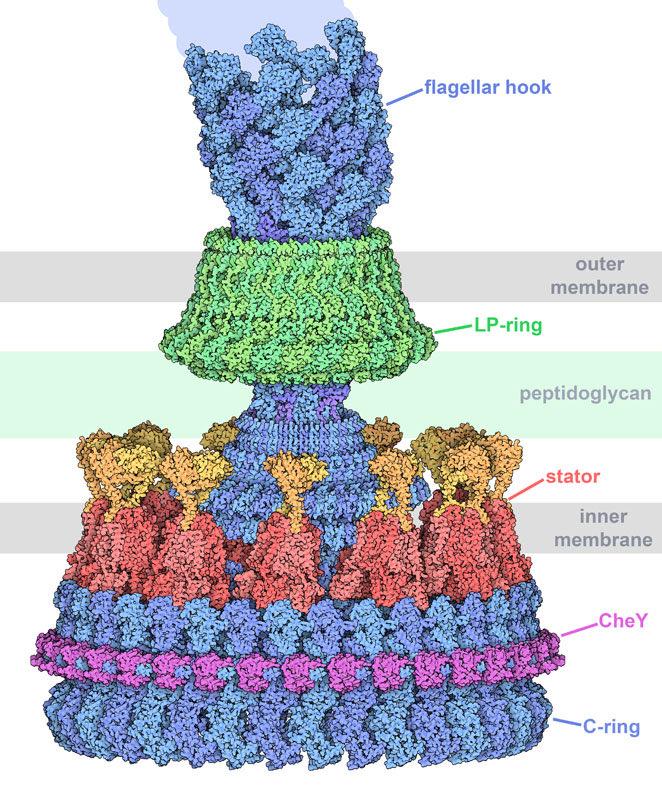
Brilliant nano-engineering like this loudly points to God, but it’s also a blow to simulation theory.
Such complexity at the cellular level, every cell being a miniature city, every bacteria requiring an actual motor to move, seems to me an insanely inefficient way to design a simulation, when you could simply program these things to move and operate the way they do.
If simulation theory is true, it seems to me we should see less physical complexity the closer we look, not more.
Natalie Wolchover@nattyover
Bacteria move around using a molecular machine called the flagellar motor that rotates faster than the flywheel of a race car engine and switches directions in an instant. After 50 yrs, scientists have finally figured out how it works. “My lifelong quest is now fulfilled.” Link⤵️
English
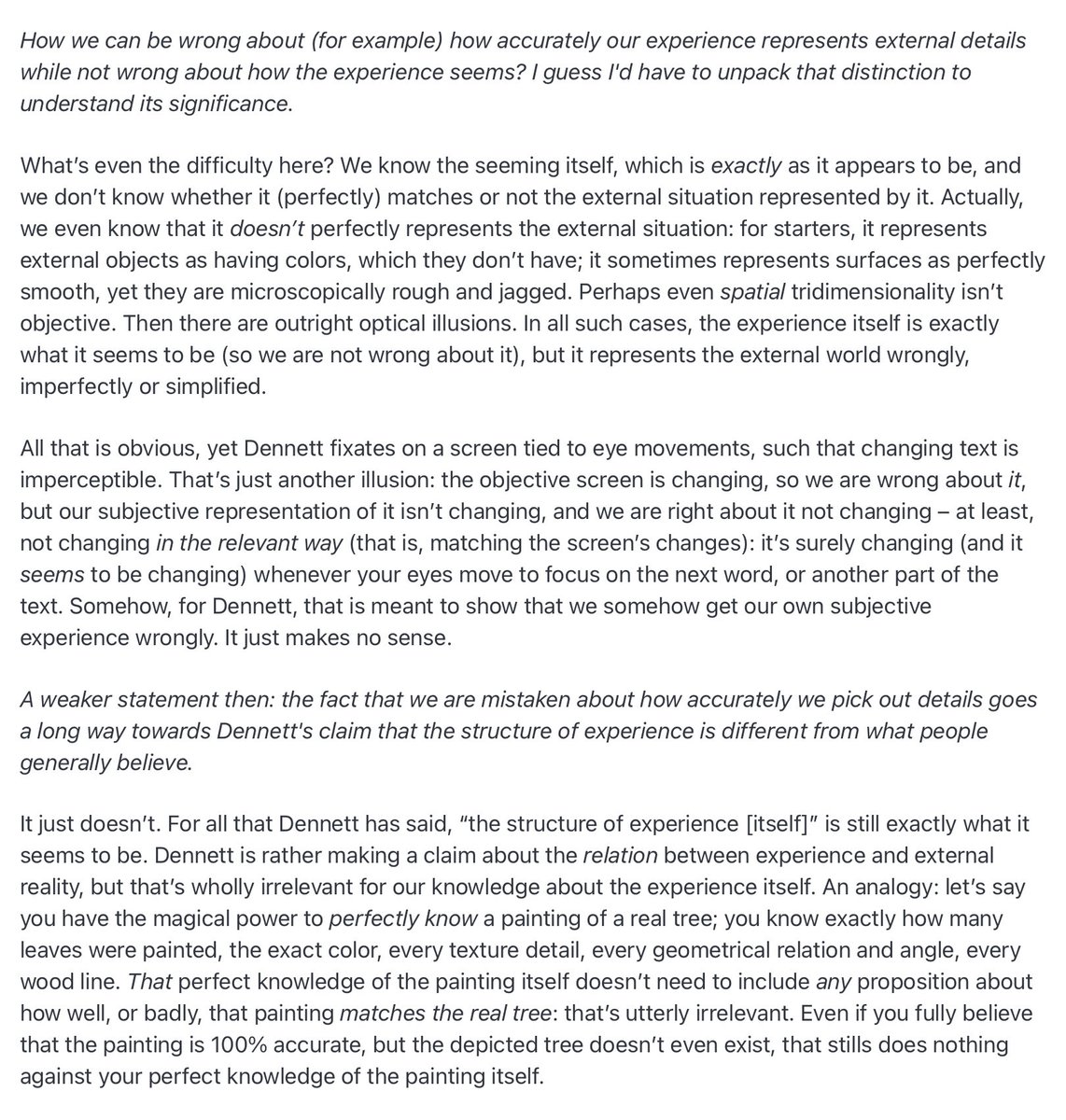
Interesting. What precisely was he still confused about? How we can be wrong about (for example) how accurately our experience represents external details while not wrong about how the experience seems? I guess I'd have to unpack that distinction to understand its significance.
A weaker statement then: the fact that we are mistaken about how accurately we pick out details goes a long way towards Dennett's claim that the structure of experience is different from what people generally believe.
English
@wijxixj @AndyMasley But that’s not being wrong about the very visual field, but about how accurately it represents external details. On *that* we are wrong a lot indeed. But it says nothing about how well we know consciousness itself. That point you just conceded, Dennett doesn’t. He *is* confused.
English
@OwlZphi @AndyMasley Mistaken about the richness of it in the sense of (in the example of the visual field) what details of the scene we actually pick out.
English
@wijxixj @AndyMasley …confused: our subjective experience (incl. visual field) *is the very appearance as such*. There’s no possible distinction between how it seems and how it is. So nothing that seems to be in our visual field CAN be illusory. Dennett confuses this with external causes of it. 2/2
English
@wijxixj @AndyMasley I can only honestly say that I *wish* I could enter the minds of people who think like you, for I can’t even form a conception of what is being thought. Read all of Dennett (and Hofstadter, Churchlands, others) to no avail. Here, for example, Dennett strikes me as clearly… 1/2
English
@modelsarereal @DrJohnVervaeke That’s not even true. There are no *representations* in a computer, just uninterpreted physical states, and causal correlation. It’s consciousness that can interpret such states *as* representing this or that. Just like money is just paper, its value being *projected* by us.
English

@OwlZphi @DrJohnVervaeke you can represent the number 4 in different ways in a computer: here some examples
binary : 100
string: "xxxx"
formal expression
"2+2"
every data has an individual kind of data representation.
in the computer and the brain
English

Most people view mental images as "inner pictures"...a seemingly intuitive notion since many experience visual-like imagery in their minds.
However, the existence of conditions like aphantasia (where individuals cannot form such visual images) complicates this perspective.
These individuals still navigate spatial questions effectively.
When asked to visualize a sunset, they may not "see" anything in their mind’s eye. Despite this, people with aphantasia can still reason spatially and navigate their environments.
For example, if you ask them: “In your bedroom, where’s the nearest window to the door?” they can accurately answer: “To my left.”
This means that the brain doesn’t need a literal picture in the mind but instead uses underlying processes to simulate spatial relationships.
English
@modelsarereal @DrJohnVervaeke “Like a computer, the brain *represents* data…” – so you do believe that a computer “represents data”, and it even follows that a computer is conscious too. Rather, a computer is pure hardware in motion, that’s all. But no point in me writing a book here to get things straight.
English
@OwlZphi @DrJohnVervaeke the subjective aspects come from the internal patterns in your brain. it is your subjective way how your hardware codes the data. the subjective data structure
English
@SpencrGreenberg I firmly believed that “human nature” (sex differences and the like) is shaped by culture. “The Selfish Gene” (Dawkins) and “The Blank Slate” (Pinker) flipped me 180, ~20y ago.
English

A question for you: what was one of the biggest changes in your beliefs that has happened in your life?
Bonus question: what was the cause of that change?
English
@modelsarereal @DrJohnVervaeke Do you *really* want to get to the bottom of this? For starters, you seem to think that the screen objectively “shows” numbers or bars (perhaps even colors). But it only emits photons. Actual numbers or bars only exist subjectively, constructed in the mind of conscious watchers.
English
@OwlZphi @DrJohnVervaeke think about a computer screen.
same data can appear as list of number or as bars with different heights.
the what it is like qustion has a clear technical answer:
the data structure.
English
@usablejam @_sevatar @allTheYud @deanwball It’s not “ancient philosophy” lol. Actual rationalism is alive and rocking. It *was* very stupid to call a de facto anti-rationalist movement “rationalism”, whoever is to blame for that. LWers are filthy extremist empiricists. 😅

English

@_sevatar @allTheYud @deanwball This is like complaining about physicists naming things such that you can split an atom. Who cares? No sane person spends an instant thinking about ancient philosophy.
English

I am aware that I follow some rationalist discourse norms (typically adverbs and adjectives used to describe my epistemics), but I have never been a rationalist in the contemporary internet sense, and my favorite philosopher’s most famous work is a biting critique of rationalism.


Eneasz Brodski@EneaszWrites
Guys, I want to see "variegated" make it into a post about weird vocab that rationalists use on the reg by next Inkhaven. don't let me down.
English
@robbensinger “Consciousness is fundamental” is overstated. What makes sense is physical stuff having some property *such that* natural selection could exploit it to make subjectivity – AND subjectivity has causal power, or it couldn’t evolve. Best bet. And low price: “physics isn’t complete”.
English

More re "Consciousness is fundamental":
"... And on the most popular versions of this view, the ghosts don't even change the dynamics of the particles. We just posit that some or all of Nature has a conscious 'side' or 'aspect' or 'inner nature', and the story ends there. So this doesn't even help solve the problem of how the particles making up our brain started thinking about consciousness or the hard problem in the first place!! We have made literally no progress, except that it feels more dignified to have a mysterious-sounding answer to give that matches the deep mystery of the question."
More re "Consciousness is fully reducible:
"... And there is no theory here that explains the data or makes sense of the arguments. There's just an enormous graveyard of failed attempts in this direction, none of which are supposed to deter us from continuing to keep the faith. And to be clear, these are all failed attempts to establish that this view is even possibly true, attempts to establish that any naturalistic account could reduce consciousness to unconscious structure or dynamics, without (overtly or covertly) drifting into non-realism or illusionism about phenomenal consciousness."
More re "Consciousness is an illusion":
"... And this one doesn't even sound logically consistent; like, how can something be an illusion without any conscious observer it's an illusion for? It really seems like a view whose sole appeal is that you get to play-act at being a cynical sober Scientist by denying the existence of things."
English
I think I'm the opposite. I think it makes complete sense that people are wildly confident about philosophy of mind in diametrically opposed ways, because there are reasonable perspectives that make all of the main alternative views look completely batshit crazy.
("Consciousness is a fundamental part of Nature": OK, so we're just accepting ghosts and sadness and the taste of bananas into our ontology alongside particle charge and spin?)
("Consciousness is fully reducible to nonconscious phenomena": OK, this one sounds the most reasonable at a glance, but if you've actually waded through the arguments ad nauseam then this view basically amounts to 'I've decided to just ignore all arguments on this matter and permanently assert the free-standing conclusion that sounds the least weird'.)
("Consciousness is an illusion": ... OK, this one's a joke, right? This is, like, the textbook example of the one claim we can know for sure is wrong, before we've even gone into theorizing about the world and its nature. I question whether you really understand what we mean by "consciousness" here.)
Andy Masley@AndyMasley
The idea of having very confident beliefs about philosophy of mind is kind of just completely alien to me. The only thing I'm especially confident about is that a lot of people have strong folk theories that don't tell us much.
English
(My own view is in the "Consciousness is an illusion" cluster.)
English
@wijxixj @AndyMasley …different. The core of the mystery: how subjective red can *possibly* emerge from objective extended bodies (in themselves colorless) interacting? It can’t, just like electromagnetic fields can’t emerge from *pure mechanicist newtonian physics*. So there’s more to physics. 3/3
English
@wijxixj @AndyMasley …description” is just our minds, again, interpreting the physics at some level of abstraction. And compare *any other form* of physical emergence: the brain itself, water, heat, hurricanes, fire – all *perfect entailed* by the subjacent physics. Consciousness is obviously… 2/3
English