g023
5K posts

Pinned Tweet

So I optimized the model, i optimized the harness, now I'm optimizing the endpoint by making an openai api to deepseek endpoint proxy that has some context compression features automatically integrated to attempt to save $$$ (works well with copilot):
gist.github.com/g023/c2bb7b540…
English
g023 retweeted

@antoniolupetti I'm working on a concept: an agent that maintains a large, external, sparse key-value memory (not vector database, but differentiable memory like a sparse Transformer memory layer) that is updated during a single long session compressing past into mem tkns & retrieve w/attention
English

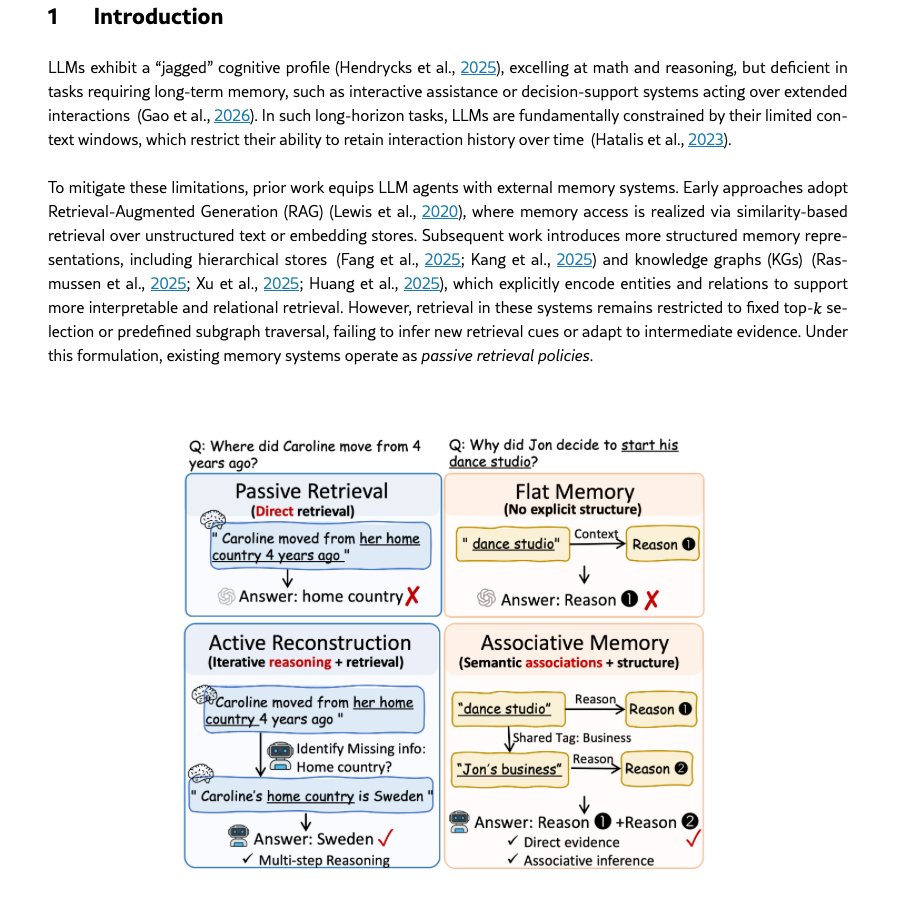
"Graph Memory for LLM Agents" is a recent paper that explores an idea that I find quite interesting. Most AI memory systems treat remembering as a retrieval problem (the model searches its memory, retrieves relevant information, and then reasons about it).
This paper argues that the process may be more dynamic than that and, instead of simply retrieving memories, an AI agent could reconstruct them during reasoning, following clues, associations, and intermediate evidence as they emerge.
What I find interesting is the possibility that memory and reasoning may not be separate processes at all, but that remembering itself could be part of reasoning.
arxiv.org/abs/2606.06036

English


@SolaTheAnalyst Try owning one in Calgary lol. Can't live without it, but you'll get taken to the cleaners.
English

@Sean_Speer Well considering AI is now being used in Alberta and BC to write all the police reports, guess what you'll be up against in court? These datacenters are for them, not you, but they'll be used against you for sure.
English

The Carney government gets it wrong on AI
This week, the Carney government released AI for All, its long-awaited national artificial intelligence strategy.
Although there are some useful aspects to the strategy—including the government’s recognition that Canada suffers too little AI adoption—its central premise is basically wrong.
The document repeatedly frames AI through the lens of “sovereignty,” including the need for greater control over AI infrastructure, data, and advanced models. But sovereignty is a poor organizing principle for Canadian AI policy.
Frontier AI development is increasingly concentrated among a handful of American and Chinese firms with capital budgets that exceed the annual spending of most national governments. The hyperscalers are investing hundreds of billions of dollars in chips, data centres, models, and talent. The notion that Ottawa can engineer a domestically controlled frontier AI ecosystem capable of competing head-to-head with those firms is an unserious starting point for Canadian policy.
University of Toronto economist @Afinetheorem has made the point particularly well. In his view, countries such as Canada face a simple strategic choice: they must find a way to become essential to either the American or Chinese AI stack. Attempting to recreate a fully sovereign stack of our own is neither economically realistic nor technologically plausible.
That insight exposes the main weakness of the government’s approach. The strategy contains pages of discussion about Canadian leadership, sovereignty, and domestic capacity. Yet it says comparatively little about how Canada will position itself within the global AI ecosystem that’s already emerging. There’s little discussion of guaranteed access to frontier models, Canada’s role in AI supply chains, or how Canadian firms can become indispensable partners to the companies building the world’s most advanced systems.
Canada has genuine advantages. We possess abundant energy resources, a strong research base, world-class universities, significant mineral assets, and geographic proximity to the United States. The goal should be to leverage those strengths to attract investment, host infrastructure, develop specialized applications, and deepen our integration into the North American AI economy.
Put simply: Canada’s AI future is more likely to depend on integration than independence. Yet if policymakers become so preoccupied with the political goal of sovereignty, they risk undermining the country’s place in the AI economy around taking shape.
The Hub@TheHubCanada
.@Sean_Speer: The Carney government gets it wrong on AI thehub.ca/2026/06/05/the…
English

@QuinnyPig 4.8 with a proper /goal command seems to be working fine for me.
English

@Tech2Wild Opus as orchestrator with deepseek as a subagent can be a pretty decent combination which can be a good way to stretch those limits.
English

@aidangomez BC and Alberta have started doing all the police reports using AI, so now that's what you are up against when you go to court. Get the government out of our AI.
English

Nick, Ivan, and I wrote a short piece on Canada’s role in artificial intelligence in the decades prior and the decades ahead. We as a country need to choose to compete to build, and resource ourselves to do that.
Our nation has the talent and ambition to succeed. Our former technology strategies across capital deployment and market adoption have failed. It’s time we take a more aggressive and strategic approach to capability development to ensure we control our destiny, protect our home, and build a foundation that gives the next generation advantage to build up.
There’s a bright future to be built if we’re willing to do what it takes to build it.
English

@yacineMTB I did a bunch of robotics stuff a few years ago, but burning the hardware out was hitting me in the wallet too much so I went back to the virtual world. Arduinos and Raspberry PIs definitely lowered the bar for entry and made it pretty fun.
English

Started out working on a structured sparse-attention idea and ended up focusing on a pure C inferencing project w/flash-decoding, so here is my glorious attempt for anyone else to use as they wish (for LFM2.5-8B-A1B @liquidai ). ~105tps/3060RTX-12GB
github.com/g023/cuda_inf
English