Princeton Policy

3.2K posts

Princeton Policy

Princeton Policy

@PrincetonPolicy

New Jersey, USA Se unió Mart 2018
139 Siguiendo151 Seguidores
Princeton Policy
Princeton Policy@PrincetonPolicy·
@biancoresearch They have a variety of options. Throttle back wells, let it spill in the desert, set it on fire, drain it into the Gulf, etc.
English
0
0
0
1
Glenn Beck
Glenn Beck@glennbeck·
I don't think President Trump should travel to China right now. @SenRickScott agrees: “I’m not gonna go. I don’t think it’s safe… They have elected to be our enemy. Think about how many Americans they’ve killed with fentanyl. They tried to destroy all of our companies. They’re threatening our allies. They’ve already taken over some islands from the Philippines, they threaten Taiwan all the time, and they steal organs from their own citizens. They put Jimmy Lai, a friend of mine, in prison, only because he ran a newspaper in Hong Kong before Xi illegally took away all the basic rights of the Hong Kong citizens. He's been in solitary confinement for five years. I admire President Trump. I admire his guts, and I would never bet against him. But I think that nothing good is going to happen.”
English
298
823
4.8K
201.5K
Princeton Policy
Princeton Policy@PrincetonPolicy·
@tparsi And does that push Pakistan into an alliance with Iran? Paks have nukes.
English
0
0
0
6
Trita Parsi
Trita Parsi@tparsi·
Pakistan steps up to mediate peace between the US and Iran, and the UAE - the close Israeli ally who claims to be a force for peace and a force against sectarianism - punishes Pakistan for its peacemaking by expelling Shia Pakistani workers. nytimes.com/2026/05/08/wor…
English
14
136
403
10.7K
Brett Erickson
Brett Erickson@BrettErickson28·
A new article published this morning by The New York Times brings to light how Russia is utilizing the Caspian Sea to held Iran evade sanctions and the blockade. “The landlocked body of water has taken on new significance, with Russia shipping military and commercial goods to bolster Tehran’s ability to withstand the U.S. assault.” “Bigger than Japan, the Caspian is considered the largest lake in the world. Much of the trade passing through it is opaque. It has proved difficult to monitor from afar, not least because ships plying the route between Russian and Iranian ports habitually turn off the transponders that allow for satellite tracking, according to maritime tracking groups. Unlike the Persian Gulf, the United States cannot interdict ships on the Caspian because only the five bordering nations have access.” nytimes.com/2026/05/09/wor…
English
4
0
5
416
Princeton Policy
Princeton Policy@PrincetonPolicy·
@gbrew24 Yes! And we can use that to our favor, if we get serious about analysis and strategy rather than the hysterical "Finish the Job" platitudes raining down on us. Here's serious regime change in Iran. If we're serious. princetonpolicy.com/ppa-blog/2026/…
English
0
1
0
25
Gregory Brew
Gregory Brew@gbrew24·
To some extent, the confused coverage of Iran's domestic situation stems from the fact that many are now just learning that the Islamic Republic does, in fact, have politics.
English
7
8
101
4.8K
Princeton Policy
Princeton Policy@PrincetonPolicy·
@marklevinshow As you told us, Iran collapsed two weeks ago because of the blockade and exploding wells. Oh, that hasn't happened?
English
0
0
0
5
Princeton Policy
Princeton Policy@PrincetonPolicy·
@TheStudyofWar Further, if gasoline prices reach $5.50 -- the oil shock level for the US -- then you should expect Iran to demand the resignation of Trump and Netanyahu. And they'll get it.
English
0
0
0
8
Institute for the Study of War
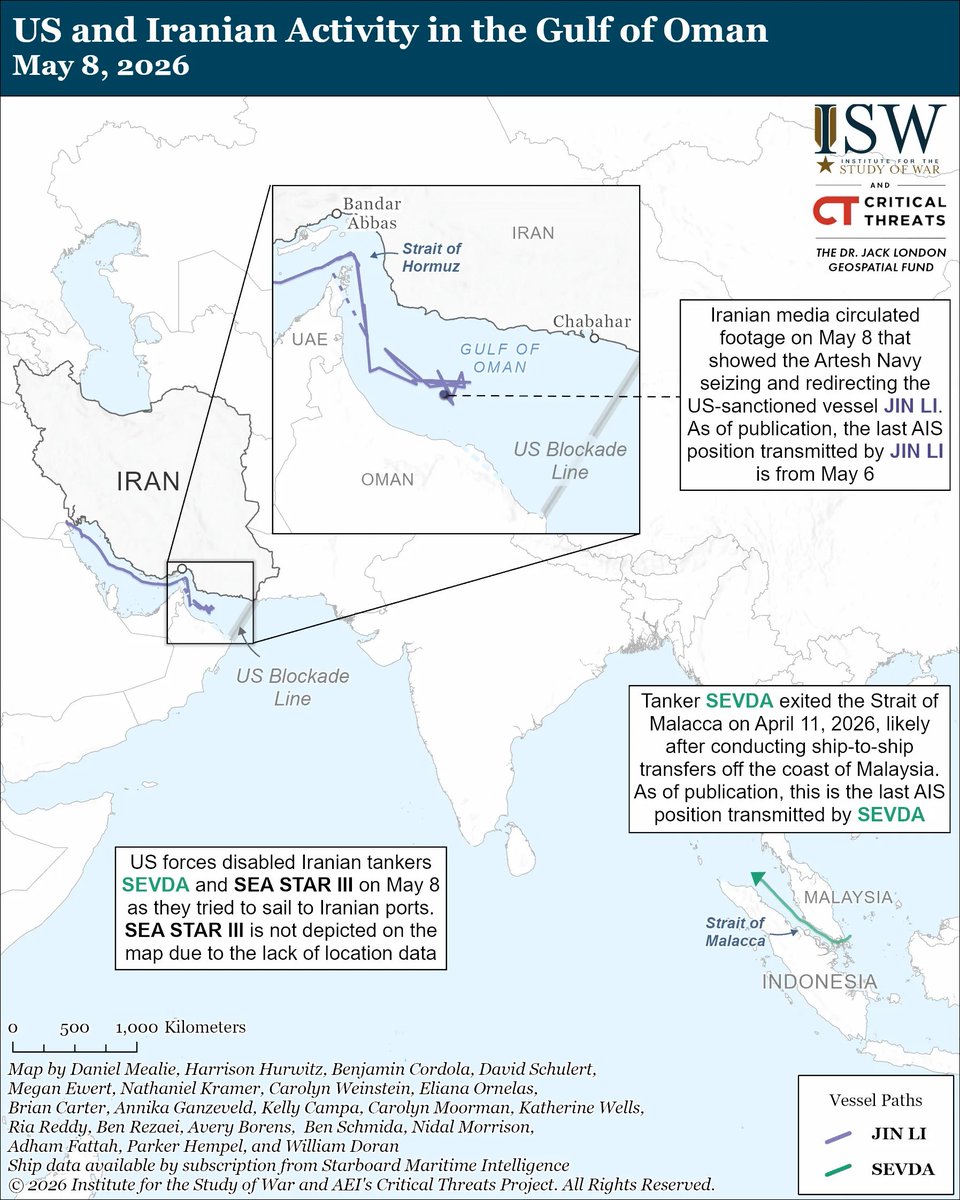
MORE: Iran’s growing reliance on the strait suggests that the regime may not concede over control of the strait in negotiations, which is consistent with ISW-CTP's ongoing assessment that some senior Iranian officials, including Islamic Revolutionary Guards Corps (IRGC) Commander Brigadier General Ahmad Vahidi who is currently driving decision-making within the regime, may prefer renewed confrontation over compromise if negotiations require Iran to relinquish control over the strait. Iran has continued to try to demonstrate its control over the Strait of Hormuz in order to sustain high global oil prices and pressure the United States into concessions. Iranian media circulated footage on May 8 that showed the Artesh Navy seizing and redirecting the vessel JIN LI in the Gulf of Oman. Iran likely uses vessel seizures to reinforce perceptions that it controls access through the strait. These seizures increase risks for commercial shipping and contribute to higher global oil prices. The United States has continued efforts to maintain an effective naval blockade against Iran as Iran continues to assert long-term sovereignty over the Strait of Hormuz. US Central Command (CENTCOM) announced on May 8 that US naval forces have redirected 57 vessels since the blockade began on April 13. CENTCOM also reported that US forces disabled two Iranian tankers, Sea Star III and Sevda, on May 8 after both vessels attempted to enter an Iranian port along the Gulf of Oman. Iran would have presumably used the tankers to expand its floating oil storage capacity as the US blockade continues to strain the regime’s ability to store crude oil. Iran has already reactivated older tankers and repurposed empty vessels as temporary offshore oil storage to alleviate some of the mounting pressure on onshore facilities.
Institute for the Study of War tweet media
Institute for the Study of War@TheStudyofWar

NEW: Iranian officials continue to frame control over the Strait of Hormuz as a key strategic interest and a critical component of long-term Iranian deterrence. Iran likely views control over the strait as essential to restoring deterrence against the United States and Israel following the degradation of its other forms of deterrence. Other Key Takeaways: The United States and Iran remain divided over key issues, particularly Iran’s nuclear program, the status of Iran’s highly enriched uranium (HEU) stockpile, and Iranian efforts to assert sovereignty over the Strait of Hormuz. The United States has continued efforts to maintain an effective naval blockade against Iran as Iran continues to assert long-term sovereignty over the Strait of Hormuz. Iran has continued to escalate rhetorically and militarily against the United Arab Emirates (UAE) amid Iranian attempts to portray the UAE as a hostile state supporting US and Israeli operations against Iran. Iran likely also seeks to demonstrate that continued US military actions against Iran will generate direct security and economic costs for Gulf states cooperating with the United States. Confidential Russian documents, seen by The Economist, revealed a Russian proposal to offer Iran several thousand drones and training for Iranian drone operators, which raises concerns about the proliferation of fiber-optic drone technology to Iran and its regional proxies. Some of these proxies have already demonstrated the ability to employ these systems against US and allied targets.

English
19
70
218
74.6K
Princeton Policy
Princeton Policy@PrincetonPolicy·
@TheStudyofWar "Iran’s growing reliance on the strait suggests that the regime may not concede over control of the strait in negotiations." Iran will concede anything for money. Are we offering them money? No. Then what do you expect?
English
0
0
0
6
Princeton Policy
Princeton Policy@PrincetonPolicy·
@McFaul He is tired and defeated. Remember, the Ukraine war was supposed to be about a weekend of sovereignty shoplifting in Iran. Now Moscow is stuck in the convenience store with the cops outside, and four years have passed.
English
0
0
0
85
Michael McFaul
Michael McFaul@McFaul·
Is it just me and my biases, or does Putin look tired and defeated here on the day of "victory"? What do you think?
Michael McFaul tweet media
English
412
182
1.2K
36.3K
Mario Nawfal
Mario Nawfal@MarioNawfal·
🇮🇷 Is Iran finally overplaying its hand? Iran already controls who gets to move oil and gas through the Strait of Hormuz. Now, according to Fars, it wants to do the same thing to the internet, forcing foreign cable companies to get permits, pay fees, and follow Iranian law just to keep their undersea cables running through the strait. Those cables carry around 15–20% of global internet and financial data traffic between Europe, the Gulf, and Asia. Think about that for a second. One narrow strip of water, and Iran would be sitting on top of both the energy flows and the data flows. You want your oil through? Pay up. You want your internet through? Pay up. It worked on shipping. They know it worked. And now they're trying to run the same move on the global internet.
Mario Nawfal tweet media
Mario Nawfal@MarioNawfal

🇺🇸🇮🇷 Zero commercial vessels transited the Strait of Hormuz in the past 24 hours. Before Operation Epic Fury launched on February 28th, that number averaged around 140 ships per day.

English
159
117
526
286.2K
Princeton Policy
Princeton Policy@PrincetonPolicy·
@mikepompeo If Iran keeps the Strait, it will in effect step into OPEC's shoes as a single player. Together with Russia, Iran will control 2/3 of global oil exports and be able to set global prices with some latitude. The Gulf exporters, odd as it may seem, may welcome it.
English
0
0
0
5
Mike Pompeo
Mike Pompeo@mikepompeo·
Too many people who should know better claim energy prices will drop if we would only take the pressure off Iran. The precise opposite is true: taking our foot off the gas would embolden the Iranian regime to hold the global economy hostage whenever it suits them.
English
87
159
931
34.4K
Senator John Cornyn
Senator John Cornyn@JohnCornyn·
Quite an argument, Chris. Do you realize you have criticized a deal that you say is “very unlikely” i.e., not likely. We need to finish defanging the Islamist regime and come home.
Chris Murphy 🟧@ChrisMurphyCT

I want this war to end - now. And I want a deal that constrains Iran's nuclear program. But what we are learning is that any deal Trump gets - and a deal is still very unlikely - is going to be WAY worse than the nuclear deal he cancelled a decade ago. 1/ Here's what we know:
English
26
1
16
2K
Gregory Brew
Gregory Brew@gbrew24·
US originally said they expected Iran's response to the latest US proposal on Thursday. That didn't happen. Trump and Rubio then said they expected the response on Friday. Didn't happen. Iran is taking its time preparing a response. Meanwhile, silence. No Trump posts threatening Armageddon. No new deadlines. US seems content to wait.
English
39
48
331
32.3K
Princeton Policy
Princeton Policy@PrincetonPolicy·
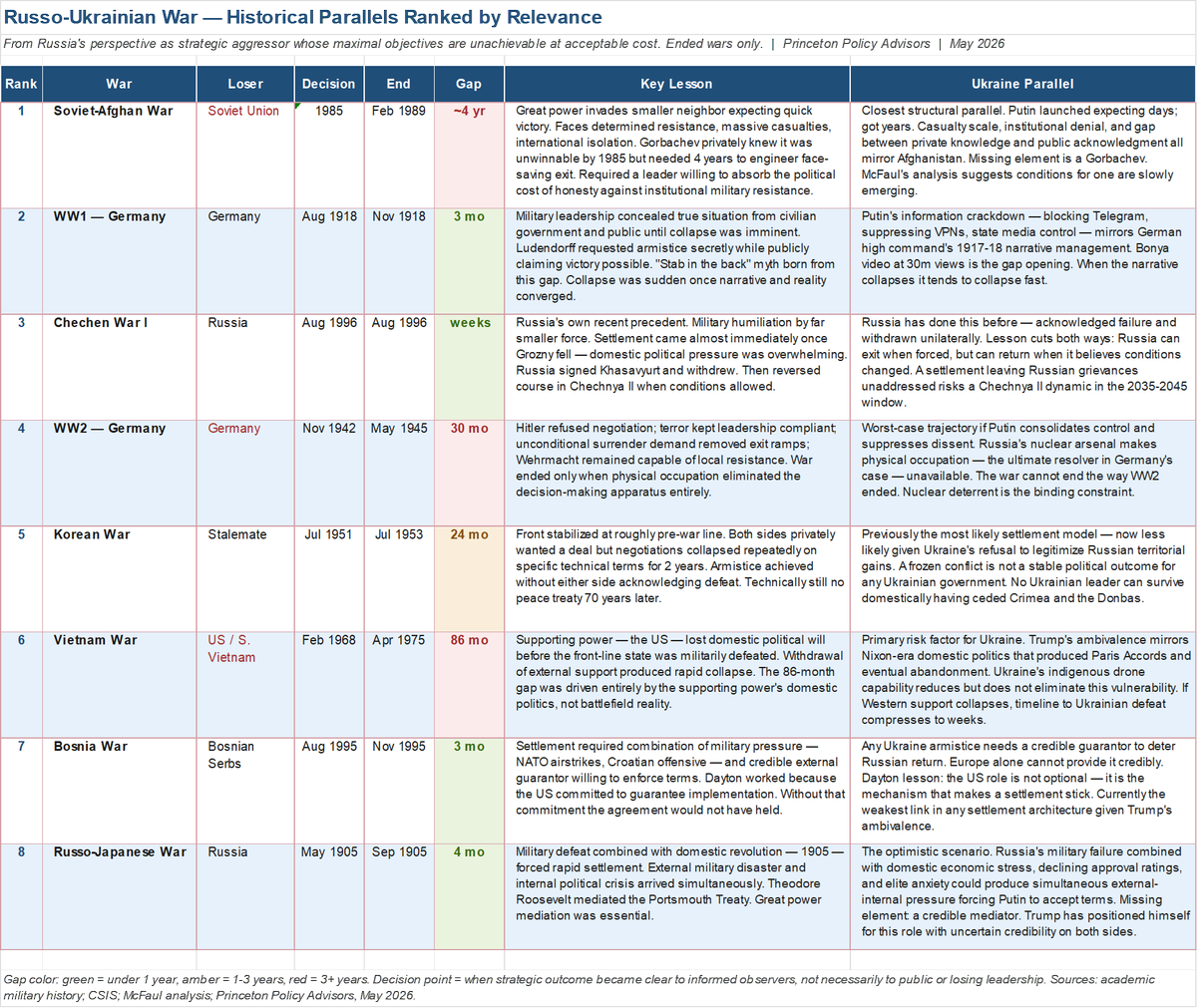
@McFaul The cracks do seem to be forming. How long from then to the end of the war, assuming it means Russian withdrawal? Here's an analysis. The range of outcomes is very wide. Perhaps the closest analogy is Afghanistan. Russia (SU) exited 4 years after Gorbachev felt the war lost.
Princeton Policy tweet media
English
0
1
0
20
Princeton Policy
Princeton Policy@PrincetonPolicy·
@McFaul However, the Afghan war was different, because Russian losses were light. At the current pace of losses, I would guess we're looking at an 18-24 month horizon to Russian withdrawal. But that's hardly better than a guess.
English
0
1
0
17
Michael McFaul
Michael McFaul@McFaul·
Your weekend read! Growing Cracks in Putin’s Dictatorship Predictions of Putin’s demise have been wrong many times before, but something is happening in Russia now that deserves more attention. Full story: michaelmcfaul.substack.com/p/growing-crac…
Michael McFaul tweet media
English
8
79
221
8.8K
Filip
Filip@Vaiconalma_·
@miadmaleki @EhsanZareei How come CIA assesses they can survive another 3-4m before economic hardship? Oil shuts in earlier, remaining forex reserves are already extremely low
English
7
0
12
19.3K
Princeton Policy
Princeton Policy@PrincetonPolicy·
@DrEliDavid @EfratLachter Because, remember, a global economic oil shock is an acceptable price to pay for an additional 5-10 years of nuclear moratorium for Israel. That seems to be your argument.
English
0
0
0
9