SMB Healthcare PE

2.5K posts

SMB Healthcare PE banner
SMB Healthcare PE

SMB Healthcare PE

@roblarson

Healthcare SMB acquisitions and Healthcare mid-market PE. Tweets about business strategy, science, and disrupting healthcare.

Inscrit le Temmuz 2007
685 Abonnements434 Abonnés
Tweet épinglé
SMB Healthcare PE
SMB Healthcare PE@roblarson·
7 questions on healthcare private equity deal environment! A media department reached out this morning with questions about the current deal environment. My answers below: 1. What do private equity investors find attractive about the healthcare space? - Most importantly, it’s a profitable market driven by underlying regulatory barriers to competition. That’s why dental practices rarely fail, while retail stores fail all the time. - In addition, you have a third party payment mechanism that separates the decision maker from the payer, resulting in healthcare spending that persistently grows at a faster rate than the overall economy. - Finally, you have economic inefficiencies all over in healthcare, so there are lots of economic rewards for those who can fix problems in the current system. 2. What are the drawbacks and risks of investing in healthcare right now? - The biggest issue *right now* is that there is regulatory and payment uncertainty given some of the statements and predictions that have been made about the DOGE effort and its potential impact on Medicaid and Medicare. That uncertainty is having a chilling effect on investment activity. - More generally, healthcare investors must always be careful with any impact they are having on patient outcomes and wellbeing. Otherwise you risk causing real harm to people (not to mention the headline risk and bottom line impacts that follow). Healthcare solutions that aren't well thought-through can have unintended consequences that are bad for everyone, especially the customer. 3. How is the Trump administration, and the sweeping changes they have already begun to make, expected to impact this sector, if at all? - Nobody knows for sure, but there is talk about significant cuts to fraud, waste, and abuse in Medicaid and potentially Medicare. The numbers that are being mentioned are large enough to suggest that “waste” might be interpreted broadly. And regardless of the type of cuts or how warranted they may be, that is potentially substantial industry revenue that might get pulled from the sector, which will have an impact. - In addition, there have been talks of potential healthcare regulatory changes such as PBM reform, FDA reform and/or resource availability, and potential restrictions on DTC pharma advertising, all of which would impact current business models. - On top of that you have other potential broader policy changes such as increased tariffs (which impact med tech, equipment and supplies companies, but also impact healthcare providers’ supplies costs), M&A regulations, immigration (which may impact staffing), and M&A regulations. 4. What do valuation multiples for healthcare deals look like? And how has that changed/is it expected to change? - Valuation multiples range widely right now – we’ve seen multiples in the single digits for either lower-quality or retail-heavy assets, and multiples in the 20’s for high-quality assets. There has been more of a focus on high-quality assets on the part of buyers, so that middle-tier and lower-quality assets aren’t getting as high multiples now as they did a few years ago, while the highest quality assets are trading at very high prices. 5. What does the opportunity set look like in the middle-market specifically? - The middle-market’s relationship to the top end of the market is similar to previous years, except that you are seeing more middle market investors emerge and more middle-market investors are showing a willingness to extend down into the lower end of the market in their search for deals. 6. There is a huge backlog of deals that has resulted from the dearth of M&A activity in recent years. Will healthcare deals comprise a significant number of the M&A deals expected to come to market? - Investment bankers are predicting that it will. And even though I don’t think I’ve ever heard an investment banker forecast that the deal market is not going to be stronger next quarter than the current quarter, I suspect they are correct. Certainly there are a lot of healthcare assets in portfolio companies that need to be sold, and LPs are asking for their money to be returned before investing in a new fund, all of which suggests that deals are going to heat up compared to recent levels. We have also seen a lot of requests for sellside work, which suggests a good number of assets coming to market later this year. 7. What is the impact of AI on the healthcare sector and is it changing the way PE firms look at companies in this space? - So far it is mostly a “future” thing, though we have seen AI show up in tech-enabled services such as imaging/radiology and in helping data companies pull insights out of unstructured data such as physician notes and discussions. Increasingly it’s expected to play a bigger role in other tech-enabled services such as revenue cycle management and other business process automation. - Down the road, there is potential for a significant impact in the healthcare software space, as software functionality becomes easier to copy and reverse engineer with AI developer tools, leading to a proliferation of software vendors, and driving downward pressure on both pricing and future development costs. Barriers to switching such as network effects, switching costs, and the mission-criticality of the software, along with barriers to functionality copying such as proprietary data and partnerships will protect against such effects, and we expect investors to increasingly focus on those attributes when evaluating healthcare IT opportunities as a result.
English

4
2
21
1.3K
Mike Botkin
Mike Botkin@MikeBotkin_·
Here is my contribution of the day. The industry that I tried rolling up but could not gain traction? Residential irrigation. I love...(repeat)...LOVE residential irrigation. A-MAZ-ING business. I just could not get traction/momentum. I hope somebody sees this and does it. Send me a check when you sell for $$$$$$
English
19
0
33
6.1K
Elvis
Elvis@elvissun·
sorry X friends i’ve been sort of mia this week heads down closing deals. best revenue day yet btw founding discount ends tomorrow midnight if you want PR for your business this is your last chance - 60% off forever then it's gone
English
5
0
13
2.4K
Max Morton
Max Morton@maxmorton6GDM·
Is anyone running cattle operations in S. Arizona now? Dairy? Pork? Poultry?
English
7
3
16
2.8K
J.D. Banker
J.D. Banker@DadInvest·
If CBS is worried about down ratings, I’d work on improving the product - these games are terrible. None of these elite 8 games have been decided by less than a 10pt margin - in addition to the absence of any Cinderella, there is no rooting interest for a casual fan in 30 point blowouts.
English
14
0
22
6.6K
Dutch Rojas
Dutch Rojas@DutchRojas·
Two years ago we ignored the experts and built something different. Our clients haven’t paid standard market rates since. We started putting hospitals and surgical practices together for employers who were tired of being told the price is the price. It wasn’t complicated. It was just uncomfortable for the people who profit from the current arrangement. This year we’re doing it with churches, manufacturers, HVAC companies, and plumbing contractors. The solution to outrageous health benefits costs has never been a better broker. It’s been employers who finally decide the pain is no longer acceptable. That decision is available to every company in America. Most just don’t know it yet…
AtlasMD@AtlasMD

The average invidual spends nearly $9k/yr on ins and nearly $26,000 per family/yr. Direct Primary Care can cost $75/mo For $900/yr you get unlimited same-day visits, your doctor's cell number, and wholesale labs. The math isn't complicated. The system is. #DirectCare

English
2
12
79
5.6K
Ole Lehmann
Ole Lehmann@itsolelehmann·
i made a 3-day Claude Cowork for Beginners course, and it's yours for free by the end, you'll have a personalized AI teammate on your computer that: • knows your style • connects to your tools • and produces finished work you can send immediately here's what you get: day 1: install cowork, set global instructions, and run your first real task (15 min) day 2: workflows that replaced hours of my week, including building landing pages from a description and running full competitive analyses in one prompt day 3: skills, plugins, and connectors so cowork actually knows how you work and can access your tools + copy-paste prompts so you can follow along as you read like + comment "COWORK" and i'll DM it to you
Ole Lehmann tweet media
English
1.8K
182
2.9K
173.6K
SMB Healthcare PE
SMB Healthcare PE@roblarson·
@EricRWeinstein @HartLabs Eric - respectfully - to be convincing I think you need to paint a clearer, more vivid picture of what you have in mind and what it would look like in practice. Saying "Coase solves this" is pricking people's curiosity but isn't giving people's minds enough to hold onto.
English
0
0
0
31
Eric Weinstein
Eric Weinstein@EricRWeinstein·
And there are even more details than that. Pick one. You have a rolling supply of rights so people get diluted over time. Or you print a cap On rights at the beginning Bitcoin style. Or whatever. You treat it as a detail. Good points. But not central yet. People don’t know This framework even exists. You are jumping the gun here imo.
English
7
0
26
2.3K
SMB Attorney
SMB Attorney@SMB_Attorney·
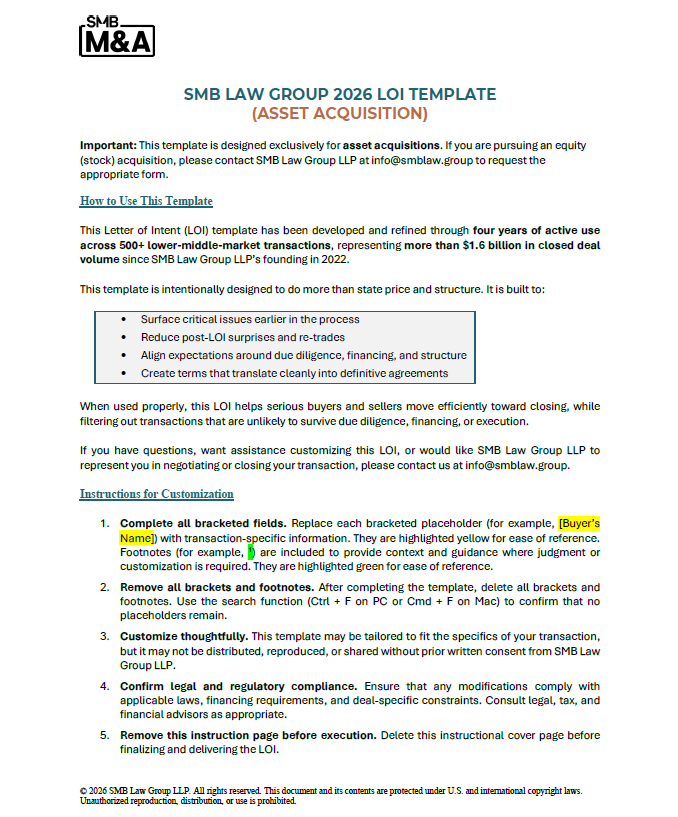
We just released our 2026 Lower-Middle-Market LOI Template. Built from: > 500+ deals > $1.6B+ closed > And the busted ones It’s designed to reduce retrades and increase close probability. If you want the template, comment: LOI We’ll auto-DM you the download link. We’re on a mission to build the #1 LMM M&A firm and the #1 provider of value in the space.
SMB Attorney tweet media
English
639
16
286
69.6K
PEoperator⚡️
PEoperator⚡️@PEoperator·
Private equity MDs to CEOs of underperforming portcos.
PEoperator⚡️ tweet media
English
8
26
394
21K
SMB Healthcare PE
SMB Healthcare PE@roblarson·
Thanks - banger of a post BTW. Thought provoking and real. The kind of situation the young CFO probably never imagined he'd be in when he raised his hand. And what a great learning experience for your friend. That's the real world right there. Not PowerPoint slides and models but real world egos and uncertainty and persuasion. He will draw on lessons learned during this episode for the rest of his career.
English
0
0
0
13
PEoperator⚡️
PEoperator⚡️@PEoperator·
@roblarson 🔥 Agree- this is absolutely the best path. Said as much in one of my replies.
English
1
0
1
189
SMB Healthcare PE
SMB Healthcare PE@roblarson·
In this situation your job is to convince the MD as to the correct course of action. If you aren't sufficiently convincing then you probably haven't looked at the problem from enough angles. You probably haven't gone deep enough into bedrock principles of competitive strategy. In fact you might not even be correct. The MD might be correct to not accept your conclusions just yet. Ask yourself if Steve Jobs would be able to convince him in your shoes, or Warren Buffet. Or Michael Porter, or Clayton Christensen. Teach yourself to analyze the company's strategic questions to the depth and multiplicity of angles that they would, and teach yourself to persuasively communicate it like they would. That's the job. Figuring out the answer isn't enough. Figuring out the answer (and how to communicate it) so deeply that you can convince everyone - from the stubborn MD to the lowly front line worker - is what is required.
PEoperator⚡️@PEoperator

Talked to a new-ish private equity portco CFO the other day... He was dropped in from the PE firm - had previously been an associate. The deal was going sideways and he wants to be an operator, so he raised his hand to step in. (Btw, this is a great way to transition into an operator role if that's your goal, especially if you're on the younger/less experienced side.) Back to the story- this was a tough assignment. Clear turnaround situation. His main observation after a few months: the company had done what the MD told them to do for years and it just didn't work. Bad investment, bad strategy, bad operating. He was frustrated because the MD had zero self awareness. And now, he himself was somehow part of the problem just a couple months in... MD is screaming and yelling and carrying on. Constantly wanting to change out people (having already fired CEO, CFO). Just pushing pushing without any new direction. Doubling down on the same ideas. Blaming everyone but himself. I'm sure there have been plenty of mistakes by plenty of people to get to this point. But at some point, the buck stops somewhere. This MD runs the firm and this deal - approved the investment, designed the capital structure, directed management, etc. - but there has been zero admission of guilt or willingness to pivot. Definition of hubris. I was in a similar situation earlier in my career. It's a tough spot when your boss won't admit mistakes or pivot and instead blames others. It leaves the organization paralyzed - scared of trying new things and certain the old things won’t work… If you find yourself in that situation, good luck. Continue doing a great job amidst the tensions you’re facing. Go the extra mile. And importantly, recognize that whoever is flailing their arms above you- that person is a human being. Different people take different approaches. Sometimes they are just trying to create urgency with the screaming and yelling. Try not to take it personally. But more often than not, it’s just a human being- probably scared, insecure, frustrated, and embarrassed - who doesn’t really know what to do either. Treat them as you would any human- with respect and compassion. Do an excellent job. But based on your evaluation of the situation and the leader, it may be prudent to move on. Don’t waste your life working for temperamental losers. And as you evaluate joining a new firm/portco, ask questions about how folks handle conflict and try to talk to others who have been on deals that didn't go as expected. You can’t always learn everything beforehand, but those could be revealing conversations.

English
1
0
1
525
PEoperator⚡️
PEoperator⚡️@PEoperator·
Talked to a new-ish private equity portco CFO the other day... He was dropped in from the PE firm - had previously been an associate. The deal was going sideways and he wants to be an operator, so he raised his hand to step in. (Btw, this is a great way to transition into an operator role if that's your goal, especially if you're on the younger/less experienced side.) Back to the story- this was a tough assignment. Clear turnaround situation. His main observation after a few months: the company had done what the MD told them to do for years and it just didn't work. Bad investment, bad strategy, bad operating. He was frustrated because the MD had zero self awareness. And now, he himself was somehow part of the problem just a couple months in... MD is screaming and yelling and carrying on. Constantly wanting to change out people (having already fired CEO, CFO). Just pushing pushing without any new direction. Doubling down on the same ideas. Blaming everyone but himself. I'm sure there have been plenty of mistakes by plenty of people to get to this point. But at some point, the buck stops somewhere. This MD runs the firm and this deal - approved the investment, designed the capital structure, directed management, etc. - but there has been zero admission of guilt or willingness to pivot. Definition of hubris. I was in a similar situation earlier in my career. It's a tough spot when your boss won't admit mistakes or pivot and instead blames others. It leaves the organization paralyzed - scared of trying new things and certain the old things won’t work… If you find yourself in that situation, good luck. Continue doing a great job amidst the tensions you’re facing. Go the extra mile. And importantly, recognize that whoever is flailing their arms above you- that person is a human being. Different people take different approaches. Sometimes they are just trying to create urgency with the screaming and yelling. Try not to take it personally. But more often than not, it’s just a human being- probably scared, insecure, frustrated, and embarrassed - who doesn’t really know what to do either. Treat them as you would any human- with respect and compassion. Do an excellent job. But based on your evaluation of the situation and the leader, it may be prudent to move on. Don’t waste your life working for temperamental losers. And as you evaluate joining a new firm/portco, ask questions about how folks handle conflict and try to talk to others who have been on deals that didn't go as expected. You can’t always learn everything beforehand, but those could be revealing conversations.
English
9
4
142
60.7K
Tanay Kothari
Tanay Kothari@tankots·
We offered 5 people a Porsche 911 GT3 RS if they could get @WisprFlow to make a mistake It's the fastest and most accurate AI voice dictation app that's 3x more accurate than ChatGPT, Claude, or Siri. Today, we’re finally launching on Android. Download now: play.google.com/store/apps/det… As a part of the launch, we’re giving away 6 months of Wispr Flow Pro for free. Like, retweet and comment ‘Wispr Flow’ to get it. Enjoy. — Written with Wispr Flow
English
4.6K
3.1K
10.8K
4.3M
Puru P
Puru P@Purush168·
Exactly right — the Change Healthcare outage exposed single-point-of-failure risk at national scale and accelerated multi-vendor redundancy strategies across RCM stacks. Hospitals now demand SOC 2 Type II + HITRUST plus proven uptime SLAs before layering any AI module; the real ROI is inside Epic/Oracle/Cerner via denial prediction models and auto-rebill workflows that leverage existing trust.
English
1
0
2
16
SMB Healthcare PE
SMB Healthcare PE@roblarson·
This is a great articulation of the value interplay between feature/middleware software and AI. When software capabilities become a commodity (which is the future AI is rapidly driving us toward) then trust is what drives value. Anyone who works in healthcare will tell you that hospitals will not be abandoning Epic for unproven AI-generated software even if the latter is free. Even if you paid them $1M to use it. Similar (to slightly lesser extent) for the RCM payment rails. Especially after the Change Healthcare fiasco. No hospitals will take an existential risk on startups offering cheap (even free) AI-generated code. The main role of AI will be to make trusted software brands more efficient, not to give rise to an army of AI healthcare startups. The exception will be serving new startup doctor practices willing to take a chance to save on software costs. Then the best-performing firms serving this niche will grow to become the next generation of trusted software brands.
BullBrezza | Macro & Crypto@BullBrezza

You are half right. And the half you are missing is worth billions. Every generation has a moment where the 'middleware' looks doomed. In 1994, everyone said ISPs were dead on arrival — why pay for internet access when the infrastructure would commoditize? Then AOL hit 30 million subscribers and sold for $164 billion. In 2008, everyone said payment processors were toast — open banking would kill the middleman. Stripe was founded anyway. Now it's worth $65 billion. The pattern isn't 'services die.' It's 'bad services die. Trusted services become infrastructure.' Here's what the 'agents will rebuild everything cheaper' thesis misses: Agents still need *trust rails.* Stripe isn't valuable because it moves money. It's valuable because 10 million businesses trust it won't break on Black Friday. Vercel isn't valuable because it deploys code. It's valuable because it doesn't go down when your product goes viral at 2am. AI can reprice capability. It cannot reprice *reliability reputation* built over a decade. The companies that survive this aren't the ones with the best features. They're the ones that became the *default answer* when something absolutely cannot fail. Commodity is a cost question. Trust is a different market entirely. The graveyard of tech is full of cheaper alternatives that nobody used.

English
1
0
0
46
SMB Healthcare PE
SMB Healthcare PE@roblarson·
@BullBrezza @chamath This is a great articulation of this critical point. And doubly true in critical areas like healthcare software.
English
0
0
3
150
BullBrezza | Macro & Crypto
BullBrezza | Macro & Crypto@BullBrezza·
You are half right. And the half you are missing is worth billions. Every generation has a moment where the 'middleware' looks doomed. In 1994, everyone said ISPs were dead on arrival — why pay for internet access when the infrastructure would commoditize? Then AOL hit 30 million subscribers and sold for $164 billion. In 2008, everyone said payment processors were toast — open banking would kill the middleman. Stripe was founded anyway. Now it's worth $65 billion. The pattern isn't 'services die.' It's 'bad services die. Trusted services become infrastructure.' Here's what the 'agents will rebuild everything cheaper' thesis misses: Agents still need *trust rails.* Stripe isn't valuable because it moves money. It's valuable because 10 million businesses trust it won't break on Black Friday. Vercel isn't valuable because it deploys code. It's valuable because it doesn't go down when your product goes viral at 2am. AI can reprice capability. It cannot reprice *reliability reputation* built over a decade. The companies that survive this aren't the ones with the best features. They're the ones that became the *default answer* when something absolutely cannot fail. Commodity is a cost question. Trust is a different market entirely. The graveyard of tech is full of cheaper alternatives that nobody used.
English
6
3
60
7K
Chamath Palihapitiya
Chamath Palihapitiya@chamath·
It should be obvious to anyone that reads the list below that many of these companies will not survive as companies in a world of AI and Agents. These are services. Some more useful than others. But none of them control any capability or rails that couldn’t be negotiated/built (from open source or otherwise) by an agent for much cheaper. The alternatives will come with no capex, no OpEx, no rent seeking etc etc. The cost advantages of these things being rebuilt as primitives and repriced so it’s principally available to other agents and AI is pretty obvious.
Sahil@sahill_og

- Claude for coding. - Supabase for backend. - Vercel for deploying. - Namecheap for domain. - Stripe for payments. - GitHub for version control. - Resend for emails. - Clerk for auth. - Cloudflare for DNS. - PostHog for analytics. - Sentry for error tracking. - Upstash for Redis. - Pinecone for vector DB. You can literally ship a startup from your bedroom now. It’s not that deep bro.

English
208
136
2.1K
851.6K
Sina Sojoodi
Sina Sojoodi@sinasojoodi·
@csigns @chamath When you use Software Factory to build the app, you own it post creation. Software Factory helps you maintain and evolve it.
English
1
0
1
221
Chamath Palihapitiya
Chamath Palihapitiya@chamath·
Here is a cold email I got from Russell Straub last night about 8090. I asked him if I could share it. Who is Russell Straub? He’s a version of many of us: entrepreneur, more than 25 years in business, a capable team, looking for a way for himself and his team to grow through AI. If 8090 can help businesses like Russell’s thrive through the AI transition, we can help many millions of employers and employees and it will have been time well spent. “Chamath! After hearing you talk about it for many months, I was intensely curious to see if 8090 could be the platform to enable our small dev team of seven to 10X themselves! I personally had not coded anything since the late 1990's, but created my account Sunday morning and dove in! Instead of trying to pilot a project from our dev queue, I decided to start with a blank slate. I had a very basic document outlining the concept for a mobile app that one of my co-founders drafted in 2017, but we never had the time or bandwidth to pursue.  I think I just copied and pasted the 6 pages of text into the starting prompt.... 8090 attacked it aggressively, peppering me with questions and suggestions and very rapidly the Refinery cranked out an impressive set of requirement docs. I was impatient, so quickly moved to the Foundry where I continued to crank out blueprints! Then to the Planner where I was initially deflated when it asked me about my dev team and I sheepishly responded that I was hoping to use an AI agent to do the actual coding, but was quickly relieved when it responded with enthusiasm and suggested I use Cursor and GitHub. So...away I went!  (I had never used Cursor or GitHub but created accounts and had them up and running on my MacBook within minutes!) It was thrilling to see components come to life super fast... I just kept plowing ahead, everytime 8090 stumped me with a question I didn't even understand, I would just ask what it suggested - and it would give me a plain english recommendation - I'd approve it - and away we went! Anyway - I was so energized I corralled 5 of 7 dev team members for a zoom call at 11:30 am to walk them thru the capability.... Bluntly told them that my perspective as an outsider to the dev team was that we had 2 bottlenecks - one at the front of the team where the creation of requirements and wireframes are painfully slow and the backend of testing/QA/deployment.  (coding itself is probably infinitely fast and NOT the bottleneck). Lots of pushback on concerns about getting the platform "familiar" with our entire codebase, and the shortcomings of creating accurate GUI or wire frames.... BUT - my strong suggestion was for at a minimum for our primary requirements writer to dive in and give it a try - and be amazed! I've been a broken record for over a year saying that "AI is definitely going to make our business model obsolete - I just hope it's not this week!"  Our business is 26.5 years old.  I'm still amazed and thankful and grateful we've made it this far. I still think we have an incredible opportunity right in front of us to take advantage of AI to transform our business and transform our marketspace and maybe become a leader or THE leader! Every day is pretty dang exciting!” Try it here: 8090.ai
English
54
23
437
122.2K
SMB Healthcare PE
SMB Healthcare PE@roblarson·
Here's an image of the culture you are describing. I don't think that's a coincidence - I think a lot of American culture is influenced by our cowboy & homestead farmer roots. Go back a couple centuries and 90% of Americans worked in agriculture. And not community rice farms where success depended on your ability to prioritize the collective. But rather single-family homestead farms and ranches where success depended on your ability to be self-sufficient, independent, and resourceful, while retaining a reputation of integrity with the broader community.
SMB Healthcare PE tweet media
English
2
0
1
74
Hunter Ash
Hunter Ash@ArtemisConsort·
I’m tired of my culture being defined as, essentially, an absence of culture. “American culture is pluralism” is an assertion that American culture is nothing. This is false. Our culture is a specific way of life created by a specific people. Our culture is honesty, honoring not just the letter but the spirit of our commitments rather than looking for loopholes, responsibility, a sense of guilt at imposing on other people, an abiding suspicion of government overreach, a desire to be left alone, open friendliness, blunt talk rather than polite euphemism, the Christian and Hellenic intellectual, spiritual, and aesthetic traditions, and much more. It is rich and specific and while there are natural Americans of non-Anglo background, they are rare outliers, usually outcasts and eccentrics in their native cultures. Most humans on Earth are not at all temperamentally suited to participate in American culture and to the extent they are allowed to come here, America becomes less American. The people telling you that American culture is nothing, that it’s some vague bumper sticker slogan or post-1960s platitude are people who do not fit in actual American culture and so wish to eliminate it, wish to impose alienation on the American people as revenge for their own correct sense that they don’t belong here, aren’t one of us, could never be one of us.
English
104
255
2.1K
35.7K
David Ch
David Ch@chhddavid·
BREAKING: @claudeai just got a massive upgrade today and I'm so happy to be a part it. From now on, Claude Opus 4.6 can build Chrome Extensions for every Chromium-based browser. We just launched Shipper, a tool that lets Claude: ✅ Build complete Chrome Extensions ✅ Recreate existing Extensions ✅ Ensure multi-browser comatibility ✅ Write privacy policies ✅ Autofill entire Chrome Web Store listings Claude Opus 4.6 can do all the above in 1 simple prompt for as low as $0.11/extension... And it takes minutes, not hours! Open up Shipper and ask Claude to "create a free ad block extension" or "auto-invite 950 people weekly on linkedin". Since this is a very special launch, if you comment "shipper" you will get FREE credits :)
English
805
219
3.1K
1.6M