
Chris Lewicki

4.9K posts

Chris Lewicki banner
Chris Lewicki

Chris Lewicki

@interplanetary

I help bridge bold space ideas to reality. Former NASA Engr/Flight Director, Planetary Resources CEO/co-founder. Building tools from lessons learned both ways.

Seattle, WA 가입일 Haziran 2008
1.8K 팔로잉6.8K 팔로워
Chris Lewicki
Chris Lewicki@interplanetary·
Props to the engineering achievement here. I often reflect on how difficult Earth would be to explore with robots, if we were sending them from another planet. The terrestrial planets - Mars, Venus, Mercury (and most of our Solar System's moons) are simple cases relative to the design boundaries on Earth!
Keller Cliffton@Keller

The Bitter Lesson of Robotics: It's extremely easy to make a video of a robot doing something once under perfect conditions then post it to X. But it often takes a decade to harden systems and design for all the insane edge cases of the real world. Many companies raising $$$$ on cool demos, but all the hard work comes after

English

0
1
3
439
Chris Lewicki
Chris Lewicki@interplanetary·
When we want to safely and repeatedly return from the surface of the Moon, everyone will quickly realize this technology is the bottleneck. It deserves SO MUCH MORE than Phase II STTR funding!
Lunar Outpost@LunarOutpostInc

Lunar Outpost and @michigantech just wrapped our NASA Phase II STTR on Lunar Surface Site Prep (LSSP), a two‑year effort advancing the tools and tech needed to construct regolith‑based infrastructure on the Moon. Over the past 24 months, we: • Developed REGOWORKS, an interactive ConOps planning tool for designing roads, landing pads, and foundations in lunar regolith. • Correlated bulk density to bearing strength and bulk modulus through atmospheric and vacuum test campaigns. • Designed a vibrating plate compactor prototype to characterize regolith compaction performance. From roads, habitats, all the way to safe landing zones, infrastructure starts with regolith. We’re proud to help lay the groundwork—literally—for sustained lunar operations. @NASA #TheNextLeap #LunarOutpost #DrivingArtemis #SpaceTech #Innovation

English
4
3
14
1K
Chris Lewicki
Chris Lewicki@interplanetary·
I think the greatest innovation of SpaceX (after establishing COTS), was generating full-ticket revenue on the front-end of every F9 booster landing attempt. When you deliver on-contract with minimal risk to revenue, while working on a game-changing innovation, it doesn’t get any better…
English
0
0
2
28
Chris Lewicki
Chris Lewicki@interplanetary·
@somefoundersalt (1) is a great opportunity for a lot of non-US founders and companies. (2) is challenging for any pre-revenue tech focused space company. It’s why many are defense contractors right now (and perhaps locked-in forever).
English
2
0
7
320
Edward
Edward@somefoundersalt·
Some convictions I now strongly hold regarding the future of the space industry: 1. Nations will want sovereign capacity for space-based infrastructure. Failing that, they will prefer to procure from non-U.S and non-Chinese companies. 2. Selling to the USG and primes inflicts significant costs for fickle customers. Space companies who can grow revenue independent of USG will be far more resilient with changing political cycles. 3. Decreasing cost of launch will turn satellites into a commodity. The high cost, low volume dynamic of the space industry will (deservedly) die. 4. Critical factors like network capacity and revisit rate scale with more satellites. Any satcom or EO company not bringing manufacturing in-house to churn out satellites at maximum volume and minimum price will die. 5. No one has priced in the Chinese. 6. The greatest innovation of SpaceX was creating an organization economically capable of pursuing long-term, civilizational projects without relying on government funding. 7. The only thing worth doing in the space industry is the above ^
English
5
5
69
3.6K
Chris Lewicki
Chris Lewicki@interplanetary·
@NASAAdmin @daancoster @SecKennedy @NASA Free coffee at the workplace would be a huge productivity investment for the program. I always had to walk to the cafe, or chip in for the informal office pool for coffee access. This is one of many problems with the FAR.
English
0
0
6
400
Philip Johnston
Philip Johnston@PhilipJohnston·
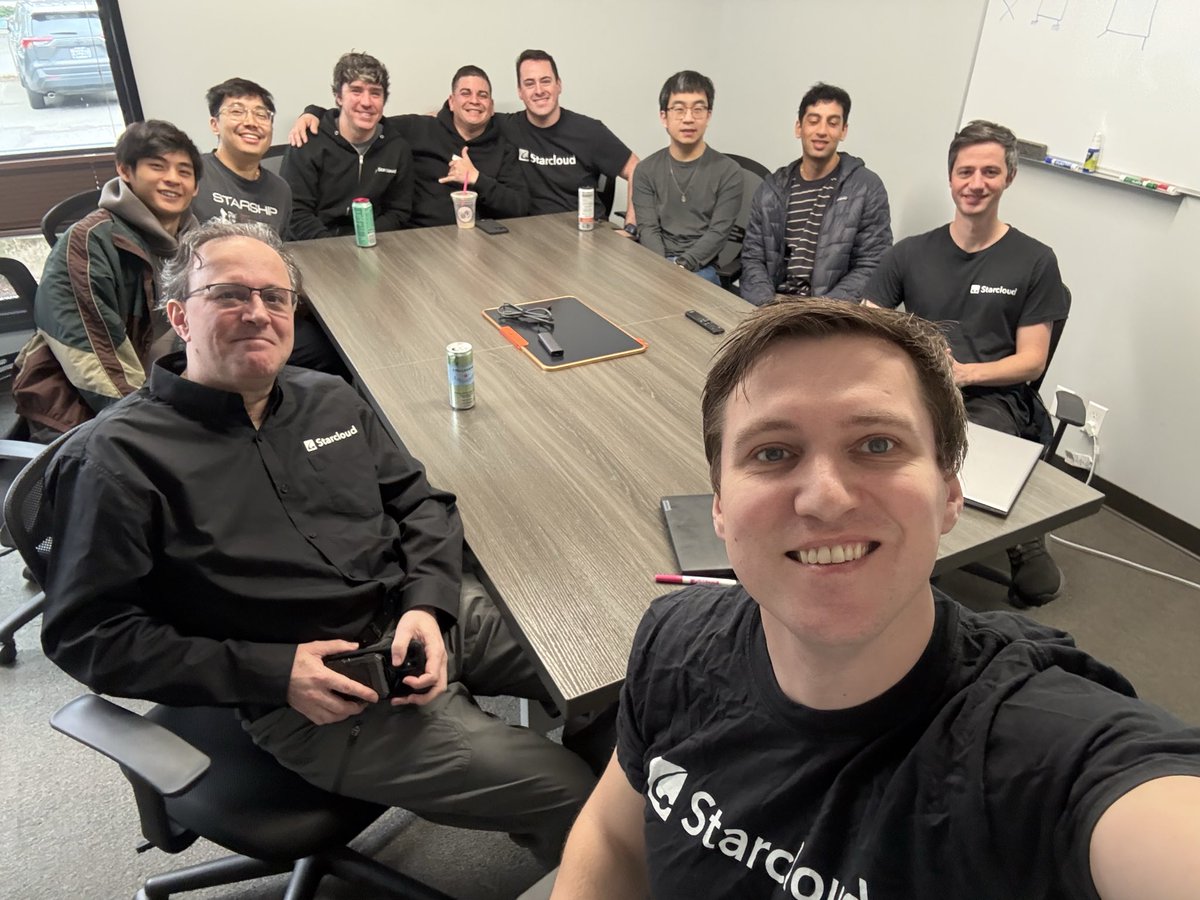
One of the nice things about being a lean engineering team is that we can still do @Starcloud_ all-hands around a conference table 🤗 Not for much longer 😢😅 From left to right: @AdiOltean, Dylan, Yaseem, Bailey, Miguel, Camilo, Stephen, Arman, @ezrafeilden
Philip Johnston tweet media
English
15
4
107
6.1K
Chris Lewicki
Chris Lewicki@interplanetary·
@chr1sa There’s an @XPRIZE in development to answer that very question. AI prizes are faster and cheaper, so it doesn’t need much more funding to be launched!
English
0
0
1
164
Chris Lewicki
Chris Lewicki@interplanetary·
@aaronburnett @mouthofmorrison AI accelerates reaching the physical bottleneck (interface with the physical world) or allows faster determination of what the actual rate-limiting bottleneck is.
English
0
0
2
23
Aaron Burnett
Aaron Burnett@aaronburnett·
@mouthofmorrison I realize I’m not being clear . I agree hardware builders have the advantage. Accelerating a bottleneck in this case means making those bottlenecks worse or at least more critical as more people try to solve them with digital world problems become easier.
English
2
0
2
131
Joe Morrison
Joe Morrison@mouthofmorrison·
One of the reasons aerospace is relatively insulated from the coming AI job-pocalypse is because of the amount of process knowledge and craftsmanship that goes into it and the long feedback loops. You could steal our designs. It would still take 10 years to catch up to where we are today. This is also why the companies trying to proliferate their manufacturing sites across the world will fail, and ultimately collapse back to a small number of highly productive production lines. The recipe is not the product. They are still many years from realizing how screwed they are.
English
9
2
49
4.4K
(Space) Case Taylor
(Space) Case Taylor@spacecasetayl0r·
Here is my 1st pass at companies I plan to cover 34 companies under coverage is a lot for 1 analyst and no associates (hence why I cut the aerospace & defense category altogether), but I am building a system of agents to help augment my capabilities - we'll see how it goes! SPACE INFRASTRUCTURE MANUFACTURING - $OHB @OHB_SE - $MDA @MDA_space - $YSS @YorkSpaceSystem - $AVIO @Avio_Group - $RDW @Redwire - $FTC @Filtronic - $VLD @VELO3DMetal POSITION / NAVIGATION / TIMING - $GRMN @Garmin - $HEXAB @HexagonAB - $TRMB @TrimbleCorpNews GROUND INFRASTRUCTURE - $GILT @GilatSatNet - $189300 @Intellian $CMTL @ComtechTel LAUNCH - $RKLB @RocketLab - $FLY @FireflySpace SATCOM - $SATS @EchoStar - $ASTS @AST_SpaceMobile - $GSAT @Globalstar - $VSAT @viasat - $SESG @SES_Satellites - $ETL @EutelsatGroup - $IRDM @IridiumComm - $SPACE42 @space42ai - $TSAT @Telesat EARTH OBSERVATION - $PL @planet - $290A @synspective - $BKSY @BlackSky_Inc - $SATL @Satellogic - $SPIR @SpireGlobal - $ISI @ImageSatIntl EXPLORATION, TOURISM, & ORBITAL SERVICES - $LUNR @Int_Machines - $186A @astroscale_HQ - $9348 @ispace_inc - $SPCE @virgingalactic
Taylor Sargent@TaylorCSargent

@spacecasetayl0r You are restarting Case Closed??

English
31
26
219
74.9K
Chris Lewicki
Chris Lewicki@interplanetary·
In this 10min video, @Erdayastronaut gives a great retelling of why it will continue to be VERY HARD to tie a media/marketing campaign to funding the space-tech it needs to be relevant. Space tech hardware development cycles are still probably an order of magnitude longer than media-promotion and budget-planning attention spans. youtube.com/watch?v=e6H8kq…
YouTube video
YouTube
English
0
0
2
533
Chris Lewicki
Chris Lewicki@interplanetary·
@aaronburnett I look forward to the future debates of: "If its cheaper to send a fully instrumented humanoid to a distant, dangerous place, will we ever create the infrastructure to send blood, meat, sensory cells and neurons?" (old robots vs humans argument)
English
2
1
6
858
Aaron Burnett
Aaron Burnett@aaronburnett·
The planet colonizing playbook will look something like: 1) send a starship to planet with starlinks and sensors to do detailed mapping and reconnaissance. 2) send a small group of starships with Optimi (plus solar) and small “starthink” constellation - this will support detailed planning and robust intelligence boost to Optimi when/if needed. 3) send larger wave of Optimi plus infrastructure for humans (habitats, ISR fuel, ISR oxygen, etc) 4) send humans. You can shave or combine a step or two depending on how fast you wanted to go.
Aaron Burnett tweet media
English
53
62
710
68.1K
Chris Lewicki
Chris Lewicki@interplanetary·
Who is going to create the "code museum" where patrons can experience the hand-crafted elegance and brute-force knowledge work that took place to construct pre-AI codebases? Surely we can all appreciate "old world craftsmanship" in a new era.
English
2
0
4
206
Chris Lewicki 리트윗함
Adam Cochran (adamscochran.eth)
Adam Cochran (adamscochran.eth)@adamscochran·
Yes - you do use an ID to vote in Congress.. With: * A free ID paid for by the government. * That they make sure you have received. * In a voter roll you are automatically on and not purged from when eligible. * With processes to manage your vote if you forget /lose your ID. If you want mandatory voter ID, then include those kinds of provisions. Otherwise you're just trying to make voter suppression easier.
Rep. Michael Cloud@RepMichaelCloud

For reference, this is how we vote in the US House: 1) Insert photo ID 2) Press button

English
412
3K
17.9K
565.8K
Chris Lewicki 리트윗함
Yuri Milner
Yuri Milner@yurimilner·
It’s great to see private initiatives investing in fundamental science, like Schmidt Sciences with its ambitious new Lazuli space telescope. Exploration and understanding of our Universe is a mission all of humanity can be part of. science.org/content/articl…
English
0
3
40
4.8K
Chris Lewicki 리트윗함
Aaron Burnett
Aaron Burnett@aaronburnett·
If you're a journalist interested in telling a balanced narrative and want the 'pro' orbital data centers logic/math, we've made it VERY VERY easy. These articles are all open and ungated. You can just grok them if you need help parsing the numbers. Please take the time to understand the math and physics behind the pro case before publishing the skeptic case as fact. Launch limiters and initial math - research.33fg.com/analysis/insid… Energy Cost from space - research.33fg.com/analysis/orbit… Location for ODCs why SSO - research.33fg.com/analysis/where… Debunking the cooling/radiator problem - research.33fg.com/analysis/debun… The ODC landscape/China's role - research.33fg.com/analysis/orbit… explaining the Chips for ODCs - research.33fg.com/analysis/elon-… We take pride in anchoring our analysis in physics and math. We also try to communicate any assumptions when made. We welcome genuine feedback. It's worth noting that we layer on a lot of conservatism in our timelines. I wouldn't be all that surprised that Elon and others make our predictions look stupid.
Larry Goldberg@TeslaLarry

This article @vsmason references is a waste of print space, reading time and intellectual effort. It starts with the ridiculous assumption that cost to orbit on a Falcon 9 is $3,600 per ton (hint: it's SpaceX's selling price!), and proceeds down the hopeless rabbit hole with continuing - and increasing - errors. If you want to get a rigorous "explainer on this issue" I recommend you follow and read posts by @aaronburnett on this subject. Best independent analysis on the economics orbital AI.

English
214
691
2.5K
1.1M
Chris Lewicki
Chris Lewicki@interplanetary·
Haven't seen any discussion here yet on SpaceMolt Having spent a unit of time on moltbook, I think I'll skip this one... spacemolt.com
English
0
0
1
136
Chris Lewicki
Chris Lewicki@interplanetary·
I think the red pill is in recognizing that the last 10% is the domain where creativity and hard work will always be needed. The edge cases. The assumptions not yet proven true. And achieving 100% on anything only gives us a ticket to the next game. The edge is where the "perfect solution" meets the messy-ness of the real world, and the recognition that there is no "optimum" - only local stability amongst competing opinions, interests, and constraints. There have been breathless promises of $100/kg launch, coast-to-coast autonomous driving, robots in every home. All of these will probably come true, but face a myriad of challenges that require constant vigilance, know-how, creativity, and experimentation to adapt to the "working solution" (not final, because we're just going to immediately invent what's next). We all need to look at the wonderful capabilities we now have to focus on the last 10%.
English
0
0
1
55
Phil Metzger
Phil Metzger@DrPhiltill·
I hear you for sure, you make great points, but I’m more black pilled 😕. I’m thinking the hardware bottleneck will be opened up well within a decade as factory automation increases, and the energy limitation is overcome by putting them in space. Im not expecting it will be just LLMs. Already there is agentic AI and I think tech will move in that direction. As faculty I’m wondering how to prepare students for careers that will last 40 years, and I think within that time (probably in 10-20 years) humans will become second-tier contributors to tech & science in our world. This makes me very sad and makes me wonder how to prepare students for this future.
English
4
1
7
262
Phil Metzger
Phil Metzger@DrPhiltill·
Worth reading if you haven’t already. This relates to the insight I had in Korea last week — about finding a role for humans in the face of AI. Humans won’t lead the world any more. I think we need to create a humanized space for ourselves.
Matt Shumer@mattshumer_

x.com/i/article/2021…

English
11
5
52
6.8K