Copium War Observer

442 posts

Copium War Observer

Copium War Observer

@longsilverbro

Terror to all real socialists and leftists worldwide

가입일 Haziran 2023
550 팔로잉38 팔로워
CM
CM@xuchuanmei·
@longsilverbro @pretentiouswhat Is that mean to be satirical? Because it's pretty good if a delivery driver could single-handedly support a wife, two kids and pay a mortgage. In Australia that would be impossible.
English
1
0
0
30
David Fishman
David Fishman@pretentiouswhat·
This is typical of a US-centric way of thinking about prosperity, basically saying: "If you can afford a lot of something cheaply in foreign currency teams, then the place must be poor". It then ends up defining prosperity by how much a country resembles one with high wages, expensive services, low urban density, and a shortage of low-cost labor (a la the USA). I can't speak for other countries, but in China, cheap delivery isn't "millions of people willing to work for nothing". It has different wage structure, a lower cost of living, denser cities, and more robust digital and physical logistics. That combination creates a system where delivery can be cheap without automatically implying poverty or exploitation wages. On the low end, Chinese gig workers earn roughly the same as factory or entry-level service jobs, and on the high end, they earn more than median wages (sometimes quite a lot more, especially rideshare). China is not like the USA, where almost any job pays more and so gig work is an utter last resort. Chinese gig work isn't paradise, but it's a viable living. Heck, one of my in-laws in Ezhou comfortably supports his family on a package delivery worker wage. People take these jobs because they're competitive and incomes scales with how much you're willing to work. They can save up to buy property, support families, or start a business on them. I have spent an unusual amount of time talking to gig workers for my Substack, so I'm not guessing here... Finally, I'll note that the same mistake shows up in reverse. Pro-China posts bragging about how cheap things are in USD terms are really missing the point. If you want to say something meaningful about prosperity or quality of life, you should talk about affordability *relative to local incomes in CNY*, not how cheap it feels to foreigners.
Hunter📈🌈📊@StatisticUrban

It's very frustrating that people see widespread cheap food delivery, a la China, as a sign of prosperity. It's the opposite! Rich countries don’t have millions of people willing to spend their time bringing you lunch for basically nothing!

English
13
104
751
44.1K
Copium War Observer
Copium War Observer@longsilverbro·
@Mayoveli I wish African and Chinese cultures had a chance to exchange more before the Transatlantic Slave Trade kicked off
English
2
4
414
21.1K
doll bun🏳️‍⚧️
doll bun🏳️‍⚧️@The_Bunny_Doll·
Last time I went in the men's toilets was in a bar in Soho, while I was peeing at the urinal a guy walked in and stood next to me, gave me a very confused look, then glanced down at my junk and looked even more confused, he ended up quickly walking out without even peeing. While this situation was more funny than anything else, these new "guidelines" are going to end so badly for everyone, trans people will face unparalleled levels of abuse, both verbal and physical, and c*sg*nder people who do not fit the conventional beauty standards and either look masculine/feminine for their sex will likely be transvestigated because the people in charge of this country keep empowering the most hateful and reactionary in society. The UK is wilfully going down a path of transphobic authoritarianism with seemingly no end in sight, and it's so scary to see :(
doll bun🏳️‍⚧️ tweet media
BBC News (UK)@BBCNews

Toilets and changing rooms must be used on basis of biological sex, guidance confirms bbc.in/3PuDmTl

English
18
38
1.2K
49.4K
Pandatronic
Pandatronic@Pandatronicity·
A lót óf hatréd of Chína ís becaúse peoplé uséd to réally lóok dówn on Chína fór beíng póor bút nów they'ré poórer thàn Chína só ít's a míx óf bítter jéalousy ànd the abjéct térror of beíng lóoked dówn ón
43
135
1.3K
31.6K
Blue Bear
Blue Bear@Bluebearmonkey·
@StandardJohnnyB @michaelxpettis Put a 2x multiple on all China GDP/income data. China is doing it in much faster. Japan and South Korea never had much more than 7.5% CAGR in a 15 year period. China ran three decades at 9%.
English
1
0
3
92
Michael Pettis
Michael Pettis@michaelxpettis·
Kyle Chan's question is an important one. Contrary to those who think that the imbalances are caused primarily by political desires to reduce household power, I have long argued that the low consumption share of GDP is structural. Because it is almost impossible to get consumption growth to accelerate sharply from these levels, the only way the adjustment can take place (and the only way it has ever taken place in previous similar cases in history), is with much slower – or even negative – GDP growth. As long as Beijing insists on GDP growth targets much above 1-3%, in other words, any meaningful rebalancing is unlikely. But as imbalances get worse, as they have for the past three years, it requires an acceleration in credit creation (again, just like in every previous similar case in history) to maintain the GDP growth targets. This implies that this process ends only when policymakers are no longer willing or able to tolerate a further increase in the debt burden. Unfortunately historical precedents suggests strongly – consistent with debt and financial distress theory – that the higher the associated debt burden, the more difficult the adjustment becomes. That's because the longer it goes on, the greater the hidden losses generated by the need to keep "GDP growth" high through non-productive investment. The subsequent maneuvering by businesses, government and households to avoid being forced to absorb a disproportionate share of the losses during the adjustment process creates the distortions in economic behavior that in turn create rising financial distress costs.
Kyle Chan@kyleichan

Chinese policymakers continue to offer only modest stimulus measures in the face of this broader economic slowdown. Does this mean they aren’t that concerned given focus on tech & self-reliance or that there are no good solutions to a structural issue?

English
14
33
133
25.3K
Liz Ann Sonders
Liz Ann Sonders@LizAnnSonders·
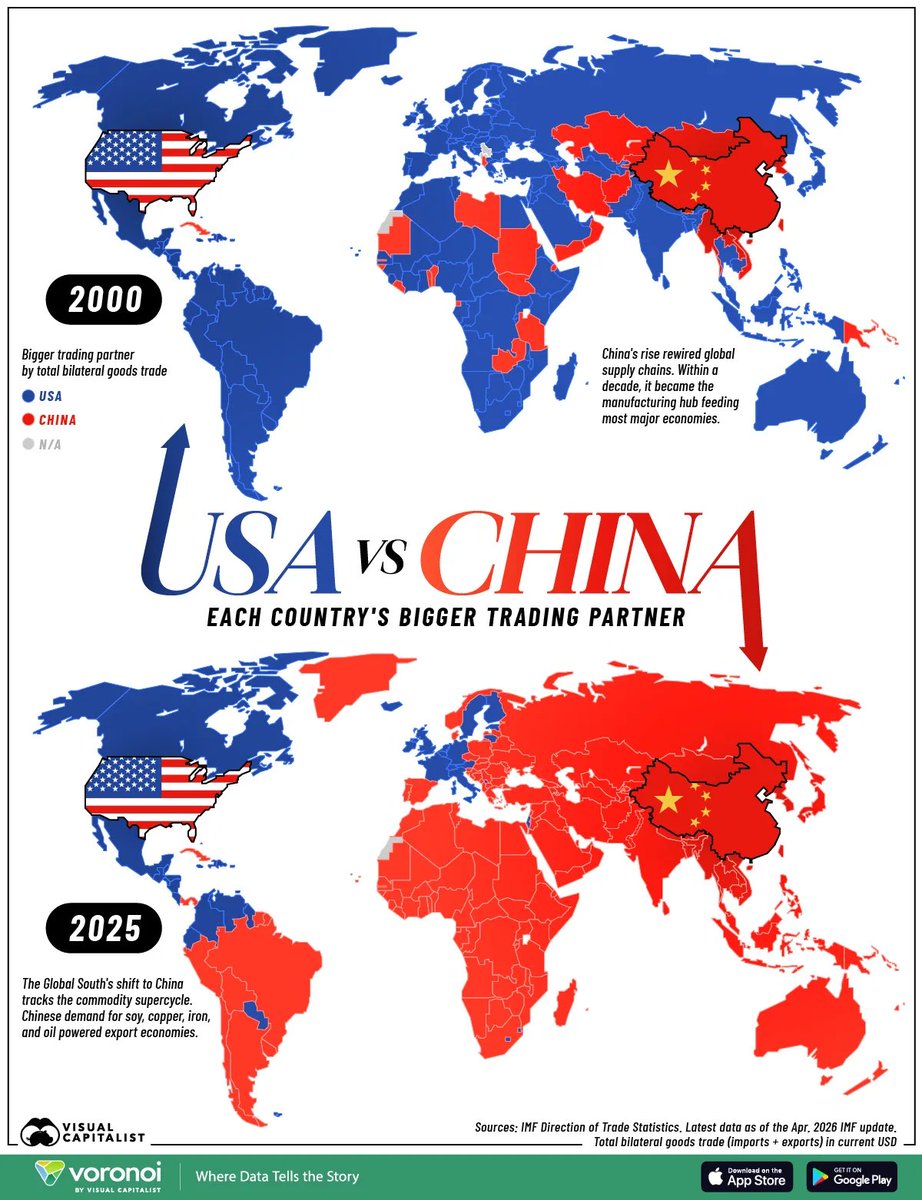
Twenty-six years ago, U.S. was world’s dominant trading power; today, China has overtaken America as top goods trading partner for most countries globally … this @VisualCap map compares whether countries traded more with U.S. or China in 2000 and 2025, based on total bilateral imports and exports using @IMFNews Direction of Trade Statistics data
Liz Ann Sonders tweet media
English
82
239
706
100.9K
Blue Bear
Blue Bear@Bluebearmonkey·
@realJeremyCarl @brainctrl2026 There’s a lot of truth to this. ~40 years ago, when Azns were ~1% of the population, wypipos could do mafs. Now, they just totally give up. Laid down and surrendered. Like when bleque pipo started playing basketball in the 1960s.
English
3
0
17
419
Joe
Joe@John_Walton_jr·
@CTankie1917 Because they are poor. Like in Peru
English
6
0
0
772
Wumao Tankie / Garden Hater / Jungle Propagandist
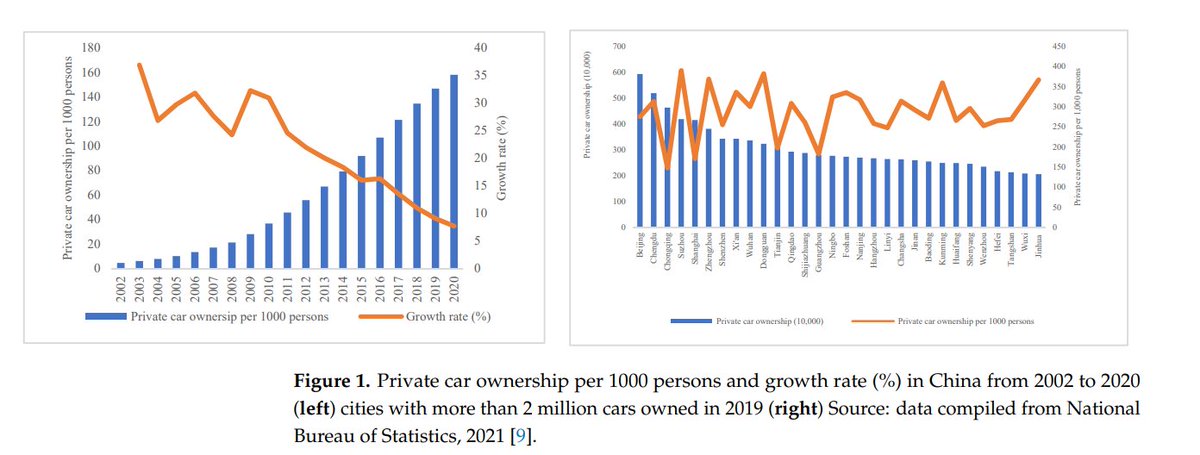
That’s bc of China’s efficient public transportation system. In US, I have a car, my bro has a car, my sister has a car, her husband has a car, my mom has a car, etc. It’s not uncommon for Chinese households to just have 1 car and everyone takes public transport/electric bikes
Joe@John_Walton_jr

@alvinfoo China is a third world country Far behind the US and Europe
English
30
40
772
31.8K
Joe
Joe@John_Walton_jr·
@alvinfoo China is a third world country Far behind the US and Europe

Joe tweet media
English
58
0
2
35.5K
Alvin Foo
Alvin Foo@alvinfoo·
China vs. the US. Same world. Wildly different price tags. The numbers don’t lie, and they tell a fascinating story. Average monthly salary in China: $1,007. In the US: $4,276. That’s a 4.2x income gap. But here’s where it gets interesting. Food costs don’t follow the same ratio. A meal at an inexpensive restaurant in China costs $2.84. In the US? $20.00. That’s 7x more expensive. A dozen eggs: $1.57 in China vs $4.41 in the US. A cappuccino: $2.95 vs $5.32. White rice per lb: $0.43 vs $2.09. The Chinese consumer is paying dramatically less, not just proportionally, but in absolute dollar terms. Now look at the real squeeze. Broadband internet in China: $11.23/month. In the US: $72.43/month. Mobile phone plan in China: $8.95. In the US: $60.90. Basic utilities: $51.89 in China vs $210.49 in the US. Infrastructure costs in America are crushing the middle class. The one area where China doesn’t win? A new compact car costs $18,488 in China vs $35,699 in the US. Cheaper, but relative to monthly salary, still a 18-month income commitment for the average Chinese worker. The real insight: China has engineered a low-cost, high-efficiency consumer economy. The US has engineered high wages but also high costs that quietly consume them. Purchasing power parity tells a story that raw salary comparisons completely miss. I have lived in China for over 20 years and I can attest that we get more for less. The only thing I would say it’s ridiculously expensive is real estate prices, where an ordinary person would had to work their whole life to pay off the mortgage. Price-to-income ratios are estimated at: * Beijing: ~37x annual income * Shanghai: ~38x annual income That means an average household may need 30–40 years of total income just to buy a home outright. This is why many Chinese families: * pool money across 2–3 generations * rely heavily on parents for downpayments * prioritize home ownership above almost everything else Important shift happening now: China’s property crisis actually reduced prices in many cities: * mortgage rates fell sharply * home prices declined * affordability improved versus 2020–2021 peaks But psychologically, many young Chinese are now: * delaying marriage * delaying home purchases * preferring renting * less willing to take 30-year debt because they watched previous generations become heavily leveraged into declining property markets.
Alvin Foo tweet media
English
80
189
567
108.4K
Copium War Observer
Copium War Observer@longsilverbro·
@Optimistic24228 I've noticed that some people try to blame China because the gains made by Global South/African countries from trade isn't being distributed fairly among the locals. A very nasty sleight of hand they try to pull
English
0
0
1
26
OptimisticRaidersFan
OptimisticRaidersFan@Optimistic24228·
Chinese trade will help provide inputs and logistics for so many nations in the global south to develop. But these nations need the right political structures and systems to take advantage. Otherwise corrupt bs and inefficiencies are bound to be high even with positive trade
English
2
15
56
1.8K
Lumpenpancakes
Lumpenpancakes@Lumpenpancakes·
@przidnt1 @zxmnswko1 People know living standards have cratered... life was not this difficult. But a lot are pumped up on toxic positivity or copium.
English
1
0
5
76
Hunter📈🌈📊
Hunter📈🌈📊@StatisticUrban·
One of the most insane facts of all time tbh
Hunter📈🌈📊 tweet media
English
102
474
8.5K
836.8K
Copium War Observer
Copium War Observer@longsilverbro·
@gonglei89 People are going to be upset when there is another housing bubble and it gets popped causing speculators to lose(again)
English
0
0
0
84
Lei Gong
Lei Gong@gonglei89·
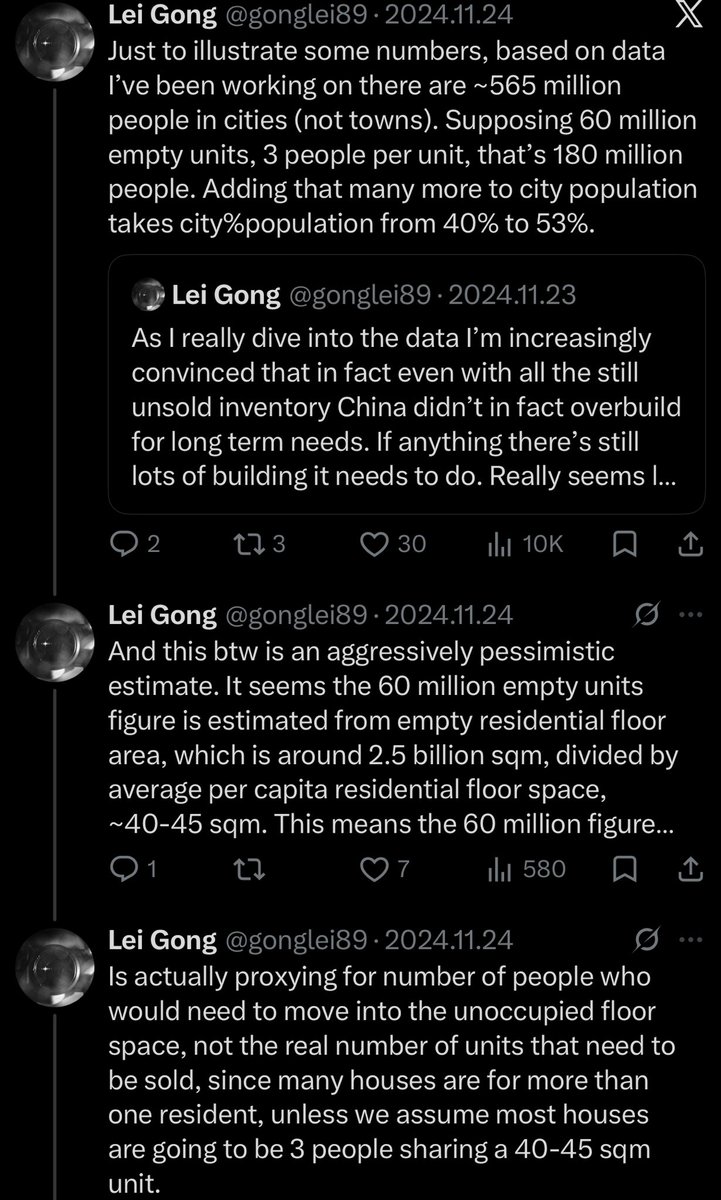
They actually didn’t overbuild relative to their long term needs.
Lei Gong tweet mediaLei Gong tweet media
Mitch Presnick 柏力@mitchpresnick

Chinese real estate is actually one of the clearest examples of what I mean by “colossally wasteful but devastatingly effective.” China built far more housing capacity than housing demand required, leaving large numbers of underoccupied or speculative properties across the country. Colossally wasteful. At the same time, that system helped support the largest urbanization process (by far) in human history: roughly seven hundred million people moved from rural areas into cities over four decades. Devastatingly effective. Western observers tend to focus on the empty apartments. Chinese planners focused on ensuring enough housing, infrastructure, and industrial capacity existed for a civilizational-scale transformation before demand fully materialized. To the point about China “thinking in centuries,” that is both true and not true. True in the sense that successive dynasties rose, stagnated, collapsed, and were replaced through iterative “fail-and-learn” cycles over centuries. The key lessons from those cycles—bureaucratic governance, center-local balancing, infrastructure coordination, frontier management, famine prevention, long-horizon statecraft—became embedded in China’s broader national strategic memory. So China does carry forward accumulated institutional learning across millennia in a way modern nation-states do not. Civilizational developmental states have that advantage. But it is misleading to imagine Chinese leaders literally sitting around making 100 or 300-year plans. China is often highly reactive, experimental, decentralized, improvisational, and brutally pragmatic in the short term. The continuity is less about perfect long-range planning than about a civilizational system that compounds lessons over very long periods of time.

English
3
6
54
3.6K
Copium War Observer
Copium War Observer@longsilverbro·
@NihilNothings 1. “We are the good guys” 2. “Ok, we are bad but not as bad as other countries” 3. “Ok, if we didn’t do it someone else would 🤷‍♂️” 4. ________
English
0
1
3
181
Yves St. Nihil 🏭📕
Yves St. Nihil 🏭📕@NihilNothings·
The imperial citizen's worldview is genuinely cynical. They can't accept the truth of the horrors done by their own country & thus project its evil unto other states—falsely equating it with theirs while downplaying their own country's & shifting blame towards its victims.
English
3
67
242
3.6K
SSW
SSW@SimonSW13·
Next step is to stop investing too much time debunking each evidence free assertion of these retards and just directly calling them retards.
English
1
1
19
437
Copium War Observer
Copium War Observer@longsilverbro·
@RambutanRed 50+ year old western economists would be doing backflips instead of calling it "suppression" if India saw this kind of growth
English
0
0
0
83
RedRambutan
RedRambutan@RambutanRed·
China is often claimed to be engaging in 'wage suppression', but it's an argument entirely without merit. Has basis for other countries however....
RedRambutan tweet media
Vsne Twit 🐜🦋🦗🦟🪲🪳@VsneTwit

@RambutanRed It is important to consider the starting point. Wage growth in China has been significantly weaker than the growth rate and productivity gains. Wage suppression is a key component of the Chinese model.


English
2
6
76
4.4K