
0xEvan.zeus

474 posts

0xEvan.zeus banner
0xEvan.zeus

0xEvan.zeus

@0xEvanWithMe

Growth @ZeusNetworkHQ & Cooking Bitcoin APP / Prev. @todayindefi / ✈️ 🌍 📷 (Please, X. Stop suspending me 🥲)

Bitcoin On Solana Katılım Şubat 2025
3.5K Takip Edilen217 Takipçiler
Sabitlenmiş Tweet
0xEvan.zeus
0xEvan.zeus@0xEvanWithMe·
The world is running the same trade: Print money → Debase currency → Buy scarcity Debt keeps rising across economies, while political incentives make monetary expansion inevitable. When money supply grows faster than productivity, currencies slowly lose purchasing power. That is the reality The Great Debasement Vault on @solana is built for: a simple strategy ($zBTC + $GOLD) to preserve purchasing power in a world of expanding money 🫡 Big thanks to @orogoldapp, @TradeNeutral, and @Titan_Exchange for partnering with us to make this product happen!
Neutral Trade@TradeNeutral

Introducing the Great Debasement Vault💰 Powered by @ZeusNetworkHQ, @orogoldapp, and @Titan_Exchange This is an index vault designed to stay anchored to scarcity and monetary neutrality, outside the reach of government money and policy-driven dilution.

English

1
1
4
177
0xEvan.zeus retweetledi
Zara Zhang
Zara Zhang@zarazhangrui·
Traditional education (learn first, build later) is backwards. Learning in the AI age should be "build first, learn later". I took CS courses in college but struggled to connect with the concepts. Turns out the best course materials are my own vibe coded apps
Zara Zhang@zarazhangrui

Introducing "codebase to course", a skill that turns any codebase into an interactive coding course So that you can learn coding through your own projects, complete with visualization, plain-English code translations, metaphors, even quizzes... I vibe code a lot but have no idea how the code works under the hood. This is how I think "learning to code" should be in the AI age: Build first, learn later Link below

English
23
19
175
10.7K
Sponge (YC W26)
Sponge (YC W26)@sponge_wallet·
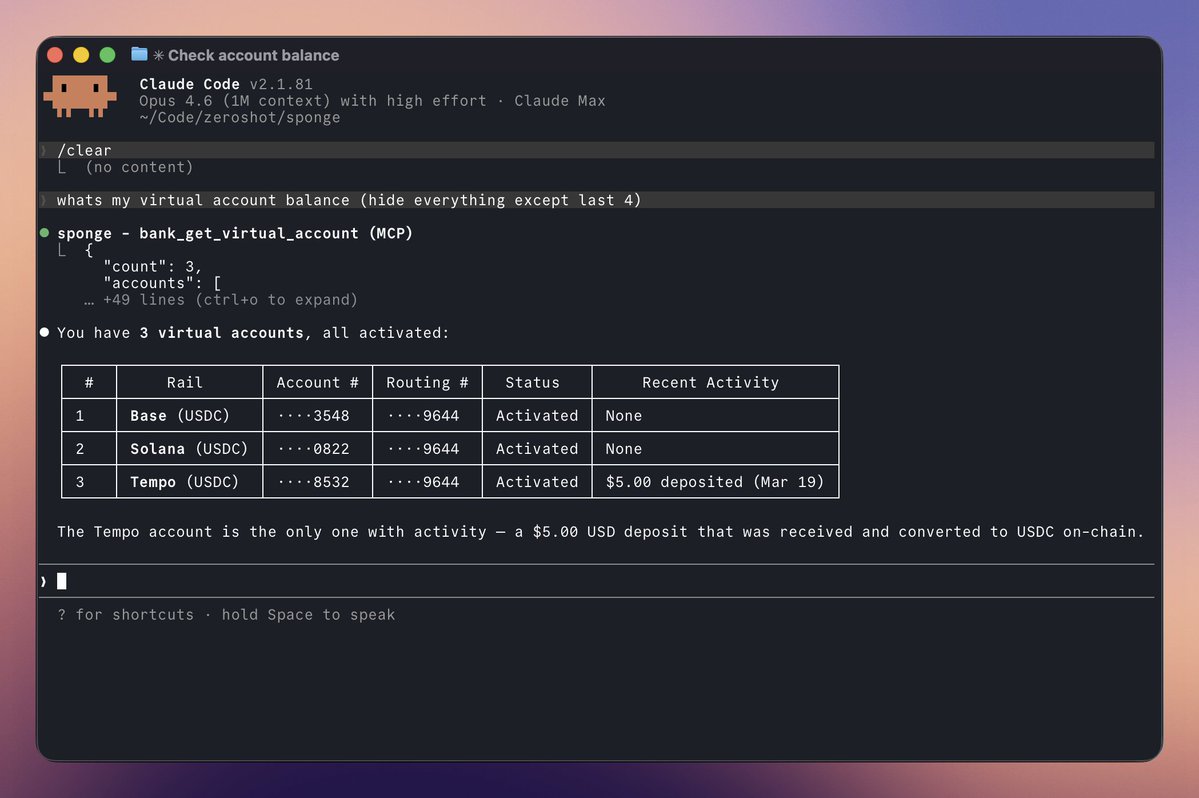
Sponge now supports virtual accounts and ACH/wire transfers. Your agents can now interact with the existing financial system: receiving and sending ACH and wire transfers.
Sponge (YC W26) tweet mediaSponge (YC W26) tweet media
English
10
3
61
5.6K
0xEvan.zeus retweetledi
Paul Graham
Paul Graham@paulg·
It's extremely valuable not to be influenced by fashion. In just about everything people do, from choosing problems to work on to buying art, there are unfashionable options that are not only better than the fashionable ones, but cheaper too, because they're unfashionable.
English
143
129
1.9K
111.5K
0xEvan.zeus retweetledi
Paul Graham
Paul Graham@paulg·
A rule of thumb that has served me well: Beware of anything with "innovation" in the name.
English
219
115
2K
91.7K
0xEvan.zeus retweetledi
Garry Tan
Garry Tan@garrytan·
@lovnexora Read a lot, experience things, spend time with people, help them, be a polymath generalist, get really intense about things you're interested in
English
16
84
589
85.7K
Sonic SVM
Sonic SVM@SonicSVM·
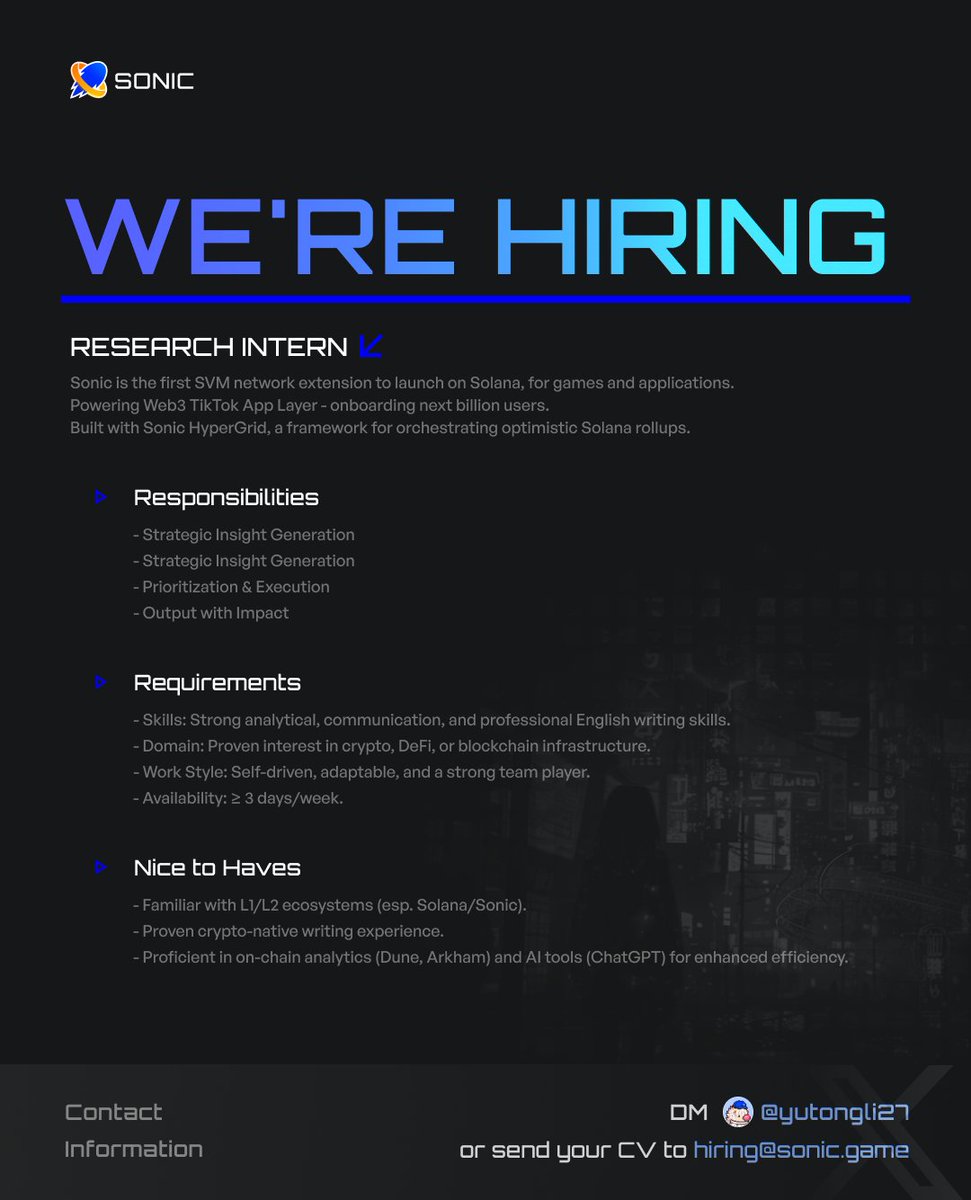
SONIC SVM is hiring Research Interns ⚡ You’ll be working on live systems across Solana, AI agents, & market infra. Testing, researching, & shipping alongside a team that moves fast. $5,000 referral bounty Know a QA or engineer who’d crush this? Tag them in the comments👇
Sonic SVM tweet media
English
118
55
878
17.1K
Michelle Fang 🌁
Michelle Fang 🌁@michelleefang·
giving away a few free passes to @Stripe Sessions on april 29-30 in sf ($999 value) i'm bringing together founders the night before for something fun 👀 + will be at the founders lounge at moscone both days✌️ reach out - would love to see you there!
English
62
5
153
14K
0xEvan.zeus retweetledi
Tempo
Tempo@tempo·
Tempo Mainnet is live! Starting today, anyone can build on Tempo through our public RPC endpoints. Alongside mainnet, we’re introducing the Machine Payments Protocol, an open standard for machine payments.
English
283
327
2.4K
640.7K
0xEvan.zeus retweetledi
Felix Rieseberg
Felix Rieseberg@felixrieseberg·
We're shipping a new feature in Claude Cowork as a research preview that I'm excited about: Dispatch! One persistent conversation with Claude that runs on your computer. Message it from your phone. Come back to finished work. To try it out, download Claude Desktop, then pair your phone.
English
962
1.5K
17.4K
6.1M
0xEvan.zeus retweetledi
Invest Like the Best
Invest Like the Best@InvestLikeBest·
Patrick Collison tells people in their 20s to not move to San Francisco. William largely agrees with him. He thinks SF has a consensus problem and has removed the risk from becoming a founder: "I'm a product of Silicon Valley. I started Plaid back in 2012. I've been there since I was 21, and it's very easy to stay in Silicon Valley. But you can start to get isolated and get very consensus focused. San Francisco is probably the most consensus place I've ever been to. That is both a huge crutch for us, but it's also probably the most valuable asset. As a founder, if you're building in something that SF believes is very consensus, but the world does not believe yet, that's actually a great operating environment. That's why Silicon Valley and SF are so dynamic and we're so in front of the curve. But we also have completely lost touch with how the rest of the world operates. Even how the everyday American operates. So I think it's very important to go to places that don't have that same bias. If you think about emerging markets specifically – the founders who build there, they're the everyday people, they live in this constrained society. They're constrained in a way that San Francisco and New York isn't. And that breeds a different type of creativity, it breeds a different type of innovation that you really can't get anywhere else. If you go to talk to people in London or Vienna or San Francisco, people are living in a world of abundance. And that causes a very specific creation cycle. SF and Silicon Valley are probably more akin to Wall Street in the 1990s than they are like a research lab in Cambridge in like the 1950s. Maybe that was Silicon Valley in the 90s, but it's not anymore. You talk to a 23-year-old and assuming you're like moderately competent and went to the right high school and college, you're going to get a $3 million seed round. And worst case scenario, you can go work at like a great company as an engineer and you'll have "founder" on your resume. There is no risk in that proposition. If you go back to pre-2008, you're on the edge of the knife, and I think that creates just so much intensity in creativity and fear that is such a critical part of the founder journey. Starting companies is just too f**king safe, and it's caused a lot of companies to be super safe companies -- like we're going to pivot to AI and wrap OpenAI/Anthropic. That's not bold, that's not ambitious. And it's because we are attracting founders that actually want to be employees. They don't think and say "if I don't pull this off, I'm going to become bankrupt. My life is over." I think that's pretty healthy. That's when you bring out the rawness of humanity. And I don't see that very much anymore."
Invest Like the Best tweet media
Patrick OShaughnessy@patrick_oshag

.@williamhockey is one of the least visible founders in tech relative to what he has created. He co-founded Plaid and is now building Column, a software company that owns a bank, and powers Ramp, Wise, Bilt, Mercury, and others. He funded it himself by borrowing against nearly everything he had in Plaid shares, and has never raised any outside capital. His story matters because so much of the value in our industry gets created through exactly this kind of extreme personal risk. He is maniacal about being the best in the world at his thing, and has spent his entire career betting on himself and doing whatever it takes to win. He also spends a lot of time outside the US (in places like Kinshasa) which has given him a rare perch on the power of the US dollar. We discuss: - Why emerging markets are often the most financially innovative - What owning 100% of his company allows him to do that VC-backed founders cannot - Getting margin called and nearly going bankrupt - Why the best founders are specialists - What it takes to be the best in the world at your thing - How Silicon Valley's consensus culture produces consensus founders - How the US dollar functions as an instrument of national security Enjoy! Timestamps: 0:00 Intro 9:19 Emerging Markets 14:03 Silicon Valley's Elite Consensus Problem 16:03 Rejecting the VC Hamster Wheel 21:45 Equity and Liquidity 26:03 Funding a Bank 29:45 The Necessity of Extreme Founder Risk 37:18 Finding Leverage 45:20 Longevity and Profitability in Banking 48:46 Matching Your Capital Structure to Your Business 51:44 The Unseen Power of the US Dollar 1:02:30 How AI Will Transform Legacy Banks 1:09:23 The Kindest Thing

English
33
64
771
321.4K
0xEvan.zeus retweetledi
David Senra
David Senra@davidsenra·
My conversation with Marc Andreessen (@pmarca), co-founder of @a16z and Netscape. 0:00 Caffeine Heart Scare 0:56 Zero Introspection Mindset 3:24 Psychedelics and Founders 4:54 Motivation Beyond Happiness 7:18 Tech as Progress Engine 10:27 Founders Versus Managers 20:01 HP Intel Founder Legacy 21:32 Why Start the Firm 24:14 Venture Barbell Theory 28:57 JP Morgan Boutique Banking 30:02 Religion Split Wall Street 30:41 Barbell of Banking 31:42 Allen & Company Model 33:16 Planning the VC Firm 33:45 CAA Playbook Lessons 36:49 First Principles vs. Status Quo 39:03 Scaling Venture Capital 40:37 Private Equity and Mad Men 42:52 Valley Shifts to Full Stack 45:59 Meeting Jim Clark 48:53 Founder vs. Manager at SGI 54:20 Recruiting Dinner Story 56:58 Starting the Next Company 57:57 Nintendo Online Gamble 58:33 Building Mosaic Browser 59:45 NSFnet Commercial Ban 1:01:28 Eternal September Shift 1:03:11 Spam and Web Controversy 1:04:49 Mosaic Tech Support Flood 1:07:49 Netscape Business Model 1:09:05 Early Internet Skepticism 1:11:15 Moral Panic Pattern 1:13:08 Bicycle Face Story 1:14:48 Music Panic Examples 1:18:12 Lessons from Jim Clark 1:19:36 Clark Versus Barksdale 1:21:22 Tesla Versus Edison 1:23:00 Edison Digression Setup 1:23:13 AI Forecasting Myths 1:23:43 Edison Phonograph Lesson 1:25:11 Netscape Two Jims 1:29:11 Bottling Innovation 1:31:44 Elon Management Code 1:32:24 IBM Big Gray Cloud 1:37:12 Engineer First Truth 1:38:28 Bottlenecks and Speed 1:42:46 Milli Elon Metric 1:47:20 Starlink Side Project 1:49:10 Closing Includes paid partnerships.
English
165
503
4K
3M
0xEvan.zeus retweetledi
Chamath Palihapitiya
Chamath Palihapitiya@chamath·
What I read this week... 1) Mastercard Brings Circle and 85+ Firms Into Crypto Payments Push Mastercard launched its Crypto Partner Program on March 11, bringing together more than 85 crypto-native firms, payments providers, and financial institutions in a formal collaboration group. Participants include Circle, Binance, PayPal, Ripple, Gemini, Paxos, SoFi, Worldpay, Polygon, Solana, Fireblocks, and BitGo. Mastercard said the program is designed as a forum for product input, standards, and collaboration. The program helps shift digital assets from experimental side rails into production-grade integration with Mastercard’s 150+ million global merchant network and core card infrastructure. The company’s stated focus is on practical payment use cases, especially cross-border remittances, B2B transfers, payouts, settlement, and other forms of money movement, where digital assets can add speed and programmability. Mastercard’s explicit goal is to fuse the “speed and programmability of digital assets” with established card rails so payments feel seamless to end users. Circle’s inclusion is front and center with their Chief Commercial Officer, Kash Razzaghi, emphasizing in the accompanying Mastercard Newsroom interview that stablecoins (starting with USDC) are moving from trading/investing into payments and store-of-value layers, especially in high-inflation markets. Circle’s role helps explain the stablecoin angle. The partnership explicitly aims to make stablecoin usage feel like typing an HTTP request, where users just send dollars, unaware of the blockchain layer beneath. This marks an institutional tipping point at which crypto and traditional finance converge to upgrade the underlying financial infrastructure. After years of parallel tracks, regulation has cleared the runway, and giants like Mastercard are now betting that collaborative infrastructure will drive the next leg of growth through cheaper, 24/7, borderless transfers that approach zero marginal cost. 2) Yann LeCun’s New AI Lab, AMI, Raises $1.03B for World Models Advanced Machine Intelligence (AMI) launched March 10, 2026, with a record $1.03 billion seed round at a $3.5 billion pre-money valuation, making it Europe’s largest seed round ever. Founded by Yann LeCun (post-Meta) as chairman, the team also includes Alexandre LeBrun (ex-Nabla CEO) as CEO and Saining Xie (ex-DeepMind and Meta) as Chief Science Officer. The lab drew co-leads from Cathay Innovation, Greycroft, Hiro Capital, HV Capital, and Bezos Expeditions. AMI’s bet is that the next important AI systems will not come from scaling next-token prediction alone. Instead, it pursues world models built on LeCun’s Joint Embedding Predictive Architecture (JEPA). This enables systems to learn from sensory/physical data, maintain persistent memory, reason causally, plan under constraints, and operate safely in the real world. AMI targets robotics, manufacturing, transportation, and healthcare. Nabla (LeBrun’s prior company and LeCun’s investment) is the first partner to gain early access to agentic clinical AI. This vision aligns with LeCun’s February 2026 arXiv paper “AI Must Embrace Specialization via Superhuman Adaptable Intelligence“, co-authored with Goldfeder, Wyder, and Shwartz-Ziv. The paper argues AGI concepts are misguided; human intelligence is specialized, not general. It proposes Superhuman Adaptable Intelligence (SAI): rapid adaptation to surpass humans on any key task, plus tackling human-infeasible domains. SAI favors SSL and world models for grounded reasoning/planning, positioning AMI as a post-LLM path where breakthroughs come from architectural innovation rather than just more compute/data. 3) Netflix Makes Major Bet on AI Filmmaking Tools Netflix announced on March 5 that it acquired InterPositive, the AI filmmaking technology company founded by Ben Affleck in 2022. The entire 16-person team (engineers, researchers, creatives) is joining Netflix, and Affleck is staying on as a senior advisor. Financial terms were not disclosed at the announcement, but Bloomberg later reported the deal could be worth up to $600 million, making it one of Netflix’s largest acquisitions. The company had been operating in stealth, building tools specifically “by filmmakers, for filmmakers.” Netflix already piloted the technology on its own production “El Eternauta,” reporting 10x efficiency gains over traditional VFX pipelines. InterPositive’s core innovation is per-film custom AI models: it ingests raw production dailies, trains a bespoke model on that specific project’s footage and style, then hands filmmakers an autonomous post-production engine. The tool can relight entire shots, remove stunt wires frame-perfectly, reframe missed angles, enhance or generate backgrounds, insert VFX elements, and fix continuity errors, saving studios months and millions of dollars. Because the model is trained on the actual film’s data, outputs stay stylistically consistent and director-controlled rather than generic. The acquisition gives Netflix an in-house post-production AI capability built around project-specific models and filmmaker-controlled workflows. In its announcement, Netflix framed the deal as “innovation for filmmaking, by filmmakers”, keeping human creatives at the center. At the same time, Affleck described the tools as purpose-built for production environments rather than general-purpose generative media. That makes the transaction less about consumer-facing AI and more about integrating specialized production software into the studio pipeline.
English
55
46
462
147.8K
0xEvan.zeus retweetledi
Lenny Rachitsky
Lenny Rachitsky@lennysan·
I rare interview with me! By my wife! My brilliant wife (@TheRialMichelle) is about to come out with her first children's book, Charts for Babies, and I thought what a fun excuse to have her come on the podcast turns the tables on me. She asked things no one else would think to ask, and many things I've never shared publicly. We chat about the specific moments that pushed me to start the newsletter, how I think about quality, what stresses me out most, the invisible treadmill built into creator businesses, and how a psychedelic experience gave me the confidence to do this work. This was so fun, and so special, and I hope you like it. Listen now 👇 youtu.be/HEqrvF7ztBE
YouTube video
YouTube
English
32
16
301
65.2K
0xEvan.zeus retweetledi
Cheng-Wei Hu
Cheng-Wei Hu@HcwXd·
I left NotebookLM a few months ago to solve a bigger problem in learning. Today, as the first step, we are launching @WonderingApp for early access. It's Duolingo for anything — turning any topic into a guided path with bite-size visual lessons that can fit into your busy schedule. But you don't sacrifice depth/effectiveness for convenience: Total Control: You decide how deep you want to go, how difficult the material should be, and how personalized the experience feels. Active Learning: We provide the tools you need to practice, test your understanding, and actually apply what you’ve learned. Long-term Mastery: It’s built to help you truly remember and master any subject, not just skim the surface.
English
214
200
3.1K
307.7K