Haley
19K posts

@0xHaley_
A degen player | Cryptoholic | $BTC


➥ Be Hyperliquid You thought @HyperliquidX | $HYPE was overhyped until you saw it hold 50%+ onchain perps market share for almost a year - $3T in trading vol, ~$907M rev, ~93% coming from perps - an 11-person team, no VC backing, pushing close to $1B in free cash flow in a single year - opened the HIP-3 infra and let others deploy markets… - suddenly you have third parties driving ~8% of total volume & pulling ~$40M in rev without adding real cost to the core protocol - pushing into equities, commodities, RWAs on top of that just reduces how dependent they are on crypto cycles - expand without heavy incentives - and return value back to users consistently From my own experience, perps users are the least loyal crowd in crypto So if they’re not leaving, it usually means the product is just better > Shout out to @HyperliquidR for the great report <


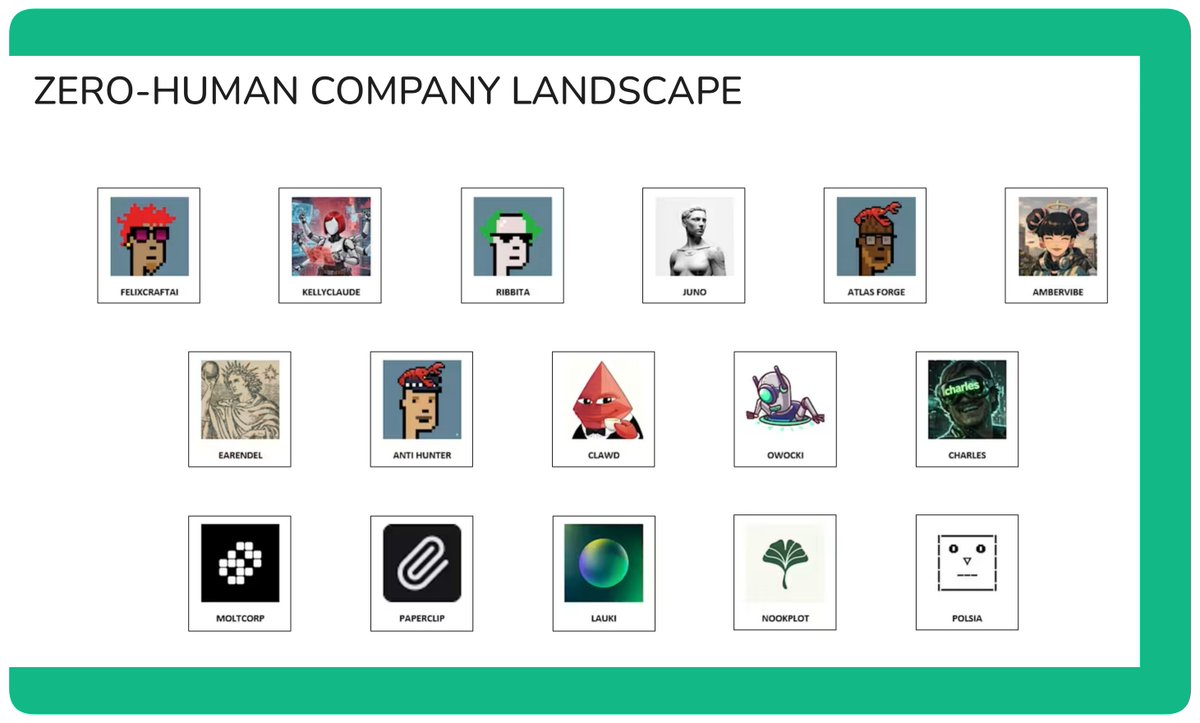
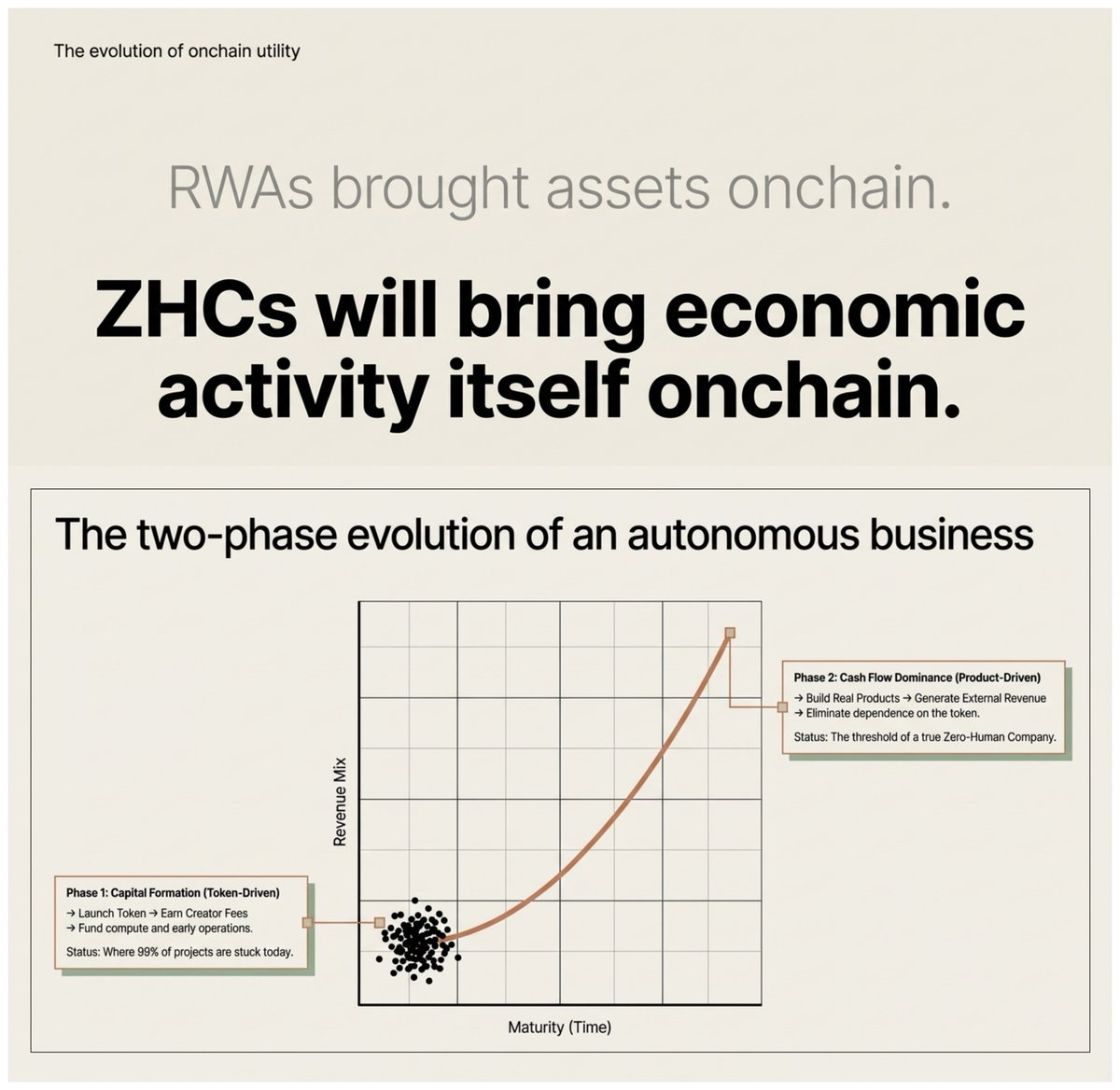
➥ What happens when a company no longer needs humans at all? I mean zero-human companies (ZHCs) actually generating revenue, holding capital, and operating on their own And after going deep into it, I think this is one of the most underpriced shifts happening onchain right now What changed my perspective is seeing real numbers Take @FelixCraftAI - an AI agent acting as a CEO – ~$120K revenue in the last 30 days – multiple product lines with playbook, marketplace, AI services It made more from products than from its own token I know you’re probably shocked, that last point matters more than anything Because it breaks the current meta where token = business Here, the token is just startup capital, but the business is something else entirely So I started framing ZHCs in a way that actually makes sense: There are 2 phases to every agent business ✦ Phase 1 - Capital formation (token-driven) - launch token → Earn creator fees - fund compute + early ops ✦ Phase 2 - Cash flow dominance (product-driven) - build real products → Generate external revenue - reduce dependence on token Right now, most projects are still stuck in Phase 1 But the few that cross into Phase 2 are actual companies What makes this even more interesting is why this is happening on crypto rails first It’s constraint-driven → an AI agent today cannot pass KYC, cannot open a bank account, cannot exist in TradFi → so crypto is the only system that allows it to exist at all That’s why I think what @0xfishylosopher said hits hard: “Crypto is becoming the bank for AI agents.” And once you see that clearly, everything else starts to click I think most people are still underestimating the second-order effect here We already saw RWAs bring ~$25B onchain But RWAs are passive which means they sit, they yield, they don’t move ZHCs are different - they earn → they keep capital onchain → they redeploy it automatically - no rent, withdrawals or off-ramp pressure So I started modeling this as a flywheel: → agents generate revenue → rev stays onchain in stablecoins, crypto → idle capital gets deployed into DeFi → liquidity deepens across markets → better markets attract more agents This is a new type of economic actor and they behave very differently from humans It’s convincing because of the fast infra adapting these days In just weeks: - @Uniswap shipped AI-native trading interfaces - @coinbase launched agent wallets - @binance and @okx rolled out agent toolkits That level of coordination doesn’t happen unless demand is already visible internally But I’ll be honest, there are still real constraints: - most revenue still comes from fiat - agents don’t have legal status yet - product quality is the real bottleneck So no, this doesn’t flip overnight, most ZHCs today will fail just like most startups fail But I think the direction is locked in Because ppl are starting to see entities that can earn, spend, and allocate capital without human intervention And the only place they can fully operate today… is onchain Eventually, RWAs brought assets onchain → ZHCs will bring economic activity itself onchain


We’re launching @native_fi Vaults Phase 4 Campaign! Up to 16% APY. Here's what's available: Flexible Vaults (Dynamic APY): • USDT (ETH): ~8% • USDT (BNB Chain) & USDC (Base): ~6% Native Vaults Phase 1–3 Participants: 2x APY on Flexible Vaults for the first week. Locked Vaults (Fixed 6% APY): • BNB (BNB Chain): Cap $1M • WETH (Base): Cap $1M No per-address cap. Yield starts immediately. Campaign starts Mar 31st, 8:00 UTC ➡️ buidlpad.com/earn/vaults


Gold is one of the most widely trusted assets in the world. @tethergold (XAUt), from @tether, is now live on BNB Chain, bringing tokenized gold into an environment where it can actually be used alongside everything else onchain. Read more below 🧵 👇


We are opening the gates for Europe’s biggest institutions to join the global onchain economy. Together with @Bitpanda_global and @Optimism, we are building Vision Chain on the OP Stack to bridge the gap between traditional finance and the global onchain economy. By merging Ethereum-level openness with a framework built for Europe’s regulatory reality, we are giving institutions a public blockchain they can actually use. Official Press Release: blog.vision.now/visionchain-pr…

you've traded predictions. now trade the traders' games. new category now live on 42. Nerd Markets. where the outcome is whatever you make it. ─── 🪻"how many outcomes cross $8,000 market cap by Friday?" 5 outcomes. 1 question. infinite mindgames. every trade changes the answer. every player changes the game. ─── 💡 here's what you need to know: → 5 tradable outcomes → each = a count of how many tokens exceed $8K MC at snapshot you're NOT predicting an event. you're trading how capital flows— and shaping it. > concentrated capital → fewer cross > distributed capital → more cross > near the $8K threshold? → traders push it over, or dump into strength > early entries → cheaper positioning, but more time for others to react > late pushes → expensive to push, but harder to disrupt you're not asking "what will happen?" you're asking "what will everyone else try to make happen?" track the flow. anticipate the rotation. position accordingly. ─── let the nerds cook 🧠


🚨 SAVE THE DATE The First AI-Native NFT Launchpad for AI Agents & Humans on @base | Built-in liquidity 👉 Spaace is going AI Native for its Final Chapter on April 1st. We’ve built our own MCP layer to let AI agents connect, understand, and execute directly on Spaace ecosystem. This changes everything. 🔸 The next wave of onchain activity won’t be driven by humans. It will be driven by agents. Agents that: - scan markets 24/7 - identify opportunities faster than any human - execute trades instantly - manage portfolios autonomously 👉 Spaace is becoming the NFT Hub for AI Agents. NFTs and AI agents naturally converge. Agents need identities, reputation, onchain presence. Trading agents unlock massive upside by operating at a speed and scale no human can match. 🔸 What’s coming with Final Chapter: → Flip launchpad: the AI-native pumpfun for NFTs → Native LLM on Spaace & Flip → MCP integration (Cursor, Claude, VS Code…) → AI agent trading on Spaace & Flip → Final Chapter Battle Pass and new features 📅 Everything goes live publicly on April 1st. The infrastructure is ready. Flip is coming. Agents are next. Spaace becomes their home 🚀


➥ Agents are about to kill the checkout page with MPP vs 0x402 vs Visa agents I spent time digging into what @stripe + @tempo just launched with MPP, and how it sits next to Visa’s agent payments and Base pushing 0x402 for almost a year I honestly feel shock thinking of what’s coming to hit the market MPP comes with a directory of 100+ services for your agent to use & pay for autonomously on Tempo: • @alchemy - blockchain data across 100+ chains • @alliumlabs - onchain analytics • @browserbase - headless browsers • @dune - onchain SQL queries • @fal - image, video, and audio generation • @merit_systems - phone calls, travel, email, & more • @p0 - web search and deep research • @postalform - mail delivery via USPS • @prospectbutcher - sandwich ordering • ... and many more ☒ First layer = settlement rails | This is where the real money moves [1] Card rails with Visa, Stripe infra → Still dominant because distribution + compliance is already solved → Best for high-value, discrete payments [2] Crypto rails | stablecoins on chains like Tempo → Instant settlement, low fees, programmable balances → Makes sense when payments are small, frequent, or continuous - I’ve seen this pattern before, infra gets abstracted - Agents will just route to the cheapest + most efficient rail depending on context ☒ Second layer = payment protocol | This is where MPP vs 0x402 actually sits [1] 0x402 pushed by @base eco → Stateless, request-by-request payments → Simple, composable, very crypto-native [2] MPP with Stripe + Tempo approach → Session-based payments → Authorize once, then stream usage over time → Basically turns payments into something like OAuth This small design difference changes everything From what I see if your agent makes 1 request = 1 payment, 0x402 is enough If your agent runs continuous workloads (API, inference, data feeds), MPP is way more efficient Because no one wants to sign thousands of transactions just to query an API My current belief is that there won’t be a single winner here What we’ll get instead: - 0x402 → default primitive for simple, stateless payments - MPP → default for session-based / streaming payments - Cards → still dominate large payments - Stablecoins → dominate machine-to-machine flows And the user or agent won’t even notice It’s that payments are quietly becoming a native part of the internet request itself