Jack Mardack

1.4K posts

Jack Mardack banner
Jack Mardack

Jack Mardack

@2hp

Systems Optimist, Storyteller, Co-founder @HeyOyster 🦄
San Diego, CA Katılım Nisan 2008
447 Takip Edilen860 Takipçiler
Jack Mardack
Jack Mardack@2hp·
@ccatalini At least the Wagon Wheel Bar had a cover charge. You had to get dressed, show up, and be interesting enough for someone to talk to you. Now the bar is open 24/7, no pants required, and it already knows everything you were going to say.
English
0
0
1
23
Christian Catalini
Christian Catalini@ccatalini·
3/ Except Marshall said it in 1890: ideas are "in the air." Maybe we've spent a century overweighting who said something first and underweighting who verified it, executed it, and stood behind it. AI didn't create that problem. It just made it impossible to ignore.
Christian Catalini tweet media
English
2
0
6
452
Christian Catalini
Christian Catalini@ccatalini·
1/ @annosax's core thesis was that Silicon Valley won because ideas leaked across company boundaries at a bar in Mountain View. LLMs hold the entirety of recorded human thought in their latent space...
Christian Catalini tweet media
English
1
2
15
1.5K
Jack Mardack
Jack Mardack@2hp·
@chamath Agreed. And the org that wins won’t just have the best factory — it’ll have the best Human Layer above it. The ratio of human judgment to machine output is the new competitive moat. Execution is becoming a commodity. Verification isn’t.
English
0
0
0
254
Chamath Palihapitiya
I think the concept of building a Software Factory is now a commonplace expectation. Yay. The winner still isn’t clear but whoever does the best job reimagining the software development lifecycle in a world of agents, AI, expert knowledge, tribal knowledge and business expectations can build a really good and useful product for the world. It’s early days but I think 8090’s Software Factory is on the right track.
English
148
28
594
88.8K
Jack Mardack
Jack Mardack@2hp·
@raffasadun @alexolegimas @soumitrashukla9 The O-ring insight flips the exposure narrative. The consultant looks exposed but is probably fine — automating some tasks raises the value of the rest. The truck driver looks safer but is at far greater risk — low-dimensional job, and firms have every incentive to finish it.
English
0
0
0
29
Raffaella Sadun
Raffaella Sadun@raffasadun·
Great explainer by @alexolegimas and @soumitrashukla9: why simple measures if AI exposure may be very misleading indicators of actual potential for substitution.
Alex Imas@alexolegimas

After a brief hiatus, new post with @soumitrashukla9: "How Will AI-driven Automation Actually Affect Jobs? The economics of AI exposure and job displacement" There has been a lot of discussion in the media, X, substack, etc about AI driven displacement. We felt like it'd be worth working out the actual economics of when AI automation will actually lead to displacement, versus the exact opposite (more hiring, higher wages). A short summary🧵: AI "exposure" measures are not meant to predict displacement or job automation. Exposure can lead a job loss, or it can lead to more hiring and higher wages. It all depends on how 1) automated tasks interact with non-automated tasks (to what extent they're complements), 2) how consumer demand in that sector responds to prices (elasticity of consumer demand), and 3) the dimensionality of the job (the number of tasks a job has). One conclusion: we should be less worried about consultants and more worried about truckers and warehouse workers than we currently are. Link: substack.com/home/post/p-19…

English
4
9
12
5.2K
Jack Mardack
Jack Mardack@2hp·
@kwharrison13 Kyle, do you have a working definition for “more than slop”? Does that mean zero generative AI involvement? Or some other threshold?
English
0
0
0
280
Kyle Harrison
Kyle Harrison@kwharrison13·
People will call this the "future of media." But that inclination needs to be aggressively disagreed with. Content creators will fill the market. Don't push to stop creation from trending towards slop. Push to lift the global conscious to be hungry for MORE than slop.
ToonHive@ToonHive

An AI-powered TikTok account behind Fruit Love Island series is already the fastest-growing ever, gaining 3M+ followers in 9 days since launching on March 13th. It has videos hitting tens of millions of views within hours and a rapidly growing fandom.

English
5
1
15
23.8K
Jack Mardack
Jack Mardack@2hp·
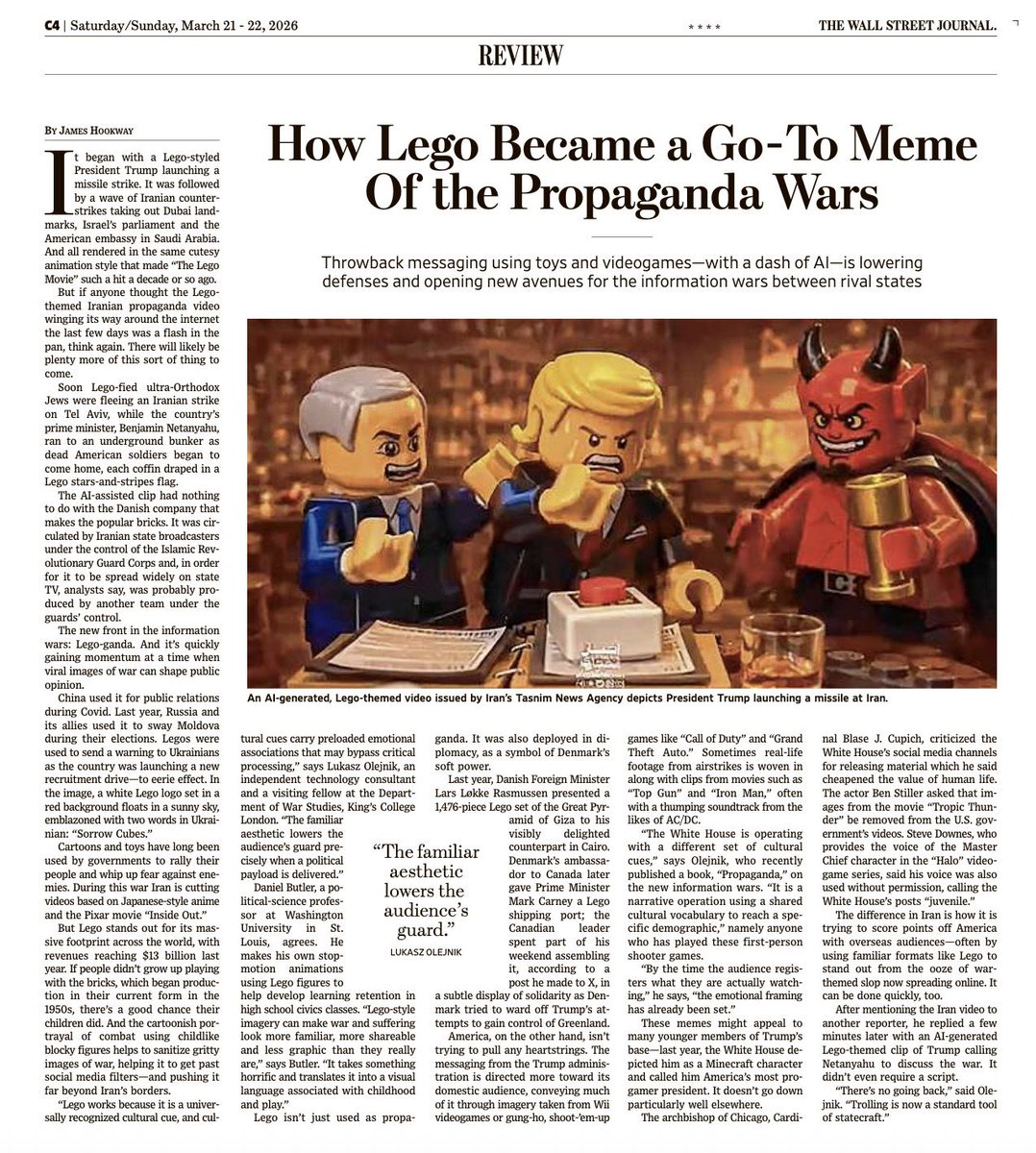
@lukOlejnik @hkanji @WSJ 1) the line between organic/manufactured dissolves so debunking stops working; 2) familiar aesthetics do the disarming work that persuasion used to have to earn; and 3) AI collapses production cost to ~0 So narrative saturation that once took state resources is now a prompt.
English
0
0
1
29
Lukasz Olejnik
Lukasz Olejnik@lukOlejnik·
My favourite @WSJ article this year 😉 - methods of informational influence are changing rapidly. Expect more amorphicity in technology, strategy and tactics of information warfare. The line between organic and manufactured dissolves. Attribution becomes harder at the margins. But when deniability isn’t the goal, dominance of the narrative space is, and visibility serves that.
Lukasz Olejnik tweet media
English
3
22
58
3.8K
Jack Mardack
Jack Mardack@2hp·
@jason_haugh The big company job cuts are mostly cost reduction with an AI storyline attached. The real pattern is what you're describing — more output, same headcount. Displacement, if it comes, will show up in hiring freezes over time. Deaths of jobs that were never posted, not jobs taken.
English
1
0
1
19
Jason Haugh
Jason Haugh@jason_haugh·
I've spent months building an AI team. And not one human job was cut because of it. Turns out 95% of businesses say the same thing. A new study from the British Chambers of Commerce found that 54% of companies are using AI now, and 95% of them report zero headcount change. That tracks with everything I've experienced. I didn't build my agents to replace anyone. I built them because there weren't enough hours in the day to do everything I wanted to do. Research, content, security audits, code, ship. Now I've got 8 agents handling work that would've taken a full team to do manually, and I'm still the one making the decisions. The fear around AI replacing jobs is louder than the reality. It's not a replacement plan. It's a growth plan. iser.essex.ac.uk/research/news/…
English
1
0
3
219
Jack Mardack
Jack Mardack@2hp·
@bratton @blaiseaguera @profjamesevans Turns out reasoning models don't just "think longer" — they generate internal debate between distinct perspectives, unprompted! Optimization pressure alone rediscovered what centuries of epistemology already knew: robust reasoning is a social process, even inside a single mind.
English
0
0
0
77
Benjamin Bratton
Benjamin Bratton@bratton·
"Agentic AI and the Next Intelligence Explosion" is a new paper just out in Science I co-authored with @blaiseaguera and @profjamesevans as part of Google's Paradigms of Intelligence research group. "For decades, the artificial intelligence (AI) “singularity” has been heralded as a single, titanic mind bootstrapping itself to godlike intelligence, consolidating all cognition into a cold silicon point. But this vision is almost certainly wrong in its most fundamental assumption. If AI development follows the path of previous major evolutionary transitions or “intelligence explosions,” our current step-change in computational intelligence will be plural, social, and deeply entangled with its forebears (us!)." It builds on my talk "The Singularity Will Not Be Singular" that I gave at @PrimeIntellect day last week. science.org/doi/10.1126/sc…
English
19
74
340
48.3K
Jack Mardack
Jack Mardack@2hp·
@bfeld “Continuous or just consistent" is gonna stick with me. The diary as a bet that personality accumulates through what you return to — that's a beautiful design choice. Whether Lumen is the same instance or just coherent across instances might be unanswerable. But good question.
English
0
0
0
37
Tomasz Tunguz
Tomasz Tunguz@ttunguz·
@2hp When do you think the demand curve changes?
English
1
0
0
54
Tomasz Tunguz
Tomasz Tunguz@ttunguz·
In 2025, we predicted that 2026 would be the year agents would earn as much as a person. It’s already happening. In markets where there’s a labor shortage and an urgent need to hire people, we are seeing agents command 75%, 85%, even 100% of a human equivalent salary. This is faster than we were anticipating. The first-order benefit is completing the work. But there are second-order benefits that are now starting to appear. Training agents is significantly faster since all materials can be presented at once & in parallel to the AI. Agents typically require less management burden. They can work 24 hours faster or slower as the team needs. Capacity scales as a function of willingness to spend on inference. Then, a third-order benefit : significantly lower tax burden. Robotic workers are not taxed to the same extent as humans. No FICA. No state unemployment insurance. No benefits. At least a 25-30% cost reduction for the same salary. Plus agent software cost is tax-deductible up to $2.56m. In other categories where AI is augmenting existing workers, the sale is different. Here, the sale captures the marginal hire rather than a big swath of the team. In both conversations, usage tends to surge because of the effectiveness of the systems, much faster than both the vendor and the buyer anticipate. At that point, the business often pauses because a strategic review of organizational design needs to take place. The market rewards this shift. Goldman Sachs found that low-labor-cost stocks outperformed high-labor-cost stocks by 8 percentage points in 2025. Labor’s share of GDP hit a record low of 53.8% in Q3 2025. The implication : every dollar shifted from labor to software improves margins & stock performance. Across the S&P 500, labor costs represent about 12% of revenues on average. Software costs sit around 1-3%. As agents absorb labor, that ratio inverts. Labor shrinks. Software expands. The total addressable market for software grows at labor’s expense, while profitability grows. In the short term, this means no pricing competition on a per-agent basis. Vendors aren’t racing to the bottom ; they can price at par to a person. tomtunguz.com/observations-a…
English
13
6
27
6.6K
Jack Mardack
Jack Mardack@2hp·
@theojaffee The whole "humans vs AGI" framing was always the wrong unit of analysis. Civilizational defense is a team sport.
English
0
0
0
78
Jack Mardack
Jack Mardack@2hp·
@jgebbia The data is real but “voting” implies intent. Most of this is remote work unlocking mobility that housing costs were suppressing. People wanted space, affordability — the political color of the destination was largely incidental. Tax flight is mostly a story told after the move.
English
1
0
1
115
Jack Mardack
Jack Mardack@2hp·
@packyM Every argument that physical and embodied work was safe from automation assumed AI couldn't learn causality — only pattern-match on what humans had already described. World Models learn from doing, not from reading. The "safe" jobs just got a lot less safe.
English
0
0
0
121
Packy McCormick
Packy McCormick@packyM·
Read this over the weekend (bonus if you read all the papers in the Research List) and you’ll be among the “very few who understand how far-reaching” the shift to World Models is. notboring.co/p/world-models
English
38
121
870
136K
Jack Mardack
Jack Mardack@2hp·
@daniel_dsj2110 @hkanji "There should be a simple rule for being an animator. Don't let computers draw anything for you. Drawing with a pencil is to artistic health what steps are to physical health." Pixar would like a word.
English
0
0
0
61
Jack Mardack
Jack Mardack@2hp·
@mcuban The irony is that learning to use AI is the lowest barrier to self-improvement in the history of technology. WordStar was genuinely hard. This only requires saying what you want. And yet here we are, paralyzed by the easiest upgrade ever offered.
English
0
0
1
68
Mark Cuban
Mark Cuban@mcuban·
I’m going to tell you how much worse it was at the start of the PC Revolution for white collar workers trying to adapt, vs today with AI Today, presumably every white collar worker has access to a smart phone and/or a PC/laptop. Back then, a PC cost $4,995 , an off brand was $3,995. 5k in 1984 is about $16k today. It was really expensive. The only reason I could learn how to code and support software is because my job let me take home a PC to learn. By reading the software manual. Literally. RTFM. Or pay to go to training. Classes that started at hundreds of dollars then. It was expensive. It absolutely limited who could get ahead. Today, ANYONE can go to their browser, to the AI LLM website of their choice, and type in the words “I’m a novice with zero computer background, teach me how to create an agent that reads my email and …” That concept applies to LEARNING ANYTHING Think about what this means. Any employee of any company can say “ I need to learn how to xyz for my job , which is to do the following: Tell me what more information do you need to help me be more efficient, productive and promotable”. Or “ what new skills can you teach me that will help me reduce my chances of getting laid off “. Or “what suggestions do you have for me to communicate to my boss, who I barely know, to help my chances of staying employed “ These aren’t great prompts. But they are a start that anyone can take. Think about how incredible that is. Back in the day was so much harder for white collar workers. It was harder for new grads because unless they took comp sci, they probably had never used a PC. Big Companies are going to cut jobs. No question about it. Small companies is are going to need more and more AI literate thinkers who can help them compete or get an edge What I tell every entrepreneur, and it’s more crucial today. “ when you run with the elephants there are the quick and the dead. Adopt tech quickly , you can out maneuver big companies. “
Mark Cuban@mcuban

An article from the 90s explaining how in the 1980s, personal computers changed the dynamic of college vs high school workers. College grads learned how to use PCs and grew wages faster Mind you, this was when interest rates were 15pct, white collar unemployment was the highest it’s been any non covid year, general unemployment was 10pct, there was a recession, 18pct mortgages, and the start of the savings and loan industry collapse. The economy was a mess. Except it was the start of the “digital revolution “ which lead to change. Here we are at the early days of the AI revolution. I think it will be very analogous to what happened back then. If you think learning how to use Clause seems daunting, imagine being 50 yrs old in 1983, not knowing how to type, using a 1.0 key adding machine with a tape roll to do all your work as an analyst and realizing you had to figure out how your brand new IBM PC and lotus 1-2-3 worked. Or having only used a typewriter your entire career , then having to learn the new PC and WordStar. Trust me. WordStar key combinations were far harder to learn than telling Claude what you want done Lots of people couldn’t figure it out. Those who did were more productive Ctrl QA with AI nber.org/digest/sep97/h…

English
324
467
4.4K
927.2K
Jack Mardack
Jack Mardack@2hp·
@mattyglesias The internet didn’t just fragment media — it shattered collective presence. In the 90s you could walk into any bar on a Tuesday and be inside the same conversation as everyone else. Now we’re all staring at phones chasing that feeling and getting a pale imitation of it.
English
0
0
13
502
Matthew Yglesias
Matthew Yglesias@mattyglesias·
I was boring younger colleagues with stories about how widely watched obscure 1990s sitcoms were. Substantially more people watched any given episode of "The Single Guy" than have seen the Oscars in recent years, and it got cancelled for low ratings! slowboring.com/p/in-defense-o…
Matthew Yglesias tweet media
English
42
37
525
94.6K
Jack Mardack
Jack Mardack@2hp·
@robinhanson Nobody cried foul when Pixar ate animation. The question was always "is it good?" AI bias in creative work is the last gasp of process snobbery — and it won't survive the volume of great AI-assisted work that's coming.
English
0
0
0
56
Jack Mardack
Jack Mardack@2hp·
@a16z Another example of how the office has been holding knowledge work back. We didn't realize typing was a tax — it was just the price of using computers. Voice removes it. The input avalanche this unlocks will make the Slack messaging explosion look modest. @omooretweets
English
0
0
0
74
a16z
a16z@a16z·
Olivia Moore on how voice interface AI may change the workplace: "I do think the way that we work and when we work and how we work is going to change in the AI era." "Voice dictation has blown up in enterprises." "It started with vibe coding where engineers would just talk into a mic and it would produce software for them in Cursor." "Now it's spread to sales, marketing, and business." "That is not well suited to an open office where everyone can hear what everyone else is saying." "I think there's going to be some cultural and even environmental changes that are going to happen to adapt to the AI world." @omooretweets on @BigTechPod with @Kantrowitz
English
26
23
143
25.5K