Action for Health

2.3K posts

Action for Health banner
Action for Health

Action for Health

@A4Horg

National nonprofit organization working to ensure fair outcomes for critical #healthcare issues. Our special projects @anthem_watch, @statecarenet.

United States Katılım Şubat 2020
2.3K Takip Edilen1.1K Takipçiler
Action for Health retweetledi
Adam Bruggeman, MD
Adam Bruggeman, MD@DrBruggeman·
“I have every lawyer in town bowing gratitude to me for the work they got out of that law.” - Pete Stark The core argument for the Stark Law has always been that without regulation, physicians with financial interests in referral destinations will over-utilize, and there is no external check to stop them. That argument may or may not have had merit in 1989. Regardless, it does not hold in a world of 50 million annual prior authorization requests. Prior authorization is prospective utilization review. Before a high-cost imaging study, surgical procedure, or specialist referral is approved, a payer independently evaluates medical necessity. That is precisely the external accountability check Stark was designed to substitute for. When qualified utilization review exists, the foundational justification for the Stark prohibition disappears. Researchers at Johns Hopkins made this case in JAMA Health Forum, proposing that self-referral should be permitted within capitated, risk-adjusted payment programs, including Medicare Advantage, because managed care tools already address the overutilization concern Stark was written to solve. A CMO at Temple Faculty Physicians arrived at the same conclusion independently, telling Becker’s this week that if a process is structured to address what patients need without a fee-for-service reward driving it, there is no reason to focus heavily on Stark restrictions. Clinical leaders and peer-reviewed research are pointing to the same answer that the accountability mechanism should be the utilization review process, not a 35-year-old ownership prohibition. For any service subject to prospective prior authorization or qualified utilization review, physician ownership of the referral destination should qualify for a Stark exception. This satisfies the desire for an external check making Stark redundant. For physician-owned hospitals, a conditional pathway makes sense. Facilities that subject their procedures to Medicare Advantage utilization review would be able to add all MA plan cases to their facility. If they want full access to the traditional Medicare population, participating in CMS’s own WISeR accountability model should qualify for a conditional exception to the 2010 ban. These are rational substitutions of modern accountability tools for an outdated and overly burdensome regulatory framework. CMS already operates the infrastructure to fix the problem. We just need Congress or CMMI to recognize it.

Adam Bruggeman, MD tweet media
English
5
8
13
781
Action for Health retweetledi
Darrel Rowland
Darrel Rowland@darreldrowland·
Here's a big one: The pharmacy benefit manager (PBM) for CVS overcharged more than $600 million in just four years of coverage for federal employees, a scathing, just-released audit by an inspector general shows oversight.gov/sites/default/…
English
8
57
144
9.2K
Action for Health
RT @DrBruggeman: OK…. Promise it’s my last response. I think it will be eye opening for many of you and expose the hypocrisy of the @FAHhos
English
0
2
0
26
Action for Health
Action for Health@A4Horg·
"The data is clear" = only the data you pay for, and literally nothing else. We'll await patiently for something more, if you have it. In the meantime, there's a lot of actual research, data, and survey results from @bmj_latest, @econliberties, @JAMA_current, @Healthgrades, @ndpanalytics, @mercatus, and @AEI that say the exact opposite. Your charade is coming to an end. And lawmakers, regulators, patients—even employers and brokers—are now realizing it, 16 years after your attempted #ACA coup de grâce. Seriously, thank you for your attention to this matter.
English
1
6
29
909
Federation of American Hospitals
There is no issue with physician-led hospitals- the issue is about the conflict of interest when physicians self-refer patients to their own hospitals. The data is clear: POHs tend to treat more commercially insured and healthier patients than full-service hospitals. In rural communities, this can leave rural hospitals with a greater financial burden, further threatening their ability to keep their doors open and keep 24/7 care available in their communities. Read more: fah.org/wp-content/upl…
English
101
2
20
95.5K
Action for Health retweetledi
Anthem Watch
Anthem Watch@anthem_watch·
Check out our latest statement highlighting Elevance Health's new facility policy metastasizing to a 12th state—California. anthemwatch.org/media/anthems-…
English
1
1
1
104
Action for Health
Action for Health@A4Horg·
Yesterday on Capitol Hill, @RepMGriffith offered this in his opening statement: "...[B]ecause of the Affordable Care Act, any existing physician-owned hospital built before 2010 is prohibited from growing beyond the size it was when the bill became law. How does that make sense? "As a result, many #patients face limited provider options in their communities and may encounter higher prices with little insight into the cost of health services." We could not agree more. ⏰ The time is up on the arbitrary ban on physician-led hospitals.
English
1
3
4
359
Action for Health retweetledi
Daniel Payne
Daniel Payne@_daniel_payne·
“We’re just kind of done with the vaccine issue,” said one White House official. “We’ve done what we want to do on the vaccine front.” On the future of the MAGA-MAHA alliance, w/ @ChelseaCirruzzo statnews.com/2026/03/13/tru…
English
2
13
14
5.4K
Action for Health retweetledi
IndeMed
IndeMed@IndeMedAction·
The states are leading. State legislatures are the laboratories of democracy, and Indiana is showing the rest of the country what's possible when lawmakers put patients first. ✅Indiana just became the first state in the nation to pass bipartisan legislation protecting patients from insurer penalties when their care involves an out-of-network provider. Senate Enrolled Act 189, authored by @ScottABaldwin, prohibits insurance companies from financially penalizing hospitals and facilities in these situations - keeping the focus where it belongs: on timely, medically necessary care. ⁉️Who's next? Indiana just handed every other state legislature a blueprint. 🔎 Read more: wimsradio.com/2026/03/03/ind…
IndeMed tweet media
English
1
27
74
60.1K
Action for Health retweetledi
Adam Bruggeman, MD
Adam Bruggeman, MD@DrBruggeman·
When a physician wins an IDR determination, the law is unambiguous. The decision is final and binding. The insurer has 30 business days to pay. That is not guidance. That is statute. So what happens when they don’t pay? The obvious solution: go to court. That option is now in serious jeopardy and the legal landscape around IDR enforcement has become one of the most consequential and underreported stories in health policy. In June 2025, the U.S. Court of Appeals for the Fifth Circuit ruled in Guardian Flight v. Health Care Service Corporation that the No Surprises Act provides no private right of action to enforce IDR awards. Providers cannot sue insurers in federal court to compel payment. The Fifth Circuit held that enforcement runs exclusively through HHS’s administrative complaint process. En banc review was denied in July 2025. That ruling is now binding precedent in the Fifth Circuit. Other courts followed. In September 2025, the Southern District of New York dismissed a provider suit against Cigna on the same grounds, holding that Congress deliberately withheld judicial confirmation authority. That same month, the Middle District of Florida dismissed a case involving over $1.1 million in unpaid IDR awards, explicitly adopting the Fifth Circuit’s reasoning even though it was not bound to do so. One court went the other way. In May 2025, the District of Connecticut ruled in a separate Guardian Flight case, involving $20 million in alleged nonpayment by Aetna and Cigna, that the NSA does provide an implied private right of action, citing the statute’s direct language requiring payment within 30 days and its declaration that awards are binding on the parties. That is a direct circuit split. Providers in different jurisdictions now operate under fundamentally different legal frameworks when trying to collect awards they have already won. Providers petitioned the Supreme Court to resolve it. In January 2026, the Court declined. The split stands. The Department of Justice, in amicus filings, warned that if providers cannot obtain court relief for nonpayment, “one of the NSA’s core features would be frustrated, upending Congress’s scheme.” The Connecticut court was equally direct, noting that “it is unlikely that any such administrative enforcement scheme could police insurers’ and health plans’ compliance with each IDR determination.” In other words, the only enforcement mechanism the Fifth Circuit left intact has already been assessed by a federal judge to be inadequate to do the job. Now layer in Loper Bright v. Raimondo, the Supreme Court’s June 2024 decision that overturned four decades of Chevron deference. Courts no longer automatically defer to HHS’s interpretation of its own enforcement authority. Any administrative mechanism HHS deploys under the NSA that relies on statutory ambiguity is now subject to independent judicial scrutiny and can be challenged and overturned. The Fifth Circuit said enforcement belongs with HHS. Loper Bright ensures that HHS’s ability to exercise that authority is itself contestable. The backstop has a backstop problem. And the compliance data predates all of this. A 2024 survey found that 1 in 4 IDR awards were already being paid late or not at all. This was before the primary judicial deterrent was removed and before agency enforcement authority became newly vulnerable to legal challenge. A system where a provider can win a binding arbitration award and have no clear mechanism to collect it is not a dispute resolution system. It is a suggestion box. Congress has the ability to fix this and a bill already on the table does exactly that. More on Friday. Interested in getting involved? Join @IndeMedAction
Adam Bruggeman, MD tweet media
English
3
9
21
1.1K
Action for Health retweetledi
IndeMed
IndeMed@IndeMedAction·
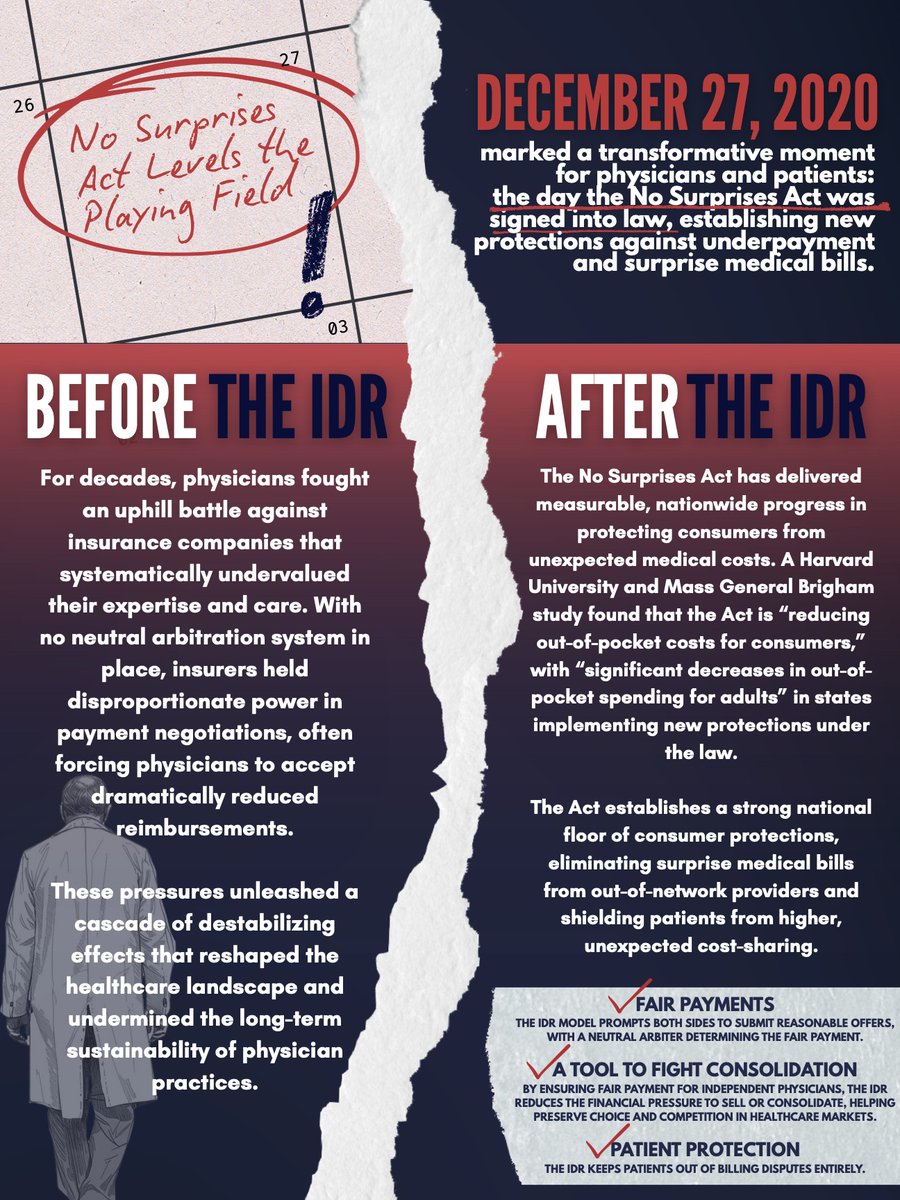
The No Surprises Act is working: ✅Patients saving $567/year ✅In-network participation is UP ✅10M+ surprise bills prevented So why are insurers pushing to gut the IDR process that keeps it fair? They recently sent a letter to the federal government urging restrictions on the very system a bipartisan Congress created. We sent a letter to HHS, Treasury & Labor to protect the NSA and the independent physicians who rely on a balanced system. 🔎Read more: indemed.org/press-release/…
IndeMed tweet media
English
0
2
0
1.2K
Action for Health retweetledi
Adam Bruggeman, MD
Adam Bruggeman, MD@DrBruggeman·
The No Surprises Act was supposed to be simple: if a payment dispute can’t be resolved between a physician and an insurer, an independent arbitrator decides. The determination is final. Binding. Done. Except it isn’t. Physicians across the country are winning IDR determinations and then waiting…. And waiting…. And waiting…. Because there’s nothing actually forcing insurers to pay. A 2024 survey by the @EDPMA found that 24% of IDR awards were either unpaid or paid incorrectly within the 30 business days the law requires. One in four. On determinations that are supposed to be legally binding. And that’s just the average. I know of groups with 0% payment rates. This isn’t a gray area. The NSA explicitly states that IDR determinations “shall be binding upon the parties involved.” The law is clear. The compliance is not. This week I’m going to walk through why the IDR system is under strain, what the enforcement gap actually looks like, and what Congress is doing about it. Because a dispute resolution process that doesn’t enforce its own outcomes isn’t a process — it’s theater.
Adam Bruggeman, MD tweet media
English
6
20
47
4.1K
Action for Health retweetledi
Adam Bruggeman, MD
Adam Bruggeman, MD@DrBruggeman·
Let me tell you what happened before I got to the OR this week. My patient needed surgery. I recommended it. My training, my board certification, and my years of clinical experience all pointed to one answer. The insurance company had a different one: not yet. That’s prior authorization and it is breaking American medicine. Here’s the number that should stop you cold: in a prospective multicenter study of orthopedic subspecialty practices across 6 states, 98.5% of prior authorization requests were ultimately approved when recommended by a fellowship-trained, board-certified orthopedic surgeon. 98.5%. The system isn’t catching bad medicine. It is a delay machine that consumes enormous resources, causes real patient harm, and exists primarily to make the economics of denial work in the insurer’s favor. The 2024 AMA survey of 1,000 physicians put numbers to what every physician already knows: - 39 prior authorizations per physician per week averaging 13 hours of physician and staff time - 93% of physicians say PA delays patient care - 82% say patients commonly abandon their recommended treatment because of PA - 29% report PA caused a serious adverse event — hospitalization, permanent damage, or death - 61% are concerned insurers are now using AI to systematically increase denial rates, with some tools producing denials up to 16 times higher This is not utilization management. This is obstruction at scale. Surgery is precision and focused on minimizing collateral damage. Prior authorization is brute force with disregard for the collateral damage. In my world, delay has a clinical cost. A patient waiting on PA for fracture repair, joint replacement, or spinal stabilization is losing function and sometimes losing the window for the best possible outcome. That cost never shows up on an insurer’s earnings call. Given that the average patient is on an insurer’s books go 3 years, delays can sometimes mean making someone else pay the bill for the necessary treatments. The consensus statement insurers signed in 2018, promising PA reform? Seven years later, only 16% of physicians working with UnitedHealthcare say anything has actually changed. They made another promise to Secretary Kennedy and Administrator Oz recently but is there any real change coming? Voluntary reform has failed. Legislative and regulatory action is the only path forward and physicians need to be loud enough for long enough that lawmakers act.
Adam Bruggeman, MD tweet media
English
18
57
127
7.7K
Action for Health retweetledi
Adam Bruggeman, MD
Adam Bruggeman, MD@DrBruggeman·
Update on Arizona HB 2211 from @JulieHoffAZ: the bill has been held and will return next session. Thank you to every physician, patient advocate, and coalition partner who engaged. Special thanks to @ArizonaMedicine for their grassroots call to action. Your voices made a difference. This is exactly how the process is supposed to work. Make no mistake, this fight is not over. The legislation will be back, and so will we. Whether it’s Tucson, Washington, D.C., or anywhere in between, we will be there. Independent medicine matters now more than ever. The No Surprises Act was designed to protect patients from unexpected bills, not to hand insurance companies a new tool to silence physicians who bill appropriately and advocate for fair reimbursement. When outside interests can report physicians to regulators simply for charging what their care is worth, the independence of medicine itself is at stake. IndeMed exists because someone has to stand between corporate influence and the doctor-patient relationship. When physicians are free to practice independently — free from intimidation and free from retaliatory reporting mechanisms — patients get better care. We'll be ready when this bill returns. Stay engaged. Stay informed. Join the fight if you haven’t already! Learn more at: indemed.org
Julie Hoffman@JulieHoffAZ

@DrBruggeman Bill was "discussed" in committee then held. Plan is to bring back next year, after stakeholder meetings

English
2
4
16
744