

AI Infrastructure
1.1K posts
AI Infrastructure
@AI_Supercycle01
Investing in AI Infrastructure
Katılım Haziran 2025
199 Takip Edilen64 Takipçiler


This is cool. A Nature feature about my project.
Many scientists dismiss n=1 experimentation. Some actively work to diminish it.
I disagree. N=1 has a role, and an increasingly important one.
My team and I use clinical trial evidence daily. It guides our decision making and it also has limits.
Most people are struggling with a health issue that ranges anywhere from annoying to life threatening. Clinical evidence doesn't always provide what's needed to act. Personal experimentation and measurement can help fill that gap.
AI, multi-omics, wearables and real-time tracking all empower the N=1 to tackle conditions that remain incurable by current medical standards.
Here is the complete write up we provided to the author:
Randomized trials are necessary but not sufficient: the case for N-of-1 measurement and experimentation
Bryan Johnson and the Blueprint & Immortals Medical and Science Team: Ali Ghanem, PhD, Damon Forbes, M.D., and Carl Seger, M.D.
Randomized controlled trials remain the gold standard for evaluating therapeutic claims, and they will continue to anchor the evidence we use to select interventions. We do not dispute this. Our argument is narrower.
The RCT is engineered to estimate the average treatment effect of a single intervention, under a fixed protocol, in a defined population.
That is exactly the right instrument for the question it was built to answer: whether an intervention works on average, and whether it is safe enough to use. It is the wrong instrument for the question that governs health and lifespan optimization: which combination of interventions, at which doses, produces the best response in a specific individual measured densely over time.
By design, the RCT averages over the very heterogeneity that personalization must exploit; its narrow endpoints, short horizons, and one-intervention-at-a-time structure are not built to resolve individual response. This limitation is structural, not a defect to be corrected with larger samples.
N=1 experiments with longitudinal, high-resolution measurement are therefore not a substitute for RCTs but a complement: the means by which population-level evidence is translated into the individually optimized, proactively preventive interventions that meaningful health and lifespan extension require.
Trials report binary endpoints and population averages that do not capture individual response [1]. In JUPITER, the number needed to treat to prevent one major cardiovascular event over five years was 252; by that endpoint, roughly 96% of treated participants gained no measurable benefit. It may be objected that the trial did measure continuous biology, since median LDL cholesterol fell by about 50% [2]. But such a biomarker change does not, by itself, secure approval or guide therapy; the decision rests on the binary endpoint.
The continuous signal is recorded yet not acted upon, other continuous changes go untracked, and none of these markers is measured in the individual patient in routine care. Neither clinician nor patient can therefore identify who benefits, who could safely forgo treatment, or who is silently accruing harm. Safety inherits the same blind spot: trials register only what they measure, or events too severe to miss.
One instructive example is rofecoxib. Approved in 1999 on analgesic and gastrointestinal endpoints, it carried none for cardiovascular harm; the signal in VIGOR (2000) [3] was read as naproxen’s protection until APPROVe settled it in 2004 [4].
But these were endpoint-based trials, built to count events, not to measure the prostacyclin-thromboxane shift that would have made the prothrombotic risk visible before it appeared as infarctions. It was not so much missed as never measured: a structural shortcoming of endpoint-based design. Negative results, moreover, are disproportionately unpublished [5], so the evidence base loses the findings that would most constrain prevailing hypotheses.
We regard N-of-1 measurement as the next frontier, enabled by the convergence of artificial intelligence, wearables, multi-omic profiling, real-time tracking, and exposome capture.
Within my own protocols, maximally quantified and self-controlled, we have already generated signals that lie beyond the published literature and constitute first-in-human observations: real-time quantification of heat-shock-protein activation against continuously measured core temperature; sauna-driven clearance of environmental organic toxins (including plasticizers like phthalates and DEHP); enhanced fertility markers under sauna with testicular cooling; a first proof-of-principle demonstration of microplastics complete elimination from the semen and by more than 90% in blood, against a background in which these particles have been found in the semen [6] and testes [7] of every man so far studied; and the first human signal of a psilocybin-induced metabolic switch that lowered blood glucose and durably improved glycemic control.
We treat all of these as observations in need of further validation; our framework is not about finding instant answers but about identifying which questions are worth asking and investigating further.
The paradigm scales. A few deeply instrumented pioneers establish the axes of a high-dimensional physiological space; a larger cohort of cartographers charts its breadth across longitudinal individuals.
Once charted, the measurement burden collapses: neighbour-embedding methods8 position a sparsely sampled person within the map of the high-dimensional individual-biomarker space, inferring state and trajectory from nearest neighbours. This is already routine in biology, where sparse genotyping arrays are imputed to whole-genome resolution against reference panels [9], and, beyond medicine, where roughly 300 social-media “likes” predicted personality better than a spouse [10]. The deep cost is paid once; thereafter each individual is situated cheaply.
The frontier we find most compelling is the unleashing of N-of-1 methods against conditions presently considered incurable. Individualized, biomarker-guided strategies are already converting such conditions from managed to treatable: a documented case of recurrent osteosarcoma brought to sustained remission under an intensive personalized regimen, and, in veterinary oncology, the first personalized mRNA cancer vaccine administered to a dog, which produced substantial tumour regression. The new focus of our protocol is to tackle chronic conditions that current medicine accepts as manageable but not treatable, and to render them treatable through advanced diagnostics and next-generation personalized therapeutics.
References
1. Kent, D. M., Steyerberg, E. & van Klaveren, D. Personalized evidence based medicine: predictive approaches to heterogeneous treatment effects. BMJ 363, k4245 (2018).
2. Ridker, P. M. et al. Rosuvastatin to prevent vascular events in men and women with elevated C-reactive protein. N. Engl. J. Med. 359, 2195–2207 (2008).
3. Bombardier, C. et al. Comparison of upper gastrointestinal toxicity of rofecoxib and naproxen in patients with rheumatoid arthritis (VIGOR Study Group). N. Engl. J. Med. 343, 1520–1528 (2000).
4. Bresalier, R. S. et al. Cardiovascular events associated with rofecoxib in a colorectal adenoma chemoprevention trial (APPROVe). N. Engl. J. Med. 352, 1092–1102 (2005).
5. Turner, E. H. et al. Selective publication of antidepressant trials and its influence on apparent efficacy. N. Engl. J. Med. 358, 252–260 (2008).
6. Li, N. et al. Prevalence and implications of microplastic contaminants in general human seminal fluid: a Raman spectroscopic study. Sci. Total Environ. 937, 173522 (2024).
7. Hu, C. J. et al. Microplastic presence in dog and human testis and its potential association with sperm count and weights of testis and epididymis. Toxicol. Sci. 200, 235–240 (2024).
8. van der Maaten, L. & Hinton, G. Visualizing data using t-SNE. J. Mach. Learn. Res. 9, 2579–2605 (2008).
9. Marchini, J. & Howie, B. Genotype imputation for genome-wide association studies. Nat. Rev. Genet. 11, 499–511 (2010).
10. Youyou, W., Kosinski, M. & Stillwell, D. Computer-based personality judgments are more accurate than those made by humans. Proc. Natl. Acad. Sci. USA 112, 1036–1040 (2015).

English

If this post gets 200 likes, I will share the interview of one of my four management 1x1's for FREE on X that I have w/ the following:
- $ADTN
- $POWI
- $BWEN
- $KLIC
Last week, had CFO 1x1's w/ $VPG and $FCEL
Top comment will be the one I share for free here on X. Comment 👇🏼
English

I always love it when I see stories like this...lol. 🤣🤣🤣
$QURE
tipranks.com/news/u-s-chess…
English
@jasonschips why $CRWV over $NBIS if its just the leverage you can just buy nbis on margin or call
English

The shitco $CRWV up 10% on a day where $SMH down 5%
(I am long said shitco)
GIF
Jason's Chips@jasonschips
It's really quite underrated. The worse something looks optically, the higher the c o n v e x i t y And bc AI lets numbers get revised up 150% in a week something that's unprofitable could be trading at like 2x realized earnings It's why I might be the sole $CRWV bull out there. Using options on it too. Leverage cubed.
English
@ren_stocks How do free subscribers redeem a one-time pass to read the paid article?
English


@Stocktwits somehow theres still people on this site shilling dog shit ethereum
English

You bought SpaceX an hour ago +3.3%
You held Ethereum for 5 years -30%

English
English


Going to drop a milly in an account to show @kevinxu what all-in really means
English

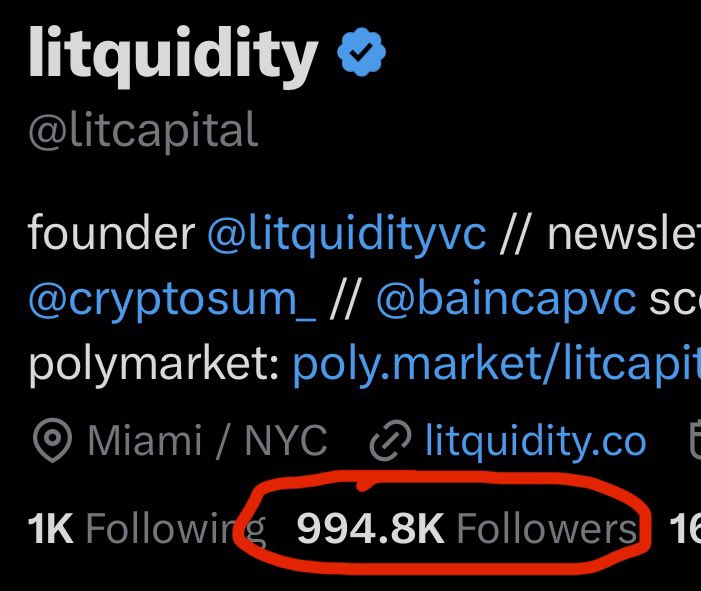
APPROACHING 1 MILLION FOLLOWERS
What should I giveaway to the community and how should I celebrate? Open to suggestions 😤
English



When I think of all the ways this could go
My brain keeps thinking $GLW is such a durable / well positioned company
Gaetano@crux_capital_
Alright, what do we think about the Anthropic news? For general software stocks? Neoclouds? Optics? Security? Overall AI trade? Let's hear your thoughts
English
English



I’m hearing rumors about a big lab using Intel foundry for their upcoming accelerator.
English
@michaelsikand Why not invest in the infrastructure needed for humanoid robotics before the S-curve begins? $VPG has already ran more than 400% in the last year because of that. If you want to learn more about $VPG please read my free article aisupercycle.substack.com/p/the-humanoid…
English

Hot take.
Anyone saying "humanoid robot" stocks are next is just farming you for clicks and views.
The iPhone moment for robotics hasn't happened and when it does it won't be too late.
English
@SemiAnalysis_ what the fuck is happening in brazil for the last couple of days
English

SITUATION DETECTED: The city of Rio de Janerio has post-trained a model.
Based on Qwen 7/2, Rio 3.5 Open 397B adds SwiReasoning on top of the base Qwen model — a framework that dynamically switches between standard chain-of-thought and latent-space reasoning, guided by entropy-based confidence signals, so the model only "thinks out loud" when it needs to and otherwise reasons silently in hidden space for better token efficiency.

English
@EhrmantrautCap_ what price do you think $AAOI reachees in 1-3 years
English

@Sandeman52 @BoomerDivvies (stock) you just have $NBIS 🤣
English
@BoomerDivvies Compounding investments are 1000x more efficient than a 9-5 job.
My stocks can now produce more $$$ in minutes than my 9-5 high paying job could make in a year.
English

If you made:
$1,000 per hour
worked 24 hours per day,
365 days a year
with no breaks ever,
it would take you 114,155 years to earn a trillion dollars.
It is an absolutely gigantic sum of money.
English