
Sabitlenmiş Tweet
⛨ Aaronaeus ⛨
19.8K posts


⛨ Aaronaeus ⛨
@Aaronaeus
Catholic Convert 🇻🇦Husband & Father ✝️ Jesus is LORD 🛐 Bible Study Leader 📖 Conservative 🇺🇸
Minnesota, USA Katılım Temmuz 2019
798 Takip Edilen2.1K Takipçiler


I think you’re confusing the Protestant definition of justification with the Catholic one.
In Protestant theology, justification and sanctification are separate. In Catholic theology, justification includes what Protestants call sanctification. God doesn’t merely declare us righteous. He actually begins making us righteous by His grace.
So when Catholics speak of growing in justification, you’re reading a Protestant definition into a Catholic doctrine and then concluding it’s contradictory. It’s not. You’re using the wrong theological framework.
The same goes for the Mass. Catholics do not teach that Christ is sacrificed over and over again. His sacrifice was once for all. At every Mass, that one sacrifice is re-presented, meaning it is made sacramentally present to us. It is not repeated, because Calvary happened once for all.
If you’re going to critique Catholic theology, at least critique what Catholics actually teach rather than filtering it through Protestant categories first.
English

Sorry, not getting the connection between what you said and the point I was making previously. Probably just overthinking it.
In Rome, you preserve and increase your justification by good works, plus you need to sacrifice Christ (in an unbloody manner) over and over again, so not sure what you mean by a sufficient sacrifice in your system.
Anyway, the only reason I brought up work was that you had wondered why I was “running away”. Glad you have a job and stuff.
I guess I’m about to run away again. Have a good day.
English
Miss Him, but can’t be depressed knowing He’s with our Savior.
Grace to You@gracetoyou
Sola Fide
English
I think you’re creating a false dilemma.
Imagine I told my wife, “I love you.” She replied, “Great. Then spend time with me, be faithful to me, and treat me like your wife.”
Would my response be, “That’s doublespeak! Either you accept my love freely, or you’re making me earn being your husband”?
Of course not. My love doesn’t earn the relationship; it’s how the relationship is lived out.
It’s the same with Christ. We don’t obey Him to make His sacrifice sufficient. We obey because He is Lord. Even the Old Testament says, “The righteous shall live by his faithfulness” (Hab. 2:4). Living faith has always been the biblical pattern. Grace doesn’t eliminate faithfulness; it produces it.
By the way, I own my own business and also help raise funds for my parish and school for my children.
English
This is all Rome Doublespeak. It’s faith, but it’s obedience, but it’s Grace, but it involves works. It’s all of Jesus, except you better live like Jesus!
Running away? Sorry, don’t have time to respond when there are exponential things I disagree with in each response…and I work.
English
I actually think you’d benefit from reading Jimmy Akin’s The Drama of Salvation. One of his strongest arguments is that we shouldn’t build a theology from two isolated passages but read all of Paul’s letters together.
When Paul contrasts faith and “works,” he’s overwhelmingly talking about works of the Mosaic Law: circumcision, dietary laws, ritual observances, and the covenant markers that separated Jews from Gentiles. That’s exactly the issue in Galatians 5. Which is why Paul immediately concludes that what counts is “faith working through love” (Gal 5:6).
At the same time, Paul repeatedly commands Christians to obey Christ. He even speaks of the “law of Christ” (Gal 6:2; 1 Cor 9:21), says that “the doers of the law will be justified” (Rom. 2:13), and teaches that “God will repay each person according to what they have done” (Rom 2:6–7). He also says we are “created in Christ Jesus for good works” (Eph 2:10), the very next verse after Ephesians 2:8–9.
So I don’t see a contradiction. Paul rejects justification by the works of the Mosaic Law, but he never rejects obedience to Christ. In fact, he expects it. That’s why he can say that what truly matters is “faith working through love.”
And why are you running away?
English
For freedom Christ has set us free; stand firm therefore, and do not submit again to a yoke of slavery.
Look: I, Paul, say to you that if you accept circumcision, Christ will be of no advantage to you. I testify again to every man who accepts circumcision that he is obligated to keep the whole law. You are severed from Christ, you who would be justified by the law; you have fallen away from grace. For through the Spirit, by faith, we ourselves eagerly wait for the hope of righteousness. For in Christ Jesus neither circumcision nor uncircumcision counts for anything, but only faith working through love.
— Galatians 5:1-6
For by grace you have been saved through faith. And this is not your own doing; it is the gift of God, not a result of works, so that no one may boast.
— Ephesians 2:8-9
Combining those two verses, when looking at the wider context, is quite the stretch.
But, appreciate the back and forth. I’m done for now, but feel free to respond one last time if you want.
English
Christ is a completely sufficient Savior.
We don’t add to His sacrifice.
The difference is that Scripture doesn’t separate saving faith from obedience.
We are saved by God’s grace through faith (Eph 2:8), but the faith that saves is one that “works through love” (Gal 5:6).
After all, even a faith that can “move mountains” is nothing without love (1 Cor 13:2), and Jesus Himself said, “If you love me, keep my commandments” (John 14:15).
English
@Aaronaeus Which makes sense for the Roman Catholic, so understand that.
Appreciate the shortened version. So, Christ is a sufficient Savior, but only to those who Believe and follow His teachings. Correct?
English
@TinyJonny Just citing actual Church teaching.
But here’s a shorter version: we are saved by the life, death, and resurrection of Jesus Christ. Through His sacrifice, Jesus conquered sin and death, offering salvation to all who believe in Him and follow His teachings.
English
@Aaronaeus Thanks for sharing.
Ugh, you posted too much to respond to 😛, but it does remind me how confusing Rome is.
Have a good day.
English

The standard I hold myself to is the early Christian martyrs. If I don't have their faith and zeal, then to me, I'm failing and lukewarm.
⛨ Aaronaeus ⛨@Aaronaeus
I love finding gems like these in the Catechism. St. Ignatius of Antioch #PrayForUs
English
God created us out of love and revealed Himself so that we might share in His divine life (CCC 52–53). In the fullness of time, He sent His Son, Jesus Christ, to save us from our sins, reveal the Father’s love, reconcile us to God, and make us children of God (CCC 422, 430, 456–460).
Jesus freely died on the Cross for the sins of the whole world and rose from the dead, conquering sin and death and opening the way to eternal life (CCC 599–605, 634, 638, 651–655, 1019). Through His grace, God offers forgiveness, justification, and new life to all who believe and respond to His call, giving us the hope of everlasting communion with Him (CCC 142, 977–980, 1987–2001, 1020).
English


⛨ Aaronaeus ⛨ retweetledi
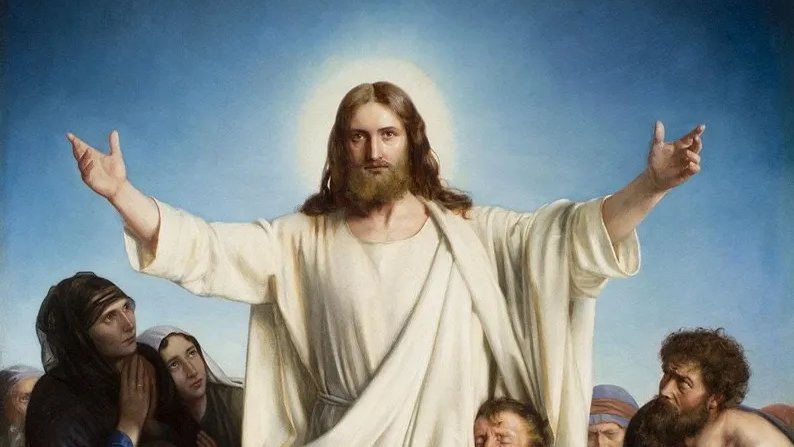
Comedian Rob Schneider Converted to Catholicism.
Schneider publicly announced his conversion and later spoke about the peace and forgiveness he found through the faith
“I think the reason the Catholic Church works for me is it’s closest to the actual words of Jesus Christ”


English
@chosenaxiom @MalvinasMaricon @grok who is Georgius Niger?
Is this person’s name a dog whistle for racism?
English


English
@ShamelessPopery @WalmartThomist Sure man he’s just claims to love everything Pinesapp and Fuentes say but not a groyper cool yeah uh huh sure.
All the while making dogwhistles in his streams.
Whatever I tried. I get your a boomer who doesn’t understand the internet but whatever CA will now spread hate
English

I haven't followed Pascal-Emmanuel Gobry closely enough to know how much we agree on all things Catholic, but he's definitely right about Kansas City:
Pascal-Emmanuel Gobry@pegobry_en
@xwanyex It’s a nice mid-sized city with affordable prices, a walkable downtown, and great BBQ
English
@JoshuaBarzon This book changed my life.
It opened my eyes to Christ’s Church and ultimately brought me to the cross where I rededicated my life to Christ.

English

You’re allowed to put one book besides the Bible in every hotel room in the world. Which book are you choosing?

English

That’s actually a great explanation of a democratic view of the Church. And as fellow Americans, I admit it sounds plain, fair, and simple.
But what makes you think Jesus established His Church that way?
Where do you see democracy in the New Testament?
Why would Christ establish a system where every individual and organization ultimately determines doctrine for itself, knowing sincere believers would inevitably arrive at contradictory conclusions?
When I read the New Testament, I don’t see a democracy. I see a kingdom. I see a King who appoints apostles, gives them authority to bind and loose, gives Peter the keys of the kingdom, and tells the faithful to listen to the Church (Matt. 16:18-19; 18:17-18). I see Acts 15, where the Church settles a doctrinal dispute for everyone, not just the people who happened to agree with the decision.
So what biblical evidence convinced you that Christ intended His Church to function like a democracy rather than a kingdom?
English

@Aaronaeus @JoshuaBarzon But if we disagree (you and I for instance) on what is a side matter, neither of us has authority over the other. You and I both answer to the same God, and will be held to account for our alignments and actions. So my beliefs apply to me, my family, my organizations, not you.
English
You get to eliminate one heresy from church history. Which false teaching would you eliminate?
English
It still baffles me about Sola Fide.
It’s clearly not biblical.

English
@McKenzielives77 I wouldn’t say they are the worst? I would say they put too much into emphasis on “speaking in tongues” and charisms of the Holy Spirit to show that one is true saved.
It’s a lot of show, but I’ve seen worse.
English

Out of all the protestant sects pentecostalism is the worst.
⛨ Aaronaeus ⛨@Aaronaeus
The sad part is I remember these cry sessions and spouting out gibberish happening every Wednesday during youth group. Pentecostalism is weird.
English
Reynaldo,
I actually understand your concern. And yes, I absolutely agree that some Catholics can take Marian devotion too far. I’ve seen it myself. But those abuses don’t define what the Catholic Church teaches.
If someone genuinely studies the Church’s teaching on Mary, as I have, they’ll find that her entire role is to point people to her Son, who is her Savior and ours. If someone were to idolize Mary, that would be explicitly forbidden by the Church and has been from the beginning. The Church teaches that she has nothing apart from God’s grace. She does not compete with Christ or take away from His glory. Everything she has comes from Him.
That’s why I cited passages like John 17:22. God really does allow His people to participate in His glory and His work without becoming rivals to Him.
To be honest, your argument reminds me of how Muslims often reason about God. I’m not saying you share the same Scriptures or theology, but the line of reasoning is similar: Muslims begin with the assumption that certain titles or honors can belong only to God and therefore must never be applied to anyone else. Yet I don’t see the Bible establishing that principle. You’re assuming that if a title is used of God, it therefore can never be applied analogically to anyone else. But where does Scripture actually teach that? Instead, we repeatedly see God allowing His people to participate in what belongs to Him by grace (father, shepherd, light, and even His glory) without anyone confusing the creature with the Creator.
English

Aaron,
The reason I have problems with calling Mary Refuge of Sinners is precisely because she's become an idol.
So, in essence, what I've cited here stands; God does not give his glory to idols.
Even with the references you're vying for do not implicate that Christians can produce litanies of titles and festivities for saints.
Your claims, were we to grant the benefit of the doubt, would follow the lines of non-sequitur reasoning. In other words, you're begging the question whenever you cite the sources that don't specifically address the topic.
This is why I don't support the evidence because you're not using these quotes in good faith; rather, they're being cited to prove Catholic doctrine, even when the source does not stand on its own.
English
