

Fanz
1.7K posts


Fairground
Perpetual markets with a level playing field for traders.
Season 0 waitlist is now open.
Reserve your spot → fairground.fi/421614/rewards

English
@Leedwipangga @get_optimum Every millisecond adds up
More time in the slot means more value captured
English

Lower latency has real economic value for Ethereum validators. It not only makes the system feel faster, but also has the potential to increase staking revenue (APR).
In its research, @get_optimum analyzed 36% of Ethereum’s total network stake represented by large validator operators. From this historical data, they found something interesting: every additional 50ms of usable slot time correlates with an increase of around 0.6–0.7% in average validator revenue. This means that if validators have an extra 50 milliseconds of effective time they can use within a slot, their average revenue could potentially rise by around 0.6% to 0.7%.
Some people may still be wondering, what is usable slot time?
On Ethereum, every slot has limited time to receive a new block, process incoming information, determine the head chain, send attestations/votes, and capture opportunities from auctions or MEV flow. If data arrives late because of latency, the validator’s effective time is reduced.
A simple illustration:
One slot = 12 seconds. But if important information arrives 300ms late, the validator loses part of its reaction time. If latency can be reduced by 50ms, the validator gains additional time to act. That is what is called usable slot time.
This additional time can increase revenue because validators have a better chance to choose the head vote more accurately, minimize missed opportunities, and significantly improve access to MEV opportunities. In other words, validators have more time to see and choose the best options.
People used to think 50ms was small. But in Ethereum staking, 50ms can mean money. At that point, latency shifts from being just a technical issue into a financial lever.
If Optimum is truly able to reduce latency through mump2p and RLNC, then they are not only making the network faster, but also potentially increasing APR for validators and stakers. Even small improvements, if they happen continuously across the network, can create a large impact.

Leedwipangga@Leedwipangga
Today we discuss how accurate validators are in selecting the head chain and how latency affects this. In Ethereum (PoS), validators must see the latest chain (head), then perform a vote (attest) to it in order to receive rewards. Of course, rewards are only obtained if the vote is correct and timely. From here, problems often arise. When latency is high, validators may be late in seeing the head, which leads to delays in voting on the chain, resulting in incorrect votes and no rewards. In another case, validators may vote correctly, but enter the slot too late, causing the vote not to be counted and rewards not to be given. In this case, latency can make you right, but still lose. The rewards you receive are calculated based on a_val (validator accuracy) and a_net (network condition). This means that it is not only the validator’s ability that determines rewards, but also the overall quality of the network. @get_optimum offers an approach to address this. By improving network quality through mump2p, which is about 150ms faster, head vote accuracy increases from 98.6% to 98.8–99.1%. It may seem small, but the impact is significant at the network scale, especially when multiplied across thousands of validators and slots. This also makes the chain more consistent and the network more stable, as there are more correct votes and fewer misses. In the end, user experience also improves. Lower latency is a win for everyone. Validators gain more optimal rewards, stakers see an increase in APR, the network becomes more stable, and the user experience becomes more reliable. Latency does not only affect speed, but determines whether validators can see and choose the correct chain in time. Even small improvements in latency can significantly increase head vote accuracy, which ultimately has a direct impact on rewards and overall network stability.
English
@ekinoks_26 @get_optimum Speed means nothing without credible neutrality
English

Nobody is asking @get_optimum the governance question yet. That will change.
Right now the project has a CEO, a COO, and a CTO. Protocol decisions sit with the founding team. That's appropriate for a pre-mainnet infrastructure project. But mump2p is positioning itself as shared propagation infrastructure for multiple L1s and validator sets. Once it's live on mainnet with a utility token and Flexnode operators, the question of who controls protocol parameters becomes real and consequential.
Specifically: who decides ShredFactor adjustments, forward shard thresholds, fee models for bandwidth, and future protocol upgrades? If the answer is "the team" indefinitely, you have a centralized dependency that every chain running mump2p has to accept. If the answer is "token holders," you inherit all the known problems of token-weighted governance: whale concentration, voter apathy, capture by institutional operators.
The Ethereum model is instructive here. ETH doesn't carry voting rights. Core protocol decisions go through social consensus among client teams and researchers, with EIPs as coordination mechanism. It's slow and messy but it's also why Ethereum is trusted as neutral infrastructure. If mump2p wants to be neutral propagation infrastructure for any chain, it needs a governance model that doesn't require chains to trust the founders indefinitely or accept token-holder capture.
I haven't seen a governance design document. That gap matters more as mainnet approaches.
@blockchainjeff

English

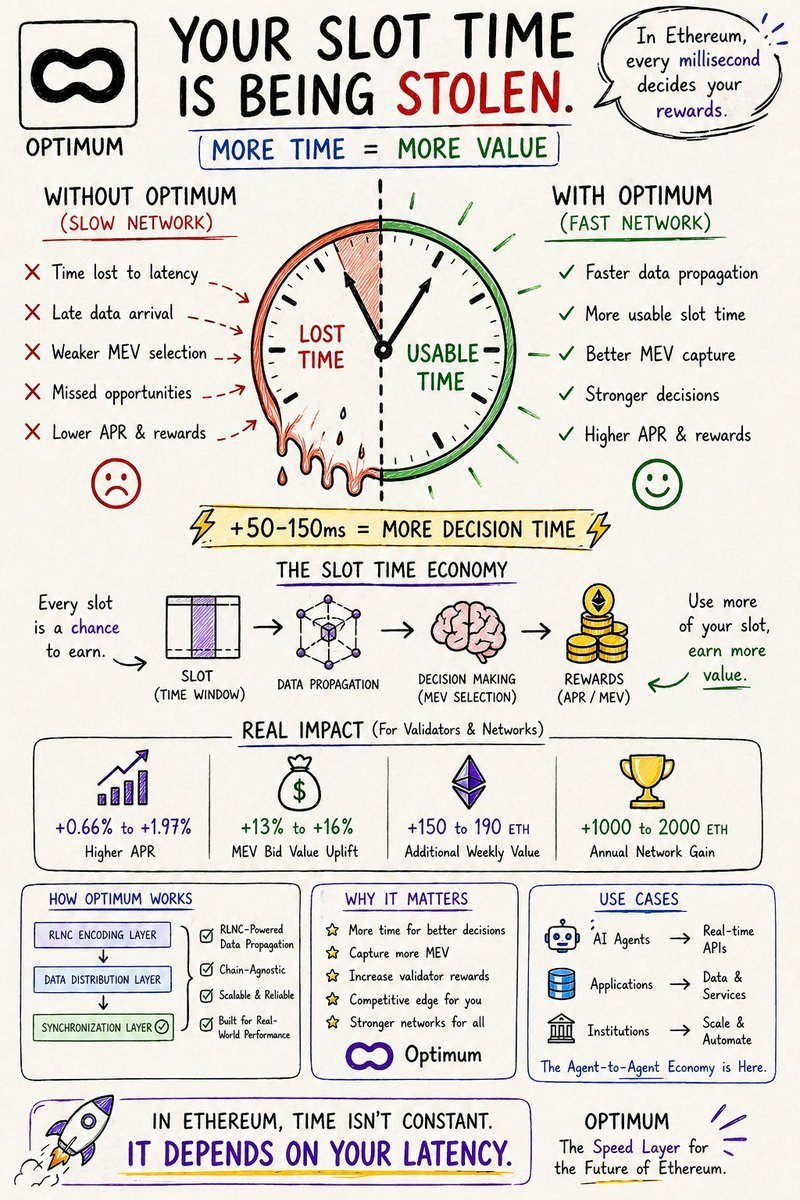
In Ethereum, every millisecond matters ⏳
Latency doesn’t just delay data it reduces your earning window.
Here’s what slower propagation actually costs you 👇
• Lost usable slot time
• Missed high-value MEV opportunities
• Lower head vote accuracy
• Reduced validator APR
Optimum solves this at the core ⚡
By improving propagation speed (~50–150ms), validators gain:
• More decision time inside each slot
• Better MEV bid selection
• Higher reward efficiency
• Stronger overall performance
Key insight:
More time → Better decisions → More rewards
You’re not underperforming…
you’re operating with less time.
@get_optimum gives that time back 🚀
English


@ArfandiXys the Rlnc infra is the killer of lower latency
More profitable to validators, perhaps stakers
English
@inkaxyz @get_optimum Solid upgrade from Optimum, more efficient, more secure, and simpler networking layer
Bootstrap-based discovery just makes more sense
English

Gmum ♾
,@get_optimum has just released Gateway version v0.0.1-rc11 making the networking layer more efficient, more secure, and easier to use.
Now no longer relying on proxies, but using bootstrap-based discovery.

inka@inkaxyz
Gmum ♾ Blockchain biggest problem can be solved with "flexnodes" a key part of @get_optimum • accelerate data distribution • provide a memory layer • overcome network bottlenecks Flexnodes are not just nodes, but an upgrade to the way data moves on the blockchain.
English

1/10
Signal density determines coordination quality.
Not more information.
Better information.

English
Lower latency = more usable slot time
→ more time to see better MEV bids
→ better block selection
→ higher rewards
It also improves consensus:
higher head vote accuracy
more consistent attestations
This isn’t theory.
It’s in the data.
@get_optimum @blockchainjeff
English

Ada update terbaru dari @get_optimum (Community Call 23 April)
Tim lagi aktif banget secara global:
*Event CODED Build Asia sukses, presentasi Kent dapet respon besar
*Muriel juga tampil di Bitcoin Expo dengan banyak feedback positif
Dari sisi tech & riset:
*Artikel terbaru soal dampak latency ke staking ETH wajib dibaca
(bukti kalau fokus mereka bukan hype, tapi fundamental)
Dari sisi komunitas & event:
*115 orang sudah berhasil nemuin fragment ke-4
(pastikan semua fragment kamu ada di 1 wallet)
Dan yang paling ditunggu 👇
*Mainnet segera launch
*Flexnodes menyusul (ada reward buat yang run node)
*Role Latency Lords dibagikan minggu depan
*Event & game baru juga segera hadir
Yuk join di komunitas @get_optimum
Cc: @PostMaklone

Aiueo@Yujiu212
Kalian sekarang bisa coba sendiri simulasi network dari @get_optimum Mereka ngebandingin langsung performa RLNC vs metode lama kayak Reed Solomon di kondisi real (mesh network). Dan hasilnya gak main main: → latency bisa sampai ~10x lebih rendah → bandwidth dipakai ~6x lebih efisien Artinya? data bisa nyampe lebih cepat ke seluruh network tanpa buang resource berlebihan. Ini penting banget di blockchain, karena beda beberapa milidetik aja bisa nentuin siapa yang dapet peluang lebih dulu. Coba sendiri di sini 👇 gmum.cc/simulation-mesh
Indonesia

What is Optimum?
Optimum is a high-performance memory infrastructure for any blockchain. Powered by RLNC, It can scale L1/L2s, enhance dapp performance & end-user UX.
Optimum is the fastest decentralized internet protocol for Web 3. It accelerates low-latency data propagation across geographically distributed nodes, so latency-sensitive applications become more responsive and the network doesn't get clogged easily.
What makes Optimum special?
Random Linear Network Coding (RLNC) – an advanced data encoding technique developed under the supervision of Prof. Muriel Medard, EECS, MIT. By applying RLNC to gossip (data propagation), Optimum
Reduces redundancy of data sent repeatedly
Increases packet loss tolerance
Guarantees optimal propagation strategy for throughput and latency even with packet loss or network contention.
Network and roles
Optimum operates as a permissionless network consisting of flexnodes—nodes that anyone can run alongside existing clients and P2P stacks.
Main Products
Mump2p
Pub/Sub compatible with libp2p/gossipsub, accelerated by RLNC. Suitable for fast and resilient propagation of blocks, blobs, and transactions.
Optimum DeRAM
Decentralized read-write memory that provides low-latency shared-state semantics across nodes.
Optimum DeROM
Decentralized read-only / append-oriented memory, optimized for broadcast and caching. Coming Soon
Flexnode who they are and what they do
Encode, decode, and forward RLNC-coded gossip frames.
Maintain bounded code buffer to recover lost packets and reduce long tail latency.
Serve DeRAM/DeROM requests according to policy and quotas via stable API.
Interoperate with existing clients and libp2p/gossipsub when needed.
Who benefits?
L1/L2 teams – Faster block/blob propagation.
Validators – Reduced miss-slot risk → potential APY/MEV increase.
Node operators & builders – Lower tail latency.
dApp developers – Faster transaction inclusion
End users – Snappier experience (UX).
Learn about Optimum here
docs.getoptimum.xyz/docs/learn/ove…

Caz@Cazzsann
Optimum is basically a super‑fast RAM for blockchains that runs on RLNC (Random Linear Network Coding). @blockchainjeff @get_optimum @MurielMedard
English

Flexnode Docker Mastery
- What is Docker Setup?
@get_optimum official Docker image for multi-chain Flexnode deployments.
One-command run ETH/Solana/Polygon stack.
(Image auto-update, it says pull latest RLNC optimizations weekly.)
Zero-config VPS deploy.
@blockchainjeff

English

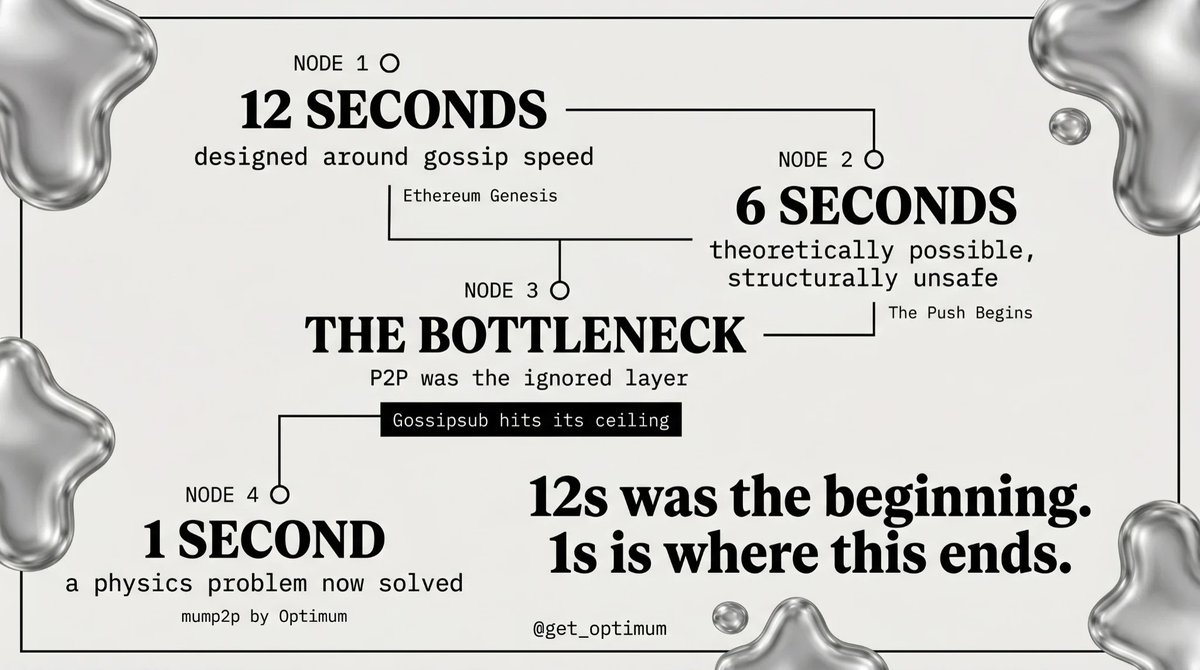
Ethereum is not slow because of compute.
Not slow because of consensus.
Slow because of gossip.
12 second slot time was designed
around the limits of Gossipsub.
mump2p changes that limit.
150ms average block propagation.
6 to 20 times faster than baseline.
90 to 95 percent less bandwidth consumed.
1 second slot time is no longer a dream.
It is a physics problem that has been solved.
@get_optimum
[ @blockchainjeff | @cryptooflashh | @aqccapital | @shariaronchain ]
Yuura (❖,❖)@0xyuura
Web3 can compute. Web3 can store data. But it still cannot use data instantly. That is the missing layer memory Without it apps feel delayed data must be fetched instead of accessed real time interaction breaks DERAM changes that Not by adding more storage but by making data available when it is needed That is what Web3 has been missing
English
Gmum ♾
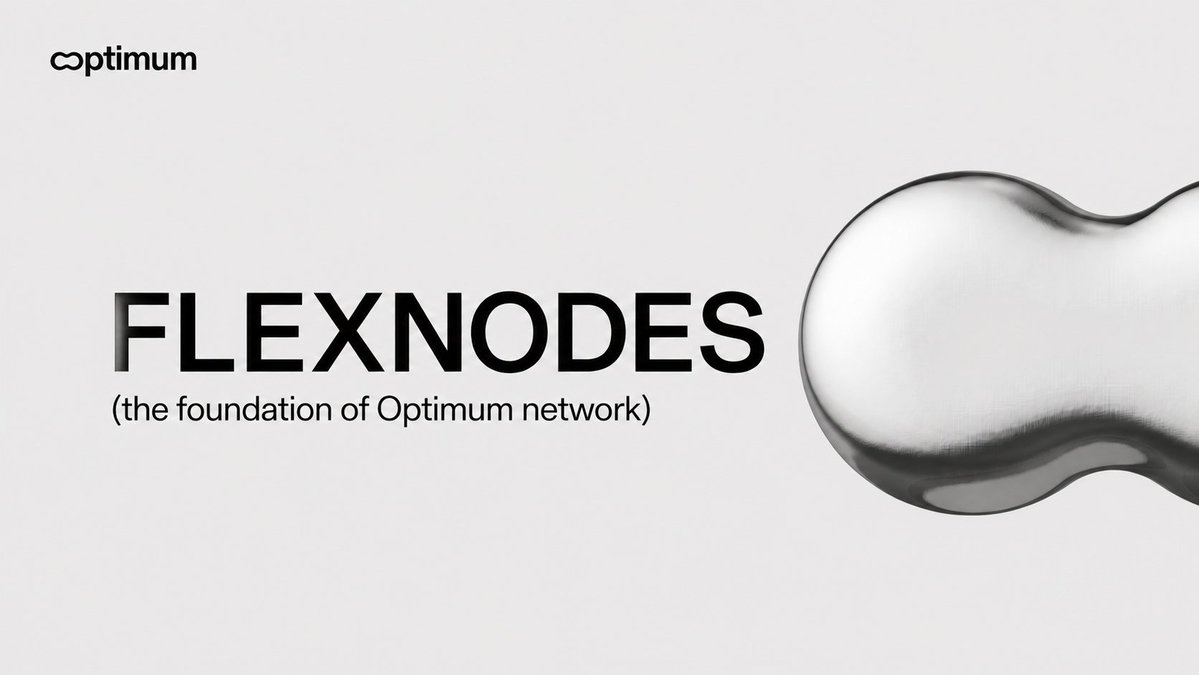
Blockchain biggest problem can be solved with "flexnodes" a key part of @get_optimum
• accelerate data distribution
• provide a memory layer
• overcome network bottlenecks
Flexnodes are not just nodes, but an upgrade to the way data moves on the blockchain.
inka@inkaxyz
,@get_optimum Components : ⟶ MuMP2P | DeRAM With this combination, some of the classic blockchain problems can be overcome • transactions are processed faster • scalability increases • the network can handle more activity Bandwidth and resource usage become more efficient
English
English
An honor to celebrate the investiture of Andrea Goldsmith (@SBUprez) as president of @stonybrooku
A wonderful moment recognizing leadership, vision, and the future of higher education
@get_optimum @blockchainjeff

Muriel Medard@MurielMedard
It was a wonderful experience to celebrate the investiture of Andrea Goldsmith @SBUprez as president of @stonybrooku and be part of a panel with @TelleWhitney of The Anita Borg Institute, Ayanna Howard of @OhioState , and Jennifer Cochran of @Stanford .
English


Energy Efficiency: The Hidden Power of Optimum
gmum fams @get_optimum
Blockchain often gets criticized for being energy‑hungry.
But what if efficiency wasn’t just about speed it was also about saving resources?
a threads 👇

English
@ERafiatul @get_optimum Finance evolves when infrastructure keeps up.
Optimum makes the flow faster and more efficient.
English

Stablecoins, Tokenization, and DeFi work together to build a financial future that is more stable, efficient, and accessible.
@viewklaraa/stablecoins-tokenization-and-the-future-of-defi-5beab19fdf69" target="_blank" rel="nofollow noopener">medium.com/@viewklaraa/st…
@get_optimum
English

Breaking down the future of decentralized infrastructure.
What exactly is @get_optimum ?
It’s more than just a protocol it’s a high-performance framework designed to redefine scalability and efficiency in the ecosystem.
Let’s dive into why this matters. 👇
@blockchainjeff

English