Awesomics

7.5K posts

Awesomics banner
Awesomics

Awesomics

@Awesomics

Celebrating the awesome power of post-genomic science, and the fruits of the Human Genome Project. Tweets by @TeamHuman_org

San Francisco Bay Area Katılım Ağustos 2010
4.9K Takip Edilen6.7K Takipçiler
Sabitlenmiş Tweet
Awesomics
Awesomics@Awesomics·
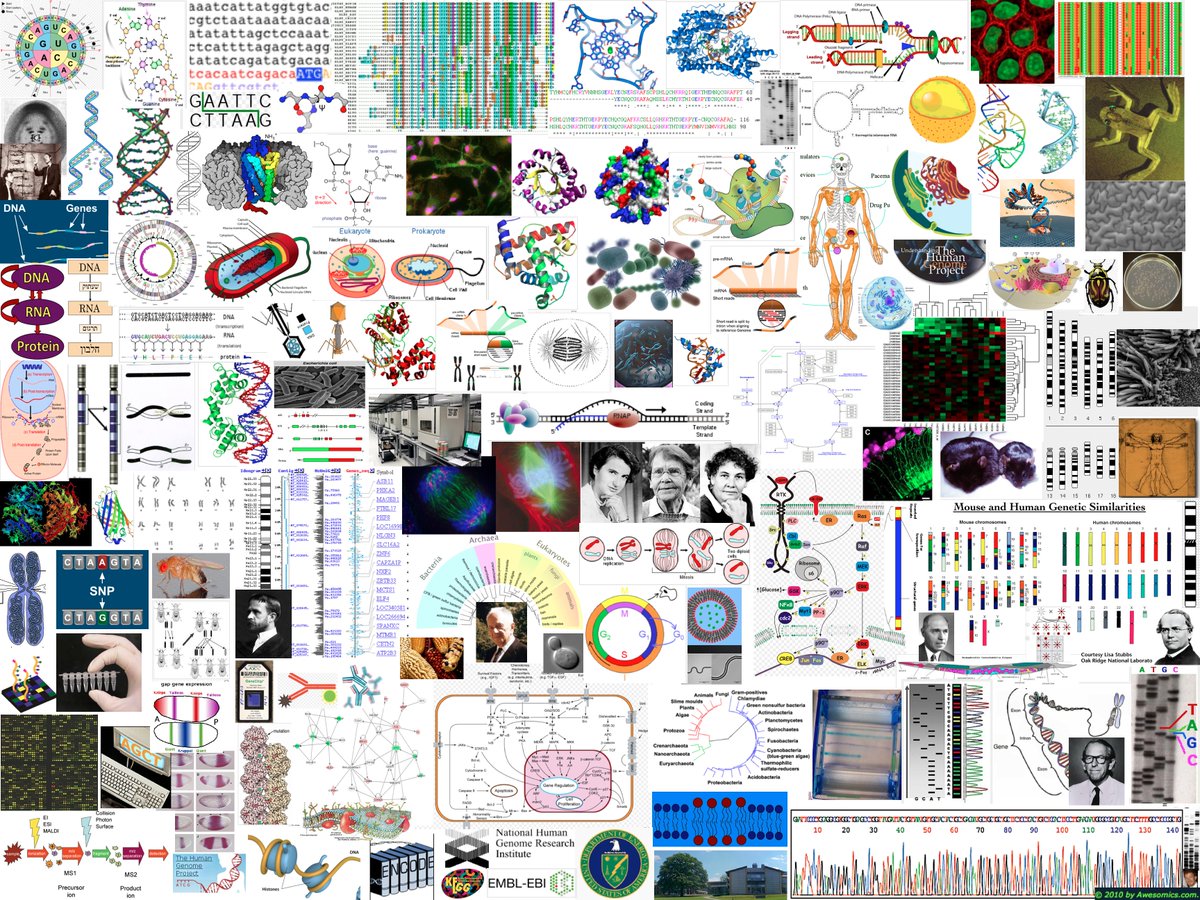
Celebrating 10 years tweeting about the awesome power of post-genomic science and the medically useful insights gleaned from whole-{genome, exome, transcriptome, proteome, metabolome, microbiome, etc-ome} analysis🧬 Looking forward to what the next 10 yrs of #omics will bring...
Awesomics tweet media
English
2
5
33
0
Awesomics retweetledi
BBC News (World)
BBC News (World)@BBCWorld·
Henrietta Lacks: Family of woman whose cells were 'stolen' settles second lawsuit bbc.in/4tR6p2C
English
27
69
226
98.8K
Awesomics
Awesomics@Awesomics·
The Gel Electrophoresis of DNA (Aaij & Borst, 1972) sciencedirect.com/science/articl… ($) History by @NikoMcCarty 👇🏼 Modern image from: Agarose Gel Electrophoresis for the Separation of DNA Fragments (Lee et al., 2012) pmc.ncbi.nlm.nih.gov/articles/PMC48… (OA) #ethidiumBromide #molbio #biotech
Awesomics tweet media
Niko McCarty.@NikoMcCarty

It is really remarkable how so many things in biology, which we take completely for granted, were adopted by accident. One example: When scientists run a gel to separate DNA molecules, they usually add ethidium bromide to the agar. Ethidium bromide is a fluorescent dye that locks into the DNA grooves and emits a red-ish color when you shine a UV light on it. It's an easy way to see where DNA ends up in the gel. But the only reason Ethidium Bromide staining even happened is because of a broken centrifuge. In 1972, two Dutch scientists (Cees Aaij and Piet Borst) were trying to separate DNA isolated from mitochondria. They were spinning down the DNA inside of a big centrifuge, and the machine broke. Undeterred, the duo decided to separate their DNA using gels instead. Agarose gel electrophoresis had been used since the 1960s to separate radiolabeled DNA. The DNA molecules were modified to carry a radioactive isotope (usually heavy phosphorus) and then scientists would move them through the gel and use a radiation detector to figure out where the DNA went. This was obviously both tedious and dangerous. The brilliant insight that Aaij and Borst had was, instead, to just add ethidium bromide to the gel so that the DNA would "light up" instead. No radiation needed. The Dutch scientists stopped using their centrifuge entirely and began separating DNA molecules using this new approach instead. Their discovery spread quickly. (The first gels looked like garbage, though!)

English
0
0
0
98
Awesomics retweetledi
Itai Yanai
Itai Yanai@ItaiYanai·
The 3 hardest things to learn as a scientist: 1. Trust the data.. especially when it’s not what you expected, 2. Trust the data.. allowing it to change your direction, 3. Trust the data.. but not too much: test with new data at every turn.
Itai Yanai tweet media
English
18
189
798
32.9K
Awesomics
Awesomics@Awesomics·
Study: Identification of a glia-associated amyloid β oligomer subtype and the rescue from reactive astrogliosis by inhibitor NU-9 alz-journals.onlinelibrary.wiley.com/doi/10.1002/al… (OA) #NU9 #AmyloidBeta #Oligomers #Alzheimers #Dementia #Neuroscience
Northwestern Feinberg School of Medicine@NUFeinbergMed

Scientists at Northwestern have discovered a previously unknown driver of #AlzheimersDisease and developed an experimental drug that shows potential as an early treatment for the condition, per @alzdemjournals. spr.ly/6010hBRIa

English
0
0
0
222
Awesomics retweetledi
Dr. Anthony Letai
Dr. Anthony Letai@NCIDirector·
We asked early career scientists what they need: funding access, grant writing support, and mentorship. @theNCI listened. We're launching a trans-institute training initiative to deliver exactly that. Learn more. cancer.gov/grants-trainin…
Dr. Anthony Letai tweet media
English
1
26
150
16.4K
Achillefs Kapanidis
Achillefs Kapanidis@AchillesKap·
Great to see our new Science Review on emerging multiplexed measurements that link the sequence of single molecules to their dynamics! From sequence to function: Bridging single-molecule kinetics and molecular diversity | Science science.org/doi/10.1126/sc…
English
3
11
36
1.5K
Awesomics retweetledi
J Cell Science
J Cell Science@J_Cell_Sci·
Leanna Owen, Margot Riggi, David Drubin, Janet Iwasa and Yidi Sun use molecular animation to depict the full progression of CME in budding yeast, with an accompanying Cell Science at a Glance article and poster. journals.biologists.com/jcs/article/13…
English
2
7
36
2.2K
Awesomics retweetledi
Sergiu P. Pasca
Sergiu P. Pasca@Sergiu_P_Pasca·
This week, we report in @Nature our effort to identify molecular convergence and divergence in #autism spectrum disorder (ASD) using human stem cell models. In this collaborative study with Dan Geschwind's lab, spanning almost a decade, we derived 96 hiPS cell lines representing 8 genetic forms of ASD, idiopathic patients, and 20 controls, and after rigorous quality control differentiated 70 lines in more than 150 experiments into human cortical #organoids for 100 days. Interestingly, early time points harbored the largest mutation-specific changes, but distinct mutations converged on shared transcriptional changes as development progressed. This is just the beginning: we will need larger cohorts and more advanced cultures that capture cell diversity and interactions, such as #assembloids. Still, this initial study illustrates how risk associated with genetically defined forms of ASD can propagate through transcriptional regulation, leading to convergent and divergent signaling defects. This work was spearheaded by the heroic efforts of Aaron Gordon and Se-Jin Yoon, together with Lucy Bicks!
Sergiu P. Pasca tweet media
English
6
37
150
9.9K
Awesomics retweetledi
Bashor Lab
Bashor Lab@BashorLab·
🚨NEW PUBLICATION ALERT🚨: In a paper out today in @ScienceMagazine we describe a way to build synthetic phosphorylation circuits with customizable sense-and-response functions in human cells. Check it out at science.org/doi/10.1126/sc…. 🧵1/n
English
2
63
252
48.4K