Andrew Brack

2.6K posts

Andrew Brack

Andrew Brack

@BrackLab

Scientist interested in preventing functional decline during aging. Program Manager at ARPA-H. Interests: Crypto, Everton FC and Boxing. Views are my own.

CA Katılım Nisan 2012
1.1K Takip Edilen4.2K Takipçiler
Sabitlenmiş Tweet
Andrew Brack
Andrew Brack@BrackLab·
What if we had therapies to extend healthspan and prevent the onset of age related diseases? I’m excited to announce my first @ARPA_H program, PROSPR. The goal is to develop validated surrogate biomarkers, new clinical endpoints and therapies to collectively extend healthspan by 20 years for all Americans.
ARPA-H@ARPA_H

What if we could predict age-induced health issues before they happen? Our new PROSPR program aims to identify biochemical and physiological markers, paving the way for faster, more targeted aging research. arpa-h.gov/news-and-event…

English
17
33
167
34.2K
Andrew Brack
Andrew Brack@BrackLab·
@AlexanderMWolf7 What did statins and glp1s get approval for? Indications with a regulatory path. And because of that many millions of people’s lives have benefitted.
English
1
0
0
6
Alexander M. Wolf
Alexander M. Wolf@AlexanderMWolf7·
@BrackLab I just doubt that "There is nothing more important than regulatory reform". Statins & GLP-1RAs made it. Any drug affecting aging can take the same prevention path, no? Regulatory reform, sure, but "most important"? A credible drug candidate would help, also with regulators.
English
1
0
0
11
Andrew Brack
Andrew Brack@BrackLab·
There is nothing more important than regulatory reform to bring treatments for aging to people. It is the conduit for a productive drug development industry.
The Alliance for Longevity Initiatives (A4LI)@theA4LI

Tomorrow, the @HouseCommerce Subcommittee on Health will examine how the @US_FDA can maintain America's leadership in biomedical innovation and strengthen U.S. drug development. Modernizing the regulatory framework is essential if we want to accelerate innovation, maintain our competitive edge in the biomedical sector, and ensure patients have access to the next generation of treatments. A4LI has submitted a letter for the hearing record urging Congress to consider our Multi-Disease Therapeutic Designation (MDTD) proposal: a regulatory pathway designed to better support therapies that target the underlying biology of aging and reduce the burden of multiple chronic diseases. 📄 Read our MDTD proposal here: a4li.org/wp-content/upl… We are thrilled to see Congress continuing this important conversation about the future of biomedical innovation, and we look forward to hearing expert perspectives on how the FDA can help foster this next generation of medical breakthroughs. ▶️ The full hearing can be livestreamed here: youtube.com/watch?v=sTL86n…

English
1
2
3
715
Andrew Brack retweetledi
Aubrey de Grey
Aubrey de Grey@aubreydegrey·
HUGE breakthrough out today, in arguably the single most neglected aspect of aging, extracellular matrix damage. Top researchers have tried & failed for decades to do this. Massive kudos to Aaron and his team! (Proud to note that Revel is a SENS spinout.) revelpharmaceuticals.com/news
English
6
20
82
3.2K
Andrew Brack
Andrew Brack@BrackLab·
bringing treatments to people and a productive drug development path requires a regulatory path. I dont make the rules. It’s just the way it works! As a former academic working in pre clinical models it took me a while to get my head around it. But my comment is not to be taken in isolation that pre clinical advances are not an important part of the drug pipeline.
English
1
0
0
20
Alexander M. Wolf
Alexander M. Wolf@AlexanderMWolf7·
@BrackLab Why not having a treatment first? Having a treatment that works in mice would be a very good argument for regulatory reform. Using animals first is not illegal. Unless, of course, you want to make money with things that don't really work.
English
1
0
0
23
Mgoes (bio/acc 🤖💉)
Mgoes (bio/acc 🤖💉)@m_goes_distance·
THESIS UPDATE: I'm increasingly convinced the biggest signal in longevity right now isn't the science, it's what the FDA is willing to validate the FDA doesn't legally recognize aging as a disease. that's not a technicality, it's federal code. which means every longevity company, no matter how good the science, has to attach itself to a specific, narrowly defined condition just to get a regulatory pathway at all that's the actual filter separating real companies from good stories not "does the biology work" "did you find the disease that lets the FDA say yes" whoever solves that problem for the whole category, not just their own drug, changes everything downstream of it that's exactly the kind of infrastructure bet we're looking for still early, and open to being wrong here.
English
15
5
69
8.1K
Andrew Brack retweetledi
Karl Pfleger
Karl Pfleger@KarlPfleger·
Agree. A4LI lobbies for both. The multi-disease therapeutic designation (a4li.org/wp-content/upl…) will unlock more VC $ for biotech & trials. The disease burden framework for NIH funding (a4li.org/wp-content/upl…) will help fix the prob that basic science funding isn't aligned with disease burden to society. Write to your lawmakers in the House & Senate advocating for these proposals, explaining why aging is so bad but also feasible to treat, explaining that treatments for aging won't cause other problems in society (ref zenodo.org/records/188830… if you like), & encouraging the lawmaker to join the bipartisan Longevity Science Caucus, & to come to next year's A4LI H-Span summit. Dylan, Brenda, myself, & others are very happy to talk to lawmakers who are interested in knowing more or have questions.
English
0
1
2
140
Andrew Brack retweetledi
Alexey Strygin
Alexey Strygin@strygah·
I'm helping organize Mirai, a pop-up city running this October at KBIC (Kobe Biomedical Innovation Cluster), with a focus on longevity biotech, medical devices, and human augmentation. @aubreydegrey, @adamgries, @realNathanCheng, @EleanorSheekey, and @cremieuxrecueil have already confirmed their presence. More big names are still in talks (TBA). 🇯🇵Japan has built some of the world's fastest regulatory pathways for cell and gene therapies, and for adjacent biotech and medtech too. The Mirai program includes in-person meetings with local regulators, research institutes, and biopharma companies, plus intros to local partners. This is for you if: - you're looking for cofounders, partners, or a job in the field; - you want to bring your product to the Japanese market; - you're hunting for cutting-edge Japanese therapies for your own market; - you want to spend a month among smart people in a cool country and learn a ton. Early-bird tickets are cheap: $399 (and even cheaper with my promo code "ALEXEY"). It does not include housing or food, though. I've attended and helped organize several events like this (Zuzalu, @ZelarCity, Viva Frontier Tower). Every one has been a great experience, and I can't recommend it enough!! We also have a great value offering for sponsors. DM me if you want to know more.
Alexey Strygin tweet media
English
3
12
45
15.7K
Ira S. Pastor
Ira S. Pastor@irat1onal·
Where Did the "Moonshot" Go??? Remember when longevity conferences were full of slides about 150-year lifespans? when investors were told aging was the greatest opportunity in medical history? promises about pending "Longevity Escape Velocity?" Fast forward... Now we're celebrating regulatory pathways designed to measure whether an older adult can function a bit better. Again...That's valuable. It's also called GERIATRICS. Somewhere along the way, "curing aging" became "optimizing decline." That's a much smaller ambition...... @kaimicahmills @elimohamad
Longevity Technology@LongevityTech

Standard disease frameworks are meeting their match as pioneers lean on functional metrics and pragmatic stepping stone indications. vist.ly/5aq23 #longevity #geroscience #fda #clinicaltrials #regulation @ARPA_H @xprize

English
5
1
20
1.3K
Andrew Brack
Andrew Brack@BrackLab·
Strange argument…”average” IC drug that improves function without delaying disease progression will not become the next glp1. I agree with you. Low IC does correlate with increased disease incidence and increased mortality, so it could serve as a canary in the coal mine. If IC serves as a short term predictor of multimorbidity and or mortality it will absolutely be tested in clinical trials. As I said in my previous tweet, happy to hear your alternatives.
English
1
0
0
22
Ira S. Pastor
Ira S. Pastor@irat1onal·
I have no problem with IC - I think such drugs will be great for the QOL of the octogenarians and nonagenarians in my family. But: - I find it hard to believe the "average IC drug" that improves function without delaying disease progression will ever become the "next GLP-1"; and - IF a company is actually sitting on the a gero-therapeutic candidate that is the "next GLP-1" and possesses the properties to do what the gero-science hypothesis has been promising us the last couple decades (significantly delaying the chronic degenerative diseases that kill the majority of us) that an IC indication will be at the top of their strategic plan...
English
1
0
0
51
Alexey Strygin
Alexey Strygin@strygah·
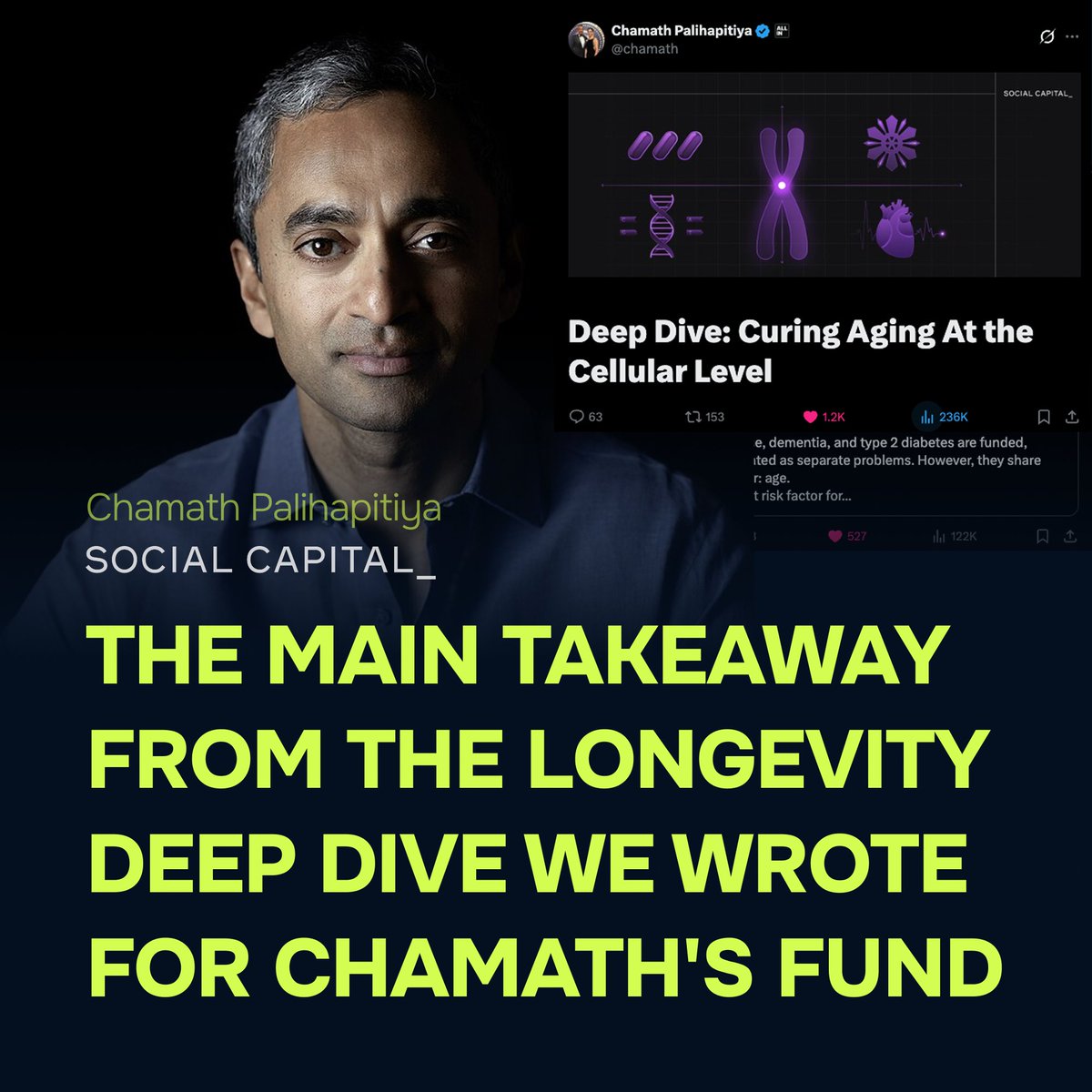
Our longevity biotech deep dive for Social Capital crossed 350k views (way more than we anticipated). The full report is private. For investors looking at longevity biotech, here are two bets worth understanding: 1) The overcrowded bet: cellular reprogramming. Bezos, Altman, and Brian Armstrong went in early, and NewLimit just raised $435M from tier-1 VCs and Eli Lilly - a genuinely bullish signal. Still, only two studies show a lifespan gain in normal mice (7-12%), so don't expect systemic rejuvenation from the first generation of epigenetic reprogramming therapies, but they'll very likely show efficacy against specific diseases. It might not be too late to enter the field, but it's definitely not early: three companies with only preclinical data are already at unicorn valuations. 2) The asymmetric bet: growing and preserving organs. Today up to 75% of donated hearts and lungs are wasted because they last only hours outside the body, and globally just ~10% of the need is met. The companies fixing that, building new organ sources and learning to bank them long-term, are early, and many are still in stealth. We personally know who's building what, and it's still possible to get in at low valuations. That's where the alpha is hidden. For the @chamath's @socialcapital deep dive, we assembled a group of 17 leading scientists, founders, and experts. Much of the useful signal is offline: who’s building in stealth, which founders can actually deliver, and which science is real versus merely well-promoted. With that work finished, we now have capacity for the next longevity biotech project for a family office, fund, private banking team, or private investor looking at the field. Beyond deep dives, we can help you source stealth deals, run due diligence, build custom intel tools, or launch client-facing longevity products. Know someone who runs a family office or fund and is into longevity? Share this with them. Want details? Let's jump on a quick call - DM.
Alexey Strygin tweet media
English
11
16
66
3.5K
Nathan of Pennsylvania
Nathan of Pennsylvania@JerichoSionNat·
@KarlPfleger @irat1onal Insufficient funding remains a major problem. Not even a fraction of one percent of GDP is allocated to fundamental research that could bring about significant breakthroughs.
English
1
0
0
54
Andrew Brack
Andrew Brack@BrackLab·
@irat1onal and @KarlPfleger. As I built #PROSPR, maybe I’ll add a few thoughts. @irat1onal You seem to conflate an endpoint with drug efficacy. The endpoint intrinsic capacity does not have to be restricted to geriatric population. PROSPR will identify measures that are purpose fit for different populations. Therefore, if a gerotherapuetic drug is the next glp1 then it will have a dramatic effect of intrinsic capacity. Bottom line, without an endpoint the field will be restricted to preclinical work. With an endpoint, drugs can be developed and approved and money will flood into the space. It’s really that simple. As in any field of medicine the first drug that gets approval will not be as potent as the most recent. Think statin-Ezetamib-PCSK9i, longevity will not be any different. I’m fortunate in my position to have regular conversations with FDA. I’m satisfied that PROSPR is on the right path-but there is work to do to test that thesis. Always happy to hear plans of how it should be done. 🖖
English
1
0
0
47
Ira S. Pastor
Ira S. Pastor@irat1onal·
No - I was was making a point that intrinsic capacity claims, while useful for companies developing drug candidates for the geriatric population and which will allow the elderly to die from the same chronic diseases with a little "pep in their step", most likely won't move the big picture longevity-bio investment needle, will pull years from company's exclusivity windows, and most likely isn't a path to your next GLP-1 event...
English
2
0
0
60
Andrew Brack
Andrew Brack@BrackLab·
@JamesPeyer : “Can you take one of these drugs that is widely viewed as an invention of the geroscience field, and show human translatability with that medicine?” Four teams in #PROSPR will attempt to break the ceiling with the following drugs: mtorc1 inhibitor, line1 inhibitor, GPER agonist and 17α-estradiol. 🖖
Agingdoc🩺Dr David Barzilai🔔MD PhD MS MBA DipABLM@agingdoc1

Can Aging Biology Build a Business That Lasts? @JamesPeyer @CambrianBio argues "the field still hasn't broken what he calls its “glass ceiling"... wewillcure.com/insights/longe…

English
1
3
5
1.4K
Andrew Brack retweetledi
UK Dynamism Fund
UK Dynamism Fund@ukdynamism·
The UK can once again be the most dynamic country in the world. Today we launch the UK Dynamism Fund, a new philanthropic fund to support the believers and the builders of UK dynamism. Apply now: ukdynamism.fund
English
22
78
241
97.5K
Andrew Brack retweetledi
Julian Issa
Julian Issa@juliankissa·
Do you predict someone will die from peptide misuse in the next 6 months? De Grey and Kaeberlein didn't hesitate. "Obviously" "100%" Kaeberlein says it already happened in the last 6 months. He explains the danger isn't the peptide itself, but the impurities in the "research-grade" ones they buy online. — Aubrey de Grey (.@aubreydegrey) and Matt Kaeberlein (.@mkaeberlein)
Julian Issa@juliankissa

I asked 4 longevity experts; "Over the next 5 years, which therapeutic wins?" Kaeberlein ranked them in this order: 1) Rapamycin 2) Plasma dilution 3) Senolytics 4) Partial reprogramming 5) NAD boosters Rapamycin tops it because it has the best, most reproducible data by far. He also says reprogramming has the highest ceiling of all. — Matt Kaeberlein (.@mkaeberlein)

English
2
3
15
1.9K
Andrew Brack retweetledi
Rob Kalesnik-Orszulak
Rob Kalesnik-Orszulak@roborszulak·
I'm hiring a CMC Regulatory Lead to drive CMC Regulatory strategy and execution at Retro. This is an opportunity to join a fast-rising, early-stage biotech backed by Sam Altman that is developing therapeutics that target the fundamental drivers of aging to treat and prevent multiple downstream age-related diseases. Our pipeline is unusually broad for a company at our stage: cell and gene therapies, small molecules, and AI-designed protein therapeutics. For someone who loves the craft of CMC regulatory work, this is a chance to work at real technical depth across multiple therapeutic modalities and help build something important. jobs.lever.co/retro/2f9b3bc9…
English
0
3
1
185
Andrew Brack
Andrew Brack@BrackLab·
@MartinBJensen @patricksmalone My hunch is that unlike CVD, a diagnostic that gives short term readouts of healthspan will be much higher than 50% mainly due to the specific consumer.
English
0
0
0
45
Martin Borch Jensen
Martin Borch Jensen@MartinBJensen·
@BrackLab @patricksmalone Yeah definitely need that to have any adoption, and it provides substrate for rituals. But it wont be automatic, CVD has nice surrogates and still 50% adherence at 1y
English
1
0
1
82
Andrew Brack retweetledi
Patrick Malone, MD PhD
Patrick Malone, MD PhD@patricksmalone·
what has finally made consumer health interesting is that prevention now has a buyer who actually captures the value: the consumer. traditional payers have weak incentives to fund long-horizon prevention because members churn every few years. the plan may pay today, while the future benefit accrues to another payer. but in consumer-pay or consumer-directed models, the person paying for the diagnostic or intervention is the same person who values avoided disease and longer healthspan. but the bigger shift is that the meaning of "prevention" is changing. for payers, prevention is mostly evaluated as cost avoidance: will this reduce future claims? in the consumer’s hands, prevention becomes a way to manage health trajectory. consumers want to know if they are aging well, metabolically healthy, cognitively sharp, or responding to an intervention. that fundamentally changes the role of diagnostics. historically, diagnostics were ordered by physicians to answer narrow clinical questions. in consumer health, diagnostics become recurring self-knowledge products, and, more importantly, interfaces for behavior change and therapeutic routing. where i think this is all headed: 1. consumer diagnostics will create new categories of therapeutic intervention. if consumers are willing to pay for earlier detection, companies can justify building interventions for states traditional medicine has not historically treated aggressively: early cognitive decline, perimenopause, muscle loss, poor sleep architecture, early osteopenia, and more. 2. the boundary between wellness and medicine will continue to blur. consumer health starts in wellness because regulation and reimbursement friction are lowest there. but the incentives push toward medicine: diagnose earlier, intervene earlier, monitor longitudinally, and eventually generate enough evidence to become standard care.
English
2
4
36
9.1K